
 100% FREE ACCESS
12th Standard Syllabus & Materials
12th Standard
TN 12th Computer Applications மின்னணு தரவு பரிமாற்றம் Sample Question Papers Study Material - QB365 Set A
NEW12th Standard
TN 12th Computer Applications மின் - வணிக பாதுகாப்பு அமைப்புகள் Sample Question Papers Study Material - QB365 Set A
NEW12th Standard
TN 12th Computer Applications மின்னணு செலுத்தல் முறைகள் Sample Question Papers Study Material - QB365 Set A
NEW12th Standard
TN 12th Computer Applications மின் - வணிகம் Sample Question Papers Study Material - QB365 Set A
NEW12th Standard
TN 12th Computer Applications திறந்த மூல கருத்துருக்கள் Sample Question Papers Study Material - QB365 Set A
NEW12th Standard
TN 12th Computer Applications வலையமைப்பு வடமிடல் Sample Question Papers Study Material - QB365 Set A

Published on: 06/01/2020
E-Commerce
Download Tamil Nadu 12th Standard Computer Applications question papers, model tests, one-mark questions, important questions, and public exam papers in PDF format. Free study materials and answer keys for TN State Board students.
Questions + Answers key
Take MCQ Computer Applications Test
1.
The First business to business transaction from _____________
Amazon
e-bav
Thompson Holidays
reddiffshop
2.
___________ is a platform for advertising products to targeted consumers.
Television
Radio
Mobile phones
social Media
3.
Which of the following is a characteristics of E-Commerce?
Products can be inspected physically before purchase.
Goods are delivered instantly.
Resource focus supply side
Scope of business is global
4.
5.
Which of the following is not a tangible good?
Mobile phone
Mobile Apps
Medicine
Flower bouquet
6.
What is another name of C2B?
7.
What is FinTech?
8.
Write a short note on out-sourcing.
9.
Differentiate tangible goods and Intangible goods with example of your own.
10.
Define E-Commerce.
11.
When a company is can be called E-business?
12.
Write short notes on web1.0, web2.0, web3.0.
13.
Write a note on name-your-own-price websites.
14.
Write a short note on the third wave of E-Commerce.
15.
Describe how E-Commerce is related to socio-technological changes?
16.
What are the Limitations of E-Commerce
17.
List out the Benefits of E-Commerce to a business organisation.
18.
How would you differentiate a traditional commerce and E-Commerce?
19.
Write about the development and growth of Electronic Commerce.
1.
(c)
Thompson Holidays
2.
(d)
social Media
3.
(d)
Scope of business is global
4.
(c)
5.
(b)
Mobile Apps
6.
C2B is also called a reverse auction model.
7.
Fintech is a new financial industry that uses technology to improve financial activity.
8.
If a company's work is hired to another company, it would be termed as out-sourcing.
9.
| SI NO | Tangible Goods | Intangible Goods |
|---|---|---|
| 1. | A tangible good is a physical object that can be perceived by touch. | Intangible assets are valuable assets that can't be touched. |
| 2. | Example : CD's, DVD's, printed books, lamp etc. | Example : Music files, Movies downloaded video games, etc. |
10.
E-Commerce can be described as the process of buying or selling products, services (or) information via computer networks.
11.
A company can be called E-Business if and only if
(i) It has the ability to conduct business electronically over the Internet.
(ii) It manages payment transaction through the Internet.
(iii) It has a platform for selling products & services via the Internet.
12.
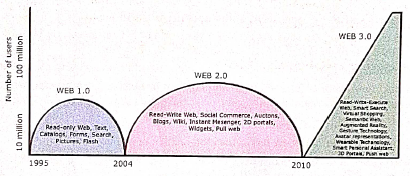
(i) Web 1.0 (Web of Content) is the early web that contained text, images, and hyperlinks and allowed users only to search for information and read it. There was a very little in the way of user interaction or content generation.
(ii) Web 2.0 (Web of Communication) is a read-write web that allowed users to interact with each other.
(iii) Web 3.0 (Web of Context) is termed as the semantic web or executable web with dynamic applications, interactive services, and "machine-to-machine" interaction.
13.
Name-your own price websites are just like normal retail sites. In contrast, the buyer negotiates with the retailer for a particular product or service. https://in.hotels.com/
14.
(i) The third wave is brought on by the mobile technologies.
(ii) It connects users for real-time and on-demand transactions via mobile technologies.
(iii) The term Web 3.0, summarize the various characteristics ofthe future Internet which include Artificial Intelligence, Semantic Web,Generic Database etc.
15.
(i) The growth of E-Commerce is also related to the socio-technological changes.
(ii) The more, the medium becomes deep rooted, the more, are the users drawn towards it. Increase of users, increases the markets.
(iii) As the markets expand, more business organizations are attracted. The more business accumulation creates competition.
(iv) The competition leads to innovation; Innovation in turn drives the development of technology; technology facilitates E-Commerce's growth.
16.
(i) E-Commerce also has some limitations. The following are the major drawbacks of E-Commerce for a business organization.
(ii) In E-Commerce, the customer should wait between placing the order and having the product in hand.
(iii) The doubts about the period of returning, will the returned goods reach source in time, refunds, exchange, and postage make one tiresome.
(iv) Privacy issues are serious in E-Commerce.
(v) In E-Commerce generating consumer information is inevitable. Not all the companies use the personal information they obtained to improve services to consumers.
(vi) Many companies misuse the information and make money out of it.
(vii) It is true that privacy concerns are a critical reason why people get cold feet about online shopping Physical product disputes are a major disadvantage in E-Commerce.
(viii) In online shopping, we would see only the pictures the seller had chosen for us.
(ix) The Internet needs to survive the trip from the supplier to the consumer. This makes the customers turn back towards traditional supply chain arrangements.
(x) It is pretty hard to knock on their door to complain or seek legal recourse. Further, even if the item is sent, it is easy to. start bothering whether or not it will ever arrive on time.
17.
(i) The e-commerce system is operated on all days and all day.
(ii) It is able to conduct business 24 x 7.
(iii) People can interact with businesses at the time of their convenience.
(iv) Speed is a major advantage of E-Commerce.
(v) Advanced Electronic communications systems allow messages to reach across the world instantaneously
(vi) The Internet is too easy to 'shop around' for products and services that may be more cheaper and effective It provides an opportunity to bu at reduced costs.
(vii) It is possible to, explore the Internet, identify original manufacturers, thereby bypass wholesalers and achieve a cheaper price.
(viii) Customers can have a wide choice by comparing and evaluating the same product at different websites before making a purchase decision.
(ix) Customers can shop from home or anywhere at their convenience.
(x) Payments can also be made through online.
18.
| Traditional Commerce | E-Commerce |
|---|---|
| Traditional commerce is buying or selling of products and services physically. | E-Commerce carries out commercial transactions electronically on the Internet. |
| Customer can easily identify, authenticate and talk to the merchant. | Neither customer nor merchant see the other. |
| Physical stores are not feasible to be open all the times. | It is always available on all time and all days of the year. |
| Products can be inspected physically before purchase. | Products can't be inspected physically before purchase. |
| Scope of business is limited to a particular area. | Scope of business is global. Vendors can expand their business worldwide. |
| Resource focuses Supply side. | Resource focuses Demand side. |
| Business Relationship is Linear. | Business Relationship is End-to-end. |
| Marketing is one way marketing | One-to-one marketing. |
| Payment is made by cash, cheque, cards, etc. | Payment system is mostly credit card and through fund transfer. |
| Most goods are delivered instantly. | It takes time to transport goods. |
19.
(i) The figure which shows the evolution of E-Commerce. Dotcom companies of first wave are mostly American companies.
(ii) The First Wave of Electronic Commerce 1995-2003: The Dotcom bubble had attracted huge investments to first wave companies.
(iii) Initially when web was 1.0 and network technology was in its starting stage, the band-width and network security was very low.
(iv) Only EDI and unstructured E-mail remained as a mode of information exchange between business.
(v) The Second Wave of Electronic Commerce 2004-2009: The second wave is the rebirth of E-Commerce after the dotcom burst.
(vi) The rapid development of network technologies and web 2.0 (interactive) offered the consumers more choices of buying. The increased web users nourished E-Commerce business (mostly B2C) during the second wave.
(vii) The second wave is the business wave globally considered wave in many countries with many languages. Language translation and currency conversion were focused here.
(viii) The Third Wave of Electronic Commerce 2010 - Present: This wave is brought on by the mobile technologies. It connects users via mobile devices for real-time and on-demand transactions.
(ix) Not only the information is filtered by time, but also the geographic coordinates are used to screen the specific location-tailored information properly.
(x) The term Web 3.0 summarize the various characteristics of the future Internet which include Artificial Intelligence, Semantic Web, Generic Database etc, ...

12th Standard Syllabus & Materials
12th Standard
TN 12th Computer Applications களப்பெயர் முறைமை (DNS) Sample Question Papers Study Material - QB365 Set A
NEW12th Standard
TN 12th Computer Applications வலையமைப்பு எடுத்துக்காட்டுகள் மற்றும் நெறிமுறைகள் Sample Question Papers Study Material - QB365 Set A
NEW12th Standard
TN 12th Computer Applications கணினி வலையமைப்பு ஓர் அறிமுகம் Sample Question Papers Study Material - QB365 Set A
NEW12th Standard
TN 12th Computer Applications PHP-உடன் MySQL-ஐ இணைத்தல் Sample Question Papers Study Material - QB365 Set A



Tamilnadu Stateboard 12th Standard Subjects

Maths

Chemistry

Physics

Biology

Computer Science

Business Maths and Statistics

Economics

Commerce

Accountancy

History
Computer Applications
Biology
Computer Technology
Computer Applications
Computer Science
Business Maths and Statistics
Commerce
Economics
Maths
Chemistry
Physics
Computer Technology
History
Accountancy

Tamil

English

French
Tamilnadu Stateboard Standards
