
 100% FREE ACCESS
12th Standard Syllabus & Materials
12th Standard
TN 12th Computer Applications மின்னணு தரவு பரிமாற்றம் Sample Question Papers Study Material - QB365 Set A
NEW12th Standard
TN 12th Computer Applications மின் - வணிக பாதுகாப்பு அமைப்புகள் Sample Question Papers Study Material - QB365 Set A
NEW12th Standard
TN 12th Computer Applications மின்னணு செலுத்தல் முறைகள் Sample Question Papers Study Material - QB365 Set A
NEW12th Standard
TN 12th Computer Applications மின் - வணிகம் Sample Question Papers Study Material - QB365 Set A
NEW12th Standard
TN 12th Computer Applications திறந்த மூல கருத்துருக்கள் Sample Question Papers Study Material - QB365 Set A
NEW12th Standard
TN 12th Computer Applications வலையமைப்பு வடமிடல் Sample Question Papers Study Material - QB365 Set A

Published on: 01/11/2019
E-Commerce Security Systems
Download Tamil Nadu 12th Standard Computer Applications question papers, model tests, one-mark questions, important questions, and public exam papers in PDF format. Free study materials and answer keys for TN State Board students.
Questions + Answers key
Take MCQ Computer Applications Test
1.
Typopiracy is variant of__________
Payment Frauds
Tampering
Cybersquatting
All of the above
2.
Which of the following is true about Ransomware
Ransomware is not a subset of malware
Ransomware deletes the file instantly
Typopiracy is a form of ransomware
Hackers demand ransom from the victim
3.
3-D Secure, a protocol was developed by
Visa
Master
Rupay
PayTM
4.
__________ protocol is used for securing credit cards transactions via the Internet
Secure Electronic Transaction (SET)
Credit Card Verification
Symmetric Key Encryption
Public Key Encryption
5.
PGP stands for
Pretty Good Privacy
Pretty Good Person
Private Good Privacy
Private Good Person
6.
In E-Commerce, when a stolen credit card is used to make a purchase it is termed as
Friendly fraud
Clean fraud
Triangulation fraud
Cyber squatting
7.
What is SET?
8.
What is DES?
9.
What is digital signature?
10.
Define non-repudiation.
11.
Write a short note on typopiracy.
12.
Write a note on PGP
13.
Differentiate asymmetric and symmetric algorithms.
14.
Write a note on certification authorities (CA).
15.
Briefly explain SSL.
16.
Differentiate symmetric key and asymmetric key encryption.
17.
Explain encryption technology.
18.
a) Malicious code threats
b) DDoS
c) Cyber Squatting
d) Confidentiality
19.
a) Information leakage
b) Confidentiality
c) Payment frauds
d) Tampering
20.
a) Cyber Squatting
b) Integrity
c) Non-repudiation
d) Privacy
21.
Assertion (A): A digital certificate is created using a Digital Signature Standard (DSS). It uses a SHA-1 or SHA-2 algorithm for encrypting and decrypting the message.
Reason(R): A digital certificate consist of certificate's owner name and public key, expiration date, a Certificate Authority's name, a Certificate Authority's digital signature.
Codes:
a) Both (A) and (R) are correct and (R) is the correct explanation of (A)
b) Both (A) and (R) are correct, but (R) is not the correct explanation of (A)
c) (A) is true and (R) is false
d) (A) is false and (R) is true
22.
Assertion (A): Digital signatures are used to verify the trust worthiness of the data being sent.
Reason (R): A digital signature is a mechanism that is used to verify that a particular digital document, message or transaction is authentic.
Codes:
a) Both (A) and (R) are correct and (R) is the correct explanation of (A)
b) Both (A) and (R) are correct, but (R) is not the correct explanation of (A)
c) (A) is true and (R) is false
d) (A) is false and (R) is true
1.
(c)
Cybersquatting
2.
(d)
Hackers demand ransom from the victim
3.
(a)
Visa
4.
(a)
Secure Electronic Transaction (SET)
5.
(a)
Pretty Good Privacy
6.
(b)
Clean fraud
7.
Secure Electronic Transaction (SET) is a security protocol for electronic payments.
8.
The Data Encryption Standard (DES)is a Symmetric key data encryption method.
9.
A digital signature is a mechanism that is used to verify that a particular digital document, message or transaction is authentic.
10.
Non-repudiation: Repudiation refers to any act of relinquishing responsibility for a message. Non-repudiation ensures that the signer who digitally signed the document cannot deny having signed it. The digitally signed documents strengthen its recipient integrity claims. Therefore, the recipient can strongly insist on the signature of the sender so as not to be easily denied at a later time.
11.
Typopiracy is a variant of Cyber Squatting. Some fake websites try to take advantage of users common typographical errors in typing a website address and direct users to a different website. Such people try to take advantage of some popular websites to generate accidental traffic for their websites. e.g. www.goggle.com, www.facebook.com
12.
Phil Zimmermann developed PGP in 1991. It is a decentralized encryption program that provides cryptographic privacy and authentication for data communication. PGP encryption uses a serial combination of Hashing, data compresion, symmetric key cryptography and asymmetric key cryptography and works on the concept of "web of Trust" It is also called "Pretty Good Privacy".
13.
| Symmetric Key Encryption | ASymmetric Key Encryption |
|---|---|
| Same key is used for both encryption and decryption | Different keys is used for encryption and decryption |
| Speed of encryption or decryption is very fast | Speed of encryption or decryption is comparatively slow |
| Plain text and cipher text are of same size | The size of cipher text is always greater than plain text. |
| Algorithms like DES, AES, RC4 uses symmetric key encryption | Algorithms like RSA, ECC, DSA use asymmetric key encryption |
| The number of key used grows exponentially with the numbers of users | The number of key used grows linearly with the numbers of users |
| Provides confidentiality. | Provides confidentiality, authenticity and non- repudiation. |
14.
(i) The certificate authority maintains a database of public keys called repository so that it can verify the user with digital signatures.
(ii) Expired certificates are usually deleted from the database by the certificate authority.
15.
1. The most common cryptographic protocol is Secure Sockets Layers (SSL). SSL is a hybrid encryption protocol for securing transactions over the internet. The SSL standard was developed by Netscape in collaboration with Mastercard, Bank of America, MCI and silicon graphics.
2. Today, all browsers in the market support SSL, and most of the secure communication are proceeded through this protocol. SSL works completely hidden for the users, who does not have to intervene in the protocol.
3. The only thing the user has to do is make sure on URL starts with https://instead of http:// where "s" obviously means secured.
4. SSL was renamed as TLS (Transport Layer Security) in 2001.
16.
| Symmetric Key Encryption | Asymmetric Key Encryption |
| Same key is used for both encryption and decryption | Different keys are used for encryption and decryption |
| Speed of encryption or decryption is very fast | Speed of encryption or decryption is comparatively slow |
| Plain text and cipher text are of same size | The size of cipher text is always greater than plain text. |
| Algorithms like DES, AES, RC4 uses symmetric key encryption | Algorithms like RSA, ECC, DSA use asymmetric key encryption |
| Provides confidentiality | Provides confidentiality, authenticity and non-repudiation |
| The number of key used grows exponentially with the number of users | The number of key used grows linearly with the number of users |
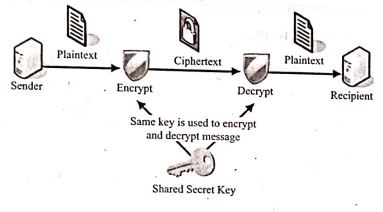 |
|
17.
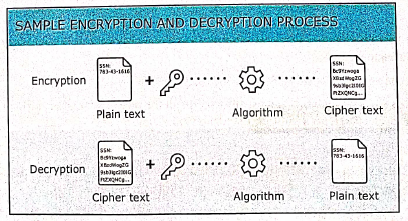
Encryption technology is an effective information security protection. It is defined as converting a plaintext into meaningless ciphertext using encryption algorithm thus ensuring the confidentiality of the data. The encryption or decryption process use a key to encrypt or decrypt the data. At present two encryption technologies are widely used. They are symmetric key encryption system and an asymmetric key encryption system. Thre figure below shows the Data Encryption and Decryption process:
18.
Confidentiality
19.
Confidentiality
20.
Cyber Squatting
21.
d) (A) is false and (R) is true
22.
d) (A) is false and (R) is true.

12th Standard Syllabus & Materials
12th Standard
TN 12th Computer Applications களப்பெயர் முறைமை (DNS) Sample Question Papers Study Material - QB365 Set A
NEW12th Standard
TN 12th Computer Applications வலையமைப்பு எடுத்துக்காட்டுகள் மற்றும் நெறிமுறைகள் Sample Question Papers Study Material - QB365 Set A
NEW12th Standard
TN 12th Computer Applications கணினி வலையமைப்பு ஓர் அறிமுகம் Sample Question Papers Study Material - QB365 Set A
NEW12th Standard
TN 12th Computer Applications PHP-உடன் MySQL-ஐ இணைத்தல் Sample Question Papers Study Material - QB365 Set A



Tamilnadu Stateboard 12th Standard Subjects

Maths

Chemistry

Physics

Biology

Computer Science

Business Maths and Statistics

Economics

Commerce

Accountancy

History
Computer Applications
Biology
Computer Technology
Computer Applications
Computer Science
Business Maths and Statistics
Commerce
Economics
Maths
Chemistry
Physics
Computer Technology
History
Accountancy

Tamil

English

French
Tamilnadu Stateboard Standards
