
 100% FREE ACCESS
12th Standard Syllabus & Materials
12th Standard
TN 12th Computer Applications மின்னணு தரவு பரிமாற்றம் Sample Question Papers Study Material - QB365 Set A
NEW12th Standard
TN 12th Computer Applications மின் - வணிக பாதுகாப்பு அமைப்புகள் Sample Question Papers Study Material - QB365 Set A
NEW12th Standard
TN 12th Computer Applications மின்னணு செலுத்தல் முறைகள் Sample Question Papers Study Material - QB365 Set A
NEW12th Standard
TN 12th Computer Applications மின் - வணிகம் Sample Question Papers Study Material - QB365 Set A
NEW12th Standard
TN 12th Computer Applications திறந்த மூல கருத்துருக்கள் Sample Question Papers Study Material - QB365 Set A
NEW12th Standard
TN 12th Computer Applications வலையமைப்பு வடமிடல் Sample Question Papers Study Material - QB365 Set A

Published on: 19/09/2022
QB365 provides a detailed and simple solution for every Possible Book Back Questions in Class 12 Computer Applications Subject -Electronic Payment Systems, English Medium. It will help Students to get more practice questions, Students can Practice these question papers in addition to score best marks.
Download Tamil Nadu 12th Standard Computer Applications question papers, model tests, one-mark questions, important questions, and public exam papers in PDF format. Free study materials and answer keys for TN State Board students.
Questions + Answers key
Take MCQ Computer Applications Test
1.
Write about smard card and type.
2.
Explain in detail : Unified payments interface
3.
4.
Briefly explain Electronic Account transfer and its types.
5.
What is credit card? Explain the key players of a credit card payment system and bring out the merits of it.
1.
The modern version of card based payment is smart cards. Smart cards along with the regular features of any card based payment system holds a EMV chip. This chip is similar to well-known sim card in appearance but differ in its functionalities. The advantage of Smart cards is that it can provide identification, authentication, data storage and application processing. Smart cards can be classified into Contact smart cards and Contactless smart cards.
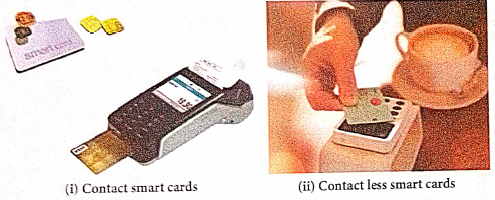
(i) Contact smart cards:
Contact smart cards have a contact area of approximately 1 square centimeter, comprising several goldplated contact pads. These pads provide electrical connectivity only when inserted into a reader, which is also used as a communications medium between the smart card and a host. e.g. a point of sale terminal(POS).
(ii) Contactless smart cards:
Contactless smart card is empowered by RF induction technology. Unlike contact smart cards, these cards require only near proximity to an antenna to communicate. Smart cards, whether they are contact or contactless cards do not have an internal power source. Instead, they use an inductor to capture some of the interrupting radio-frequency signal, rectify it and power the card's processes.
2.
Unified Payments Interface:
(i) Unified Payments Interface (UPI) is a real-time payment system developed by National Payments Corporation of India (NCPI) to facilitate inter-bank transactions. It is simple, secure and instant payment facility.
(ii) This interface is regulated by the Reserve Bank of India and used for transferring funds instantly between two bank accounts through mobile (platform) devices. http://www.npci.org.in/
(iii) It also provides the "peer to peer" collect request which can be scheduled and paid as per requirement and convenience.
(iv) UPI is developed on the basis of Immediate Payment Service (IMPS). To initiate a transaction, UPI applications use two types of address - global and local.
(v) Virtual payment address (VPA) also called as UPI-ID, is a unique ID similar to email id (e.g. name@ bankname) enable us to send and receive money from banks.
(vi) The bank or the financial institution allows the customer to generate VPA using phone number associated with Aadhaar number and bank account number. VPA replaces bank account details thereby completely hides critical information.
(vii) The MPIN (Mobile, banking Personal Identification number) is required to confirm each paymernt.
Advantages :
(i) Immediate money transfers through mobile device round the clock 24 x 7.
(ii) Can use single mobile application for accessing multiple bank accounts
(iii) Single Click Authentication for transferring of fund.
(iv) It is not required to enter the details such as Card no, Account number, IFSC etc. for every transaction.
(v) Electronic payments will become much easier without requiring a digital wallet or credit or debit card.
3.
4.
Apart from card based payment systems there are many alternative electronic payment systems. With the advent of computers, network technologies and electronic communications a large number of alternative electronic payment systems have emerged. These include ECS (Electronic Clearing Services), EFT (Electronic funds transfers), Real Time Gross Settlement system (RTGS) etc. These Electronic Payment systems are used in tendering cash in domestic and international transactions.
Electronic Clearing Services (ECS):
Electronic Clearing Service can be defined as repeated transfer of funds from one bank account to multiple bank accounts or vice versa using computer and Internet technology. The payer instructs the bank to debit from his bank account and credit it to one or more payee bank account provided amounts and dates of the payments earlier. This system provides the convenience of paperless payments. ECS can be used for both credit and debit purposes i.e. for making bulk payments or bulk collection of amounts.
Electronic Funds Transfer:
Electronic Funds Transfer (EFT) is the "electronic transfer" of money over an online network. The amount sent from the sender's bank branch is credited to the receiver's bank branch on the same day in batches. Unlike traditional processes, EFT saves the effort of sending a demand draft through post and the inherent delay in reaching the money to the receiver. Banks may charge commission for using this service. EFT is a widely used method for moving funds from one account to another in B2B business models.
Real Time Gross Settlement:
Real Time Gross Settlement System (RTGS) is a payment system particularly used for the settlement of transactions between financial institutions, especially banks. As name indicates, RTGS transactions are processed at the realtime. RTGS payments are also called as push payments that are initiated ("triggered") by the payer. RTGS payments are generally large-value payments, i.e. high-volume transactions.
Real-time gross settlement transactions are:
Unconditional: the beneficiary will receive funds regardless of whether he fulfills his obligations to the buyer or whether he would deliver the goods or perform a service of a quality consistent with the order.
Irrevocable: a correctly processed transaction cannot be reversed and its money cannot get refunded (the so-called settlement finality).
5.
Credit card is an electronic payment system normally used for retail transactions. A credit card enables the bearer to buy goods or services from a vendor, based on the cardholder's promise to the card issuer to payback the value later with an agreed interest. Every credit card account has a purchased limit set by the issuing bank or the firm. A credit card is different from a debit card where the credit card issuer lends money to customer instead of deducting it from customer's bank account instantly.
Key players in operations of credit card:
Bearer: The holder of the credit card account who is responsible for payment of invoices in full (transactor) or a portion of the balance (revolver) the rest accrues interest and carried forward.
Merchant: Storekeeper or vendor who sell or providing service, receiving payment made by its customers through the credit card.
Acquirer: Merchant's bank that is responsible for receiving payment on behalf of merchant send authorization requests to the issuing bank through the appropriate channels.
Credit Card Network: It acts as the intermediate between the banks. The Company responsible for communicating the transaction between the acquirer and the credit card issuer. These entities operate the networks that process credit card payments worldwide and levy interchange fees.
E.g. Visa, MasterCard, Rupay
Issuer: Bearer's bank, that issue the credit card, set limit of purchases, decides the approval of transactions, issues invoices for payments, charges the holders in case of default and offer card- linked products such as insurance, additional cards and rewards plan.
Advantages of credit card:
1. Most credit cards are accepted worldwide.
2. It is not necessary to pay physical money at the time of purchase. The customer gets an extra period to pay the purchase.
3. Depending on the card, there is no need to pay annuity.
4. Allows purchases over the Internet in installments.
5. Some issuers allows "round up" the purchase price and pay the difference in cash to make the transactions easy.

12th Standard Syllabus & Materials
12th Standard
TN 12th Computer Applications களப்பெயர் முறைமை (DNS) Sample Question Papers Study Material - QB365 Set A
NEW12th Standard
TN 12th Computer Applications வலையமைப்பு எடுத்துக்காட்டுகள் மற்றும் நெறிமுறைகள் Sample Question Papers Study Material - QB365 Set A
NEW12th Standard
TN 12th Computer Applications கணினி வலையமைப்பு ஓர் அறிமுகம் Sample Question Papers Study Material - QB365 Set A
NEW12th Standard
TN 12th Computer Applications PHP-உடன் MySQL-ஐ இணைத்தல் Sample Question Papers Study Material - QB365 Set A



Tamilnadu Stateboard 12th Standard Subjects

Maths

Chemistry

Physics

Biology

Computer Science

Business Maths and Statistics

Economics

Commerce

Accountancy

History
Computer Applications
Biology
Computer Technology
Computer Applications
Computer Science
Business Maths and Statistics
Commerce
Economics
Maths
Chemistry
Physics
Computer Technology
History
Accountancy

Tamil

English

French
Tamilnadu Stateboard Standards
