
 100% FREE ACCESS
12th Standard Syllabus & Materials
12th Standard
TN 12th Computer Applications மின்னணு தரவு பரிமாற்றம் Sample Question Papers Study Material - QB365 Set A
NEW12th Standard
TN 12th Computer Applications மின் - வணிக பாதுகாப்பு அமைப்புகள் Sample Question Papers Study Material - QB365 Set A
NEW12th Standard
TN 12th Computer Applications மின்னணு செலுத்தல் முறைகள் Sample Question Papers Study Material - QB365 Set A
NEW12th Standard
TN 12th Computer Applications மின் - வணிகம் Sample Question Papers Study Material - QB365 Set A
NEW12th Standard
TN 12th Computer Applications திறந்த மூல கருத்துருக்கள் Sample Question Papers Study Material - QB365 Set A
NEW12th Standard
TN 12th Computer Applications வலையமைப்பு வடமிடல் Sample Question Papers Study Material - QB365 Set A

Published on: 19/09/2022
QB365 provides a detailed and simple solution for every Possible Creative Questions in Class 12 Computer Applications Subject -Electronic Payment Systems, English Medium. It will help Students to get more practice questions, Students can Practice these question papers in addition to score best marks.
Download Tamil Nadu 12th Standard Computer Applications question papers, model tests, one-mark questions, important questions, and public exam papers in PDF format. Free study materials and answer keys for TN State Board students.
Questions + Answers key
Take MCQ Computer Applications Test
1.
What are the steps to transfer fund using net banking?
2.
Explain about anatomy of a credit card.
3.
What is ECS? How ECS is used for? Differentiate ECS credit afld debit.
4.
What are the classification of electronic payment methods and explain about macro electronic payment systems?
5.
Explain the advantages of UPI?
6.
Write the steps to transfer funds using Net Banking.
7.
Write in detail about the classification of smart cards
8.
Explain In detail about Credit card Number.
9.
Explain the advantages of Credit card.
10.
What is cryptocurrency? Explain the same.
1.
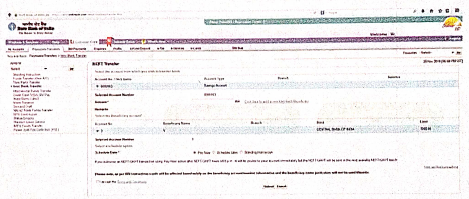
Step 1: Login to net banking account using unique user name and password provided by the bank earlier.
Step 2: Add the beneficiary as a payee to enable transfer of fund. The following details like Account Number, Name, IFSC about the beneficiary are to be filled in the 'Add New Payee' section.
Step 3: Once the beneficiary is added, choose RTGS / NEFT / IMPS as mode of Fund Transfer.
Step 4: Select the account to transfer money from, select the payee, enter the amount to be transfered and add remarks (optional).
Step 5: Click on submit.
Step 6: Enter the OTP received to mobile number linked to the corresponding account to complete the transaction.
Modern Electronic funds transfers are secured by a personal identification number (PIN), one-time password (OTP) etc. An automated clearing house (ACH) processes the payment then.
2.
All Payment cards (including debit card) are usually plastic cards of size 85.60 mm width x 53.98 mm height, rounded corners with a radius of 2.88 mm to 3.48 mm and thickness of 0.76 mm. These standards dimensions are maintained universally in accordance with ISO/IEC 7810#ID-1.
(i) Publisher: Emblem of the issuing bank (along with the sub category or scheme if any)
(ii) Credit card number: The modern credit card number has 16-digit unique identification number.
The first digit of the credit card number is Major Industry Identifier (MII). It identifies the issuer category. e.g. 1 - Airlines, 4-Banks
The next 5 digits uniquely identifies the issuing organization.
The first 6 digits together called as Issuer Identifier number (IIN) or Bank Identification number (BIN)
The next 9 digits are the account number.
The last digit is a check digit
(iii) Name of the cardholder: It is visibly embossed on the front side (additionally stored on the magnetic stripe) some cards like gift cards do not hold any name.
(iv) EMV chip: It is integrated chip in addition to magnetic stripe to store cardholder's information.
EMV stands for Europay, MasterCard, Visa. These three names correspond to the names of the companies which are responsible to develop this technology. It is categorized into Chip-and Signature and Chip-and-PIN.
(v) RFID symbol: It is four curved lines radiating rightwards similar to a tilted Wi-Fi symbol. It indicates that it is a contactless smartcard.
(vi) Expiration month and year: It is visible on the front side (also stored on the magnetic stripe or chip). The card is valid until the last day of the month printed on it.
(vii) Card brand logo: It is the name of the credit card network company. Visa and MasterCard are leading credit card network companies. Rupay is Indian domestic open loop card launched in 2012.
(viii) Magnetic stripe: It is an iron based magnetic material containing encrypted data about the card holder and account number.
(ix) Hologram: Hologram is a security feature that prevents duplication. It is a 3-dimentional image formed by interference of light beams.
(x) Signature: It is cardholder's signature at the back of the card, used as an attempt to identify cardholder's identity. It also holds the last 4 digits of card number.
(xi) CVC/CVV: Card Verification code/value is a 3 digit code usually printed to the left of signature pane validates the card. CVC2 is used in contact less transactions.
3.
Electronic Clearing Service can be defined as repeated transfer of funds from one bank account to multiple bank accounts or vice yersa using computer and Internet technology. The payer instructs the bank to debit from his bank account and credit it to one or more payee bank account provided amounts and dates of the payments earlier. This system provides the convenience of paperless payments. ECS can be used for both credit and debit purposes i.e. for making bulk payments or bulk collection of amounts,
| ECS Credit | ECS Debit | ||
| (i) | ECS credit is used for making a single account is debited and multiple accounts are credited. |
(i) | ECS debit is an inverse of ECS credit. |
| (ii) | In this mode, a single account is debited and multiple accounts are credited. | (ii) | In this mode, multiple accounts are debited and then a single account is credited. |
| (iii) | This type of transactions are push transactions. | (iii) | This type of transaction are a Pull transaction. |
| (iv) | E.9., If a company has to pay salary to its 100 employees it can use ECS credit system than crediting every employees' account separately. | (iv) | E.g. The insurance premium of bulk number of customers is debited from the customer's bank account on their prior consent and paid to insurance company. |
4.
Based on the value of money transactions, processing time, processing requirements, security issues and usability electronic Payment systems are generally classified into two types. They are
1. Micro electronic Payment Systems
2. Macro electronic Payment Systems
Macro electronic payment systems support payments of higher value. The security requirements are more rigorous in macro payment systems because of huge money transactions. Banks will impose a minimum transaction overhead on macro payment systems. These transactional over heads for the usage of computationally expensive cryptographic operations prevent these payment systems to be used for the payment of small amounts. Some of the popular macro on-line payment systems are mentioned below.
1. Card based payment systems
2. Electronic account transfer
3. Electronic cash payment systems
4. Mobile payment systems and internet payment systems
5.
(i) Immediate money transfers through mobile device round the clock 24 x 7.
(ii) Can use single mobile application for accessing multiple bank accounts
(iii) Single Click Authentication for transferring of fund.
(iv) It is not required to enter the details such as Card no, Account number, IFSC etc. for every transaction.
(v) Electronic payments will become much easier without requiring a digital wallet or credit or debit card
6.
Step 1: Login to net banking account using unique user name and password provided by the bank earlier.
Step 2: Add the beneficiary as a payee to enable transfer of fund. The following details like Account Number, Name, IFSC about the beneficiary' are to be filled in the 'Add New Payee'section.
Step 3: Once the beneficiary is added, choose RTGS/ NEFT/ IMPS as mode of Fund Transfer.
Step 4: Select the account to transfer money from, select the payee, enter the amount to be transferred and add remarks (optional).
Step 5: Click on submit.
Step 6: Enter the OTPreceivedto mobile number linked to the corresponding account to complete the transaction.
7.
(i) Contact smart cards
1. Contact smart cards have a contact area of approximately 1 square centimeter, comprising several gold plated contact pads.
2. These pads provide electrical connectivity only when inserted into a reader, which is also used as a communications medium between the smart card and a host. e.g. a point of sale terminal(POS).
(ii) Contactless smart cards
1. Contactless smart card is empowered by RF induction technology.
2. Unlike contact smart cards, these cards require only near proximity to an antenna to communicate.
3. Smartcards, whether they are contact or contactless cards do not have an internal power source.
4. Instead, they use an inductor to capture some of the interrupting radio-frequency signal, rectify it and power the card's processes.
8.
1. Credit card number: The modern credit card number has 16-digit unique identification number.
2. The first digit of the credit card number is Major Industry Identifier (MII).
i) It identifies the issuer category.
ii) e.g. 1 - Airlines,4 - Banks
3. The next 5 digits uniquely identify the issuing organization
4. The first 6 digits together called as Issuer Identifier number (IlN) or Bank Identification number (BIN).
5. The next 9 digits are the account number.
6. The last digit is a check digit (based to the Luhn algorithm).
9.
1. Most credit cards are accepted worldwide.
2. It is not necessary to pay physical money at the time of purchase.
3. The customer gets an extra period to pay the purchase.
4. Depending on the card, there is no need to pay annuity.
5. Allows purchase over the Internet in installments
6. Some issuers allows "round up" the purchase price and pay the difference
7. In cash to make the transactions easy
10.
1. A cryptocurrency is a unique virtual (digital) asset designed to work as a medium of exchange using cryptographic algorithm.
2. This algorithm secures the transactions by recording it in blockchain and controls the creation of additional units of the currency.
3. Cryptocurrency is also called as cryptocoins, e-cash, alternative currencies or virtual currencies and are classified as a subset of digital currencies.
4. The function of cryptocurrency is based on technologies such as Mining, Blockchain, Directed Acyclic Graph, Distributed register (ledger), etc. The information about the transaction is usually not encrypted and is available in clear text.
5. The term "cryptocurrency" began to be used after the appearance of the Bitcoin. Bitcoin is the most popular and the first decentralized cryptocurrency. Bitcoin payment system, was developed in 2009 by an unknown person or a group under the pseudonym "SatosiNakamoto".
6. Currently, more than 1300 cryptocurrencies are listed over 200 special cryptocurrency stock exchanges. Most (not all) are based on different types of blockchain technology.
7. Many cryptocurrencies operate on the basis of the same source code, in which the authors make only a few minor changes in parameters like time, date, distribution of blocks, number of coins, etc. These currencies are called as fork. In fork, both cryptocurrencies can share a common transaction history in blockchain until the split.
8. Altcoins is the collective name for all cryptocurrencies that appeared after Bitcoin. The early Altcoins, Litecoin and Namecoin appeared in 2011. Their miners sought to overcome a number of problems inherent in Bitcoin (for example, Litecoin has a higher transaction rate) or use blockchain technology in other areas
9. Many altcoins are inherently very similar to Bitcoin in characteristics and structure.
10. The cryptocurrency units are created by the solution of cryptographic tasks called mining.
11. Blockchains are an open distributed book that records transactions of cryptocurrencies between any two parties in an efficient and verifiable manner.

12th Standard Syllabus & Materials
12th Standard
TN 12th Computer Applications களப்பெயர் முறைமை (DNS) Sample Question Papers Study Material - QB365 Set A
NEW12th Standard
TN 12th Computer Applications வலையமைப்பு எடுத்துக்காட்டுகள் மற்றும் நெறிமுறைகள் Sample Question Papers Study Material - QB365 Set A
NEW12th Standard
TN 12th Computer Applications கணினி வலையமைப்பு ஓர் அறிமுகம் Sample Question Papers Study Material - QB365 Set A
NEW12th Standard
TN 12th Computer Applications PHP-உடன் MySQL-ஐ இணைத்தல் Sample Question Papers Study Material - QB365 Set A



Tamilnadu Stateboard 12th Standard Subjects

Maths

Chemistry

Physics

Biology

Computer Science

Business Maths and Statistics

Economics

Commerce

Accountancy

History
Computer Applications
Biology
Computer Technology
Computer Applications
Computer Science
Business Maths and Statistics
Commerce
Economics
Maths
Chemistry
Physics
Computer Technology
History
Accountancy

Tamil

English

French
Tamilnadu Stateboard Standards
