
 100% FREE ACCESS
12th Standard Syllabus & Materials
12th Standard
TN 12th Computer Applications மின்னணு தரவு பரிமாற்றம் Sample Question Papers Study Material - QB365 Set A
NEW12th Standard
TN 12th Computer Applications மின் - வணிக பாதுகாப்பு அமைப்புகள் Sample Question Papers Study Material - QB365 Set A
NEW12th Standard
TN 12th Computer Applications மின்னணு செலுத்தல் முறைகள் Sample Question Papers Study Material - QB365 Set A
NEW12th Standard
TN 12th Computer Applications மின் - வணிகம் Sample Question Papers Study Material - QB365 Set A
NEW12th Standard
TN 12th Computer Applications திறந்த மூல கருத்துருக்கள் Sample Question Papers Study Material - QB365 Set A
NEW12th Standard
TN 12th Computer Applications வலையமைப்பு வடமிடல் Sample Question Papers Study Material - QB365 Set A

Published on: 10/09/2022
QB365 provides a detailed and simple solution for every Possible Creative Questions in Class 12 Computer Applications Subject - Network Examples and Protocols, English Medium. It will help Students to get more practice questions, Students can Practice these question papers in addition to score best marks.
Download Tamil Nadu 12th Standard Computer Applications question papers, model tests, one-mark questions, important questions, and public exam papers in PDF format. Free study materials and answer keys for TN State Board students.
Questions + Answers key
Take MCQ Computer Applications Test
1.
Explain in detail about TCP/IP reference model layers?
2.
Compare 1G, 2G, 3G, and 4G.
3.
Difference between Internet, Intranet and Extranet.
4.
What are the merits and demerits of TCP/IP reference model?
5.
Explain working of TCP/IP.
6.
Explain in detail about RFID system and its types.
7.
Explain in detail about wi-fi and its advantages.
8.
Explain about Fifth Generation of Mobile Networks.
9.
Write short notes on Fourth Generation of Mobile Networks.
10.
Explain in detailed about Third Generation of Mobile Networks.
11.
Explain in detailed about Second Generation of Mobile Networks.
1.
TCP/IP reference model has four layer They are Network Interface layer, Network layer, Transport layer and Application layer.
(1) Network Interface layer:
1. It is the bottom most level layer. It is comparable are being used in this to that of the OSI physical and data link layers. Different TCP/IP protocols are being used in this layer.
2. Ethernet and Token Ring for LAN
3. x - 25, frame relay, and ATM for wide area networks (WAN)
4. It is assumed to be an unreliable layer.
(2) Network layer:
1. It is the layer where data is addressed, packaged, and routed among networks.
2. Protocols are: Internet protocol, address resolution protocol, Internet control/message protocol,
3. Internet Group management protocol.
Internet Protocol: (IP)
1. Routable protocol which uses IP addresses to deliver packets. It is an unreliable protocol, does not guarantee delivery of information.
2. Address Resolution Protocol (ARP)
3. Resolves IP address to MAC addresses ie, map IP network addresses to the hardware addresses.
4. Internet Control Message Protocol (ICMP):
5. Used by network devices to send error messages and operational information.
6. Internet Group Management Protocol (IGMP)
7. It is a communication protocol used by hosts and routers to send multiple IP address at once.
(3) Transport layer:
1. The sessions are recognized and data packets are swapped between hosts in this layer. Two main protocol are.
2. Transmission Control Protocol (TCP): provides reliable connection oriented transmission between two hosts, It ensures delivery of packets between the hosts.
3. User Datagram Protocol (UDP): provides connectionless, unreliable, one to one, one to many delivery.
(4) Application layer:
1. It is similar to session, presentation and application layers of the OSI model. The application protocols are
2. Hyper Text Transfer Protocol (HTTP): The core protocol of the world wide seb.
3. File Transfer Protocol (FTP): enables a client to send and receive complete files from a server
4. Telnet: Connect to another computer on the Internet
5. Simple Mail Transfer Protocol (SMTP): provide email services,
6. Domain Name System (DNS): Refer to other host computers by using names rather than numbers.
2.
| 1G | 2G | 3G | 4G | |
| Introduced in year | 1980 | 1993 | 2001 | 2009 |
| Technology | AMPS, NMT | GSM | WCDMA | LTE, WIMAX |
| Characteristic | First wireless communication | Digital version | Digital broadband speed increment | Very high speed, all IP |
| Supports | Voice only | Voice and data | Voice and data | Voice and data |
| Advantage | Simpler | SIM introduced multimedia features | High-security international roaming | High speed, global mobility |
| Disadvantage | Limited capacity not secure | Low network range slow data rate | High power consumption | Hard to implement |
| Applications | Voice calls | Voice call, short message browsing | Video conferencing mobile TV GPS | High-speed applications, mobile TV, wearable devices |
3.
| Sl.No | Internet | Intranet | Extranet |
| 1. | It is a global system of inter-connected computer | It is a private network specific to an organization | It is a private network that network to share information uses public on with suppliers and vendors |
| 2. | Not regulated by any authority | It is regulated by organization | It is regulated by multiple organization |
| 3. | Network is accessible to everyone connected | Network is accessible only to members organization | Network is accessible to members organization and external members with access to network |
| 4. | Sharing information throughout the world | Sharing sensitive information throughout organisation | Sharing information between members and external members |
| 5. | Security is dependent of the user of device connected to network | Security is enforced via a firewall | Security is enforced via firewall that separates internet and extranet |
| 6. | Any user can access anonymously | User should have valid user/password to access | User should have valid user id/password to access. |
4.
Merits:
1. It operated independently
2. It is scalable.
3. Client/server architecture.
4. Supports a number of routing protocols.
5. can be used to established a connection between two computers.
Demerits:
1. Transport layer does not guarantee delivery of packets.
2. The model cannot be used in any other application.
3. Replacing Protocol is not easy.
4. It has not clearly separated its services, interfaces and protocols.
5.
TCP/IP:
(i) Transmission Control Protocol/Internet Protocol, TCP/IP is a set of protocols which governs communications among all computers on the Internet. TCP/IP protocol tells how information should be packaged. sent, and received, as well as how to get to its destination.
(ii) TCP WORKING: TCP/IP is a combination of two protocols: Transmission Control Protocol (TCP) and Internet Protocol (IP).
(iii) The Internet Protocol typically specifies the logistics of the packets that are sent out over networks; it specifies the packets which have to go, where to go and how to get there.
(iv) The Transmission Control Protocol is accountable for guaranteeing the trustworthy transmission of data. It checks if any packet is not transmitted and submits it again.
Frequent TCP/IP Protocols :
(i) HTTP - It is used between a web client and a web server and it guarantees non-secure data transmissions.
(ii) HTTPS – It is used between a web client and a web server ensures secure data transmissions.
(iii) FTP - It is used between computers for sending and receiving file.
Domain Names and TCP/IP Addresses :
The address for any website is not as easy as to remember, domain name are used instead. For example, 216.58.216.164 is one of the IP address for Google and google.com is the domain name.
6.
RFID stands for Radio Frequency Identification, RFID uses RF wireless technology. RFID used for radio waves to read and capture information stored on a tag attached to an object. Tag can be read from several feet away and does not need to be in direct line of sight of the reader to be tracked. RFID has been made up of two parts a reader and tag or a label. RFID tags are installed with a transmitter and a receiver. RFID component on the tags has two parts: a micro which stores and processes the information, and the antenna to receive and transmit a signal. The tag replies the information from its memory bank. The reader will transmit to read the result to RFID computer program.
There are two types of RFID system
(i) Active RFID
(ii) Passive RFID
(i) Active RFID system: The tag has its own power source. These systems used for larger distances and to track high value goods like vehicles.
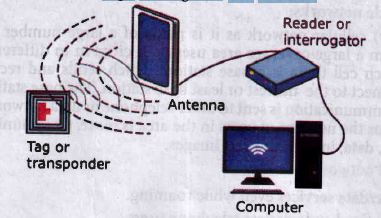
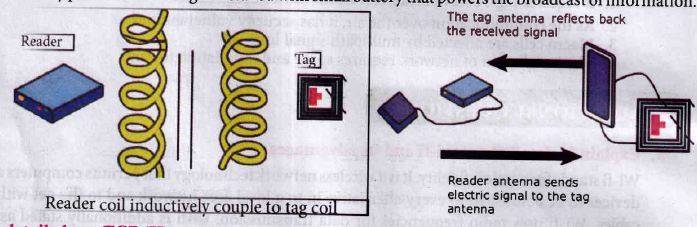
(ii) Passive RFID system: The tag gets power through power from a reader antenna to the tag antenna, they are used for shorter range transmission.
1. Passive RFID tag will induced the reader to receive radio wave energy and restored the information back to the reader.
2. Battery powered RFID tag is installed with small battery that powers the broadcast of information.
7.
Wi-fi stands for wireless fidelity. It is a wireless network technology that permits computers and alternative devices to be connected to every alternative in to a local area network and to the net without wires and cables. Wi-fi uses radio frequencies for data transmission. wi-fi is additionally stated as wireless local area network that stands for wireless local area network and 802.11 that is that the technical code for the protocol.
Advantages:
(i) It provides mobility
(ii) It provides connection to internet
(iii) Flexibility of LAN
(iv) Ensures connectivity
(v) It allows places that are remote to benefit from connectivity
(vi) Low cost, high benefits
8.
(i) SG is the stage succeeds the 4G (LTE/WiMAx), 3G(umts) and 2G(GSM)syetems.
(ii) SG targets to performance the high data rate, reduced latency, energy saving, cost reduction, higher system, capacity, and massive device connectivity.
(iii) The two phasesof SG,First one will be Release-1S complete by March 2019, Second one Release- 16is expected to complete at March2020, for submission to the ITU (International Telecommunication Union) as a candidate IMT- 2020 technology.
(iv) The ITU IMT - 2020 provides speeds up to 20 gigabits per second it has been demonstrated with millimeter waves of lS giga hertz and higher frequency. 3 GPPstandards includes any network using the New Radio software. SGNew Radio can accessat lower frequencies from 600 MHzto 6 GHz.
(v) Speed in the lower frequencies are only modest higher than 4G systems, estimated at lS% to SO%faster
9.
(i) 4G is at the research stage. 4G was based on an adhoc networking model where there was no need for a fixed infrastructure operation.
(ii) Adhoc networking requires global mobility features (e.g. Mobile IP) and connectivity to a global IPv6 network to support an IP addressfor each mobile device. Logicallyroaming in assorted IP networks (for example: 802.11 WLAN,
(iii) GPRSand UMTS) were be possible with higher data rates, from 2Mbit/s to 10-100Mbit/s, offering reduced delays and newly services.
(iv) Mobile devices will not expect on a fixed infrastructure, they will require enhanced intelligence to self-configure in adhoc networks and having routing capabilities to route over packets switched network.
10.
(i) Third generation of mobile systems merges different mobile technology standards, and uses higher frequency bands for transmission and Code Division Multiple Access to delivery data rates of up to 2Mbit/s supports multimedia services (MMS: voice, video and data) .
(ii) European standard is UMTS(Universal Mobile Telecommunication Systems).
(iii) Mobile phones systems continue to use digital transmission with SIM authentication for billing systems and for data incorruption.
(iv) Data transmission used a WCDMA. WCDMA stands for (Wideband Code Division Multiple Access).
(v) One technique to obtain data rates between 384kbit/s and 2048kbit/s. Few 3G suppliers use ATM (Asynchronous Transfer Mode) for their 'over the air' network with in MPLS(Multiprotocol Label Switching) or IP for theirs backbone network.
(vi) Mobility still supported at layer2, and hence like 2G it still prohibits seamless roaming beyond heterogeneous access networks and routing domains.
(vii) The transmission were band frequencies are between 1900 and 2200 MHz. All UMTS license holders at the UK holds a 20-year license with the condition that 80% population coverage is achieved by 31 December 2007.
(viii) The present third generation licensed operators in the UK can be seen below as at August 2004.
11.
(i) The second generation of mobile systems was placed on digital transmission with GSM.
(ii) GSM stands for (Global System for Mobile communication) was most popular standard which is used in second generation, using 900MHl and 1800MHz for the frequency bands.
(iii) GSM mobile systems grown digital transmission using SIM. SIM stands for (Subscriber Identity Module) technology to authenticate a user for identification and bllling purposes and to encrypt the data to prevent listen without permission (eaves dropping).
(iv) The transmission used as TDMA. TMDA stands for (Time Division Multiple Access) and CDMA One stands for (Code Division MultipleAccess ) method to increase the amount of information transported on the network.
(v) Mobility is supported at layer 2, which stops seamless roaming across assorted access networks and routing domains. This means each operator must cover the entire area or have agreements in place to permit roaming.

12th Standard Syllabus & Materials
12th Standard
TN 12th Computer Applications களப்பெயர் முறைமை (DNS) Sample Question Papers Study Material - QB365 Set A
NEW12th Standard
TN 12th Computer Applications வலையமைப்பு எடுத்துக்காட்டுகள் மற்றும் நெறிமுறைகள் Sample Question Papers Study Material - QB365 Set A
NEW12th Standard
TN 12th Computer Applications கணினி வலையமைப்பு ஓர் அறிமுகம் Sample Question Papers Study Material - QB365 Set A
NEW12th Standard
TN 12th Computer Applications PHP-உடன் MySQL-ஐ இணைத்தல் Sample Question Papers Study Material - QB365 Set A



Tamilnadu Stateboard 12th Standard Subjects

Maths

Chemistry

Physics

Biology

Computer Science

Business Maths and Statistics

Economics

Commerce

Accountancy

History
Computer Applications
Biology
Computer Technology
Computer Applications
Computer Science
Business Maths and Statistics
Commerce
Economics
Maths
Chemistry
Physics
Computer Technology
History
Accountancy

Tamil

English

French
Tamilnadu Stateboard Standards
