
 100% FREE ACCESS
12th Standard Syllabus & Materials
12th Standard
TN 12th Computer Applications மின்னணு தரவு பரிமாற்றம் Sample Question Papers Study Material - QB365 Set A
NEW12th Standard
TN 12th Computer Applications மின் - வணிக பாதுகாப்பு அமைப்புகள் Sample Question Papers Study Material - QB365 Set A
NEW12th Standard
TN 12th Computer Applications மின்னணு செலுத்தல் முறைகள் Sample Question Papers Study Material - QB365 Set A
NEW12th Standard
TN 12th Computer Applications மின் - வணிகம் Sample Question Papers Study Material - QB365 Set A
NEW12th Standard
TN 12th Computer Applications திறந்த மூல கருத்துருக்கள் Sample Question Papers Study Material - QB365 Set A
NEW12th Standard
TN 12th Computer Applications வலையமைப்பு வடமிடல் Sample Question Papers Study Material - QB365 Set A

Published on: 10/09/2022
QB365 provides a detailed and simple solution for every Possible Creative Questions in Class 12 Computer Applications Subject - Open Source Concepts, English Medium. It will help Students to get more practice questions, Students can Practice these question papers in addition to score best marks.
Download Tamil Nadu 12th Standard Computer Applications question papers, model tests, one-mark questions, important questions, and public exam papers in PDF format. Free study materials and answer keys for TN State Board students.
Questions + Answers key
Take MCQ Computer Applications Test
1.
Explain in detail about Open Network Management system? (NMS).
2.
Explain in detail about Open Source Software vs Free Software.
3.
How Open source software and developers work? Explain it with a diagram.
4.
what is open source software? why it is called open source software? - Explain.
5.
Explain in detail about Open Source Software and Free Software.
6.
Explain in detail about Open NMS.
7.
Explain in detail about network simulation tool - NS2
1.
1. Open NMS is a free and open-source initiative grade network monitoring and management platform.
2. It is established and maintained by a community of users developers and by the Open NMS Group and it offering services, training and support.
3. The goal of open NMS is to be an actually distributed, scalable management application platform for all features of the FCAPS network management model.
4. FCAPS - Fault, Configuration, Accounting, Performance, Security,
5. The emphasis is on Fault and performance management. It was intended to cope tens of thousands of devices from a single server as well as achieve unlimited devices using a cluster of servers.
6. Open NMS comprises a discovery engine to routinely configure and manage network devices without operator intervention. Open NMS is the world first software for Network monitor and management with open source options.
7. There are two types in this Meridian and Horizon.
8. For stability and long term support choose Meridian which is best for Enterprises as well as business.
9. Horizon used where innovation occurs frequently.
10. It is the Best for IT-ecosystem, new technologie monitoring.
11. Open NMS was released in 1999 by Steve Giles, Brian weaver and Luke Rindfuss.
12. In 2004 open NMS group was created by Balog Malt Brozouski, and David Hustace.
13. It is written in java and can run on all type of platform.
14. It gives us Event Management & Notification, Discovery & Provisioning, service monitoring and
15. Data collection won lot of awards for best of open source software.
2.
(i) OSS is slightly different from free software.
(ii) Both deal with the ability to download and modify software without restriction or charge.
(iii) In contrast, the OSS criteria, which the Open Source Initiative developed a decade later, place more emphasis on the modification of software, and the consequences of altering source code, licensing, and distribution.
(iii) Obviously, the two overlap; some would say the differences between OSS and free software are more philosophical than practical.
(iv) However, neither should be confused with freeware.
(v) Freeware usually refers to proprietary software that users can download at no cost, but the whose source code cannot be changed.
3.
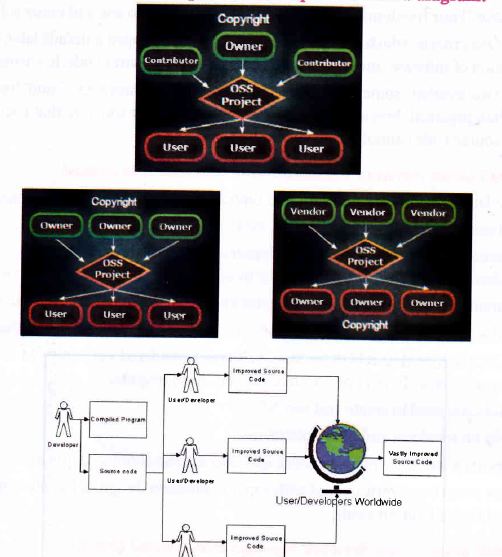
OSS projects are collaboration that improve skills and build connection in the field.
Domains that developers can contribute to the Open source community include:
(i) Communication tools.
(ii) Distributed revision control system.
(iii) Bug tracker and task lists.
(iv) Testing and debugging tools.
4.
Open source software has been developed by a variety of programmers. However, to add a new change to the software, the modified code will be submitted to a group of dedicated programmers. These programmers then test the modified codes and if it satisfies the appropriate rules, it will then be distributed to all. Open source simply refers to making the source code of the software freely available for users or other developers to use and make changes into the original repository or fork the project into and build a new one. Open source software is usually created and updated by many programmers around the world and made freely accessible.
Some of the examples are NS2, OPEN NMS, Ubuntu, My SQL, PDF creator, Open office, GIMP, PHP, ANDROID.
5.
(i) OSS is slightly different from free software.
(ii) Both deal with the ability to download and modify software without restriction or charge.
(iii) In contrast, the OSS criteria, which the Open Source Initiative developed a decade later, place more emphasis on the modification of software, and the consequences of altering source code, licensing, and distribution.
(iii) Obviously, the two overlap; some would say the differences between OSS and free software are more philosophical than practical.
(iv) However, neither should be confused with freeware.
(v) Freeware usually refers to proprietary software that users can download at no cost, but the whose source code cannot be changed.
6.
(i) Open NMS (Network Management System) is a free and open-source initiative grade network monitoring and management platform.
(ii) It is established and maintained by a community of users, developers and by the Open NMS Group.
(iii) It offering services, training, and support.
The goal is for Open NMS
(i) The goal is for Open NMS to be an actually distributed, scalable management application platform for all features of the FCAPS (Fault, Configuration, Accounting, Performance, Security) network management model.
(ii) Presently the emphasis is on Fault and Performance Management.
It was intended to cope tens of thousands of devices from a single server as well as achieve unlimited devices using a cluster of servers.
Features:
(i) OpenNMS comprises a discovery engine to routinely configure and manage network devices without operator intervention. It is written in Java and is issued under the GNU (General Public License.)
(ii) OpenNMS is the World's first software for Network monitor and management with opensource options.
OpenNMS- Types:
There are two types in this Meridian and Horizon.
Meridian: When we need stability and long term support choose Meridian which is best for Enterprises as well as businesses.
Horizon:
(i) It is used where innovation occurs frequently.
(ii) It is Best for IT-ecosystem, new technology monitoring.
History:
(i) OpenNMS was Released in 1999 by Steve Giles, Brian Weaver, and Luke Rindfuss.
(ii) In 2004 OpenNMS Group was created by Balog, Matt Brozowski, and David Hustace.
(iii) It is written in Java and can run on all type of platform.
(iv) It gives us Event management & Notification, Discovery & Provisioning, service monitoring, and Data Collection.
(v) Won a lot of awards for best of opensource software.
7.
Network simulation
In a computer network, network simulation is a method whereby a software program models the activities of a network by calculating the communication between the different network objects such as(routers, nodes, switches, access points, links, etc.).
Network simulator
(i) A network simulator is a software program that replicates the functioning of a computer network.
(ii) In simulators, the computer network is typically demonstrated with devices, traffic, etc. and the performance is evaluated.
Normally, users can then adapt the simulator to accomplish their precise analysis needs.
Network Parameters:
The network parameters define the state of the network (node placement, existing links) and the events (data transmissions, link failures, etc.).
Trace files:
A significant output of the simulation is the trace files. Trace files can document every incident that happened in the simulation and are used for examination.
NS2: NETWORK SIMULATOR version 2.
(i) It was considered explicitly for exploration in network communication and event-driven opensource simulator in computer.
(ii) OTCL and C++ used to create and run NS2.
(iii) NS2 works on Windows and Linux platforms that support wired or wireless network and also use the command line interface as a user interface.
API:
(i) API a pure event base software tool with super simulation design, it has more models which help the user to get desired output easily.

12th Standard Syllabus & Materials
12th Standard
TN 12th Computer Applications களப்பெயர் முறைமை (DNS) Sample Question Papers Study Material - QB365 Set A
NEW12th Standard
TN 12th Computer Applications வலையமைப்பு எடுத்துக்காட்டுகள் மற்றும் நெறிமுறைகள் Sample Question Papers Study Material - QB365 Set A
NEW12th Standard
TN 12th Computer Applications கணினி வலையமைப்பு ஓர் அறிமுகம் Sample Question Papers Study Material - QB365 Set A
NEW12th Standard
TN 12th Computer Applications PHP-உடன் MySQL-ஐ இணைத்தல் Sample Question Papers Study Material - QB365 Set A



Tamilnadu Stateboard 12th Standard Subjects

Maths

Chemistry

Physics

Biology

Computer Science

Business Maths and Statistics

Economics

Commerce

Accountancy

History
Computer Applications
Biology
Computer Technology
Computer Applications
Computer Science
Business Maths and Statistics
Commerce
Economics
Maths
Chemistry
Physics
Computer Technology
History
Accountancy

Tamil

English

French
Tamilnadu Stateboard Standards
