
 100% FREE ACCESS
12th Standard Syllabus & Materials
12th Standard
TN 12th Maths Applications of Matrices and Determinants Sample Question Papers Study Material - QB365 Set A
NEW12th Standard
TN 12th Computer Applications மின்னணு தரவு பரிமாற்றம் Sample Question Papers Study Material - QB365 Set A
NEW12th Standard
TN 12th Computer Applications மின் - வணிக பாதுகாப்பு அமைப்புகள் Sample Question Papers Study Material - QB365 Set A
NEW12th Standard
TN 12th Computer Applications மின்னணு செலுத்தல் முறைகள் Sample Question Papers Study Material - QB365 Set A
NEW12th Standard
TN 12th Computer Applications மின் - வணிகம் Sample Question Papers Study Material - QB365 Set A
NEW12th Standard
TN 12th Computer Applications திறந்த மூல கருத்துருக்கள் Sample Question Papers Study Material - QB365 Set A

Published on: 03/09/2019
Introduction to Database Management System
Download Tamil Nadu 12th Standard Computer Applications question papers, model tests, one-mark questions, important questions, and public exam papers in PDF format. Free study materials and answer keys for TN State Board students.
Questions + Answers key
Take MCQ Computer Applications Test
1.
The structure representing the organizational view of entire database is known as ______ in MySQL database.
Schema
View
Instance
Table
2.
Which is the MySQL instance responsible for data processing?
MySQL Client
MySQL Server
SQL
Server Daemon Program
3.
Communication is established with MySQL using
SQL
Network calls
Java
API’s
4.
The _____ diagram gives a logical structure of the database graphically?
Entity-Relationship
Entity
Architectural Representation
Database
5.
Which language is used to request information from a Database?
Relational
Structural
Query
Compiler
6.
What is Relationship and List its types.
7.
8.
Define Data Model and list the types of data model used.
9.
Write few commands used by DBA to control the entire database.
10.
Discuss on Cardinality in DBMS.
11.
Explain on Evolution of DBMS.
12.
13.
Discuss on various database models available in DBMS.
1.
(a)
Schema
2.
(b)
MySQL Server
3.
(a)
SQL
4.
(a)
Entity-Relationship
5.
(c)
Query
6.
In ER Model, relationship exits between two entities.
Types :
(i) one-to-one Relationship,
(ii) one-to-many Relationship,
(iii) many-to-many Relationship.
7.
8.
Data models define how the logical structure a database is modeled. Data models define how data is connected to each other and how they are processed andstored inside the system
Types of Data Model :
1) Hierarchical database model
2) Network model
3) Relational model
4) object oriented database model
9.
(i) USE Database: This command is used to select the database in MySQL for working.
Syntax:
mysql>use test:
Database changed
mysql>
(ii) SHOW Database: Lists all the databases available in the database server.
Syntax:
mysql>show databases;
(iii) SHOW Tables: Lists all the tables available in the current database we are working in.
Syntax: mysql>show tables;
10.
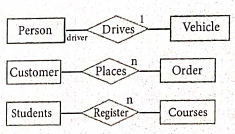
Cardinality is defined as the number of items that must be included in a relationship (i.e) number of entities in one set mapped with the number of entities of another set via the relationship The three classifications in Cardinality are one-to-one, one-to-many and Many-to-Many.
In the above example we have two entities Person and Vehicle. If we consider a person driving vehicle, then we have one-to-one relationship between Person and Vehicle.
In the above example, Customer places the Order is a one-to-many relationship. Here the customer can place multiple orders and the order is related to only one customer.
The example of many-to-many relationship is Students registering the Courses. A student can register more than one courses and A course can be registered by many students. Hence it is many-to-many.
11.
Evolution of DBMS:
(i) The concept of storing the data started before 40 years in various formats.
(ii) In earlier days they have used punched card technology to store the data. Then files were used.
(ii) The file systems were known as predecessor of database system.
(iv) Various access methods in file system were indexed, random and sequential access.
The file system had more limitations like.
Data Duplication : Same data is used by multiple resources for processing, thus created multiple copies of same data wasting the spaces.
High Maintenance : Access control and verifying data consistency needs high maintenance cost.
Security : Less security provided to the data.
(v) So database systems became popular to overcome the above limitations of file system.
12.
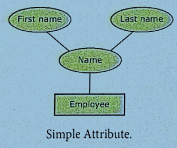
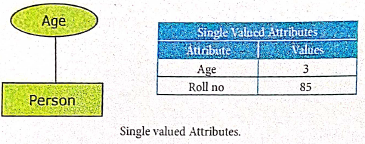
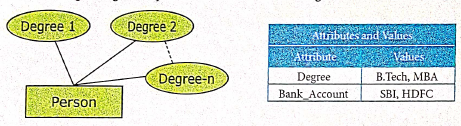
13.
The database technology came into existence in terms of models with relational and object- relational behavior. The major database models are listed below:
1. Hierarchical Database Model:
(i). The famous Hierarchical database model was IMS (Information Management System), IBM's first DBMS.
(ii). In this model each record has information in parent/child relationship like a tree structure.
(iii). The collection of records was called as record types. This individual records are equal to rows.
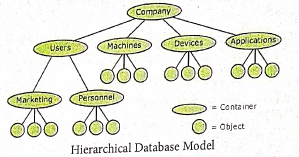
Advantages: Less redundant data, efficient search, data-integrity and security.
Limitations: Complex to implement and difficulty in handling many to many relationship.
2. Network model:
(i). The first developed network data model was IDS (Integrated Data Store) at Honeywell.
(ii). Network model is similar to Hierarchical model except that in this model each member can have more than one owner.
(iii). The Many to Many relationships are handled in a better way.
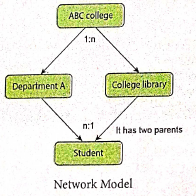
(iv). This model identified by the three database components Network schema, Sub schema and Language for data management.
Network schema: schema defines all about the structure of the data base.
Sub schema: controls on views of the database for the user.
Language: basic procedural for accessing the database.
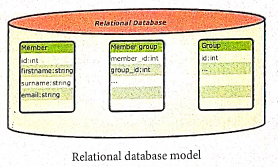
3. Relational model:
Oracle and DB2 are few commercial relational models in use Relational model is defined with two terminologies: Instance and Schema.
Instance: A table consisting of rows and columns.
Schema: Specifies the structure including name and type of each column.
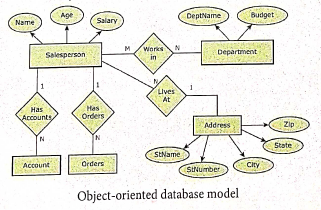
4. Object oriented database model:
(i). This model incorporates the combination of Object Oriented Programming (OOP's) concepts and database technologies.
(ii). Practically, this model serves as the base of Relational model. Object oriented model uses small, reusable software known as Objects.
(iii). These are stored in object oriented database.

12th Standard Syllabus & Materials
12th Standard
TN 12th Computer Applications வலையமைப்பு வடமிடல் Sample Question Papers Study Material - QB365 Set A
NEW12th Standard
TN 12th Computer Applications களப்பெயர் முறைமை (DNS) Sample Question Papers Study Material - QB365 Set A
NEW12th Standard
TN 12th Computer Applications வலையமைப்பு எடுத்துக்காட்டுகள் மற்றும் நெறிமுறைகள் Sample Question Papers Study Material - QB365 Set A
NEW12th Standard
TN 12th Computer Applications கணினி வலையமைப்பு ஓர் அறிமுகம் Sample Question Papers Study Material - QB365 Set A



Tamilnadu Stateboard 12th Standard Subjects

Maths

Chemistry

Physics

Biology

Computer Science

Business Maths and Statistics

Economics

Commerce

Accountancy

History
Computer Applications
Biology
Computer Technology
Computer Applications
Computer Science
Business Maths and Statistics
Commerce
Economics
Maths
Chemistry
Physics
Computer Technology
History
Accountancy

Tamil

English

French
Tamilnadu Stateboard Standards
