
 100% FREE ACCESS
12th Standard Syllabus & Materials
12th Standard
TN 12th Computer Applications மின்னணு தரவு பரிமாற்றம் Sample Question Papers Study Material - QB365 Set A
NEW12th Standard
TN 12th Computer Applications மின் - வணிக பாதுகாப்பு அமைப்புகள் Sample Question Papers Study Material - QB365 Set A
NEW12th Standard
TN 12th Computer Applications மின்னணு செலுத்தல் முறைகள் Sample Question Papers Study Material - QB365 Set A
NEW12th Standard
TN 12th Computer Applications மின் - வணிகம் Sample Question Papers Study Material - QB365 Set A
NEW12th Standard
TN 12th Computer Applications திறந்த மூல கருத்துருக்கள் Sample Question Papers Study Material - QB365 Set A
NEW12th Standard
TN 12th Computer Applications வலையமைப்பு வடமிடல் Sample Question Papers Study Material - QB365 Set A

Published on: 19/10/2019
Database Concepts
Download Tamil Nadu 12th Standard Computer Science question papers, model tests, one-mark questions, important questions, and public exam papers in PDF format. Free study materials and answer keys for TN State Board students.
Questions + Answers key
Take MCQ Computer Science Test
1.
Which of the following is an organized collection of data?
Word Processor
Spreadsheet
Programming language
Database
2.
3.
A tuple is also known as
table
row
attribute
field
4.
Which of the following is an RDBMS?
Dbase
Foxpro
Microsoft Access
SQLite
5.
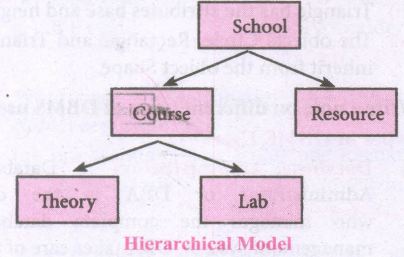
What type of relationship does hierarchical model represents?
one-to-one
one-to-many
many-to-one
many-to-many
6.
What is the acronym of DBMS?
DataBase Management Symbol
Database Managing System
DataBase Management System
DataBasic Management System
7.
What is E F Codd rules?
8.
What is database?
9.
What is normalization?
10.
What is data consistency?
11.
List some examples of RDBMS.
12.
Mention few examples of a database.
13.
List the types of DBMS users.
14.
List the components of DBMS
15.
Write a note on different types of DBMS users.
16.
Explain Object Model with example.
17.
What is the role of DBA?
18.
What is the difference between Select and Project command?
19.
Differentiate DBMS and RDBMS.
20.
21.
Choose the incorrect statement from the following
(i) End users are the one who manage the license keys.
(ii) DBA are the one who stores, retrieve, update and delete data.
(iii) Choosing appropriate structures to represent data and store the data in the database is done by database designers.
(iv) Application programmers are involved in developing and designing the parts of DBMS
(a) i and ii
(b) iii and iv
(c) i and iii
(d) ii and iv
22.
Choose the incorrect statement from the following
(a) IBM developed Hierarchical data model
(b) EF Codd proposed the Relational database model
(c) Network model represents the data in many to one relationships
(d) Chen developed the ER model
1.
(d)
Database
2.
(a)
3.
(b)
row
4.
(d)
SQLite
5.
(b)
one-to-many
6.
(c)
DataBase Management System
7.
Database normalization was first proposed by Dr. Edgar F Codd as an integral part of RDBMS in order to reduce data redundancy and improve data integrity. These rules are known as E F Codd Rules.
8.
(i) Database is a repository collection of related data organized in a way that data can be easily accessed, managed and updated.
(ii) Database can be a soft ware or hardware based, with one sole purpose of storing data.
9.
Database normalization was first proposed by Dr.Edgar F Codd as an integral part of RDBMS in order to reduce data redundancy and improve data integrity. These rules are known as E FCodd Rules.
10.
Data Consistency means that data values are the same at all instances of a database.
11.
(i) SQL server
(ii) Oracle
(iii) MySql
(iv) Maria DB
(v) SQLite.
12.
(i) Foxpro
(ii) dbase
13.
(i) Database Administrators(DBA)
(ii) Application or software developers
(iii) End User
(iv) Database designers
14.
The Database Management System can be divided into five major components as follows:
(i) Hardware
(ii) Software
(iii) Data
(iv) Procedures / Methods
(v) Database Access Languages
15.
Database Administrators:
Database Administrator or DBA is the one who manages the complete database management system. DBA takes care of the security of the DBMS, managing the license keys, managing user accounts and access etc.
Application Programmers or software Developers:
This user group is involved in developing and designing the parts of DBMS.
End User:
All modern applications, web or mobile, store user data. Applications are programmed in such a way that they collect user data and store the data on DBMS systems running on their server. End users are the one who store, retrieve, update and delete data.
Database designers:
Database designers are responsible for identifying the data to be stored in the database for choosing appropriate structures to represent and store the data.
16.
Object model stores the data in the form of objects, attributes and methods, classes and inheritance. This model handles more complex applications, such as Geographic information System (GIS),sdentific experiments, engineering design and manufacturing. It is used in file Management System. It represents real world objects, attributes and behaviors. It provides a clear modular structure. It is easy to maintain and modify the existing code.
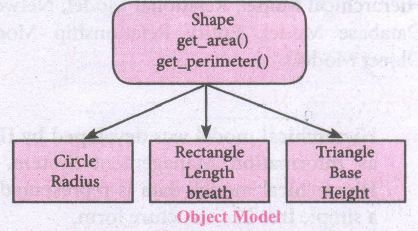
An example of the Object model is Shape, Circle, Rectangle and Triangle are all objects in this model
(i) Circle has the attribute radius.
(ii) Rectangle has the attributes length and breadth.
(iii) Triangle has the attributes base and height.
(iv) The objects Circle, Rectangle and. Triangle inherit from the object Shape
17.
Database Administrator or DBA is the one who manages the complete database management system. DBA takes care of the security of the DBMS, managing the license keys, managing user accounts and access etc.
18.
| Select | Project |
|---|---|
| 1. Symbol - σ | 1. Symbol - π |
| 2. Selecting a subset with tuples | 2. Contains a vertical subset of relation. |
| 3. Select filters out all tuples that don't satisfy the condition. |
3. Projection eliminates all attributes of the input relation except in the projection list. |
19.
| Basis of Comparison | DBMS | RDBMS |
|---|---|---|
| Expansion | Database Management System | Relational Database Management System |
| Data storage | Navigational model ie data by linked records | Relational model (in tables). ie data in tables as row and column |
| Data redundancy | Exhibit | Not Present |
| Normalization | Not performed | RDBMS uses normalization to reduce redundancy |
| Data access | Consumes more time | Faster, compared to DBMS. |
| Keys and indexes | Does not use. | used to establish relationship. Keys are used in RDBMS. |
| Transaction management | Inefficient, Error prone and insecure | Efficient and secure |
| Distributed Databases | Not supported | Supported by RDBMS. |
| Example | Dbase, FoxPro. | SQL server, Oracle, mysql, MariaDB, SQLite. |
20.
.JPG)
.JPG)
.JPG)
.JPG)
21.
(a) i and ii
22.
(c) Network model represents the data in many to one relationships

12th Standard Syllabus & Materials
12th Standard
TN 12th Computer Applications களப்பெயர் முறைமை (DNS) Sample Question Papers Study Material - QB365 Set A
NEW12th Standard
TN 12th Computer Applications வலையமைப்பு எடுத்துக்காட்டுகள் மற்றும் நெறிமுறைகள் Sample Question Papers Study Material - QB365 Set A
NEW12th Standard
TN 12th Computer Applications கணினி வலையமைப்பு ஓர் அறிமுகம் Sample Question Papers Study Material - QB365 Set A
NEW12th Standard
TN 12th Computer Applications PHP-உடன் MySQL-ஐ இணைத்தல் Sample Question Papers Study Material - QB365 Set A



Tamilnadu Stateboard 12th Standard Subjects

Maths

Chemistry

Physics

Biology
Computer Science

Business Maths and Statistics

Economics

Commerce

Accountancy

History

Computer Applications
Biology
Computer Technology
Computer Applications
Computer Science
Business Maths and Statistics
Commerce
Economics
Maths
Chemistry
Physics
Computer Technology
History
Accountancy

Tamil

English

French
Tamilnadu Stateboard Standards
