
 100% FREE ACCESS
12th Standard Syllabus & Materials
12th Standard
TN 12th Computer Applications மின்னணு தரவு பரிமாற்றம் Sample Question Papers Study Material - QB365 Set A
NEW12th Standard
TN 12th Computer Applications மின் - வணிக பாதுகாப்பு அமைப்புகள் Sample Question Papers Study Material - QB365 Set A
NEW12th Standard
TN 12th Computer Applications மின்னணு செலுத்தல் முறைகள் Sample Question Papers Study Material - QB365 Set A
NEW12th Standard
TN 12th Computer Applications மின் - வணிகம் Sample Question Papers Study Material - QB365 Set A
NEW12th Standard
TN 12th Computer Applications திறந்த மூல கருத்துருக்கள் Sample Question Papers Study Material - QB365 Set A
NEW12th Standard
TN 12th Computer Applications வலையமைப்பு வடமிடல் Sample Question Papers Study Material - QB365 Set A

Published on: 03/02/2021
12th Standard Computer Science English Medium Algorithmic Strategies Reduced Syllabus Important Questions 2021
Download Tamil Nadu 12th Standard Computer Science question papers, model tests, one-mark questions, important questions, and public exam papers in PDF format. Free study materials and answer keys for TN State Board students.
Questions + Answers key
Take MCQ Computer Science Test
1.
Linear search is also called
Sequential search
Quick search
Binary search
Selection search
2.
How many asymptotic notations are mostly used to represent time complexity of algorithms?
Three
Two
One
Many
3.
Which characteristics of algorithm defined the operation involving division by zero?
Finiteness
Definiteness
Input
Correctness
4.
The way of defining an algorithm is called
Pseudo strategy
Programmic strategy
Algorithmic strategy
Data structured strategy
5.
Which of the following is not a searching technique?
(i) Linear
(ii) Binary
(iii) Selection
(iv) Merge
Only i
Only ii
Only iii
iii and iv
6.
Which of the following is an example of data structures?
List
Tuple
Dictionary
All of these.
7.
Which of the following is not an example of data structures?
Control statement
Structure
List
Dictionary
8.
Which of the following is not a characteristic of an algorithm?
Definiteness
Correctness
Data structure
Effectivenes
9.
Which of the following are the characteristics of an algorithm?
(i) Definiteness
(ii) Correctness
(iii) Effectiveness
i, ii
ii, iii
Only ii
i, ii and iii
10.
Which of the following is a finite set of instructions to accomplish a particular task?
Flowchart
Functions
Algorithm
Abstraction
11.
If a problem can be broken into subproblems which are reused several times, the problem possesses which property?
Overlapping subproblems
Optimal substructure
Memoization
Greedy
12.
The Θ notation in asymptotic evaluation represents
Base case
Average case
Worst case
NULL case
13.
Time complexity of bubble sort in best case is
θ (n)
θ (nlogn)
θ (n2)
θ (n(logn) 2)
14.
From the following sorting algorithms which algorithm needs the minimum number of swaps?
Bubble sort
Insertion sort
Selection sort
All the above
15.
The word comes from the name of a Persian mathematician Abu Ja’far Mohammed ibn-i Musa al Khowarizmi is called?
Flowchart
Flow
Algorithm
Syntax
16.
Write a note on Big omega asymptotic notation.
17.
What are the three asymptotic notations used to represent time complexity of algorithms?
18.
Define algorithmetic strategy?
19.
Name the two factors, which decide the efficiency of an algorithm.
20.
How the analysis of algorithms and performance evaluation can be divided?Explain.
21.
What does analysis of an algorithm deals with?
22.
How the efficiency of an algorithm is defined?
23.
Give an example of data structures
24.
What is searching? Write its types.
25.
26.
Write a pseudo code that defines Fibonacci Iterative algorithm with Dynamic programming approach.
27.
Write a pseudo code for selection sort Algorithm.
28.
Write a pseudo code for bubble sort algorithm
29.
Write a pseudo code for Binary search
30.
Write a pseudo code for linear search
31.
Write a note on time/space trade off
32.
List the manipulation manipulated effectively through data structures by algorithm.
33.
Write a note on Asymptotic notation.
34.
What are the factors that influence time and space complexity.
35.
List the characteristics of an algorithm.
36.
Explain the sorting algorithm that uses n-1 number passes to get the final sorted list.
37.
Explain the selection sort Algorithm with an example.
38.
Define efficiency of an algorithm? How the efficiency of an algorithm was determined?
39.
Explain complexity of an algorithm.
40.
Explain the concept of Dynamic programming with suitable example.
41.
Discuss about Linear search algorithm.
42.
Explain the characteristics of an algorithm.
1.
(a)
Sequential search
2.
(a)
Three
3.
(b)
Definiteness
4.
(c)
Algorithmic strategy
5.
(d)
iii and iv
6.
(d)
All of these.
7.
(a)
Control statement
8.
(c)
Data structure
9.
(d)
i, ii and iii
10.
(c)
Algorithm
11.
(a)
Overlapping subproblems
12.
(b)
Average case
13.
(a)
θ (n)
14.
(c)
Selection sort
15.
(c)
Algorithm
16.
Big Omega is the reverse Big O, if Big O is used to describe the upper bound (worst - case) of a asymptotic function, Big Omega is used to describe the lower bound (best-case).
17.
(i) BigO
(ii) BigW
(Iii) Big \(\mu \)
18.
A way of designing algorithm is called algorithmic strategy
19.
(i) Time factor
(ii) Space factor
20.
Analysis of algorithms and performance evaluation can be divided into two different phases:
(i) A Priori estimates: This is a theoretical performance analysis of an algorithm. Efficiency of an algorithm is measured by assuming the external factors.
(ii) A Posterori testing: This is called performance measurement. In this analysis, actual statistics like running time and required for the algorithm executions are collected.
21.
(i) Analysis of an algorithm usually deals with the running and execution time of various operations involved.
(ii) The running time of an operation is calculated as how many programming instructions is executed per operation
22.
Efficiency of an algorithm is defined by the utilization of time and space complexity
23.
Examples for data structures are arrays, structures, list, tuples, dictionary.
24.
A searching algorithm is the step-by step procedure used to locate specific data among a collection of data. There are two types of searching are.
(i) Linear Search
(ii) Binary Search
25.
26.
The following shows a simple Dynamic programming approach for the generation of Fibonacci series.
Initialize f0 = 0,f1 =1
Step 1 - Print the initial values of Fibonacci f0 and f1
Step 2 - Calculate fibanocci fib \(\leftarrow \) f0+ f1
Step 3 - Assign f0\(\leftarrow \) fl , f1\(\leftarrow \) fib
Step 4 - Print the next consecutive value of fibanocci fib
step 5 - Goto step-2 and repeat until the specified number of terms generated
For example if we generate fibobnacci series upto 10 digits, the algorithm will generate the series as shown below:
The Fibonacci series is : 0 1 1 2 3 5 8 13 21 34 55
27.
(i) Start from the first element i.e., index-0, we search the smallest element in the array, and replace it with the element in the first position.
(ii) Now we move on to the second element position, and look for smallest element present in the sub-array, from starting index to till the last index of sub - array.
(iii) Now replace the second smallest identified in step-2 at the second position in the or original array, or also called first position in the sub array.
(iv) This is repeated, until the array is completely sorted.
28.
(i) Start with the first element i.e., index = 0, compare the current element with the next element of the array.
(ii) If the current element is greater than the next element of the array, swap them.
(iii) If the current element is less than the next or right side of the element, move to the next element. Go to Step 1 and repeat until end of the index is reached.
29.
Start with the middle element:
(I) If the search element is equal to the middle element of the array i.e., the middle value = number of elements in array/2, then return the index of the middle element.
(ii) If not, then compare the middle element with the search value,
(iii) If the search element is greater than the number in the middle index, then select the elements to the right side of the middle index, and go to Step-1
(iv) If the search element is less than the number in the middle index, then select the elements to the left side of the middle index, and start with Step-1 ( When a match is found, display success message with the index of the element matched.
(vi) If no match is found for all comparisons, then display unsuccessful message
30.
(i) Traverse the array using 'for loop'
(ii) In every iteration, compare the target search key value with the current value of the list.
(iii) If the values match, display the current index and value of the array
(iv) If the values do not match, move on to the next array element
(v) If no match is found, display the search element not found.
31.
(i) A space-time or time-memory trade off is a way of solving in less time by using more storage space or by solving a given algorithm in very little space by spending more time.
(ii) To solve a given programming problem, many different algorithms may be used. Some of these algorithms may be extremely time-efficient and others extremely spaceefficient.
(iii) Time/space trade off refers to a situation where you can reduce the use of memory at the cost of slower program execution, or reduce the running time at the cost of increased memory usage.
32.
| Search | To search an item in a data structure using linear and binary search. |
|---|---|
| Sort | To sort items in a certain order using the methods such as bubble sort, insertion sort, selection sort, etc. |
| Insert | To insert an item (s) in a data structure. |
| Update | To update an existing item (s) in a data structure. |
| Delete | To delete an existing item (s) in a data structure. |
33.
Asymptotic Notations are languages that uses meaningful statements about time and space complexity. The following three asymptotic notations are mostly used to represent time complexity of algorithms:
(i) Big O: Big O is often used to describe the worst -case of an algorithm.
(ii) Big \(\Omega \):Big Omega is the reverse Big O, if Big O is used to describe the upper bound (worst - case) of a asymptotic function, Big Omega is used to describe the lower bound (best -case).
(iii) Big \(\Theta \):When an algorithm has complexity with lower bound = upper bound, Say that an algorithm has a complexity O(n log n) and \(\Omega \) (n log n), it's actually has the complexity \(\Theta \) (n log n), which means the running time of that algorithm always falls in n log n in the best-case and worst-case.
34.
(i) Time Factor -Time is measured by counting the number of key operations like comparisons in the sorting algorithm.
(ii) Space Factor -Space is measured by the maximum memory space required by the algorithm.
35.
(i) Input
(ii) Output
(iii) Finiteness
(iv) Definiteness
(v) Effectiveness
(vi) Correctness
(vii) Simplicity
(viii) Unambiguous
(ix) Feasibility
(x) Portable
(xi) Independent
36.
(i) Insertion sort is a simple sorting algorithm. It works by taking elements from the list one by one and inserting then in their correct position in to a new sorted list.
(ii) This algorithm builds the final sorted array at the end. This algorithm uses n-1 number of passes to get the final sorted list as per the pervious algorithm as we have discussed.
Pseudo for Insertion sort:
Step 1 - If it is the first element, it is already sorted.
Step 2 - Pick next element
Step 3 - Compare with all elements in the sorted sub-list
Step 4 - Shift all the elements in the sorted sublist that is greater than the value to be sorted Step 5 - Insert the value Step 6 - Repeat until list is sorted.
37.
(i) The selection sort is a simple sorting algorithm that improves on the performance of bubble sort by making only one exchange for every pass through the list.
(ii) This algorithm will first find the smallest elements in array and swap it with the element in the first position of an array, then it will find the second smallest element and swap that element with the element in the second position, and it will continue until the entire array is sorted in respective order.
(iii) This algorithm repeatedly selects the next smallest element and swaps in into the right place for every pass. Hence it is called selection sort.
Pseudo code:
(i) Start from the first element i.e., index-(), we search the smallest element in the array, and replace it with the element in the first position.
(ii) Now we move on to the second element position, and look for smallest element present in the sub-array, from starting index to till the last index of sub - array.
(iii) Now replace the second smallest identified in step-2 at the second position in the or original array, or also called first position in the sub array.
(iv) This is repeated, until the array is completely sorted.
(v) Let's consider an array with values {13, 16, 11, 18, 14, 15}
(vi) Below, we have a pictorial representation of how selection sort will sort the given array respective order.
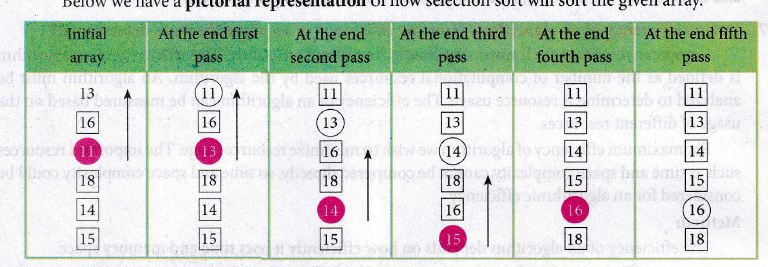
(i) In the first pass, the smallest element will be 11, so it will be placed at the first position.
(ii) After that, next smallest element will be searched from an array.
(iii) Then leaving the first element, next smallest element will be searched. It get 13 as smallest, so it will be placed at the second position.
(iv) Then leaving 11 and 13. It will search for the next smallest element and put it at third position and keep doing this until array is sorted.
(v) Finally, it will get the sorted array end of the pass.
38.
(i) Computer resources are limited that should be utilized efficiently. The efficiency of an algorithm is defined as the number of computational resources used by the algorithm.
(ii) An algorithm must be analyzed to determine its resource usage. The efficiency of an algorithm can be measured based on the usage of different resources.
(iii) For maximum efficiency of algorithm we wish to minimize resource usage. The important resources such as time and space complexity cannot be compared directly, so time and space complexity could be considered for an algorithmic efficiency.
Method for determining Efficiency:
(i) The efficiency of an algorithm depends on how efficiently it uses time and memory space.
(ii) The time efficiency of an algorithm is measured by different factors. For example, write a program for a defined algorithm, execute it by using any programming language, and measure the total time it takes to run.
(iii) The execution time that you measure in this case would depend on a number of factors such as: -
1. Speed of the machine
2. Compiler and other system Software tools
3. Operating System
4. Programming language used
5. Volume of data required
(iv) However, to determine: how efficiently an algorithm solves a given problem, you would like to determine how the execution time is affected by the nature of the algorithm.
(v) Therefore, we need to develop fundamental laws that determine the efficiency of a program in terms of the nature of the underlying algorithm.
39.
Suppose A is an algorithm and n is the size of input data, the time and space used by the algorithm A are the two main factors, which decide the efficiency of A.
(i) Time Factor: Time is measured by counting the number of key operations like comparisons in the sorting algorithm.
(ii) Space Factor: Space is measured by the maximum memory space required by the algorithm. The complexity of an algorithm f (n) gives the running time and/or the storage space required by the algorithm in terms of n as the size of input data.
(iii) Time Complexity: The Time complexity of an algorithm is given by the number of steps taken by the algorithm to complete the process.
(iv) Space Complexity: Space complexity of an algorithm is the amount of memory required to run to its completion. The space required by an algorithm is equal to the sum of the following two components:
A fixed part is defined as the total space required to store certain data and variables for an algorithm. For example, simple variables and constants used in an algorithm.
A variable part is defined as the total space required by variables, which sizes depends on the problem and its iteration. For example: recursion used to calculate factorial of a given value n.
40.
(i) Dynamic programming is an algorithmic design method that can be used when the solution to a problem can be viewed as the result of a sequence of decisions.
(ii) Dynamic programming approach is similar to divide and conquer. The given problem is divided into smaller and yet smaller possible sub-problems.
(iii) Dynamic programming is used whenever problems can be divided into similar subproblems. so that their results can be reused to complete the process.
(iv) Dynamic programming approaches are used to find the solution in optimized way. For every inner subproblem, dynamic algorithm will try to check the results of the previously solved sub-problems.
(v) The solutions of overlapped sub-problems are combined in order to get a better solution.
Steps to doDynamic programming :
(i) The given problem will be divided into smaller overlapping sub-problems.
(ii) An optimum solution for the given problem can be achieved by using result of smaller sub-problem.
(iii) Dynamic algorithms uses Memoization
Fibonacci Series - An example :
(i) Fibonacci series generates the subsequent number by adding two previous numbers. Fibonacci series starts from two numbers -Fib 0 & Fib 1. The initial values of Fib 0 & Fib l can be taken as 0 and 1.
(ii) Fibonacci series satisfies the following conditions:
Fibn = Fiba-1 + Fiba-2
(iii) Hence, a Fibonacci series for the n value 8 can look like this
Fib8 = 0 1 1 2 3 5 8 13
Fibonaeci Iterative Algorithm with Dynamic programning approach : The following example shows a simple Dynamic programning approach for the generation ot Fibonacci series.
Initialize f0 = 0, f1 = 1.
Step- 1: Print the initial values of Fibonacci f0 and f1
Step- 2: Calculate Fibonacci fib \(\leftarrow \) f0+ f1
Step- 3: Assign f0 \(\leftarrow \) f1, f1 \(\leftarrow \) fib
Step- 4: Print the next consecutive value of Fibonacci fib
Step- 5: Go to step-2 and repeat until the specified number of terms generated
Example:
if we generate Fibonacci series up to 10 digits, the algorithm will generate the series as shown below:
The Fibonacci series is:
0 1 1 2 3 5 8 13 21 34 55.
41.
(i) Linear search also called sequential search is a sequential method for finding a particular value in a list.
(ii) This method checks the search element with each element in sequence until the desired element is found or the list is exhausted. In this searching algorithm, list need not be ordered.
procedure :
1. Traverse the array using for loop
2. In every iteration, compare the target search key value with the current value of the list.
(i) If the values do not match, move on to the next array element.
(ii) If the values match, display the current index and value of the array.
3. If no match is found, display the search element not found.
(iii) To search the number 25 in the array given below, a linear search will go step by step in a sequential order starting from the first element in the given array if the search element is found that index is returned otherwise the search is continued till the last index of the array. In this example number 25 is found at index number 3.
| index | 0 | 1 | 2 | 3 | 4 |
| values | 10 | 12 | 20 | 25 | 30 |
Example 1:
Input: values[] = {5, 34, 65, 12, 77, 35)
target = 77
Output: 4
Example 2:
Input: values[] = [101, 392, 1, 54, 32, 22, 90, 93) target = 200
Output: -1 (not found)
42.
| Input | Zero or more quantities to be supplied. |
| Output | At least one quantityis produced. |
| Finiteness | Algorithms must terminate after finite number of steps. |
| Definiteness | All operations should be well defined. For example operations involving division by zero or taking square root for negative number are unacceptable. |
| Effectiveness | Every instruction must be carried out effectively. |
| Correctness | The algorithms should be error free. |
| Simplicity | East to implement. |
| Unambiguous | Algorithm should be clear and unambiguous. Each of its steps and their inputs/outputs should be clear and must lead to only one meaning. |
| Feasibility | Should be feasible with the avaliable resources. |
| Portable | An algorithm should be generic, independent of any programming language or an operating system able to handle all range of inputs. |
| Independent | An algorithm should have step-by-step directions, which should be independent of any programming code. |

12th Standard Syllabus & Materials
12th Standard
TN 12th Computer Applications களப்பெயர் முறைமை (DNS) Sample Question Papers Study Material - QB365 Set A
NEW12th Standard
TN 12th Computer Applications வலையமைப்பு எடுத்துக்காட்டுகள் மற்றும் நெறிமுறைகள் Sample Question Papers Study Material - QB365 Set A
NEW12th Standard
TN 12th Computer Applications கணினி வலையமைப்பு ஓர் அறிமுகம் Sample Question Papers Study Material - QB365 Set A
NEW12th Standard
TN 12th Computer Applications PHP-உடன் MySQL-ஐ இணைத்தல் Sample Question Papers Study Material - QB365 Set A



Tamilnadu Stateboard 12th Standard Subjects

Maths

Chemistry

Physics

Biology
Computer Science

Business Maths and Statistics

Economics

Commerce

Accountancy

History

Computer Applications
Biology
Computer Technology
Computer Applications
Computer Science
Business Maths and Statistics
Commerce
Economics
Maths
Chemistry
Physics
Computer Technology
History
Accountancy

Tamil

English

French
Tamilnadu Stateboard Standards
