
 100% FREE ACCESS
12th Standard Syllabus & Materials
12th Standard
TN 12th Computer Applications மின்னணு தரவு பரிமாற்றம் Sample Question Papers Study Material - QB365 Set A
NEW12th Standard
TN 12th Computer Applications மின் - வணிக பாதுகாப்பு அமைப்புகள் Sample Question Papers Study Material - QB365 Set A
NEW12th Standard
TN 12th Computer Applications மின்னணு செலுத்தல் முறைகள் Sample Question Papers Study Material - QB365 Set A
NEW12th Standard
TN 12th Computer Applications மின் - வணிகம் Sample Question Papers Study Material - QB365 Set A
NEW12th Standard
TN 12th Computer Applications திறந்த மூல கருத்துருக்கள் Sample Question Papers Study Material - QB365 Set A
NEW12th Standard
TN 12th Computer Applications வலையமைப்பு வடமிடல் Sample Question Papers Study Material - QB365 Set A

Published on: 09/03/2020
12th Standard Computer Science English Medium All Chapter Book Back and Creative Three Mark Question 2020
Download Tamil Nadu 12th Standard Computer Science question papers, model tests, one-mark questions, important questions, and public exam papers in PDF format. Free study materials and answer keys for TN State Board students.
Questions + Answers key
Take MCQ Computer Science Test
1.
Which constraint helps to set a limit value placed for a field?
2.
Write the syntax for the following commands.
(i) INSERT
(ii) DELETE
(iii) UPDATE
3.
Write the output for the following statement.
(i) print ("PYTHON" . lower ())
(ii) print ("PYTHON" . islower ())
(iii) print ("PYTHON" . isupper ())
(iv) print ("PYTHON" . upper ())
4.
Write the usage of the following format string characters.
(i) % c
(ii) % d (or) % i
(iii) % s
5.
List the types of DBMS users.
6.
Explain the data model that represent parent child relationship.
7.
Read the following code. What does the following represents.
(i) Labels
(ii) Usage
(iii) X ticks
(iv) Range
(v) Show
8.
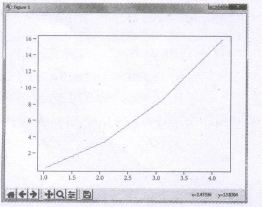
Write a python code to display the following plot.
9.
Write a note on SELECT statement in SQL.
10.
Write the sqlite steps to connect the database.
11.
Write a note of return statement.
12.
When do you call the function to perform a specify task?
13.
How to import modules in python?
14.
Write a note on
(i) sys module
(ii) OS module
(iii) getopt module
15.
Fill up the blanks in the following program to get the output:
Value of x = 10
Value of y = 20
Sum of x and y= 30
Class sample:
x, __ = 10, 20 -------------------1
s = -------------------------2
print ("value of x =", __ ) ------------3
print ("value of y =", __ ) -------------4
print ("sum of x and y =", __ ) --------5
16.
What will be output of the following program?
17.
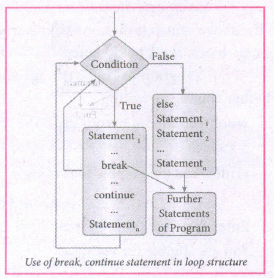
Draw the flowchart that illustrates the use of break and continue statement in loop structure.
18.
Write a note on object.
19.
Write a program to read a file with default delimiter comma.
20.
How will you create CSV normal file?
21.
Fill up the blanks in the following.
(i) Diet = {'Roll No' : 12001, 'SName': 'Meena', 'Mark1': 98, 'Marl2' : 86}
print("Dietionary elements before deletion: \n", Diet)
del Diet['Mark1] # __________
(ii) print("Dietionary elements after deletion of a element: \n", Diet)
Dict.clear()# ___________
(iii) print("Dietionary after deletion of all elements: \n", Diet) del Diet
print(Diet) # ____________
22.
Differentiate list and tuple.
23.
Write a pseudo code that defines Fibonacci Iterative algorithm with Dynamic programming approach.
24.
Write a pseudo code for bubble sort algorithm
25.
What are the rules followed while defining python identifier?
26.
Write a Python program to get the following output.
Output:
Enter Number 1: 50
Enter Number 2: 50
The sum of 50 and 50 is 100
27.
How will you ensure the principle of data encapsulation in object - oriented programming?
28.
Write a note on module.
29.
Write a note on Data Abstraction.
30.
Identify the constructor and selector from the following.
(I) City = Make city (name, lat, Ion)
(ii) Get name (city)
(ill) Make point (x,y)
(iv) x coord (point)
(v) y coord (point)
31.
Write an algorithm to check whether the entered number is even or odd.
32.
Explain the syntax of function definitions.
33.
Write any three uses of data visualization.
34.
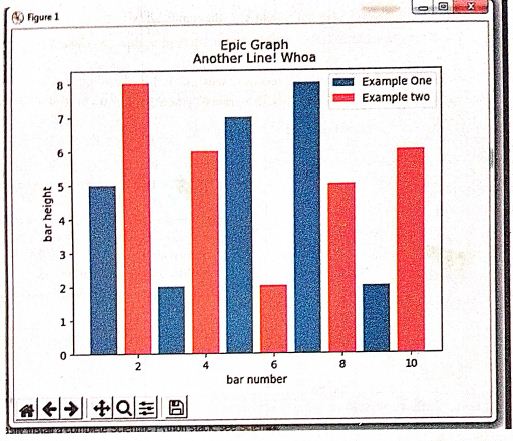
Draw the output for the following data visualization plot.
import matplotlib.pyplot as plt
plt.bar([1,3,5,7,9],[5,2,7,8,2], label="Example one")
plt.bar([2,4,6,8,10],[8,6,2,5,6], label="Example two", color='g')
plt.legend()
plt.xlabel('bar number')
plt.ylabel('bar height')
plt.title('Epic Graph in Another Line! Whoa')
plt.show()
35.
Read the following details.Based on that write a python script to display records in desending order of
Eno
database name :- organization.db
Table name :- Employee
Columns in the table :- Eno, EmpName, Esal, Dept
36.
What is the use of Where Clause.Give a python statement Using the where clause.
37.
What is sys.argv? What does it contain?
38.
What is MinGW? What is its use?
39.
What is the difference between reader() and DictReader() function?
40.
Write a Python program to read a CSV file with default delimiter comma (,).
41.
Write a SQL statement using DISTINCT keyword.
42.
Write any three DDL commands.
43.
44.
What is the role of DBA?
45.
What is the output of the following program?
class Greeting:
def __init__(self, name):
self.__name = name
def display(self):
print("Good Morning ", self.__name)
obj=Greeting ('Bindu Madhavan')
obj.display()
46.
Write a class with two private class variables and print the sum using a method.
47.
Write a shot note about sort( ).
48.
What are the difference between list and Tuples?
49.
Write a note about count( ) function in python.
50.
Write a Python program to display the given pattern
C O M P U T E R
C O M P U T E
C O M P U T
C O M P U
C O M P
C O M
C O
C
51.
How recursive function works?
52.
What is composition in functions?
53.
Write the syntax of while loop.
54.
Write note on if..else structure.
55.
What are the factors that influence time and space complexity.
56.
Discuss about Algorithmic complexity and its types.
57.
Write short notes on Escape sequences with examples.
58.
Write short notes on Arithmetic operator with examples.
59.
Why access control is required?
60.
61.
What are the different ways to access the elements of a list. Give example.
62.
Which strategy is used for program designing? Define that Strategy.
63.
Differentiate pure and impure function.
64.
What is the side effect of impure function. Give example.
1.
Check Constraint: This constraint helps to set a limit value placed for a field. When we define a check constraint on a single column, it allows only the restricted values on that field. Example showing check constraint in the student table:
CREATE TABLE Student
(
Admno integer NOT NULL PRIMARY KEY
Name char(20) NOT NULL,
Gender char(1),
Age integer (CHECK<=19), ⟶ Check Constraint
Place char(10),
);
In the above example the check constraint is set to Age field where the value of Age must be less than or equal to 19.
2.
(i) INSERT:
INSERT INTO <table-name>
[column-list] VALUES (values);
(ii) DELETE:
DELETE FROM table-name WHERE condition;
(iii) UPDATE:
UPDATE <table-name > SET column-name = value, column-name = value, ... WHERE condition;
3.
(i) python
(ii) false
(iii) false
(iv) PYTHON
4.
(i) character
(ii) Signed decimal integer
(iii) String
5.
(i) Database Administrators(DBA)
(ii) Application or software developers
(iii) End User
(iv) Database designers
6.
(i) Hierarchical model was developed by IBM as Information Management System.
(ii) In Hierarchical model, data is represented as a simple tree like structure form. This model represents a one-to-many relationship ie parent-child relationship.
(iii) One child can have only one parent but one parent can have many children. This model is mainly used in IBM Main Frame computers.
7.
(i) Labels ⇾ Specifies labels for the bars.
(ii) Usgae ⇾ Assign values to the labels specified.
(iii) Xticks ⇾ Display the tick marks along the x-axis at the values represented. Then specify the label for each tick mark.
(iv) Range ⇾ Create sequence of numbers.
(v) Show ⇾ Displays the plot
8.
Program:
For example, to plot x versus y, you can issue the command:
import matplotlib. pyplot as plt
pIt.plot([1,2,3,4], [1,4,9,16])
plt.show ( )
Output:
9.
(i) "SELECT" is the most commonly used statement in SQL.
(ii) The SELECT Statement in SQL is used to retrieve or fetch data from a table in a database.
(iii) The syntax for using this statement is "Select * from table_name" and all the table data can be fetched in an object in the form of list of lists. List the classes used in
10.
Step 1: Import sqlite3
Step 2: Create a connection using connect o method and pass the name of the database File
Step 3: Set the cursor object cursor = connection. cursor ( )
11.
The return statement:
(i) The return statement causes your function to exit and returns a value to its caller. The it point of functions in general is to take inputs and return something.
(ii) The return statement is used when a function is ready to return a value to its caller. So, only one return statement is executed at run time even though the function contains multiple return statements.
(iii) Any number of 'return' statements are allowed in a function definition but only one of them is executed at run time.
12.
(i) When you want to perform a particular task that you have defined in a function, you call the name of the function responsible for it.
(ii) If you need to perform that task multiple times throughout your program, you don't need to type all the code for the same task again and again.
(iii) You just call the function dedicated to handling that task, and the call tells Python to run the code inside the function.
13.
(i) We can import the definitions inside a module to another module. We use the import keyword to do this.
(ii) Using the module name we can access the functions defined inside the module. The dot (.) operator is used to access the functions. The syntax for accessing the functions from the module is
<module name>. <function name>
(iii) Example: >>> factorial.fact(5)
14.
(i) sys module provides access to some variables used by the interpreter and to functions that interact with the interpreter
(ii) OS module in Python provides a way of using operating system dependent functionality
(iii) The getopt module of Python helps you to parse (split) command-line options and arguments.
15.
1. - y
2. - sample 0
3. - s.x
4. - s. y
5. - s. x + s. y
16.
for word in "Jump Statement":
if word = = "e":
break
print (word, end=")
else:
print ("End of the loop")
print ("\n End of the program")
Output:
Jump Stat
End of the program
17.
18.
(i) Object is a collection of data and function that act on those data. Class is a template for the object
(ii) According to the concept of Object Oriented Programming, objects are also called as instances of a class or class variable.
(iii) In Python, everything is an object. For example, all integer variables that we use in our program is an object of class into Similarly all string variables are also object of class string.
19.
#importing csv
import csv
#opening the csv file which is in different location with read mode
with open('c:\\pyprg\\ sample1.csv', 'r') as F:
#other way to open the file is f= ('c:\\pyprg\\ sample1.csv', 'r')
reader = csv.reader(F)
# printing each line of the Data row by row
print(row)
F.close ( )
20.
To create a CSV file in Notepad,
(i) First open a new file using
File ⟶New or ctrl +N.
(ii) Then enter the data separating each value with a comma and each row with a new line.
(iii) For example consider the following details
Topic1, Topic2, Topic3
one, two, three
Example1, Example2, Example3
(iv) Save this content in a file with the extension.csv.
21.
(i) # Deleting a particular element
(ii) # Deleting all elements
(iii) # Deleting entire dictionary
22.
(i) In a list, elements are defined within square brackets, whereas in tuples, they may be enclosed by parenthesis.
(ii) The elements of a tuple can be even defined without parenthesis.
(iii) Whether the elements defined within parenthesis or without parenthesis, there is no differente in it's function.
23.
The following shows a simple Dynamic programming approach for the generation of Fibonacci series.
Initialize f0 = 0,f1 =1
Step 1 - Print the initial values of Fibonacci f0 and f1
Step 2 - Calculate fibanocci fib \(\leftarrow \) f0+ f1
Step 3 - Assign f0\(\leftarrow \) fl , f1\(\leftarrow \) fib
Step 4 - Print the next consecutive value of fibanocci fib
step 5 - Goto step-2 and repeat until the specified number of terms generated
For example if we generate fibobnacci series upto 10 digits, the algorithm will generate the series as shown below:
The Fibonacci series is : 0 1 1 2 3 5 8 13 21 34 55
24.
(i) Start with the first element i.e., index = 0, compare the current element with the next element of the array.
(ii) If the current element is greater than the next element of the array, swap them.
(iii) If the current element is less than the next or right side of the element, move to the next element. Go to Step 1 and repeat until end of the index is reached.
25.
(i) An identifier must start with an alphabet (A..Z or a..z) or underscore (_)..
(ii) Identifiers may contain digits (0 .. 9).
(iii) Python identifiers are case sensitive i.e. uppercase and lowercase letters are distinct. (iv) Identifiers must not be a python keyword.
(v) Python does not allow punctuation character such as %,$, @ etc., within identifiers.
26.
x = int(input ("Enter Number 1")
y = int(input("Enter Number 2")
print ("The sum of", x, " and ", y, "is", x+y)
27.
Public members (generally methods declared in a class) are accessible from outside the class. The object of the same class is required to invoke a public method. This arrangement of private instance variables and public methods ensures the principle of data encapsulation.
28.
(i) A module is a part of a program. Programs are composed of one or more independently developed modules. A single module can contain one or several statements closely related each other.
(ii) Modules work perfectly on individual level and can be integrated with other modules. A software program can be divided into modules to ease the job of programming and debugging as well.
(iii) A program can be divided into small functional modules that work together to get the output. The process of subdividing a computer program into separate subprograms is called Modular programming.
(iv) Modular programming enables programmers to divide up the work and debug pieces of the program independently. The examples of modules are procedures, subroutines, and functions.
29.
(i) Data abstraction is supported by defining an abstract data type (ADT) which is a collection of constructors and selectors.
(ii) Constructors create an object, bundling together different pieces of information, while selectors extract individual pieces of information from the object.
30.
(i) Constructor
(ii) Selector
(iii) Constructor
(iv) Selector
(v) Selector
31.
(requires: x>= 0)
let rec even x :=
x=0II odd (x-I)
return 'even'
(requires: x > = 0)
let odd x :=
x< >0 && even (x-I)
return 'odd'
32.
(i) The syntax to define functions is close to the mathematical usage: the definition is introduced by the keyword let, followed by the name of the function and its arguments; then the formula that computes the image of the argument is written after an = sign. If you want to define a recursive function: use "let rec" instead of "let".
(ii) Syntax: The syntax for function definitions:
let rec fn a1 a2 ... an :;= k
(iii) Here the 'fn' is a variable indicating an identifier being used as a function name. The names 'a1' to 'an' are variables indicating the identifiers used as parameters. The keyword 'rec' is required if 'fn' is to be a recursive function; otherwise it may be omitted.
33.
(i) Data Visualization help users to analyze and interpret the data easily.
(ii) It makes complex data understandable and usable.
(iii) Various Charts in Data Visualization helps to show relationship in the data for one or more variables.
34.
35.
Program: Display the records in descending order using python script
import mysqldb
db = mysqldb.connect ("local host", "user", "123", "organization")
cursor = db.cursor()
cursor.execute ("SELECT *FROM Employee ORDER BY Name DESC")
result = cursor.fetchall()
for row in results:
ENO = row[0], EmpName = row[1], EmpDept = row[2]
print ENO, EmpName, EmpDept
db.close()
36.
The WHERE clause is used to extract only those records that fulfill a specified condition. In this example we are going to display the different grades scored by male students from "student table.
import sqlite3
connection = sqlite3.connect ("Academy.db")
cursor = connection.cursor()
cursor.execute ("SELECT DISTINCT (Grade) FROM student where gender = "M")
result = cursor.fetchall()
print(* result, sep ="\n")
Output:
('B,')
('A,')
('C,')
('D,')
37.
sys.argv is the list of command-line arguments passed to the Python program. argv contains all the items that come along via the command-line input, it's basically an array holding the command-line arguments of the program.
To use syss.argv, we will first have to import sys. The first argument, sys.argv [0], is always the name of the program as it was invoked and sys.argv [1] is the first argument we pass to the program.
Example:
main (sys.argv [1]) - Accepts the program file and the input file as a list. argv[0] contains the python program which is need not to be passed because by default _main_contains source code reference and argv[1] contains the name of the C++ file which is to be processed.
38.
(i) MinGW refers to a set of runtime header files, used in compiling and linking the code of C, C++ and FORTRAN to be run on Windows Operating System.
(ii) MinGw- W64 (version of MinGW) is the best compiler for C++ on Windows. To compile and execute the C++ program, need 'g++' for Windows. MinGW allows to compile and execute C++ program dynamically through Python program using g++.
(iii) Python program that contains the c++ coding can be executed only through 'MinGW_w64 project' run terminal. The run terminal open the command -line window through which Python program should be executed.
(iv) g++ is a program that calls GCC (GNU C compiler) and automatically links the required C++ Library files to the object code.
39.
The main difference between the csv.reader( ) and DictReader( ) is in simple terms csv.reader and csv.writer work with list/ tuple, while csv. DictReader and csv.DictWriter work with dictionary. csv. DictReader and csv. DictWriter take additional argument fieldnames that are used as dictionary keys.
40.
Program: To read a csv file with comma (,)
#importing csv
import csv
#opening the csv file which is in different location with read mode
with open('c:\\Pyprg\ \sample1.csv', 'r') as F:
#other way to open the file is
f=('C:\\pyprg\\sample1.csv', 'r')
reader = csv.reader(F))
#printing each line of the Data row by row.
print (row)
F. close( )
Output:
['SNO','NAME', 'CITY']
['12101', 'RAM', 'CHENNAI']
['12102', 'LAVANYA' "TIRUCHY']
['12103', 'LAKSHMAN', 'MADURAI']
41.
(i) The DISTINCT keyword is used along with the SELECT command to eliminate duplicate rows in the table. This helps to eliminate redundant data.
(ii) For Example: SELECT DISTINCT Place FROM Student;
Will display the following data as follows:
Place
Chennai
Banglore
Delhi
42.
Data Definition Language:
(i) Create Command: To create tables in the database.
CREATE TABLE Student
(Admno integer,
Name char(20),
Gender char(1),
Age integer,
Place char(10),
);
(ii) Alter Command: The ALTER command is used to alter the table structure like adding a column, renaming the existing column, change the data type of any column or size of the column or delete the column from the table.
ALTER TABLE <table-name> ADD <column-name><data type><size>;
To add a new column "Address" of type 'char' to the Student table, the command is used as
ALTER TABLE Student ADD Address char;
(iii) Drop Command: The DROP TABLE command is used to remove a table from the database.
The table can be deleted by DROP TABLE command in the following way:
DROP TABLE table-name;
43.
44.
Database Administrator or DBA is the one who manages the complete database management system. DBA takes care of the security of the DBMS, managing the license keys, managing user accounts and access etc.
45.
Good Morning Bindu Madhavan.
46.
Code:
class Sample:
def_init_(self, n1, n2):
self._n1=nt
self_n2-n2
def sum(self):
print ("Class Variable 1:" self_n1)
print ("Class Variable 2:", self_n2)
S=Sample (5,10)
S.sum()
Output:
Class Variable 1:5
Class Variable 2: 10
Sum: 15
47.
Sort ( ) :
It sorts the element in list.
Syntax :
List.sort(reverse=True|False,key=myfunc)
Sorts the element in list :
Both arguments are optional
(i) If reverse is set as True, list sorting is in descending order.
(ii) Ascending is default.
(iii) Key=myFunc; "myFunc" - the name of the user defined function that specifies the sorting criteria.
Example :
MyList = [Thilothamma', "Tharani', 'Anitha','SaiSree', 'Lavanya')
MyList.sort( )
print(MyList)
MyList.sort(reverse=True)
print(MyList)
Output :
['Anitha', 'Lavanya', 'SaiSree', 'Tharani', 'Thilothamma']
['Thilothamma', 'Tharani', 'SaiSree', 'Lavanya', 'Anitha']
48.
(i) The elements of a list are changeable (mutable) whereas the elements of a tuple are unchangeable (immutable), this is the key difference between tuples and list.
(ii) The elements of a list are enclosed within square brackets[ ]. But the elements of a tuple are enclosed by parenthesis().
(iii) Iterating tuples is faster than list.
49.
| Syntax | Description | Example |
| count (str,beg,end) | Returns the number of substrings Occurs within the given range. Remember that substring may be a single character. Range (beg and end) arguments are optional. If it is not given, python searched in whole string. Search is case sensitive. | >>>str1="Raja Raja Chozhan" >>>print(str1.count("Raja")) 2 >>>print(str1.count("r")) 0 >>>print(str1.count("R")) 2 >>>print(str1.count("a")) 5 >>>print(str1.count('a',0,5)) 2 >>>print(str1.count('a',11)) 1 |
50.
Str 1 = "COMPUTER"
index = 0
for i in str 1:
print (str 1[:index -1])
index =1
51.
(i) Recursive function is called by some external code.
(ii) If the base condition is met then the program gives meaningful output and exits.
(iii) Otherwise, function does some required processing and then calls itself to continue recursion.
52.
(i) The value returned by a function may be used as an argument for another function in a nested manner.
(ii) This is called composition, For example, if we wish to take a numeric value or an expression as a input from the user, we take the input string from the user using the function input() and apply eval() function to evaluate its value.
53.
Syntax :
while <condition>;
statements block 1
[else:
statements block2]
54.
(i) The if.. else statement provides control to check the true block as well as the false block,
(ii) Syntax :
if
statemets-block 1
else :
statement-block 2
(iii) if..else statement thus provides possibilities and the condition determines which BLOCK is to be executed.
55.
(i) Time Factor -Time is measured by counting the number of key operations like comparisons in the sorting algorithm.
(ii) Space Factor -Space is measured by the maximum memory space required by the algorithm.
56.
The complexity of an algorithm f (n) gives the running time and/or the storage space required by the algorithm in terms of n as the size of input data.
(i) Time Complexity: The Time complexity of an algorithm is given by the number of steps taken by the algorithm to complete the process.
(ii) Space Complexity: Space complexity of an algorithm is the amount of memory required to run to its completion.
57.
(i) In Python strings, the backslash "\" is a special character, also called the"escape" character.
(ii) It is used in representing certain whitespace characters: "\t" is a tab, "\n\" is a newline, and "\r" is a carriage return.
(iii) For example to print the message "It's raining", the Python command is
>>> print ("It \ 's raining")
It's raining
Python supports the following escape sequence characters.
| Escape sequence characters | Description | Example | Output |
| \\ | Backslash | >>> print('\\ test") | \test |
| \' | Single - quote | >>> print("Doesn\'t") | Doesn't |
| \'' | Double - quote | >>>print("\"'python\"") | "python" |
| \n | New line | Print ("python"\n","lang..") | Python lang. |
| \t | Tab | Prlnt ("python'","\t","lang.,") | Python lang.. |
58.
(i) An arithmetic operator is a mathematical operator that takes two operands and performs a calculation on them. They are used for simple arithmetic.
(ii) Most computer languages contain a set of such operators that can be used within equations to perform different types of sequential calculations.
(iii) Python supports the following Arithmetic operators.
| Operator-Operation | Examples | Result |
| Assume a=100 and b=10 Evaluate the following expressions | ||
| + (Addition) | >>> a+b | 110 |
| - (Subtraction) | >>> a-b | 90 |
| * (Multiplication) | >>> a*b | 1000 |
| / (Division) | >>> a/b | 10.0 |
| % (Modulus) | >>> a%30 | 10 |
| ** (Exponent) | >>> a**2 | 10000 |
| // (Floor Division) | >>> a// 30 (Integer Division) | 3 |
59.
(i) Access control is a security technique that regulates who or what can view or use resources in a computing environment.
(ii) It is a fundamental concept in security that minimizes risk to the object.
(iii) In other words access control is a selective restriction of access to data.
(iv) In object oriented programming languages is implemented through access modifiers.
60.
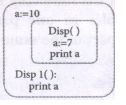
61.
(i) The elements of a list can be accessed in two ways. The first way is via our familiar method of multiple assignment, which unpacks a list into its elements and binds each element to a different name.
lst := [10, 20]
x, y := lst
(ii) In the above example x will become l0 andy will become 20.
(iii) A second method for accessing the elements in a list is by the element selection operator. Unlike a list literal, a square brackets expression directly following another expression does not evaluate to a list value, but instead selects an element from the value of the preceding expression.
Ist [0]
10
lst [1]
20
62.
A powerful strategy for designing programs, 'wishful thinking'. Wishful Thinking is the formation of beliefs and making decisions according to what might be pleasing to imagine instead of by appealing to reality.
63.
| S.No | Pure Function | Impure Function |
|---|---|---|
| (i) | The return value of the pure functions solely depends on its arguments passed. | The return value of the impure functions does not solely depend on its arguments passed. |
| (ii) | If you call the pure functions with the same set of arguments, you will always get the same return values. | If you call the impure functions with the same set of arguments. You might get the different return values. |
| (iii) | They do not have any side effects. | They cause side effects. For example: random(),Date() |
| (iv) | They do not modify the arguments which are passed to them | They may modify the arguments which are passed to them |
64.
The variables used inside the function may cause side effects though the functions which are not passed with any arguments. In such cases the function is called impure function.
For example the mathematical function random() will give different outputs for the same function call.
let randomnumber :=
a := random()
if a > 10 then
return: a
else
return: 10

12th Standard Syllabus & Materials
12th Standard
TN 12th Computer Applications களப்பெயர் முறைமை (DNS) Sample Question Papers Study Material - QB365 Set A
NEW12th Standard
TN 12th Computer Applications வலையமைப்பு எடுத்துக்காட்டுகள் மற்றும் நெறிமுறைகள் Sample Question Papers Study Material - QB365 Set A
NEW12th Standard
TN 12th Computer Applications கணினி வலையமைப்பு ஓர் அறிமுகம் Sample Question Papers Study Material - QB365 Set A
NEW12th Standard
TN 12th Computer Applications PHP-உடன் MySQL-ஐ இணைத்தல் Sample Question Papers Study Material - QB365 Set A



Tamilnadu Stateboard 12th Standard Subjects

Maths

Chemistry

Physics

Biology
Computer Science

Business Maths and Statistics

Economics

Commerce

Accountancy

History

Computer Applications
Biology
Computer Technology
Computer Applications
Computer Science
Business Maths and Statistics
Commerce
Economics
Maths
Chemistry
Physics
Computer Technology
History
Accountancy

Tamil

English

French
Tamilnadu Stateboard Standards
