
12th Standard Syllabus & Materials
12th Standard
TN 12th Computer Applications மின்னணு தரவு பரிமாற்றம் Sample Question Papers Study Material - QB365 Set A
NEW12th Standard
TN 12th Computer Applications மின் - வணிக பாதுகாப்பு அமைப்புகள் Sample Question Papers Study Material - QB365 Set A
NEW12th Standard
TN 12th Computer Applications மின்னணு செலுத்தல் முறைகள் Sample Question Papers Study Material - QB365 Set A
NEW12th Standard
TN 12th Computer Applications மின் - வணிகம் Sample Question Papers Study Material - QB365 Set A
NEW12th Standard
TN 12th Computer Applications திறந்த மூல கருத்துருக்கள் Sample Question Papers Study Material - QB365 Set A
NEW12th Standard
TN 12th Computer Applications வலையமைப்பு வடமிடல் Sample Question Papers Study Material - QB365 Set A

Published on: 03/02/2021
12th Standard Computer Science English Medium Control Structures Reduced Syllabus Important Questions With Answer Key 2021
Download Tamil Nadu 12th Standard Computer Science question papers, model tests, one-mark questions, important questions, and public exam papers in PDF format. Free study materials and answer keys for TN State Board students.
Questions + Answers key
Take MCQ Computer Science Test
1.
A loop placed within another loop is called as ____ loop structure.
entry check
exit check
nested
conditional
2.
How many keywords are there to achieve jump statements in python?
2
4
3
5
3.
Which statement in python used to transfer the center from one part of the program to another unconditionally?
Jump
loop
alternative
iterative
4.
range (20), the range count from
1 to 20
0 to 19
1 to 19
0 to 20
5.
Which of the following function generates the list of values starting from start till stop-1?
sequence()
range()
input()
print()
6.
Which of the following is not a type of branching statements?
if
if-else
if-elif
while
7.
Checking whether the given number is even or odd can be done using
sequential
alternative or branching
iterative or looping
iterative or sequential
8.
What can be learned through alternative or branching statement?
looping
decision making
functions
classes
9.
Which of the following is not control structures?
Sequential
Branching
Operator
Looping
10.
Which of the following is used to alter the control flow of the process depending on the state of the process?
control structure
control statement
program statement
control structure or control statement
11.
Which of the following are the executable segments that yield the result?
Operator
Statements
Keywords
Identifiers
12.
Which punctuation should be used in the blank?
if < condition > ____
statements-block 1
else:
statements-block 2
;
::
!
" : "
13.
14.
The condition in the if statement should be in the form of
Arithmetic or Relational expression
Arithmetic or Logical expression
Relational or Logical expression
Arithmetic
15.
How many important control structures are there in Python?
3
4
5
6
16.
What is the expression. or statement at? 1? and ?2? in the following program to get the output 2 4 6 8.
for ?!? in range (2, ?2?, 2):
print (i, end =")
17.
What are the two types of looping construct in python?
18.
Write the syntax of alternative method to write complete if-else.
19.
Write a program in python to check if the accepted number even or odd.
a = int(input("Enter any number:"))
if a%2==0:
print (a, "is an even number")
else:
print (a, "is an odd number")
20.
What is meant by alternative or branching?
21.
Write note on range () in loop.
22.
Define control structure.
23.
Write is the syntax of if..else statement.
24.
Write note on break statement.
25.
List the control structures in Python.
26.
Why we need to construct the pass statement?
27.
What will be the range of values displayed by the following?
28.
Write the syntax of working of continue statement in for and while loop.
29.
Draw the flowchart that illustrates the working of break statement
30.
Draw a flowchart that illustrates the working of while loop.
31.
Write a note on simple if statement with an example.
32.
List the differences between break and continue statements.
33.
Write the syntax of while loop.
34.
Write note on if..else structure.
35.
Write a program to display
A
A B
A B C
A B C D
A B C D E
36.
Write a program in python to display the following output.
(i) 5 5 5 5 5
4 4 4 4
3 3 3
2 2
1
(ii) 1 2 3 4 5
1 2 3 4
1 2 3
1 2
1
37.
Write a program in python to display he following output.
1
2 2
3 3 3
4 4 4 4
5 5 5 5 5
38.
Explain Jump statement in python.
39.
Write a program to display multiplication table for a given number.
40.
Write a program to display all 3 digit odd numbers.
41.
Write a detail note on if..else..elif statement with suitable example.
42.
Write a detail note on for loop.
1.
(c)
nested
2.
(c)
3
3.
(a)
Jump
4.
(b)
0 to 19
5.
(b)
range()
6.
(d)
while
7.
(b)
alternative or branching
8.
(b)
decision making
9.
(c)
Operator
10.
(d)
control structure or control statement
11.
(b)
Statements
12.
(d)
" : "
13.
(c)
14.
(c)
Relational or Logical expression
15.
(a)
3
16.
?1? - i
?2? - 10
17.
Python provides two types of looping constructs:
(i) while loop
(ii) for loop
18.
Syntax:
variable = variablel if condition else variable 2
19.
Output:
Enter any number: 56
56 is an even number
Output 2:
Enter any number: 67
67 is an odd number
20.
There may be situations in our real life programming where we need to skip a segment or set of statements and execute another segment based on the test of a condition. This is called alternative or branching.
21.
The range() is a built-in function, to generate series of values between two numeric intervals.
The syntax of range() is as follows:
range (start,stop,[step])
Where,
start - refers to the initial value
stop - refers to the final value
step - refers to increment value, this is optional part.
22.
A program statement that causes a jump of control from one part of the program to another is called control structure or control statement.
23.
Syntax:
if < condition >:
statements-block 1
else:
statements-block 2
24.
The break statement terminates the loop containing it. Control of the program flows to the statement immediately after the body of the loop.
25.
There are three important control Structures
(i) Sequential
(ii) Alternative or Branching
(iii) Iterative or Looping
26.
pass statement is generally used as a placeholder. When we have a loop or function that is to be implemented in the future and not now, we cannot develop such functions or loops with empty body segment because the interpreter would raise an error. So, to avoid this we can use pass statement to construct a body that does nothing.
27.
range (1,30,1) - will start the range of values from 1 and end at 29
range (2,30,2) - will start the range of values from 2 and end at 28
range (30,3,-3) - will start the range of values from 30 and end at 6
range (20) - will consider this value 20 as the end value(or upper limit) and starts the range count from 0 to 19 (remember always ranget) will work till stop -1 value only)
28.
for var in sequence:
# code inside for loop
if condition:
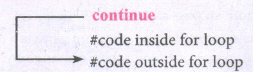
while test expression:
#code inside while loop
if condition:
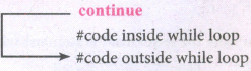
29.
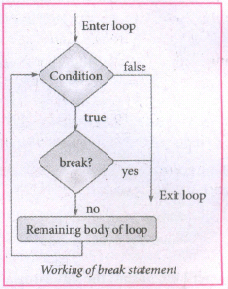
30.
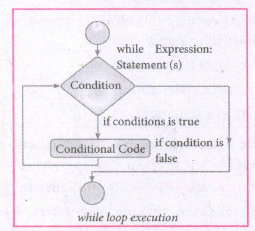
31.
Simple if statement: Simple if is the simplest of all decision making statements. Condition should be in the form of relational or logical expression.
Syntax:
if
statements-block1
In the above syntax if the condition is true statements - block 1 will be executed.
Example: Program to check the age and print whether eligible for voting
x=int (input("Enter your age :"))
if x > = 18:
print ("You are eligible for voting")
Output 1:
Enter your age: 34
You are eligible for voting
Output 2:
Enter your age: 16
>>>
32.
| Break | Continue |
| The break statement terminates the loop containing it. | The continue statement is used to skip the remaining part of a loop. |
| Control of the program flows to the statement immediately after the body ot the loop. | Control of the program flows start with next iteration |
| Syntax : break | Syntax : continue |
33.
Syntax :
while <condition>;
statements block 1
[else:
statements block2]
34.
(i) The if.. else statement provides control to check the true block as well as the false block,
(ii) Syntax :
if
statemets-block 1
else :
statement-block 2
(iii) if..else statement thus provides possibilities and the condition determines which BLOCK is to be executed.
35.
for i in range (1, 6) :
for j in range (65, 65 + i)
a = chr(j)
print a
print
36.
(i) for i in range (5, 0,-1):
for j in range (1, i + 1):
print (i, end =' ')
print (end = '\n')
i+ = 1
(ii) for i in range (5, 0, -1):
for j in range (1, i + 1):
print (j end =' ')
print (i, end = '\n')
i+ = 1
37.
for i in range (1,6):
for j in range (1, i+1)
print (i, end =' ')
print (end = '\n')
i+ = 1
38.
The jump statement in Python, is used to unconditionally transfer the control from one part of the program to another. There are three keywords to achieve jump statements in Python: break, continue, pass. The following flowchart illustrates the use of break and continue.
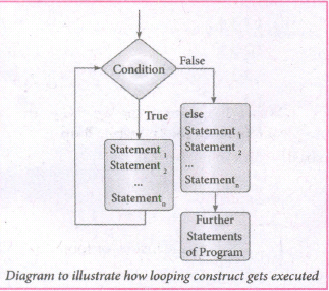
(i) break statement: The break statement terminates the loop containing it. Control of the program flows to the statement immediately after the body of the loop. A while or for loop will iterate till the condition is tested false, but one can even transfer the control out of the loop (terminate) with help of break statement. When the break statement is executed, the control flow of the program comes out of the loop and starts executing the segment of code after the loop structure. If break statement is inside a nested loop (loop inside another loop), break will terminate the innermost loop.
Syntax:
break
(ii) Continue statement: Continue statement unlike the break statement is used to skip the remaining part of a loop and start with next iteration.
Syntax:
continue
(iii) Pass statement: pass statement is generally used as a placeholder. When we have a loop or function that is to be implemented in the future and not now, we cannot develop such functions or loops with empty body segment because the interpreter would raise an error. So, to avoid this we can use pass statement to construct a body that does nothing.
Syntax:
pass
39.
Multiplication table :
num =int(input("Enter the number: "))
print("multiplication Table of", num)
for i in range(1,11):
print (num,"x",i, "= ",num*i )
Output :
Enter the number : 6
Multiplication Table of 6
6 x 1 = 6
6 x 2 = 12
6 x 3 = 18
6 x 4 = 24
6 x 5 = 30
6 x 6 = 36
6 x 7 = 42
6 x 8 = 48
6 x 9 = 54
6 x 10 = 60.
40.
for i in range (100, 1000):
if a%2==1:
print b
Output :
101,103,105,107,...........,997,999
41.
Nested if..elif..else statement :
(i) When we need to construct a chain of if statement(s) then 'elif' clause can be used instead of 'if else'.
(ii) Syntax:
if < condition - 1>:
statements-block 1
elif < condition - 2>:
statements-block 2
else:
statements-block n
(iii) In the syntax of if..elif ..else mentioned above, condition -1 is tested if it is true then statements-block 1 is executed, otherwise, the control checks condition-2, if it is true statements-block 2 is executed and even if it fails statements-block n mentioned in else part is executed.
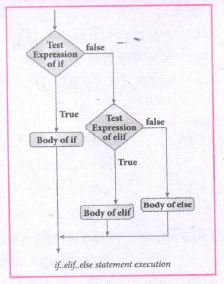
(iv) 'elif' clause combines if..else-if ..else statements to one if..elif ... else. 'elif' can be considered to be abbreviation of 'else if'. In an 'if' statement there is no limit of 'elif' clause that can be used, but an 'else' clause if used should be placed at the end.
(v) Example: # Program to illustrate the use of nested if statement
| Average | Grade |
| > = 80 and above | A |
| > = 70 and < 80 | B |
| > = 60and < 70 | C |
| > = 50 and < 60 | D |
| Otherwise | E |
m1 = int (input("Enter mark in first subject:"))
m2 = int (input("Enter mark in second subject:"))
avg = (m1+m2)/2
if avg > =80:
print ("Grade : A")
elif avg > =70 and avg < 80:
print ("Grade : B")
elif avg > =60 and avg < 70:
print ("Grade : C")
elif avg > =50 and avg < 60:
print ("Gradec: D")
else:
print("Grade : E")
Output 1:
Enter mark in first subject : 34
Enter mark in second subject : 78
Grade : D
Output 2:
Enter mark in first Subject : 67
Enter mark in second subject : 73
Grade: B
42.
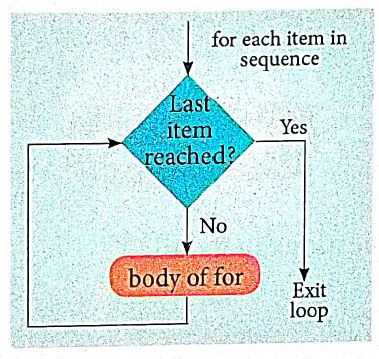
(i) for loop : The for loop usually known as a definite loop, because the programmer knows exactly how many times the loop will be executed.
(ii) Syntax:
for counter_variable in sequence:
statements - block 1
[else: # optional block
statements - block 2]
(iii) The for ... in statement is a looping statement used in Python to iterate over a sequence of objects, i.e., it goes through each item in a sequence. Here the sequence is the collection of ordered or unordered values or even a string.
(iv) range (): The range() is a built-in function,to generate series of values between two numeric intervals
(iv) The syntax of range() follows :
range (start, stop, [step])
Where,
start - refers to the initial value
stop - refers to the final values
step - refers to increment value, this is optional part.
Examples for range( ):
range (1,30,1) - will start the range of values from 1 and end at 29
range (2,30,2) - will start the range of values from 2 and end at 28
range (30,3,-3) - will start the range of values from 30 and end at 6.
range (20) - will consider this value 20 as the end value and starts the range count from 0 to 19
Example :
# Program to illustrate the use of for loop - to print single digit even number
for i in range (2,10,2):
print (i, end=' ')
Output :
2 4 6 8

12th Standard Syllabus & Materials
12th Standard
TN 12th Computer Applications களப்பெயர் முறைமை (DNS) Sample Question Papers Study Material - QB365 Set A
NEW12th Standard
TN 12th Computer Applications வலையமைப்பு எடுத்துக்காட்டுகள் மற்றும் நெறிமுறைகள் Sample Question Papers Study Material - QB365 Set A
NEW12th Standard
TN 12th Computer Applications கணினி வலையமைப்பு ஓர் அறிமுகம் Sample Question Papers Study Material - QB365 Set A
NEW12th Standard
TN 12th Computer Applications PHP-உடன் MySQL-ஐ இணைத்தல் Sample Question Papers Study Material - QB365 Set A



Tamilnadu Stateboard 12th Standard Subjects

Maths

Chemistry

Physics

Biology
Computer Science

Business Maths and Statistics

Economics

Commerce

Accountancy

History

Computer Applications
Biology
Computer Technology
Computer Applications
Computer Science
Business Maths and Statistics
Commerce
Economics
Maths
Chemistry
Physics
Computer Technology
History
Accountancy

Tamil

English

French
Tamilnadu Stateboard Standards
