
 100% FREE ACCESS
12th Standard Syllabus & Materials
12th Standard
TN 12th Maths Applications of Matrices and Determinants Sample Question Papers Study Material - QB365 Set A
NEW12th Standard
TN 12th Computer Applications மின்னணு தரவு பரிமாற்றம் Sample Question Papers Study Material - QB365 Set A
NEW12th Standard
TN 12th Computer Applications மின் - வணிக பாதுகாப்பு அமைப்புகள் Sample Question Papers Study Material - QB365 Set A
NEW12th Standard
TN 12th Computer Applications மின்னணு செலுத்தல் முறைகள் Sample Question Papers Study Material - QB365 Set A
NEW12th Standard
TN 12th Computer Applications மின் - வணிகம் Sample Question Papers Study Material - QB365 Set A
NEW12th Standard
TN 12th Computer Applications திறந்த மூல கருத்துருக்கள் Sample Question Papers Study Material - QB365 Set A

Published on: 03/02/2021
12th Standard Computer Science English Medium Data Abstraction Reduced Syllabus Important Questions 2021
Download Tamil Nadu 12th Standard Computer Science question papers, model tests, one-mark questions, important questions, and public exam papers in PDF format. Free study materials and answer keys for TN State Board students.
Questions + Answers key
Take MCQ Computer Science Test
1.
Tuple is constructed by using ______ and________
( )
[ ]
<>
{}
2.
A ________ is a comma separated values surround with parentheses.
List
Tuple
Set
Dictionary
3.
______is made up of list or Tuples
Set
Pair
Dictionary
Control Structures
4.
______ are functions that retrieve information from the data type.
Constructors
Selectors
List
Tuple
5.
A________ data representation is defined as an independent part of the program.
Abstract
Concrete
List
Tuple
6.
The basic idea of ________ is to structure programs so that they operate on abstract dat(a)
Encapsulation
Polymorphism
Data type
Data Abstraction
7.
The____________ can be implemented using singly linked list or doubly linked list
Tuple ADT
List ADT
Function ADT
List ADT
8.
Classes are the representation for___________
Abstract datatype
Built-in datatype
Concrete datatype
Essential datatype
9.
Data Abstraction allows programmers to treat code as_______
Objects
Classes
Members
Parameters
10.
CDT expansion is
Collective Data Type
Class Data Type
Concrete Data Type
Central Data Type
11.
Which of the following as bundled data and the functions that work on that data?
Object
Pair
List
Class
12.
Which of the following defines a data abstraction by grouping related data items?
List
Pair
Class
Tuple
13.
Which of the following does not allow us to name the various parts of a multi-item object?
List
Triple
Pair
All of these
14.
How many ways are there to represent pair datatypet?
2
4
3
5
15.
List can also be called as
Functions
Class
Structure
Pairs
16.
How many values can be stared in the list?
4
10
100
Multiple
17.
Which of the following is contracted by placing expressions within square brackets separated by commas?
List
Tuple
Set
Dictionary
18.
How many parts are the!"ein the program?
2
3
4
Many
19.
In which data representation, a definition for each function is known
User defined
Buil-in
Abstract
Concrete
20.
Which of the following extract the information of the object?
Constructors
Functions
Selectors
Destructors
21.
Which of the following function that facilitate the data abstraction?
Constructors
Destructors
Selectors
a and c
22.
To facilitate data abstraction, How many types of functions are created?
2
3
4
Only one
23.
The process of providing only the essentials and hiding the details is known as
Functions
Abstraction
Encapsulation
Pairs
24.
Which of the following provides modularity?
Datatypes
Subroutines
Classes
Abstraction
25.
Which of the following is a powerful concept that allows programmers to treat codes as objects?
Encapsulation
Data Abstraction
Inheritance
Polymorphism
26.
Which of the following is a compound structure?
Pair
Triplet
single
quadrat
27.
The data type whose representation is unknown are called
Built in datatype
Derived datatype
Concrete datatype
Abstract datatype
28.
29.
How the elements of a list can be accessed?
30.
From the statement P1 : = Preson(), What does P1 and person referred.
31.
How a class defines a data abstraction?
32.
Write a pseudocode to depressant rational numbers using list.
33.
Write a note on pair datatype
34.
How the concrete level of data abstraction implemented?
35.
Write the pseudo code for the representation of the rational number using constructor & selector.
36.
Identify which is the constructor and selector from the following statement.
(i) The Functions that retrieve information from the datatype.
(ii)The function which creates an object.
37.
Give an example of implementing an ADT
38.
What is a Tuple? Give an example.
39.
What is a List? Give an example.
40.
41.
Differentiate constructors and selectors.
42.
What is abstract data type?
43.
Give an example of an ADT for rational numbers.
44.
Write a note on Data Abstraction.
45.
Identify the constructor and selector from the following.
(I) City = Make city (name, lat, Ion)
(ii) Get name (city)
(ill) Make point (x,y)
(iv) x coord (point)
(v) y coord (point)
46.
Identify Which of the following are List, Tuple and class ?
(a) arr [1, 2, 34]
(b) arr (1, 2, 34)
(c) student [rno, name, mark]
(d) day= (‘sun’, ‘mon’, ‘tue’, ‘wed’)
(e) x= [2, 5, 6.5, [5, 6], 8.2]
(f) employee [eno, ename, esal, eaddress]
47.
What are the different ways to access the elements of a list. Give example.
48.
Identify Which of the following are constructors and selectors?
(a) N1:=number()
(b) accetnum (n1)
(c) displaynum (n1)
(d) eval (a/b)
(e) x,y:= make slope (m), make slope (n)
(f) display()
49.
Which strategy is used for program designing? Define that Strategy.
50.
Differentiate Concrete data type and abstract datatype.
51.
Explain the representation of Abstract datatype using rational numbers.
52.
How will you access the multi-item. Explain with example.
53.
What is a List? Why List can be called as Pairs. Explain with suitable example.
54.
How will you facilitate data abstraction. Explain it with suitable example.
1.
(a)
( )
2.
(b)
Tuple
3.
(b)
Pair
4.
(b)
Selectors
5.
(b)
Concrete
6.
(d)
Data Abstraction
7.
(b)
List ADT
8.
(a)
Abstract datatype
9.
(a)
Objects
10.
(c)
Concrete Data Type
11.
(d)
Class
12.
(c)
Class
13.
(d)
All of these
14.
(a)
2
15.
(d)
Pairs
16.
(d)
Multiple
17.
(a)
List
18.
(a)
2
19.
(d)
Concrete
20.
(c)
Selectors
21.
(d)
a and c
22.
(a)
2
23.
(b)
Abstraction
24.
(d)
Abstraction
25.
(b)
Data Abstraction
26.
(a)
Pair
27.
(d)
Abstract datatype
28.
(a)
29.
(i) The elements of a list can be accessed in two ways.
(ii) The first way is via multiple assignment and the second method is by the element selection operator
30.
Person is referred to as a class or a type, while p1 is referred to as an object or an instance.
31.
(i) A class defines a data abstraction by grouping related data items. A class is not just data, it has functions defined within it.
(ii) Functions are subordinate to the class because their job is to do things with the data of the class.
32.
rational(n, d):
return [n, d]
numer(x):
return x[0]
denom(x):
return x[1]
33.
(i) A pair is a compound data type that holds two other pieces of data. The two ways of representing the pair data type.
(ii) The first way is using List construct and the second way to implement pairs is with the tuple construct.
34.
(i) To implement the concrete level of data abstraction, languages like Python provides a compound structure called Pair which is made up of list or Tuple.
(ii) The first way to implement pairs is with the List construct
35.
The pseudo code for the representation of the rational number using the above constructor and selector is component
x,y:=8,3
rational(n,d)
numer(x)/numer(y)
- - output: 2.6666666666666665
36.
(i) Selector
(ii) Constructor
37.
(i) There can be different ways to implement an ADT, for example, the, List ADT can be implemented using singly linked list or doubly linked list.
(ii) Similarly, stack ADT and Queue ADT can be implemented using lists
38.
(i) A tuple is a comma-separated sequence of values surrounded with parentheses. Tuple is similar to a list.
(ii) The difference between the two is that you cannot change the elements of a tuple once it is assigned whereas in a list, elements can be changed
(iii) Example : colour = ('red', 'blue, 'Green')
39.
List is constructed by placing expressions within square brackets separated by commas. List can store multiple values.
Example:
1st := [10, 20]
x, y:= 1st
In the above example x will become 10 and y will become 20.
40.
41.
| S.No | Constructors | Selectors |
| (i) |
Constructors are functions that build the abstract data type. |
Selectors are functions that retrieve information from the data type. |
| (ii) | Constructors create an object, bundling together different pieces of information. | Selectors extract individual pieces of information from the object |
42.
(i) Abstract Data type (ADT) is a type (or class) for objects whose behavior is defined by a set of value and a set of operations.
(ii) The definition of ADT only mentions what operations are to be performed but not how these operations will be implemented.
43.
An ADT for rational numbers:
- - constructor
- - constructs a rational number with numerator n, denominator d
rational(n, d)
- - selector
number(x) \(\rightarrow \) returns the numerator of rational number x
denom(y) \(\rightarrow \) returns the denominator of rational number y
44.
(i) Data abstraction is supported by defining an abstract data type (ADT) which is a collection of constructors and selectors.
(ii) Constructors create an object, bundling together different pieces of information, while selectors extract individual pieces of information from the object.
45.
(i) Constructor
(ii) Selector
(iii) Constructor
(iv) Selector
(v) Selector
46.
(a) List
(b) Tuple
(c) Class
(d) Tuple
(e) List
(f) Class
47.
(i) The elements of a list can be accessed in two ways. The first way is via our familiar method of multiple assignment, which unpacks a list into its elements and binds each element to a different name.
lst := [10, 20]
x, y := lst
(ii) In the above example x will become l0 andy will become 20.
(iii) A second method for accessing the elements in a list is by the element selection operator. Unlike a list literal, a square brackets expression directly following another expression does not evaluate to a list value, but instead selects an element from the value of the preceding expression.
Ist [0]
10
lst [1]
20
48.
(a) Constructors
(b) Selectors
(c) Selectors
(d) Selectors
(e) Constructors
(f) Selectors
49.
A powerful strategy for designing programs, 'wishful thinking'. Wishful Thinking is the formation of beliefs and making decisions according to what might be pleasing to imagine instead of by appealing to reality.
50.
| S.No | Concrete data type | Abstract data type |
| (i) | Concrete Data Types or structures (CDT's) are direct implementations of a relatively simple concept | Abstract Data Types (ADT's) offer a high level view (and use) of a concept independent of its implementation. |
| (ii) | A concrete data type is a data type whose representation is known. | Abstract data type the representation of a data type is unknown. |
51.
(i) The basic idea of data abstraction is to structure programs so that they operate on abstract data. That is, our programs should use data in such a way, as to make as few assumptions about the data as possible.
(li) At the same time, a concrete data representation is defined as an independent part of the program.
(iii) Any program consist of two parts. The two parts of a program are, the part that operates on abstract data and the part that defines a concrete representation, is connected by a small set of functions that implement abstract data in terms of the concrete representation.
(iv) To illustrate this technique, let us consider an example to design a set of functions for manipulating rational numbers.
(v) Example: A rational number is a ratio of integers, and rational numbers constitute an important sub-class of real numbers. A rational number such as 8/3 or 19/23 is typically written as : < numerator > /< denominator >
(vi) where both the < numerator > and <denominator>
(vii) However, you can create an exact representation for rational numbers by combining together the numerator and denominator.
(viii) As we know from using functional abstractions, we can start programming productively before you have an implementation of some parts of our program.
(ix) Let us begin by assuming that you already have a way of constructing a rational number from a numerator and a denominator. You also assume that, given a rational number, you have a way of selecting its numerator and its denominator component.
52.
(i) The structure construct (In OOP languages it's called class construct) is used to represent multi-part objects where each part is named (given a name). Consider the following pseudo code:
Class Person:
creation()
first Name:=""
last Name:=""
id :=""
email :=""
The new data type Person is pictorially represented as
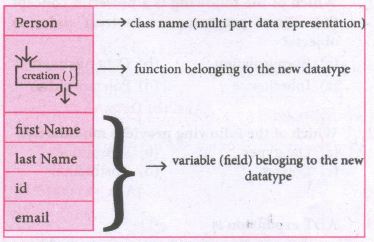
In the case of something more complex, like a person, we have a multí-item object where each item is a named thing: the first name, the last name, the id, and the email. One could use a list to represent a person:
Person = ['padmashri', 'Baskar', '994-222-1234', 'compsci@gmail.com']
| Let main() contains | |
| p1:=Person() | statement creates the object |
| first name:= "padmashri" | setting a field called firstName with value padamashri |
| last name:= "Baskar" | setting a field called last name with value Baskar |
| id:= "994-222-1234" | setting a field called id value 994-222-1234 |
| email="compsci@gmail.com" | setting a field called email with value compsci@gmail.com |
| -- output of firstName: Padmashri | |
(ii) The class (structure) construct defines the from for multi-part objects that represent a person.
(iii) Person is referred to as a class or a type, while pl is referred to as an object or an instance.
(iv) Here class Person as a Cookie cutter, and pl as a particular cookie, Using the cookie cutter you can make many cookies, Same way using class created many objects of that type.
(v) A class defines a data abstraction by grouping related data items. A class is not just data, it has functions defined within it, We say such functions are subordinate to the class because their job is to do thngs with the data of the class.
53.
List :
(i) List is constructed by placing expressions within square brackets separated by commas. Such an expression is called a list literal. List can store multiple values. Each value can be of any type and can even be another list.
Example for List [10, 20].
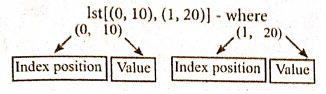
(ii) The elenments of a list can be accessed in two ways. The first way is via our familiar method of multiple assignment, which unpacks a list into its elements and binds each elenment to a different name.
Ist := [10, 20]
x, y = lst
(iii) In the above example x will become l0 and y will become 20. A second method for accessing the elements in a list is by the element selection operator.
(iv) Unlike a list literal, a square-brackets expression directly following another expression does not evaluate to a list value, but instead selects an element from the value of the preceding expression.
lst [0]
10
Ist [1]
20
(v) In both the example mentioned above mathematically we can represent list similar to a set.
Pair :
Any way of bundling two values together into one can be considered as a pair. Lists are a common methodto do so. Therefore List can be called as Pairs.
54.
Data abstraction is used to define an Abstract Data Type (ADT), which is a collection of constructors and selectors. T facilitate data abstraction,you will need to create two types of functions : Constructors and Selectors.
Constructors :
(i) Constructors are functions that build the abstract data type.
(ii) Constructors create an object, bundling together different pieces of information.
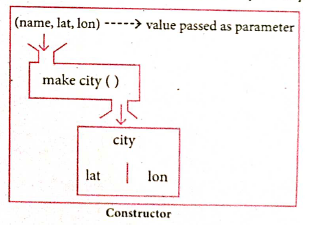
(iii) For example, say you have an abstract data type called city.
(iv) This city object will hold the city's name, and its latitude and longitude.
(v) To create a city object, you'd use a function like city = makecity (name, lat, lon).
(vi) Here makecity (name, lat, lon) is the constructor which creates the object city.
Selectors :
(i) Selectors are functions that retrieve information from the data type.
(ii) Selectors extract individual pieces of information fromn the object.
(iii) To extract the information of a city object, you wouldused functions like
getname(city)
getlat(city)
getlon(city)
These are the selectors because these functions extract the information of the city object.
.png)

12th Standard Syllabus & Materials
12th Standard
TN 12th Computer Applications வலையமைப்பு வடமிடல் Sample Question Papers Study Material - QB365 Set A
NEW12th Standard
TN 12th Computer Applications களப்பெயர் முறைமை (DNS) Sample Question Papers Study Material - QB365 Set A
NEW12th Standard
TN 12th Computer Applications வலையமைப்பு எடுத்துக்காட்டுகள் மற்றும் நெறிமுறைகள் Sample Question Papers Study Material - QB365 Set A
NEW12th Standard
TN 12th Computer Applications கணினி வலையமைப்பு ஓர் அறிமுகம் Sample Question Papers Study Material - QB365 Set A



Tamilnadu Stateboard 12th Standard Subjects

Maths

Chemistry

Physics

Biology
Computer Science

Business Maths and Statistics

Economics

Commerce

Accountancy

History

Computer Applications
Biology
Computer Technology
Computer Applications
Computer Science
Business Maths and Statistics
Commerce
Economics
Maths
Chemistry
Physics
Computer Technology
History
Accountancy

Tamil

English

French
Tamilnadu Stateboard Standards
