
 100% FREE ACCESS
12th Standard Syllabus & Materials
12th Standard
TN 12th Maths Applications of Matrices and Determinants Sample Question Papers Study Material - QB365 Set A
NEW12th Standard
TN 12th Computer Applications மின்னணு தரவு பரிமாற்றம் Sample Question Papers Study Material - QB365 Set A
NEW12th Standard
TN 12th Computer Applications மின் - வணிக பாதுகாப்பு அமைப்புகள் Sample Question Papers Study Material - QB365 Set A
NEW12th Standard
TN 12th Computer Applications மின்னணு செலுத்தல் முறைகள் Sample Question Papers Study Material - QB365 Set A
NEW12th Standard
TN 12th Computer Applications மின் - வணிகம் Sample Question Papers Study Material - QB365 Set A
NEW12th Standard
TN 12th Computer Applications திறந்த மூல கருத்துருக்கள் Sample Question Papers Study Material - QB365 Set A

Published on: 03/02/2021
12th Standard Computer Science English Medium Database Concepts Reduced Syllabus Important Questions With Answer Key 2021
Download Tamil Nadu 12th Standard Computer Science question papers, model tests, one-mark questions, important questions, and public exam papers in PDF format. Free study materials and answer keys for TN State Board students.
Questions + Answers key
Take MCQ Computer Science Test
1.
How many types of relationships used in a database?
3
5
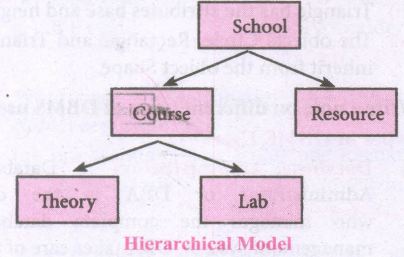
2
4
2.
Who are the one responsible for identifying the data to be stored in the data base?
DBA
Application programmers
End user
Database designers
3.
Who manages the complete database management system?
End user
DBA
DB designer
software developer
4.
The basic structure of data in relational model is
Tables
rows
columns
tuples
5.
Which of the following is a simple abstraction of complex real world data gathering environment?
Data redundancy
Data consistency
Data abstraction
Data model
6.
Which of the following used to write commands to update and delete data stored in database?
Procedures
Methods
Database Access language
Hardware/software
7.
Which of the following DBMS components that manage databases to take backups, report generation?
Square
Hardware
Data
Procedures
8.
Which of the following divides the data in such a way that repetition of data is minimum in the database?
Segregation
Normalisation
Integrity
Consistency
9.
Which of the following makes the data more meaningful and connected in the database?
Information
Security
Relationship
Data models
10.
Which of the following is not an example of DBMS?
Foxpro
Dbase
CoBoL
Ms-Access
11.
Which of the following provided an interface to perform various operations to create a database, storing and updating data?
SQL
DBA
DBMS
Algebra
12.
Which of the following allows users to store, process and analyze data easily?
My SQL
Relational Algebra
Datamodels
DBMS
13.
Which of the following is an organized collection of data, which can be stared and a cersed through computer system
Database
Worksheet
DBMS
Information
14.
Which of the following is an organized collection of data?
Word Processor
Spreadsheet
Programming language
Database
15.
16.
Write a note on
(i) SELECT Operation
(ii) PROJECT Operation
17.
What is E F Codd rules?
18.
List the types of RDBMS software.
19.
List the characteristics of DBMS.
20.
Differentiate data and information.
21.
What is database?
22.
What is normalization?
23.
What is the difference between Hierarchical and Network data model?
24.
What is data consistency?
25.
List some examples of RDBMS.
26.
Mention few examples of a database.
27.
Fill up the blank.
(I) A table is known as a _____________
(ii) A table row is known as a __________
(iii) A table column is known as a ________
28.
Write a note on database structure.
29.
List the components of DBMS
30.
Write the advantages of DBMS.
31.
Write a note on DBMS or write a note on a software that allows us to create, define and manipulate database.
32.
What does the term database refers?
33.
Write a note on different types of DBMS users.
34.
Explain Object Model with example.
35.
36.
What is the role of DBA?
37.
What is the difference between Select and Project command?
38.
Explain the components of DBMS.
39.
Explain the characteristics of DBMS.
40.
Explain the different operators in Relational algebra with suitable examples.
41.
Differentiate DBMS and RDBMS.
42.
Explain the different types of relationship mapping.
43.
1.
(d)
4
2.
(d)
Database designers
3.
(b)
DBA
4.
(a)
Tables
5.
(d)
Data model
6.
(c)
Database Access language
7.
(d)
Procedures
8.
(b)
Normalisation
9.
(c)
Relationship
10.
(c)
CoBoL
11.
(c)
DBMS
12.
(d)
DBMS
13.
(a)
Database
14.
(d)
Database
15.
(a)
16.
(i) SELECT Operation (symbol : σ): The SELECT operation is used for selecting a subset with tuples according to a given condition.
(ii) PROJECT Operation (symbol: II): The projection eliminates all attributes of the input relation but those mentioned in the projection list. The projection method defines a relation that contains a vertical subset of Relation.
17.
Database normalization was first proposed by Dr. Edgar F Codd as an integral part of RDBMS in order to reduce data redundancy and improve data integrity. These rules are known as E F Codd Rules.
18.
SQL server, Oracle, MySQL, MariaDB, SQLite.
19.
DBMS Supports Transactions : It allows us to better handle and manage data integrity in real world applications where multi-threading is extensively used.
20.
(i) Data are raw facts stored in a computer. A data may contain any character, text, word or a number.
(ii) Information is formatted data, which allows to be utilized in a significant way.
21.
(i) Database is a repository collection of related data organized in a way that data can be easily accessed, managed and updated.
(ii) Database can be a soft ware or hardware based, with one sole purpose of storing data.
22.
Database normalization was first proposed by Dr.Edgar F Codd as an integral part of RDBMS in order to reduce data redundancy and improve data integrity. These rules are known as E FCodd Rules.
23.
| Hierarichal data Model | Network data model |
| In Hierarchical model, a child record has only one parent node | In a Network model, a child may have many parent nodes, |
| It Hierarchical model, data is represented as a simple tree like structure form. | It represents the data in many-to-many lationships. |
24.
Data Consistency means that data values are the same at all instances of a database.
25.
(i) SQL server
(ii) Oracle
(iii) MySql
(iv) Maria DB
(v) SQLite.
26.
(i) Foxpro
(ii) dbase
27.
(i) Relation
(ii) Tuple
(iii) Attribute
28.
(i) Table is the entire collection of related data in one table, referred to as a File or Table where the data is organized as row and column.
(ii) Each row in a table represents a record, which is a set of data for each database entry.
(iii) Each table column represents a Field, which groups each piece or item of data among the records into specific categories or types of data. Eg. StuNo., StuName, StuAge, StuClass, StuSec.,
A Table is known as a RELATIQN
A Row is known as a TUPLE
A column is known as an ATTRIBUTE
29.
The Database Management System can be divided into five major components as follows:
(i) Hardware
(ii) Software
(iii) Data
(iv) Procedures / Methods
(v) Database Access Languages
30.
Advantages of DBMS:
(i) Segregation of application program
(ii) Minimal data duplication or Data Redundancy
(iii) Easy retrieval of data using the Query Language
(iv) Reduced development time and maintenance
31.
(i) A DBMS is a soft ware that allows us to create, define and manipulate database, allowing users to store, process and analyze data easily.
(ii) DBMS provides us with an interface or a tool, to perform various operations to create a database, storing of data and for updating data, etc.
(iii) DBMS also provides protection and security to the databases. It also maintains data consistency in case of multiple users.
32.
(i) A database is an organized collection of data, generally stored and accessed electronically from a computer system.
(ii) The term "database" is also used to refer to any of the DBMS, the database system or an application associated with the database
(iii) Because of the close relationship between them, the term "database" is often used casually to refer to both a database and the DBMS used to manipulate it.
33.
Database Administrators:
Database Administrator or DBA is the one who manages the complete database management system. DBA takes care of the security of the DBMS, managing the license keys, managing user accounts and access etc.
Application Programmers or software Developers:
This user group is involved in developing and designing the parts of DBMS.
End User:
All modern applications, web or mobile, store user data. Applications are programmed in such a way that they collect user data and store the data on DBMS systems running on their server. End users are the one who store, retrieve, update and delete data.
Database designers:
Database designers are responsible for identifying the data to be stored in the database for choosing appropriate structures to represent and store the data.
34.
Object model stores the data in the form of objects, attributes and methods, classes and inheritance. This model handles more complex applications, such as Geographic information System (GIS),sdentific experiments, engineering design and manufacturing. It is used in file Management System. It represents real world objects, attributes and behaviors. It provides a clear modular structure. It is easy to maintain and modify the existing code.
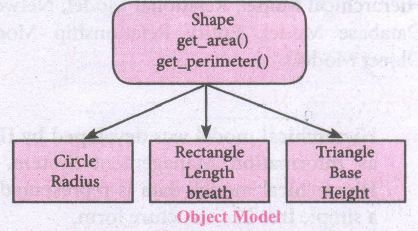
An example of the Object model is Shape, Circle, Rectangle and Triangle are all objects in this model
(i) Circle has the attribute radius.
(ii) Rectangle has the attributes length and breadth.
(iii) Triangle has the attributes base and height.
(iv) The objects Circle, Rectangle and. Triangle inherit from the object Shape
35.
36.
Database Administrator or DBA is the one who manages the complete database management system. DBA takes care of the security of the DBMS, managing the license keys, managing user accounts and access etc.
37.
| Select | Project |
|---|---|
| 1. Symbol - σ | 1. Symbol - π |
| 2. Selecting a subset with tuples | 2. Contains a vertical subset of relation. |
| 3. Select filters out all tuples that don't satisfy the condition. |
3. Projection eliminates all attributes of the input relation except in the projection list. |
38.
The Database Management System can be divided into five major components as follows:
(i) Hardware
(ii) Software
(iii) Data
(iv) Procedures / Methods
(v) Database Access Languages
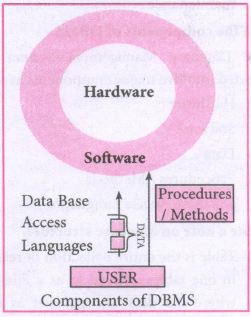
(i) Hardware: The computer, hard disk, I/O channels for data, and any other physical component involved in storage of data
(ii) Software: This main component is a program that controls everything. The DBMS software is capable of understanding the Database Access Languages and interprets into database commands for execution.
(iii) Data: It is that resource for which DBMS is designed. DBMS creation is to store and utilize data.
(iv) Procedures/Methods: They are general instructions to use a database management system such as installation of DBMS, manage databases to take backups, report generation, etc
(v) DataBase Access Languages: They are the languages used to write commands to access, insert, update and delete data stored in any database.
Examples of popular DBMS: Dbase, FoxPro
39.
Characteristics of Database Management System
| 1. Data stored into Table | Data is never directly stored into the database. Data is stored into tables, created inside the database. DBMS also allows to have relationship between tables which makes the data more meaningful and connected. |
| 2. Reduced Redundancy | In the modern world hard drives are very cheap, but earlier when hard drives were too expensive, unnecessary repetition of data in database was a big problem But DBMS follows Normalisation which divides the data in such a way that repetition is minimum. |
| 3. Date Consistency | On live data, it is being continuously updated and added, maintaining the consistency of data can become a challenge. But DBMS handles it by itself. |
| 4. Support Multiple user and Concurrent Access | DBMS allows multiple users to work on it( update, insert, delete data) at the same time and still manages to maintain the data consistency. |
| 5. Query Language | DBMS provides users with a simple query language, using which data can be easily fetched, inserted, deleted and updated in a database. |
| 6. Security | The DBMS also takes care of the security of data, protecting the data from unauthorized access. In a typical DBMS, we can create user accounts with different access permissions, using which we can easily secure our data by restricting user access. |
| 7. DBMS Supports Transactions | It allows us to better handle and manage data integrity in real world applications where multi-threading is extensively used. |
40.
Relational Algebra is divided into various groups
Unary Relational Operations.
(i) SELECT (symbol: σ)
(ii) PROJECT ( symbol: π)
Relational Algebra Operations from Set Theory:
(i) UNION (U)
(ii) INTERSECTION (∩)
(iii) DIFFERENCE (-)
(iv) CARTESIAN PRODUCT (X)
SELECT (symbol: σ)
(i) General from σ (R) with a relation R and a condition C on the attributes of R
(ii) The SELECT operation is used for selecting a subset with tuples according to a given condition.
(iii) Select filters out all tuples that do not satisfy C
STUDENT:
| Studio | Name | Course | Year |
|---|---|---|---|
| CS1 | Kannan | Big Data | II |
| CS2 | Gowri Shankar | R language | I |
| CS3 | Lenin | Big Data | I |
| CS4 | Padmaja | Python Programming | I |
σ course = "Big Data" (STUDENT)
| Studio | Name | Course | Year |
|---|---|---|---|
| CS1 | Kannan | Big Data | II |
| 2 | Lenin | Big Data | I |
PROJECT (symbol: II)
(i) The projection eliminates all attributes of the input relation but those mentioned in the projection list.
(ii) The projection method defines a relation that contains a vertical subset of Relation.
Example: 1
IIcourse (STUDENT)
Result:
| Course |
| Big Data |
| R language |
| Python Programming |
Example 2
IIstudent,course (STUDENT)
Result:
| Stud no | Course |
| CS1 | Big Data |
| CS2 | R language |
| CS3 | Big Data |
| CS4 | Python Programming |
UNION (Symbol: U)
(i) It includes all tuples that are in tables A or in B. It also eliminates duplicates. Set A Union Set B would be expressed as A U B
Example 3:
| Table A | |
|---|---|
| Studio | Name |
| CS1 | Kannan |
| CS2 | Lenin |
| CS3 | Padmaja |
| Table A | |
|---|---|
| Studio | Name |
| CS1 | Kannan |
| CS2 | Gowrishakaran |
| CS3 | Lenin |
Result:
| Table A | |
|---|---|
| Studio | Name |
| CS1 | Kannan |
| CS2 | Gowri Shakaran |
| CS3 | Lenin |
| CS4 | Padmaja |
SET DIFFERENCE (Symbol: -)
(i) The result of A - B, is a relation which includes all tuples that are in A but not in B.
(ii) The attribute name of A has to match with the attribute name in B.
Example: 4
using Table B Example 3
Result:
| Table A - B | |
|---|---|
| CS4 | Padmaja |
INTERSECTION (symbol: ∩) A ∩ B:
(i) Defines a relation consisting of a set of all tuple that are in both in A and B. However, A and.B must be union-compatible.
Example: 5
Using Table in Example 3
Result:
| Table A - B | |
|---|---|
| CS1 | Kannan |
| CS3 | Lenin |
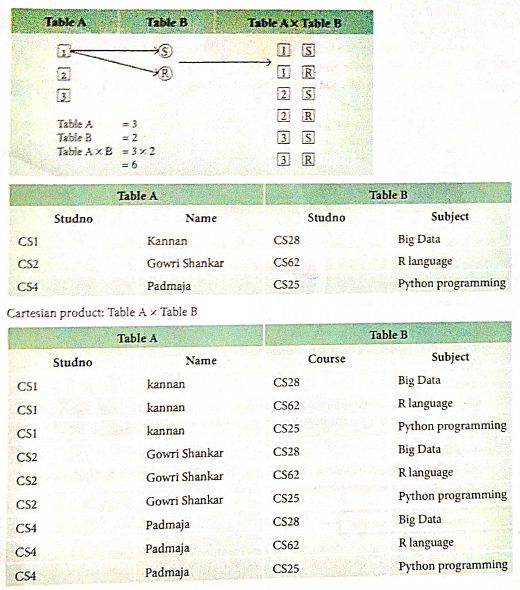
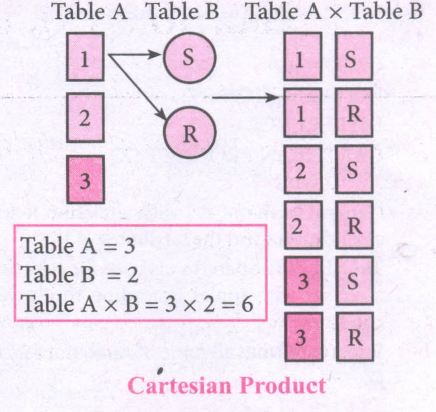
PRODUCT OR CARTESIAN PRODUCT (Symbol: X)
(i) Cross product is a way of combining two relations. The resulting relation contains, both relations being combined.
(ii) A x B means A times B, where the relation A and B have different attributes.
(iii) This type of operation is helpful to merge columns from two relations.
.JPG)
.JPG)
41.
| Basis of Comparison | DBMS | RDBMS |
|---|---|---|
| Expansion | Database Management System | Relational Database Management System |
| Data storage | Navigational model ie data by linked records | Relational model (in tables). ie data in tables as row and column |
| Data redundancy | Exhibit | Not Present |
| Normalization | Not performed | RDBMS uses normalization to reduce redundancy |
| Data access | Consumes more time | Faster, compared to DBMS. |
| Keys and indexes | Does not use. | used to establish relationship. Keys are used in RDBMS. |
| Transaction management | Inefficient, Error prone and insecure | Efficient and secure |
| Distributed Databases | Not supported | Supported by RDBMS. |
| Example | Dbase, FoxPro. | SQL server, Oracle, mysql, MariaDB, SQLite. |
42.
Types of relationships:
(i) One-to-One Relationship
(ii) One-to-Many Relationship
(iii) Many-to-One Relationship
(iv) Many-to-Many Relationship
(i) One-to-One Relationship:
In One-to-One Relationship, one entity is related with : only one other entity. One row in a table is linked with only one row in another table and vice versa.
For example: A student can have only one exam number

(ii) One-to-Many Relationship.
In One-to- Many relationship, one entity is related to many other entities. One row in a table A is linked to many rows in a table B, but one row in a table B is linked to only one row in table A.
For example: One Department has many staff members.
.JPG)
(iii) Many-to-One Relationship:
In Manyto- One Relationship, many entities can be related with only one in the other entity.
For example:
A number of staff members working in one Department.
Multiple rows in staff members table is related with only one row in Department table.
.JPG)
(iv) Many-to-Many Relationship:
A manyto- many relationship occurs when multiple records in a table are associated with multiple records in another table.
(i) Example 1:
Customers and Product
Customers can purchase various products and Products can be purchased by many customers
(ii) Example 2:
Students and Courses
A student can register for many Courses and a Course may include many students
(iii) Example 3:
Books and Student.
Many Books in a Library are issued to many students.
.JPG)
43.
.JPG)
.JPG)
.JPG)
.JPG)

12th Standard Syllabus & Materials
12th Standard
TN 12th Computer Applications வலையமைப்பு வடமிடல் Sample Question Papers Study Material - QB365 Set A
NEW12th Standard
TN 12th Computer Applications களப்பெயர் முறைமை (DNS) Sample Question Papers Study Material - QB365 Set A
NEW12th Standard
TN 12th Computer Applications வலையமைப்பு எடுத்துக்காட்டுகள் மற்றும் நெறிமுறைகள் Sample Question Papers Study Material - QB365 Set A
NEW12th Standard
TN 12th Computer Applications கணினி வலையமைப்பு ஓர் அறிமுகம் Sample Question Papers Study Material - QB365 Set A



Tamilnadu Stateboard 12th Standard Subjects

Maths

Chemistry

Physics

Biology
Computer Science

Business Maths and Statistics

Economics

Commerce

Accountancy

History

Computer Applications
Biology
Computer Technology
Computer Applications
Computer Science
Business Maths and Statistics
Commerce
Economics
Maths
Chemistry
Physics
Computer Technology
History
Accountancy

Tamil

English

French
Tamilnadu Stateboard Standards
