
 100% FREE ACCESS
12th Standard Syllabus & Materials
12th Standard
TN 12th Computer Applications மின்னணு தரவு பரிமாற்றம் Sample Question Papers Study Material - QB365 Set A
NEW12th Standard
TN 12th Computer Applications மின் - வணிக பாதுகாப்பு அமைப்புகள் Sample Question Papers Study Material - QB365 Set A
NEW12th Standard
TN 12th Computer Applications மின்னணு செலுத்தல் முறைகள் Sample Question Papers Study Material - QB365 Set A
NEW12th Standard
TN 12th Computer Applications மின் - வணிகம் Sample Question Papers Study Material - QB365 Set A
NEW12th Standard
TN 12th Computer Applications திறந்த மூல கருத்துருக்கள் Sample Question Papers Study Material - QB365 Set A
NEW12th Standard
TN 12th Computer Applications வலையமைப்பு வடமிடல் Sample Question Papers Study Material - QB365 Set A

Published on: 02/02/2021
12th Standard Computer Science English Medium Reduced Syllabus Important Questions - 2021 Part - 2
Download Tamil Nadu 12th Standard Computer Science question papers, model tests, one-mark questions, important questions, and public exam papers in PDF format. Free study materials and answer keys for TN State Board students.
Questions + Answers key
Take MCQ Computer Science Test
1.
Which type of chart shows the relationship between a numerical variable and categorical variable?
line
bar
pie
x-y plot
2.
The different kinds of plot created using
Matplotlib
Matplot
Plotlib
Matliplot
3.
Which button will help to navigate the chart?
Navigate
Pan
Home
Zoom
4.
Which of the following command will take an arbitrary number of arguments?
show ( )
plot ( )
legend ( )
title ( )
5.
______ makes your program easier to write, read test and fix errors.
Functions
List
Tuples
Loops
6.
Which of the following is not a five number summary in box plot visualization?
First Quartile
Second Quartile
Third Quartile
Minimum
7.
In Python matplotlib is a
control structure
dictionary
library
list
8.
Count ( ) returns ________ if there were no matching rows.
0
1
NOT NULL
NULL
9.
Non-keyword variable arguments are called
List
Tuples
Dictionaries
Arguments
10.
The ____ of the class should be accessed through instance of a class.
Objects
Members
Functions
Tuples
11.
The ____________ function in python is used to find the length of a list.
len ( )
length ( )
listlength ( )
lenlist ( )
12.
Write the output for the following.
A = {'A', 2, 4, 'D'}
B= {'A', 'B', 'C', 'D'}
print (B - A)
{'B', 'C'}
{2,4}
(2,4)
('B', 'C')
13.
What plays a vital role in Python programming?
Statements
Control
Structure
Indentation
14.
elif can be considered to be abbreviation of
nested if
if..else
else if
if..elif
15.
If a problem can be broken into subproblems which are reused several times, the problem possesses which property?
Overlapping subproblems
Optimal substructure
Memoization
Greedy
16.
Which of the following is not a token?
Interpreter
Identifiers
Keyword
Operators
17.
The data type whose representation is unknown are called
Built in datatype
Derived datatype
Concrete datatype
Abstract datatype
18.
The data type whose representation is known are called
Built in datatype
Derived datatype
Concrete datatype
Abstract datatype
19.
The functions which will give exact result when same arguments are passed are called
Impure functions
Partial Functions
Dynamic Functions
Pure functions
20.
Which of the following carries out the instructions defined in the interface?
Operating System
Compiler
Implementation
Interpreter
21.
Write a SQL statement to modify the student table structure by adding a new field.
22.
Find the error in the following program to get the given output?
class Fruits:
def __init__(self, f1, f2):
self.f1 = f1
self.f2 = f2
def display(self):
print("Fruit 1 = %s, Fruit 2 = %s" %(self.f1, self.f2))
F = Fruits ('Apple', 'Mango')
del F.display
F.display()
Output: Fruit 1 = Apple, Fruit 2 = Mango
23.
Explain the difference between del and clear( ) in dictionary with an example.
24.
What will be the output of the following code?
list = [2**x for x in range(5)]
print (list)
25.
26.
Write the rules of local variable.
27.
List the differences between break and continue statements.
28.
Write note on if..else structure.
29.
What do you understand by Dynamic programming?
30.
List the characteristics of an algorithm.
31.
What are string literals? Explain.
32.
33.
What are the different ways to access the elements of a list. Give example.
34.
Differentiate pure and impure function.
35.
Mention the characteristics of Interface.
36.
Write the processing skills of SQL.
37.
Explain different types arguments used in python with an example.
38.
Write a python program to execute the following C++ program.
C++ program:
/*Write a C++ program using a user defined
function to function cube of a number. */
// Now select File⇾New in Notepad and type the C++ program
#include
using namespace std;
// Function declaration
int cube(int num),
int main( )
{
int num;
int c;
cout<< "Enter any number: "<<endl;
cin >>num;
c = cube(num);
cout<< "Cube of" << num<< " is "<< c;
return 0;
}
//Function to find cube of any number
int cube(int num)
{
return (num * num * num);
}
// Save this file as cube_file.cpp
39.
Explain the commands for wrapping C++ code.
40.
Explain Jump statement in python.
41.
Write a program to read the CSV file through python using reader ( ) method.
42.
Explain with an example how will you return multiple values in tuples.
43.
How will access all elements of a list? Write the execution table example.
44.
Explain the representation of Abstract datatype using rational numbers.
45.
Consider the following table Supplier and item .Write a python script for (i) to (ii)
| SUPPLIER | ||||
| Suppno | Name | City | Icode | SuppQty |
| S001 | Prasad | Delhi | 1008 | 100 |
| S002 | Anu | Bangalore | 1010 | 200 |
| S003 | Shahid | Bangalore | 1008 | 175 |
| S004 | Akila | Hydrabad | 1005 | 195 |
| S005 | Girish | Hydrabad | 1003 | 25 |
| S006 | Shylaja | Chennai | 1008 | 180 |
| S007 | Lavanya | Mumbai | 1005 | 325 |
i) Display Name, City and Itemname of suppliers who do not reside in Delhi.
ii) Increment the SuppQty of Akila by 40
46.
Differentiate DBMS and RDBMS.
47.
Explain the different types of function with an example.
48.
Write any Five Characteristics of Modules.
49.
Identify in the following program
| let rec gcd a b:= if b <> 0 then gcd b (a mod b) else return a: |
i) Name of the function
ii) Identify the statement which tells it is a recursive function
iii) Name of the argument variable
iv) Statement which invoke the function recursively
v) Statement which terminates the recursion
50.
What are called tuples?
51.
What are arguments? What are the types?
52.
What is meant by Nested loop structure?
53.
Write a python program to calculate the sum of numbers between. 1 and 100.
54.
What is meant by alternative or branching?
55.
How will you insert elements in a list? Write the syntax.
56.
Write the syntax of using for keyword to access all elements in the list. Pg 136 x 9.
57.
Name the four collections of data types in python programming language.
58.
What is algorithm analysis?
59.
What is algorithmic solution?
60.
Assume a = 50 and b = 40. write the output the following statement.
(i) print ("The a > b or a = := b = ", a > b or a==b)
(ii) print ("The a > b and a == b = ", a > b and a==b)
(iii) print ("The not a > b == ", not a > b)
61.
Name the tokens where the whitespace in necessary in python.
62.
Write the output of the following program
Disp()
a:=10
Disp 1():
print a
Disp 1():
print a
Disp()
63.
What is the use of LEGB rule?
64.
How a class defines a data abstraction?
1.
(b)
bar
2.
(a)
Matplotlib
3.
(c)
Home
4.
(b)
plot ( )
5.
(a)
Functions
6.
(b)
Second Quartile
7.
(c)
library
8.
(a)
0
9.
(b)
Tuples
10.
(b)
Members
11.
(a)
len ( )
12.
(a)
{'B', 'C'}
13.
(d)
Indentation
14.
(c)
else if
15.
(a)
Overlapping subproblems
16.
(a)
Interpreter
17.
(d)
Abstract datatype
18.
(c)
Concrete datatype
19.
(d)
Pure functions
20.
(c)
Implementation
21.
ALTER TABLE <table-name> ADD <column- name><data type><size>;
Example: ALTER TABLE Student MODIFY Address char (25)
22.
In line No.8, del F.display will not come.
23.
| del | Clear( ) | |
| (i) | The del statements is used to delete elements whose index is known. | The function clear ( ) is used to delete all the elements in list. |
| (ii) | The del statement can also be used to delete entire list. | It deletes only the elements and retains the list. |
| (iii) | Example: del Dict ["MarkT"] | Example : Dict.clear( ) |
24.
Output: [1,2,4,8,16]
25.
26.
Rules of local variable:
(i) A variable with local scope can be accessed only within the function/block that it is created in.
(ii) When a variable is created inside the function the variable becomes local to it.
(iii) A local variable only exists while the function is executing.
(iv) The formal parameters are also local to function.
27.
| Break | Continue |
| The break statement terminates the loop containing it. | The continue statement is used to skip the remaining part of a loop. |
| Control of the program flows to the statement immediately after the body ot the loop. | Control of the program flows start with next iteration |
| Syntax : break | Syntax : continue |
28.
(i) The if.. else statement provides control to check the true block as well as the false block,
(ii) Syntax :
if
statemets-block 1
else :
statement-block 2
(iii) if..else statement thus provides possibilities and the condition determines which BLOCK is to be executed.
29.
(i) Dynamic programming is an algorithmic design method that can be used when the solution to a problem can be viewed as the result of a sequence of decisions.
(ii) Dynamic programming approach is similar to divide and conquer. The given problem is divided into smaller and yet smaller possible sub-problems.
(iii) Dynamic programming is used whenever problems can be divided into similar sub-problems. So that their results can be re-used to complete the process.
(iv) Dynamic programming approaches are used to find the solution in optimized way. For every inner subproblem, dynamic algorithm will try to check the results of the previously solved sub-problems. The solutions of overlapped sub-problems are combined in order to get the better solution.
30.
(i) Input
(ii) Output
(iii) Finiteness
(iv) Definiteness
(v) Effectiveness
(vi) Correctness
(vii) Simplicity
(viii) Unambiguous
(ix) Feasibility
(x) Portable
(xi) Independent
31.
(i) In Python, a string literal is a sequence 0 characters surrounded by quotes. Python supports Single, double and triple quotes for a string.
(ii) A character literal is a single character surrounded by single or double quotes. The value with triple-quote u ''' ''' is used to give multi-line string literal.
Program:
To test String Literals:
# Demo Program to test String Literals
strings = "This is Python"
char = "C"
multiline_str = ''''This is a multiline string with more than one line code.'''
print (strings)
print (char)
print (multiline_str)
# End of the Program
Output:
This is Python
C
This is a multiline string with more than one line code.
32.
33.
(i) The elements of a list can be accessed in two ways. The first way is via our familiar method of multiple assignment, which unpacks a list into its elements and binds each element to a different name.
lst := [10, 20]
x, y := lst
(ii) In the above example x will become l0 andy will become 20.
(iii) A second method for accessing the elements in a list is by the element selection operator. Unlike a list literal, a square brackets expression directly following another expression does not evaluate to a list value, but instead selects an element from the value of the preceding expression.
Ist [0]
10
lst [1]
20
34.
| S.No | Pure Function | Impure Function |
|---|---|---|
| (i) | The return value of the pure functions solely depends on its arguments passed. | The return value of the impure functions does not solely depend on its arguments passed. |
| (ii) | If you call the pure functions with the same set of arguments, you will always get the same return values. | If you call the impure functions with the same set of arguments. You might get the different return values. |
| (iii) | They do not have any side effects. | They cause side effects. For example: random(),Date() |
| (iv) | They do not modify the arguments which are passed to them | They may modify the arguments which are passed to them |
35.
(i) The class template specifies the interfaces to enable an object to be created and operated properly.
(ii) An object's attributes and behaviour is controlled by sending functions to the object.
36.
The various processing skills of SQL are:
(i) Data Definition Language (DDL): The SQL DDL provides commands for defining relation schemas (structure), deleting relations, creating indexes and modifying relation schemas.
(ii) Data Manipulation Language (DML): The SQL DML includes commands to insert, delete, and modify tuples in the database.
(iii) Embedded Data Manipulation Language: The embedded form of SQL is used in high level programming languages.
(iv) View Definition: The SQL also includes commands for defining views of tables.
(v) Authorization: The SQL includes commands for access rights to relations and views of tables.
(vi) Integrity: The SQL provides forms for integrity checking using condition.
(vii) Transaction control: The SQL includes commands for file transactions and control over transaction processing.
37.
(i) Required Arguments:
"Required Arguments" are the arguments passed to a function in correct positional order. Here, the number of arguments in the function call should match exactly with the function definition. Atleast one parameter to prevent syntax errors to get the required output.
(ii) Example:
def printstring(str):
print ("Example - Required arguments")
print (str)
return
# Now you can call printstring() function
printstring ("Welcome")
Output:
Example - Required arguments
Welcome
(iii) When the above code is executed, it produces the following error.
Traceback (most recent call last):
File "Req-arg.py", line 10, in
printstring()
TypeError: printstring() missing 1 required positional argument: 'str'
(iv) Instead of printstring() in the above code if we use printstring ("Welcome") then the output is
Output:
Example - Required arguments
Welcome
Keyword Arguments:
Keyword arguments will invoke the function after the parameters are recognized by their parameter names. The value of the keyword argument is matched with the parameter name and so, one can also put arguments in improper order (not in order).
(ii) Example:
def printdata (name):
print ("Example-1 Keyword arguments")
print ("Name :":name)
return
# Now you can call printdatat() function
printdata(name = "Gshan")
(iii) When the above code is executed, it produces the following output:
Output:
Example-1 Keyword arguments
Name:Gshan
Default Arguments:
In Python the default argument is an argument that takes a default value if no value is provided in the function call. The following example uses default arguments, that prints default salary when no argument is passed.
Example:
def printinfo( name, salary = 3500):
print ("Name: ", name)
print ("Salary: ", salary)
return
printinfo("Mani")
(iii) When the above code is executed, it produces the following output
Output:
Name: Mani
Salary: 3500
(iv) When the above code is changed as print info("Ram,":2000) it produces the following output:
Output:
Name: Ram
Salary: 2000
Syntax - Variable-Length Arguments:
(i) def function_name(*args):
function_body
return_statement
(ii) Example:
def printnos (*nos):
for n in nos:
print(n)
return
# now invoking the printnos() function
print ('Printing two values')
printnos (1,2)
print ('Printing three values')
printnos (10,20,30)
Output:
Printing two values
1
2
Printing three values
10
20
30
38.
# Save the File as fun.py
# Program that compiles and executes a .cpp file
# Python fun.py -i c:\pyprg\cube_file.cpp
Python Program:
import sys, os, getopt
def main(argv):
cpp_file ="
exe_file ="
opts,args = getopt.getopt(argv, "i:",['ifile='])
for 0, a in opts:
if 0 in ("-i", "--ifile"):
cpp_file = a + '.cpp'
exe_file = a + '.exe'
run(cpp_file, exe_file)
def run(cpp_file, exe_file):
print("Compiling" + cpp_file)
os.system('g++ ' + cpp_file + '-o' + exe_ file)
print("Running" + exe_file)
print(" ----------------- ")
print
os.system( exe_file)
print
if _name_ =='_main_':
main(sys.argv[1:])
39.
commands for wrapping C++ code:
if___name___ =='___main___':
main(sys.argv[ 1:])
_name_ (A Special variable) in Python:
(i) Since there is no main ( ) function in Python, when the command to run a Python program is given to the interpreter, the code that is at level 0 indentation is to be executed.
(ii) However, before doing that, interpreter will define a few special variables. __name___ is one such special variable which by default stores the name of the file. If the source file is executed as the main program, the interpreter sets the ___name___ variable to have a value as "___main___".
(iii) __name__ is a built-in variable which evaluates to the name of the current module. Thus it can be used to check whether the current script is being run on its own.
(iv) For example consider the following:
if ___name___ ==' ___main___':
main (sys.argv[1:])
(v) if the command line Python program itself is going to execute first, then _main_ contains the name of that Python program and the Python special variable _name_ also contain the Python program name.
(vi) If the condition is true it calls the main which is passed with C++ file as argument.
40.
The jump statement in Python, is used to unconditionally transfer the control from one part of the program to another. There are three keywords to achieve jump statements in Python: break, continue, pass. The following flowchart illustrates the use of break and continue.
(i) break statement: The break statement terminates the loop containing it. Control of the program flows to the statement immediately after the body of the loop. A while or for loop will iterate till the condition is tested false, but one can even transfer the control out of the loop (terminate) with help of break statement. When the break statement is executed, the control flow of the program comes out of the loop and starts executing the segment of code after the loop structure. If break statement is inside a nested loop (loop inside another loop), break will terminate the innermost loop.
Syntax:
break
(ii) Continue statement: Continue statement unlike the break statement is used to skip the remaining part of a loop and start with next iteration.
Syntax:
continue
(iii) Pass statement: pass statement is generally used as a placeholder. When we have a loop or function that is to be implemented in the future and not now, we cannot develop such functions or loops with empty body segment because the interpreter would raise an error. So, to avoid this we can use pass statement to construct a body that does nothing.
Syntax:
pass
41.
import csv
csv.register_dialect('myDialect', delimiter = ',',skipinitialspace = True)
F=open('c:\\pyprg\\sample2.csv', 'r')
reader = csv.reader(F, dialect = 'myDialect')
for row in reader:
print(row)
F.close( )
42.
(i) A function can return only one value at a time, but Python returns more than one value from a function. Python groups multiple values and returns them together.
(ii) Example: Program to return the maximum as well as minimum values in a list
def Min_Max(n):
a = max(n)
b = min(n)
return (a, b)
Num = (12, 65, 84, 1, 18, 85, 99)
(Max_Num, Min_Num) = Min_Max(Num)
print("Maximum value = ", Max_Num)
print("Minimum value = ", Min_Num)
(iii) Output:
Maximum value = 99
Minimum value = 1
43.
(i) Loops are used to access all elements from a list. The initial value of the loop must be zero. Zero is the beginning index value of a list.
(ii) Example:
Marks = [10, 23, 41, 75]
i = 0
while i < 4:
print (Marks[i])
i = i + 1
Output:
10
23
41
75
(iii) In the above example, Marks list contains four integer elements i.e., 10, 23, 41, 75. Each element has an index value from 0. The index value of the elements are 0, 1, 2, 3 respectively.
(iv) Here, the while loop is used to read all the elements. The initial value of the loop is zero, and the test condition is < 4, as long as the test condition is true, the loop executes and prints the corresponding output
(iv) During the first iteration, the value of i is zero, where the condition is true. Now, the following statement print (Marks [i] gets executed and prints the value of Marks [0] element ie. 10.
(v) The next statement i = i + 1 increments the value of i from 0 to 1. Now, the flow of control shifts to the while statement for
(vi) checking the test condition. The process repeats to print the remaining elements of Marks list until the test condition of while loop becomes false. The following table shows that the execution of loop and the value to be print.
| Iteration | i | while i < 4 |
print (Marks[i]) | i = i + 1 |
| 1 | 0 | 0< 4 True | Marks [0] =10 | 0+1=1 |
| 2 | 1 | 1 < 4 True | Marks [1]=23 | 1+1=2 |
| 3 | 2 | 2 < 4 True | Marks [2]=41 | 2+1=3 |
| 4 | 3 | 3 < 4 True | Marks [3]=75 | 3+1=4 |
| 5 | 4 | 4 < 4 False |
44.
(i) The basic idea of data abstraction is to structure programs so that they operate on abstract data. That is, our programs should use data in such a way, as to make as few assumptions about the data as possible.
(li) At the same time, a concrete data representation is defined as an independent part of the program.
(iii) Any program consist of two parts. The two parts of a program are, the part that operates on abstract data and the part that defines a concrete representation, is connected by a small set of functions that implement abstract data in terms of the concrete representation.
(iv) To illustrate this technique, let us consider an example to design a set of functions for manipulating rational numbers.
(v) Example: A rational number is a ratio of integers, and rational numbers constitute an important sub-class of real numbers. A rational number such as 8/3 or 19/23 is typically written as : < numerator > /< denominator >
(vi) where both the < numerator > and <denominator>
(vii) However, you can create an exact representation for rational numbers by combining together the numerator and denominator.
(viii) As we know from using functional abstractions, we can start programming productively before you have an implementation of some parts of our program.
(ix) Let us begin by assuming that you already have a way of constructing a rational number from a numerator and a denominator. You also assume that, given a rational number, you have a way of selecting its numerator and its denominator component.
45.
(i) Program to Display Name, city and Item Name of suppliers who do not reside in Delhi:
import mysqldb
db = mysqlkdb.Connect ("Supplier.db")
cursor = db.cursor()
cursor. execute ("'SELECT NAME, CITY, ICode FROM Supplier WHERE CITY <> "Delh")
db. commit()
result=cursor.fetchall()
print ("result, sep = "\n")
db. close()
(ii) Program to Increment the suppQty of Akila by 40:
import mysqldb
db = mysqldb.Connect ("ltem.db"')
cursor = db.cursor()
cursor. execute ("UPDATE Item SET Name = 'Akila' WHERE SuppQty = 235)
db. commit()
cursor. execute ("SELECT * FROM Item")
result = cursor.fetchall()
print ("result, sep ="\n")
db. close()
46.
| Basis of Comparison | DBMS | RDBMS |
|---|---|---|
| Expansion | Database Management System | Relational Database Management System |
| Data storage | Navigational model ie data by linked records | Relational model (in tables). ie data in tables as row and column |
| Data redundancy | Exhibit | Not Present |
| Normalization | Not performed | RDBMS uses normalization to reduce redundancy |
| Data access | Consumes more time | Faster, compared to DBMS. |
| Keys and indexes | Does not use. | used to establish relationship. Keys are used in RDBMS. |
| Transaction management | Inefficient, Error prone and insecure | Efficient and secure |
| Distributed Databases | Not supported | Supported by RDBMS. |
| Example | Dbase, FoxPro. | SQL server, Oracle, mysql, MariaDB, SQLite. |
47.
Functions are named blocks of code that are designed to do one specific job.
Types of Functions :
(i) User-defined Functions
(ii) Built-in Functions
(iii) Lambda Functions
(iv) Recursion Function
User defined functions:
1. Functions defined by the users themselves are called user defined function.
2. Functions must be defined, to create and use certain functionality.
3.Function blocks begin with the keyword "def" followed by function name and parenthesis ().
Syntax:
def
return
def hello ():
print ("hello Python")
return
Built-in function: Functions which are using Python libraries are called Built-in function.
x = 20
y = 23.2
print('x=',abs(x))
print ('y=', abs(y))
Output:
x = 20
y = 23.2
Lambda function :
1. In Python, anonymous function is a function that is defined without a name.
2. While normal functions are defined using the def keyword, in Python anonymous functions are defined using the lambda keyword.
3.Hence anonymous functions are also called as lambda functions.
Example:
Sum =lambda arg1, arg 2: arg 1 + arg 2
print ("The sum is:", sum (30,40))
print ("The sum is:", sum (-30,40))
Output:
The sum is: 70
The sum is: 10
Recursion Function: Function that calls itself is known as recursive.
Overview of how recursive function works :
(a) Recursive function is called by some external code.
(b) If the base condition is met then the program gives meaningful output and exits.
(c) Otherwise, function does some required processing and then calls itself to continue recursion.
Example:
def fact(n):
if n==0:
return 1
else:
return n* fact (n-1)
print (fact (0))
print (fact (5))
Output:
1
120
48.
The following are the desirable characteristics of a module.
(i) Modules contain instructions, processing logic, and data.
(ii) Modules can be separately compiled and stored in a library.
(iii) Modules can be included in a program.
(iv) Module segments can be used by invoking a name and some parameters.
(v) Module segments can be used by other modules.
49.
(i) gcd
(ii) let rec gcd
(iii) a, b
(iv) gcd(a mod b)
(v) return a
50.
Non-keyword variable arguments are called tuples.
51.
Arguments are used to call a function and there are primarily 4 types of functions. They are: Required arguments, Keyword arguments, Default arguments and Variable-length arguments.
52.
A loop placed within another loop is called as nested loop structure. A while; within another while; for within another for; for within while and while within for to construc nested loops.
53.
Program to calculate the sum of numbers 1 to 100
Program:
n= 100
sum=0
for counter in ranget (1, n + 1):
sum = sum + counter
print("Sum of 1 until %d: %d" % (n,sum))
Output:
Sum of 1 until 100: 5050
54.
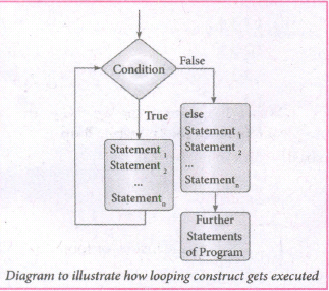
There may be situations in our real life programming where we need to skip a segment or set of statements and execute another segment based on the test of a condition. This is called alternative or branching.
55.
(i) To include an element at your desired position, you can use insert ( ) function. The insert( ) function is used to insert an element at any position of a list.
(ii) Syntax:
List.insert (position index, element)
56.
Syntax:
for index_var in list:
print (index_ var)
57.
Python programming language has four collections of data types such as List, Tuples, Set and Dictionary.
58.
An estimation of the time and space complexities of an algorithm for varying input sizes is called algorithm analysis.
59.
An algorithm that yields expected output for a valid input is called an algorithmic solution
60.
(i) The a > b or a == b = True
(ii) The a > b and a == b = False
(iii)The not a > b = False.
61.
Whitespace separation is necessary between tokens, identifiers or keywords.
62.
The output of the program
10
10
63.
The LEGB rule is used to decide the order in which the scopes are to be searched for scope resolution. The scopes are listed below in terms of hierarchy (highest to lowest).
64.
(i) A class defines a data abstraction by grouping related data items. A class is not just data, it has functions defined within it.
(ii) Functions are subordinate to the class because their job is to do things with the data of the class.

12th Standard Syllabus & Materials
12th Standard
TN 12th Computer Applications களப்பெயர் முறைமை (DNS) Sample Question Papers Study Material - QB365 Set A
NEW12th Standard
TN 12th Computer Applications வலையமைப்பு எடுத்துக்காட்டுகள் மற்றும் நெறிமுறைகள் Sample Question Papers Study Material - QB365 Set A
NEW12th Standard
TN 12th Computer Applications கணினி வலையமைப்பு ஓர் அறிமுகம் Sample Question Papers Study Material - QB365 Set A
NEW12th Standard
TN 12th Computer Applications PHP-உடன் MySQL-ஐ இணைத்தல் Sample Question Papers Study Material - QB365 Set A



Tamilnadu Stateboard 12th Standard Subjects

Maths

Chemistry

Physics

Biology
Computer Science

Business Maths and Statistics

Economics

Commerce

Accountancy

History

Computer Applications
Biology
Computer Technology
Computer Applications
Computer Science
Business Maths and Statistics
Commerce
Economics
Maths
Chemistry
Physics
Computer Technology
History
Accountancy

Tamil

English

French
Tamilnadu Stateboard Standards
