
 100% FREE ACCESS
12th Standard Syllabus & Materials
12th Standard
TN 12th Computer Applications மின்னணு தரவு பரிமாற்றம் Sample Question Papers Study Material - QB365 Set A
NEW12th Standard
TN 12th Computer Applications மின் - வணிக பாதுகாப்பு அமைப்புகள் Sample Question Papers Study Material - QB365 Set A
NEW12th Standard
TN 12th Computer Applications மின்னணு செலுத்தல் முறைகள் Sample Question Papers Study Material - QB365 Set A
NEW12th Standard
TN 12th Computer Applications மின் - வணிகம் Sample Question Papers Study Material - QB365 Set A
NEW12th Standard
TN 12th Computer Applications திறந்த மூல கருத்துருக்கள் Sample Question Papers Study Material - QB365 Set A
NEW12th Standard
TN 12th Computer Applications வலையமைப்பு வடமிடல் Sample Question Papers Study Material - QB365 Set A

Published on: 02/02/2021
12th Standard Computer Science English Medium Reduced Syllabus Important Questions with Answer key - 2021 Part - 2
Download Tamil Nadu 12th Standard Computer Science question papers, model tests, one-mark questions, important questions, and public exam papers in PDF format. Free study materials and answer keys for TN State Board students.
Questions + Answers key
Take MCQ Computer Science Test
1.
In which plot the width of the bars mayor may not be same?
Histogram
Pie chat
Bar chat
Line
2.
______ and_____ are the key features of object oriented programming.
List and tuples
Set and dictionary
Classes and objects
Variables and methods
3.
4.
What is the output of the following program? import csv
d=csv.reader(open('c:\PYPRG\ch13\city.csv'))
next(d)
for row in d:
print(row)
if the file called “city.csv” contain the following details
chennai,mylapore
mumbai,andheri
chennai,mylapore
mumbai,andheri
chennai,mumba
chennai,mylapore,mumbai,andheri
5.
Which of the following is the output of the following program?
class Student:
def __init__(self, name):
self.name=name
print (self.name)
S=Student(“Tamil”)
Error
Tamil
name
self
6.
What is the use of type() function in python?
To create a Tuple
To know the type of an element in tuple.
To know the data type of python object
To create a list.
7.
What will be the output of the following code?
str1 = "Chennai Schools"
str1[7] = "-"
Chennai-Schools
Chenna-School
Type error
Chennai
8.
What is the output of the following snippet?
T=1
while T:
print(True)
break
False
True
0
1
9.
Time complexity of bubble sort in best case is
θ (n)
θ (nlogn)
θ (n2)
θ (n(logn) 2)
10.
Which of the following is not a stable sorting algorithm?
Insertion sort
Quick sort
Merge sort
Selection sort
11.
Which of the following character is used to give comments in Python Program?
#
&
@
$
12.
The members that are accessible from within the class and are also available to its sub classes is called
Public members
Protected members
Secured members
Private members
13.
The data structure which is a mutable ordered sequence of elements is called
Built in
List
Tuple
Derived data
14.
The small sections of code that are used to perform a particular task is called
Subroutines
Files
Pseudo code
Modules
15.
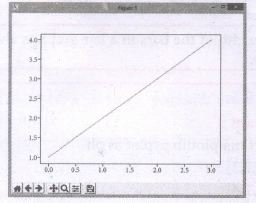
Write a python code to display the following plot.
16.
What is the purpose of using
(i) COUNT ( )
(ii) AVG ( )
(iii) SUM ( )
(iv) MAX ( )
(v) MIN ( )
17.
Write the key features of Python.
18.
What is MinGW? What is its use?
19.
Write any three DDL commands.
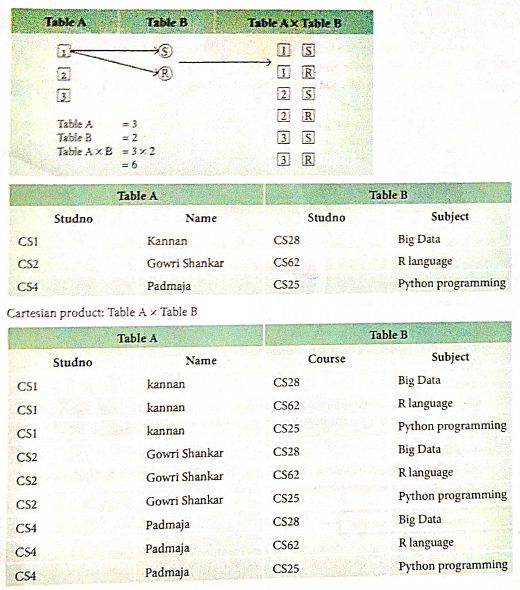
20.
21.
What is the output of the following program?
class Greeting:
def __init__(self, name):
self.__name = name
def display(self):
print("Good Morning ", self.__name)
obj=Greeting ('Bindu Madhavan')
obj.display()
22.
What are class members? How do you define it?
23.
Explain the difference between del and clear( ) in dictionary with an example.
24.
What is the use of format( )? Give an example.
25.
List the differences between break and continue statements.
26.
Write note on if..else structure.
27.
List the characteristics of an algorithm.
28.
Define Local scope with an example.
29.
What are the different ways to access the elements of a list. Give example.
30.
Wha happens if you modify a variable outside the function? Give an example.
31.
Mention the characteristics of Interface.
32.
Explain TCL commands in detail.
33.
Explain the components of DBMS.
34.
Explain different types arguments used in python with an example.
35.
Write a program to calculate area and circumference of a circle.
36.
How will you sort more than one column in a CSV file? Explain with an example.
37.
Explain with an example how will you return multiple values in tuples.
38.
Explain the concept access control.
39.
Explain the various buttons in a matplotlib window.
40.
Write a SQL statement to create a table for employee having any five fields and create a table constraint for the employee table.
41.
Differentiate DBMS and RDBMS.
42.
Write a Python code to find the L.C.M. of two numbers.
43.
Discuss about Linear search algorithm.
44.
How will you facilitate data abstraction. Explain it with suitable example.
45.
Identify in the following program
| let rec gcd a b:= if b <> 0 then gcd b (a mod b) else return a: |
i) Name of the function
ii) Identify the statement which tells it is a recursive function
iii) Name of the argument variable
iv) Statement which invoke the function recursively
v) Statement which terminates the recursion
46.
Why the following identifiers are invalid?
(i) 12 Name
(ii) name$
(iii) physics-mark
(iv) break
47.
What is the purpose of using Input-output functions?
48.
Write the output of the following program
a:=10
Disp():
a:=7
print a
Disp 1():
print a
49.
What are the types of variable scope
50.
How the elements of a list can be accessed?
51.
Give an example of implementing an ADT
52.
Give an example of function definition parameter with type.
53.
List the types of Visualizations in Matplotlib.
54.
Which method is used to fetch all rows from the database table?
55.
Mention the default modes of the File.
56.
Do you modify a string in Python?
57.
What is an Algorithm?
58.
What are the different modes that can be used to test Python Program?
59.
What is a Tuple? Give an example.
60.
What is abstract data type?
1.
(a)
Histogram
2.
(c)
Classes and objects
3.
(a)
4.
(b)
mumbai,andheri
5.
(b)
Tamil
6.
(c)
To know the data type of python object
7.
(c)
Type error
8.
(b)
True
9.
(a)
θ (n)
10.
(d)
Selection sort
11.
(a)
#
12.
(b)
Protected members
13.
(b)
List
14.
(a)
Subroutines
15.
Program:
import matplotlib.pyplot as plt
pIt.plot([1, 2, 3, 4]) ,
plt.show ( )
Output:
16.
(I) COUNT ( ) function returns the number of rows in a table.
(ii) AVG ( ) function retrieves the average of a selected column of rows in a table.
(iii) SUM ( ) function retrieves the sum of a selected column of rows in a table.
(iv) MAX( ) function returns the largest value of the selected column.
(v) MIN( ) function returns the smallest value of the selected column.
17.
(i) It is a general purpose programming language which can be, used for both scientific and non-scientific programming.
(ii) It is a platform independent programming language.
(iii) The programs written in Python are easily readable and understandable.
18.
(i) MinGW refers to a set of runtime header files, used in compiling and linking the code of C, C++ and FORTRAN to be run on Windows Operating System.
(ii) MinGw- W64 (version of MinGW) is the best compiler for C++ on Windows. To compile and execute the C++ program, need 'g++' for Windows. MinGW allows to compile and execute C++ program dynamically through Python program using g++.
(iii) Python program that contains the c++ coding can be executed only through 'MinGW_w64 project' run terminal. The run terminal open the command -line window through which Python program should be executed.
(iv) g++ is a program that calls GCC (GNU C compiler) and automatically links the required C++ Library files to the object code.
19.
Data Definition Language:
(i) Create Command: To create tables in the database.
CREATE TABLE Student
(Admno integer,
Name char(20),
Gender char(1),
Age integer,
Place char(10),
);
(ii) Alter Command: The ALTER command is used to alter the table structure like adding a column, renaming the existing column, change the data type of any column or size of the column or delete the column from the table.
ALTER TABLE <table-name> ADD <column-name><data type><size>;
To add a new column "Address" of type 'char' to the Student table, the command is used as
ALTER TABLE Student ADD Address char;
(iii) Drop Command: The DROP TABLE command is used to remove a table from the database.
The table can be deleted by DROP TABLE command in the following way:
DROP TABLE table-name;
20.
21.
Good Morning Bindu Madhavan.
22.
Variables defined inside a class are called as "Class Variable" and functions are called as "Methods. Class variable and methods are together known as members of the class. The class members should be accessed through objects or instance of class. A class can be defined anywhere in a Python program.
Defining classes: In Python, a class is defined by using the keyword class. Every class has a unique name followed by a colon (:).
Syntax for Defining a Class:
class class_name:
statement_1
statement_2
....................
....................
statement_n
23.
| del | Clear( ) | |
| (i) | The del statements is used to delete elements whose index is known. | The function clear ( ) is used to delete all the elements in list. |
| (ii) | The del statement can also be used to delete entire list. | It deletes only the elements and retains the list. |
| (iii) | Example: del Dict ["MarkT"] | Example : Dict.clear( ) |
24.
(i) The format( ) function used with strings is very versatile and powerful function used for formatting strings.
(ii) The curly braces {} are used as placeholders or replacement fields which get replaced along with format( ) function.
Example:
num1 = int (input("Number 1:"))
num2 = int (input("Number 2:"))
print ("The, sum of {} and {} is {}". format (num1, num2, (num1 + num2)))
Output:
Number 1: 34
Number 2: 54
The sum of 34 and 54 is 88.
25.
| Break | Continue |
| The break statement terminates the loop containing it. | The continue statement is used to skip the remaining part of a loop. |
| Control of the program flows to the statement immediately after the body ot the loop. | Control of the program flows start with next iteration |
| Syntax : break | Syntax : continue |
26.
(i) The if.. else statement provides control to check the true block as well as the false block,
(ii) Syntax :
if
statemets-block 1
else :
statement-block 2
(iii) if..else statement thus provides possibilities and the condition determines which BLOCK is to be executed.
27.
(i) Input
(ii) Output
(iii) Finiteness
(iv) Definiteness
(v) Effectiveness
(vi) Correctness
(vii) Simplicity
(viii) Unambiguous
(ix) Feasibility
(x) Portable
(xi) Independent
28.
(i) Local scope refers to variables defined in current function. Always, a function will first look up for a variable name in its local scope.
(ii) Only if it does not find it there, the outer scopes are checked.
(iii) Look at this example:
|
1. Disp(): |
Entire program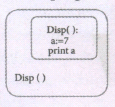 |
Output of the Program 7 |
(iv) On execution of the above code the variable a displays the value 7, because it is defined and available in the local scope.
29.
(i) The elements of a list can be accessed in two ways. The first way is via our familiar method of multiple assignment, which unpacks a list into its elements and binds each element to a different name.
lst := [10, 20]
x, y := lst
(ii) In the above example x will become l0 andy will become 20.
(iii) A second method for accessing the elements in a list is by the element selection operator. Unlike a list literal, a square brackets expression directly following another expression does not evaluate to a list value, but instead selects an element from the value of the preceding expression.
Ist [0]
10
lst [1]
20
30.
The most popular groups of side effects is modifying the variable outside of function.
For example:
let y: = 0
(int) inc (int) x
y: =y+x;
return (y)
In the above example the value of y get changed inside the function definition due to which the result will change each time.
31.
(i) The class template specifies the interfaces to enable an object to be created and operated properly.
(ii) An object's attributes and behaviour is controlled by sending functions to the object.
32.
TCL commands:
(i) COMMIT command: The COMMIT command is used to permanently save any transaction to the database. When any DML commands like INSERT. UPDATE. DELETE commands are used. the changes made by these commands are not permanent. It is marked permanent only after the COMMIT command is given from the SQL prompt. Once the COMMIT command is given. the changes made cannot be rolled back. The COMMIT command is used as COMMIT;
(ii) ROLLBACK command:
The ROLLBACK command restores the database to the last committed. state. It is used with SAVEPOINT command to jump to a particular savepoint location. The syntax for the ROLLBACK command is: ROLLBACK TO save point name;
(iii) SAVEPOINT command:
The SAVEPOINT command is used to temporarily save a transaction so that you can rollback to the point whenever required. The different states of our table can be saved at anytime using different names and the rollback to that state can be done using the ROLLBACK command.
SAVEPOINT savepoint_name;
33.
The Database Management System can be divided into five major components as follows:
(i) Hardware
(ii) Software
(iii) Data
(iv) Procedures / Methods
(v) Database Access Languages
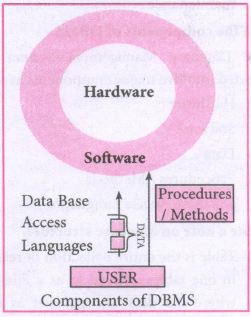
(i) Hardware: The computer, hard disk, I/O channels for data, and any other physical component involved in storage of data
(ii) Software: This main component is a program that controls everything. The DBMS software is capable of understanding the Database Access Languages and interprets into database commands for execution.
(iii) Data: It is that resource for which DBMS is designed. DBMS creation is to store and utilize data.
(iv) Procedures/Methods: They are general instructions to use a database management system such as installation of DBMS, manage databases to take backups, report generation, etc
(v) DataBase Access Languages: They are the languages used to write commands to access, insert, update and delete data stored in any database.
Examples of popular DBMS: Dbase, FoxPro
34.
(i) Required Arguments:
"Required Arguments" are the arguments passed to a function in correct positional order. Here, the number of arguments in the function call should match exactly with the function definition. Atleast one parameter to prevent syntax errors to get the required output.
(ii) Example:
def printstring(str):
print ("Example - Required arguments")
print (str)
return
# Now you can call printstring() function
printstring ("Welcome")
Output:
Example - Required arguments
Welcome
(iii) When the above code is executed, it produces the following error.
Traceback (most recent call last):
File "Req-arg.py", line 10, in
printstring()
TypeError: printstring() missing 1 required positional argument: 'str'
(iv) Instead of printstring() in the above code if we use printstring ("Welcome") then the output is
Output:
Example - Required arguments
Welcome
Keyword Arguments:
Keyword arguments will invoke the function after the parameters are recognized by their parameter names. The value of the keyword argument is matched with the parameter name and so, one can also put arguments in improper order (not in order).
(ii) Example:
def printdata (name):
print ("Example-1 Keyword arguments")
print ("Name :":name)
return
# Now you can call printdatat() function
printdata(name = "Gshan")
(iii) When the above code is executed, it produces the following output:
Output:
Example-1 Keyword arguments
Name:Gshan
Default Arguments:
In Python the default argument is an argument that takes a default value if no value is provided in the function call. The following example uses default arguments, that prints default salary when no argument is passed.
Example:
def printinfo( name, salary = 3500):
print ("Name: ", name)
print ("Salary: ", salary)
return
printinfo("Mani")
(iii) When the above code is executed, it produces the following output
Output:
Name: Mani
Salary: 3500
(iv) When the above code is changed as print info("Ram,":2000) it produces the following output:
Output:
Name: Ram
Salary: 2000
Syntax - Variable-Length Arguments:
(i) def function_name(*args):
function_body
return_statement
(ii) Example:
def printnos (*nos):
for n in nos:
print(n)
return
# now invoking the printnos() function
print ('Printing two values')
printnos (1,2)
print ('Printing three values')
printnos (10,20,30)
Output:
Printing two values
1
2
Printing three values
10
20
30
35.
class Circle:
pi=3.14
def _init_(self.radius):
self.radius=radius
def area(self):
return Circle. pi*(self.radius**2)
def circumference(self):
return 2*Circle.pi*self.radius
r=int(input("Enter Radius: "))
Ce=Circle(r)
print("The Area =",C.area())
print("The Circumference =", Cxircumferencet())
36.
To sort by more than one column you can use itemgetter with multiple indices: operator. itemgetter (1,2).
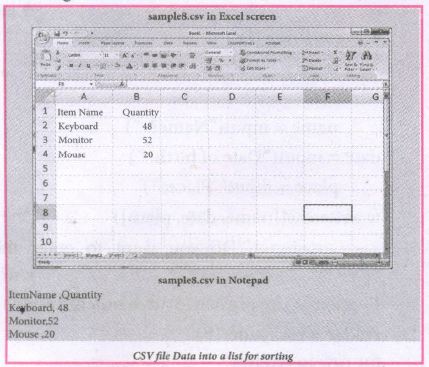
The following program do the task mentioned above using operator.itemgetter(col_no)
Example:
# Program to sort the entire row by using a specified column.
# declaring multiple header files
import csv, operator
#One more way to read the file
data = csv.reader(open('c:\\PYPRG\ \sample8.csv'))
next(data) #(to omit the header)
#using operator module for sorting multiple columns
sortedlist = sorted (data, key=operator.
itemgetter(1) # 1 specifies we want to sort
# according to second column for row in sortedlist:
print(row)
Output:
['Mouse', '20']
['Keyboard', '48']
['Monitor', '52']
37.
(i) A function can return only one value at a time, but Python returns more than one value from a function. Python groups multiple values and returns them together.
(ii) Example: Program to return the maximum as well as minimum values in a list
def Min_Max(n):
a = max(n)
b = min(n)
return (a, b)
Num = (12, 65, 84, 1, 18, 85, 99)
(Max_Num, Min_Num) = Min_Max(Num)
print("Maximum value = ", Max_Num)
print("Minimum value = ", Min_Num)
(iii) Output:
Maximum value = 99
Minimum value = 1
38.
(i) Access control is a security technique that regulates who or what can view or use resources in a computing environment.
(ii) It is a fundamental concept in security that minimizes risk to the object.
(iii) In other words access control is a selective restriction of access to data. IN Object oriented programming languages it is implemented through access modifiers.
(iv) Classical object-oriented languages, such as C++ and Java. control the access to class members by public, private and protected keywords.
(v) Private members of a class are denied access from the outside the class. They can be handled only from within the class.
(vi) Public members (generally methods declared in a class) are accessible from outside the class. The object of the same class is required to invoke a public method. This arrangement of private instance variables and public methods ensures the principle of data encapsulation.
(vii) Protected members of a class are accessible from within the class and are also available to its sub-classes. No other process is permitted access to it. This enables specific resources of the parent class to be inherited by the child class.
(viii) Python doesn't have any mechanism that effectively restricts access to any instance variable or method. Python prescribes a convention of prefixing the name of the variable or method with single or double underscore to emulate the behaviour of protected and private access specifiers.
(ix) All members in a Python class are public by default. whereas by default in C++ and java they are private. Any member can be accessed from outside the class environment in Python which is not possible in C++ and java.
39.
(i) Home Button \(\rightarrow \) The Home Button will help one to begun navigating the chart. If you ever want to return back to the original view, you can click on this.
(ii) Forward/Back buttons \(\rightarrow \) These buttons can be used like the Forward and Back buttons in browser. Click these to move back to the previous point you were at, or forward again.
(iii) Pan Axis \(\rightarrow \) This cross-looking button allows you to click it, and then click and drag graph around.
(iv) Zoom \(\rightarrow \) The Zoom button lets you click on it, then click and drag a square would like to zoom into specifically. Zooming in will require a left click and drag. Zoom out with a right click and drag.
(v) Configure Subplots\(\rightarrow \) This button allows you to configure various spacing options with figure and plot.
(vi) Save Figure \(\rightarrow \)This button will allow you to save figure in various forms
40.
Table constraint:
Table constraint apply to a group of one or more columns. The Syntax tor a table created with Constraint is given as below:
CREATE TABLE <table_name>
(<column name> <datatype>[<size>]
<column constraint>,
(<column name> <data type> [<size>]
<column constraint).....
<table constraint>(<column name>, [<column name>..........])............);
Following is an example for employee table with "NOT NULL' column constraint. This constraint enforces a field to always contain a value.
CREATE TABLE employee (No int NOT NULL PRIMARY KEY,
NAME varchar(50), Age int (10), Address varchar(50)
PhoneNo int(10), Pincode int (6) PRIMARY KEY (NAME, PhoneNo);
The above command creates a table "employee" in which the field No of integer type is defined NOT NULL, which means this field must have values. The field NAME is of char type. The fields NAME, PhoneNo, have table constraint.
41.
| Basis of Comparison | DBMS | RDBMS |
|---|---|---|
| Expansion | Database Management System | Relational Database Management System |
| Data storage | Navigational model ie data by linked records | Relational model (in tables). ie data in tables as row and column |
| Data redundancy | Exhibit | Not Present |
| Normalization | Not performed | RDBMS uses normalization to reduce redundancy |
| Data access | Consumes more time | Faster, compared to DBMS. |
| Keys and indexes | Does not use. | used to establish relationship. Keys are used in RDBMS. |
| Transaction management | Inefficient, Error prone and insecure | Efficient and secure |
| Distributed Databases | Not supported | Supported by RDBMS. |
| Example | Dbase, FoxPro. | SQL server, Oracle, mysql, MariaDB, SQLite. |
42.
Program:
def lcm(x, y):
if x>y:
greater = x
else:
greater = y
while (True):
if ((greater % x == 0) and (greater % y ==0))
lcm = greater
break
greater + = 1
return lcm
a = int (input ("Enter the first number:"))
b = int (input ("Enter the second number: "))
print ("The L.C.M of", a, "and", b, "is", lcm (a, b))
[OR]
Method II: (without using functions)
a = int (input ("Enter the first number:"))
b = int (input ("Enter the second number:"))
if a>b:
mini a
else:
min 1 = b
while (1):
if (min 1% a 0 and mini 1% b=0):
print ("LCM is:", mini)
break
mini = min 1+1
Output:
Enter the first number: 15
Enter the second number: 20
LCM is: 60
43.
(i) Linear search also called sequential search is a sequential method for finding a particular value in a list.
(ii) This method checks the search element with each element in sequence until the desired element is found or the list is exhausted. In this searching algorithm, list need not be ordered.
procedure :
1. Traverse the array using for loop
2. In every iteration, compare the target search key value with the current value of the list.
(i) If the values do not match, move on to the next array element.
(ii) If the values match, display the current index and value of the array.
3. If no match is found, display the search element not found.
(iii) To search the number 25 in the array given below, a linear search will go step by step in a sequential order starting from the first element in the given array if the search element is found that index is returned otherwise the search is continued till the last index of the array. In this example number 25 is found at index number 3.
| index | 0 | 1 | 2 | 3 | 4 |
| values | 10 | 12 | 20 | 25 | 30 |
Example 1:
Input: values[] = {5, 34, 65, 12, 77, 35)
target = 77
Output: 4
Example 2:
Input: values[] = [101, 392, 1, 54, 32, 22, 90, 93) target = 200
Output: -1 (not found)
44.
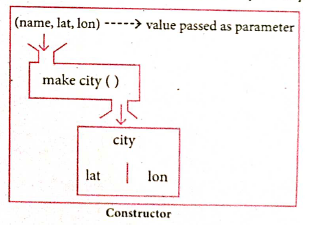
Data abstraction is used to define an Abstract Data Type (ADT), which is a collection of constructors and selectors. T facilitate data abstraction,you will need to create two types of functions : Constructors and Selectors.
Constructors :
(i) Constructors are functions that build the abstract data type.
(ii) Constructors create an object, bundling together different pieces of information.
(iii) For example, say you have an abstract data type called city.
(iv) This city object will hold the city's name, and its latitude and longitude.
(v) To create a city object, you'd use a function like city = makecity (name, lat, lon).
(vi) Here makecity (name, lat, lon) is the constructor which creates the object city.
Selectors :
(i) Selectors are functions that retrieve information from the data type.
(ii) Selectors extract individual pieces of information fromn the object.
(iii) To extract the information of a city object, you wouldused functions like
getname(city)
getlat(city)
getlon(city)
These are the selectors because these functions extract the information of the city object.
.png)
45.
(i) gcd
(ii) let rec gcd
(iii) a, b
(iv) gcd(a mod b)
(v) return a
46.
(i) An identifies must start with an alphabet.
(ii) No punctuation characters are allowed.
(iii) Only underscore (-) allowed.
(iv) Identifiers must not be a Python keyword.
47.
The input () function helps to enter data at run time by the user and the output function print () is used to display the result of the program on the screen after execution.
48.
The output of the program
7
10
49.
(i) Local scope
(ii) Enclosed scope
(iii) Global scope
(iv) Built-in scope
50.
(i) The elements of a list can be accessed in two ways.
(ii) The first way is via multiple assignment and the second method is by the element selection operator
51.
(i) There can be different ways to implement an ADT, for example, the, List ADT can be implemented using singly linked list or doubly linked list.
(ii) Similarly, stack ADT and Queue ADT can be implemented using lists
52.
(requires: b > 0 )
(returns: a to the power of b)
let rec pow (a: int) (b: int) : int :=
if (b=0) then 1
else a * pow b (a-1 )
53.
(i) Line plot
(ii) Scatter plot
(iii) Histogram
(iv) Box plot
(v) Bar chart and
(vi) Pie chart
54.
The fetchall() method is used to fetch all rows from the database table.
result = cursor. fetchall()
55.
The default is reading in text mode. In this mode, while reading from the file the data would be in the format of strings.
56.
Strings in python are immutable. That means, once you define a string moditications or deletion is not allowed. However, we can replace the existing string entirely with the new string.
57.
An algorithm is a finite set of instructions to accomplish a particular task. It is a step-by-step procedure for solving a given problem.
58.
(i) In Python, programs can be written in two namely Interactive mode and script mode.
(ii) Interactive mode allows us to write codes in Python command prompt (>>>).
(iii) Script mode is used to create and edit python source file.
59.
(i) A tuple is a comma-separated sequence of values surrounded with parentheses. Tuple is similar to a list.
(ii) The difference between the two is that you cannot change the elements of a tuple once it is assigned whereas in a list, elements can be changed
(iii) Example : colour = ('red', 'blue, 'Green')
60.
(i) Abstract Data type (ADT) is a type (or class) for objects whose behavior is defined by a set of value and a set of operations.
(ii) The definition of ADT only mentions what operations are to be performed but not how these operations will be implemented.

12th Standard Syllabus & Materials
12th Standard
TN 12th Computer Applications களப்பெயர் முறைமை (DNS) Sample Question Papers Study Material - QB365 Set A
NEW12th Standard
TN 12th Computer Applications வலையமைப்பு எடுத்துக்காட்டுகள் மற்றும் நெறிமுறைகள் Sample Question Papers Study Material - QB365 Set A
NEW12th Standard
TN 12th Computer Applications கணினி வலையமைப்பு ஓர் அறிமுகம் Sample Question Papers Study Material - QB365 Set A
NEW12th Standard
TN 12th Computer Applications PHP-உடன் MySQL-ஐ இணைத்தல் Sample Question Papers Study Material - QB365 Set A



Tamilnadu Stateboard 12th Standard Subjects

Maths

Chemistry

Physics

Biology
Computer Science

Business Maths and Statistics

Economics

Commerce

Accountancy

History

Computer Applications
Biology
Computer Technology
Computer Applications
Computer Science
Business Maths and Statistics
Commerce
Economics
Maths
Chemistry
Physics
Computer Technology
History
Accountancy

Tamil

English

French
Tamilnadu Stateboard Standards
