
 100% FREE ACCESS
12th Standard Syllabus & Materials
12th Standard
TN 12th Maths Applications of Matrices and Determinants Sample Question Papers Study Material - QB365 Set A
NEW12th Standard
TN 12th Computer Applications மின்னணு தரவு பரிமாற்றம் Sample Question Papers Study Material - QB365 Set A
NEW12th Standard
TN 12th Computer Applications மின் - வணிக பாதுகாப்பு அமைப்புகள் Sample Question Papers Study Material - QB365 Set A
NEW12th Standard
TN 12th Computer Applications மின்னணு செலுத்தல் முறைகள் Sample Question Papers Study Material - QB365 Set A
NEW12th Standard
TN 12th Computer Applications மின் - வணிகம் Sample Question Papers Study Material - QB365 Set A
NEW12th Standard
TN 12th Computer Applications திறந்த மூல கருத்துருக்கள் Sample Question Papers Study Material - QB365 Set A

Published on: 05/09/2022
QB365 provides a detailed and simple solution for every Possible Creative Questions in Class 12 Computer Science Subject - Scoping , English Medium. It will help Students to get more practice questions, Students can Practice these question papers in addition to score best marks.
Download Tamil Nadu 12th Standard Computer Science question papers, model tests, one-mark questions, important questions, and public exam papers in PDF format. Free study materials and answer keys for TN State Board students.
Questions + Answers key
Take MCQ Computer Science Test
1.
Explain in detail about access control techniques?
2.
Explain in detail about modular programming an list out the benefits of modular programming.
3.
Explain in detail about LEGB rule with an example?
4.
Explain in detail about the scope, variable scope and lifetime of a variable.
5.
Explain in detail about mapping with an example?
6.
Explain the concept access control.
1.
1. Access control is a security technique that regulates who or what can view or use resources in a computing environment. It is a fundamental concept in security that minimizes risk to the object. In other words, access control is a selective restriction of access to data.
2. In object oriented programming languages it is implemented through access modifiers. Classical object oriented language, such as C++ and java, control the access to class members by public, private and protected Keywords.
3. Private members of a class are denied access from the outside the class. They can be handled only from within the class.
4. Public members are accessible from outside the class. This arrangement of private instance variables and public methods ensures the principle of data encapsulation.
5. Protected members of a class are accessible from within the class and are also available to its sub-classes.
6. This enables specific resources of the parent class to be inherited by the child class.
2.
A module is a part of a program, Programs are composed of one or more independently developed modules A single module can contain one or several statements closely related each other. Modules. work perfectly on individual level and can be integrated with other modules.
A software program can be divided into modules to ease the job of programming and debugging as well. A program can be divided into small functional modules that work together to get the output.
The process of subdividing a computer program into separate sub-programs is called modular programming.
Modular programming enables programmers to divide up the work and debug pieces of the program independently. The examples of modules are procedures, subroutines, and functions.
Benefits:
(i) Less code to be written.
(ii) The code is stored across multiple files.
(iii) Code is short, simple and easy to understand.
(iv) Errors can easily be identified, as they are localized to a subroutine or function.
(v) The same code can be used in many applications.
(vi) The scoping of variables can easily be controlled.
3.
Scope also defines the order in which variables have to be mapped to the object in order to obtain the value.
Example:
1. x:= 'outer x variable'
2. display ():
3. x:= 'inner x variable'
4. print x
s. display 0
When the above statements are executed the statements 4 and 5 display the result as
Output:
Outer x variable
inner x variable
Above statements give different outputs because the same variable name x resides in different scopes, one inside the function display () and the other in the upper level.
The value 'outer x variable' is printed When x is referenced outside the function definition. Whereas when display() gets executed, 'inner x variable' is printed which is the x value inside the function definition.
A rule is followed in order to decide from which scope a variable has to be picked.
The LEGB rule is used to decide the order in which the scopes are to be searched for scope resolution. The scopes are listed below in terms of hierarchy.


4.
Scope:
The scope of a variable is that part of the code where it is visible.
Variable Scope:
Essentially, they're addresses to an object in memory. When we assign a variable with := to an instance, we're binding the variable to that instance - Multiple variables can be mapped to the same instance.
Lifetime Variable:
The lifetime of the variable is only till the end of the procedure. Also, the duration for which a variable is alive is called its 'lifetime'.
5.
The process of binding a variable name with an object is called mapping. = (equal to sign) is used in programming languages to map the variable and object.
Programming languages keeps track of all these mappings with namespaces. Namespaces are containers for mapping names of variables to objects.
The words are mapped with its meaning in dictionaries whereas names are mapped with objects in programming language. This allows access to objects by names we choose to assign to them.
In the following example, a is first mapped to the integer 5. In this case, a is the variable name, while the integer value 5 is the object.
Then, b is set equal to a. This actually means that b is now bound to the same integer value as a, which is 5.
(i) x:=5
(ii) b:=a
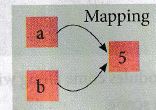
Now consider the following extension of the above statements
(i) a:=5
(ii) b:=a
(iii) n:=3
If we then change a to be equal to 3, a
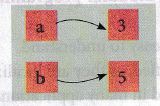
6.
(i) Access control is a security technique that regulates who or what can view or use resources in a computing environment.
(ii) It is a fundamental concept in security that minimizes risk to the object.
(iii) In other words access control is a selective restriction of access to data. IN Object oriented programming languages it is implemented through access modifiers.
(iv) Classical object-oriented languages, such as C++ and Java. control the access to class members by public, private and protected keywords.
(v) Private members of a class are denied access from the outside the class. They can be handled only from within the class.
(vi) Public members (generally methods declared in a class) are accessible from outside the class. The object of the same class is required to invoke a public method. This arrangement of private instance variables and public methods ensures the principle of data encapsulation.
(vii) Protected members of a class are accessible from within the class and are also available to its sub-classes. No other process is permitted access to it. This enables specific resources of the parent class to be inherited by the child class.
(viii) Python doesn't have any mechanism that effectively restricts access to any instance variable or method. Python prescribes a convention of prefixing the name of the variable or method with single or double underscore to emulate the behaviour of protected and private access specifiers.
(ix) All members in a Python class are public by default. whereas by default in C++ and java they are private. Any member can be accessed from outside the class environment in Python which is not possible in C++ and java.

12th Standard Syllabus & Materials
12th Standard
TN 12th Computer Applications வலையமைப்பு வடமிடல் Sample Question Papers Study Material - QB365 Set A
NEW12th Standard
TN 12th Computer Applications களப்பெயர் முறைமை (DNS) Sample Question Papers Study Material - QB365 Set A
NEW12th Standard
TN 12th Computer Applications வலையமைப்பு எடுத்துக்காட்டுகள் மற்றும் நெறிமுறைகள் Sample Question Papers Study Material - QB365 Set A
NEW12th Standard
TN 12th Computer Applications கணினி வலையமைப்பு ஓர் அறிமுகம் Sample Question Papers Study Material - QB365 Set A



Tamilnadu Stateboard 12th Standard Subjects

Maths

Chemistry

Physics

Biology
Computer Science

Business Maths and Statistics

Economics

Commerce

Accountancy

History

Computer Applications
Biology
Computer Technology
Computer Applications
Computer Science
Business Maths and Statistics
Commerce
Economics
Maths
Chemistry
Physics
Computer Technology
History
Accountancy

Tamil

English

French
Tamilnadu Stateboard Standards
