
 100% FREE ACCESS
12th Standard Syllabus & Materials
12th Standard
TN 12th Computer Applications மின்னணு தரவு பரிமாற்றம் Sample Question Papers Study Material - QB365 Set A
NEW12th Standard
TN 12th Computer Applications மின் - வணிக பாதுகாப்பு அமைப்புகள் Sample Question Papers Study Material - QB365 Set A
NEW12th Standard
TN 12th Computer Applications மின்னணு செலுத்தல் முறைகள் Sample Question Papers Study Material - QB365 Set A
NEW12th Standard
TN 12th Computer Applications மின் - வணிகம் Sample Question Papers Study Material - QB365 Set A
NEW12th Standard
TN 12th Computer Applications திறந்த மூல கருத்துருக்கள் Sample Question Papers Study Material - QB365 Set A
NEW12th Standard
TN 12th Computer Applications வலையமைப்பு வடமிடல் Sample Question Papers Study Material - QB365 Set A

Published on: 12/02/2020
12th Standard Economics All Chapter Bookback and Important Questions-II-2019-2020
Download Tamil Nadu 12th Standard Economics question papers, model tests, one-mark questions, important questions, and public exam papers in PDF format. Free study materials and answer keys for TN State Board students.
Questions + Answers key
Take MCQ Economics Test
1.
Match the correct codes
| 1 | A fee | i | Charged by public authorities for rendering a service to the citizens |
| 2 | A fine | ii | A penalty imposed on an individual for violation of law |
| 3 | Earnings from Public Enterprises | iii | The Government also gets revenue by way of surplus from public enterprises |
| 4 | A grant | iv | One government to another is an important source of revenue |
(1) – (i) (2) – (ii) (3) – (iv) (4) – (iii)
(1) – (ii) (2) – (iii) (3) – (iv) (4) – (i)
(1) – (iv) (2) – (iii) (3) – (i) (4) – (ii)
(1) – (i) (2) – (ii) (3) – (iii) (4) – (iv)
2.
Impact of a tax refers to
Final money burden
Immediate money burden
Indirect real burden
None of the above
3.
Income tax satisfies the canon of …………….?
equity
equality
economy
efficiency
4.
Which of the following is correct representation in terms of trade agreement?
EU < CM > CU > FTA
EU > CM > CU > FTA
EU > CM< CU > FTA
EU< CM < CU < FTA
5.
Until _________ became the member of World Bank in 1980, India was the largest beneficiary of the World Bank assistance.
South Africa
China
Nepal
Indonesia
6.
As of now, The IBRD has _________ member countries.
188
189
35
210
7.
The Cambridge version of the quantity theory of money was developed by:
Fisher
Alfred Marshall
Pigou
Keynes
8.
What is considered as the starting point of Keynes theory of employment and income?
The principle of effective demand
The principle of effective supply
The principle of effective equilibrium
Say’s Market Law
9.
The missing part of the cycle
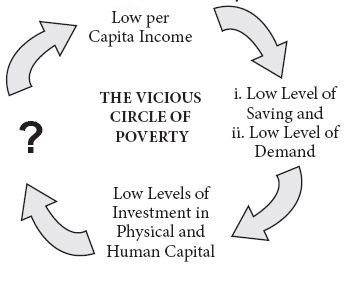
Low income
Low tax
Low productivity
Low investment
10.
Expand the CDR.
Cash Deposit Ratio (CDR)
Currency Digital Ratio (CDR)
Currency Deposit Ratio (CDR)
Currency Deposit Ration (CDR)
11.
Identify an example of digital currency.
crypto currencies
ATM
Legal Tender Money
None of the above
12.
Capital formation refers to the net addition to the ___________ which are either tangible like plants and machinery or intangible like health, education, and research.
existing flow of capital goods
old stock of capital goods
anticipated flow of capital goods
existing stock of capital goods
13.
What are the income limits of Middle Income Countries as per World Development Report?
GNI Per Capita Ranging Between $ 906 And $ 11, 115
GDP Per Capita Ranging Between $ 906 And $ 11, 115
Per Capita Ranging $ 11, 115 and above
GDP Per Capita Ranging Between $ 906 or below
14.
How many divisions of operations that NSSO has?
four divisions
three divisions
five divisions
two divisions
15.
The term ‘Regression’ was first coined and used in 1877 by________.
Hicks
Friedman
Galton
Spearman
16.
Find the equation of multiple correlation.
Qd= f (P, Pc, Ps, t, y)
X= a – bx
Y= a + bx
Y= a – bx
17.
The value of ‘intermediate goods’ are excluded from GDP calculation because
It will increase the GDP unduly
It results in double counting of same value
Intermediate goods are not important
All the above
18.
Absolute advantage is determined by
actual differences in labor productivity between countries
relative differences in labor productivity between countries.
both (a) and (b)
neither (a) nor (b)
19.
Which of the following statements are correct?
1. A new study has found that changes in solar activity contributed no more than 10 percent to global warming in the 20th century published in the journal Environmental Research Letters.
2. It has been proposed that cosmic rays may have a role in cooling the earth by encouraging clouds to form, which subsequently reflect the sun’s rays back into space.
3. Researchers found a high correlation between cosmic rays and global temperatures occurring every 22 years.
1 only
1 and 2 only
2 and 3 only
All of the above
20.
The marginal propensity to save is defined as:
1-ΔC/ΔY
S/Y
Y/S
Y/ΔS
21.
Assertion: If the market forces of demand and supply are allowed to play freely, equilibrium will be automatically restored in course of time
Reason: Under the free exchange rate system, the automatic adjustments of the balance of payments can take place through changes in the variables like price, interest, income and capital flows.
Both (A) and (R) are true and (R) is the correct explanation of (A)
Both (A) and (R) are true, but (R) is not the correct explanation of (A)
(A) is true, but (R) is false
(A) is false, but (R) is true
22.
Find the odd one in the context green house effect.
Oxygen
Carbon dioxide
methane
Chlorofluoro Carbon
23.
The relationship between the ___________ and _________is generally explained in the form of a “Material Balance Model’’ developed by AlenKneese and R.V. Ayres.
economy and the ecosystem
society and the environment
ecosystem and society
economy and the environment
24.
Find the missing flow of concept of H-O Theorem. Abundance of skilled labour → specialisation → ………?……..→ exchange for goods are services produced by countries with abundance of unskilled labour
import
export
devaluation
factor endowment
25.
Which of the following is not a macroeconomic goal?
Full Employment
Price Stability
Economic Security
All of the above are macro economic goals
26.
Who defined the following statement for an economy? “A system by which people earn their living.”
J.R. Hicks
A.J. Brown
J.S. Mill
J.M. Keynes
27.
Consumption function is the relationship ______ between and the national income.
Consumption expenditure
Government expenditure
Distribution expenditure
Investment expenditure
28.
If the Keynesian consumption function is C = 10 + 0.8Y then, if disposable income is Rs 1000, what is amount of total saving?
810
190
0.8
0.81
29.
__________ Framework is useful for economists as well as policy makers.
Social Accounting
Statistics
Capital Gains
None of these
30.
____________ attributes unemployment to a lack of effective demand.
J.M. Keynes
J.B.Say
Wonnacott
Marshall
31.
Say's law of market is the core of the __________ theory of employment.
classical
economical
environmental
proportional
32.
Formula for calculating NNP at factor cost.
\(\frac{Nominal\ GDP}{Real\ GDP}\times 100\)
NNP at Market Prices - Indirect taxes + Subsidies.
GNP - Depreciation allowance
Output = Income = Expenditure
33.
_________ is the life blood of all the activities.
Finance
Sales
Deposits
Loans
34.
Finance is the life blood of all economic activities such as________
trade
commerce
agriculture
all the above
35.
RBI will act as the banker to the ___________
Private concern
Society
Government of India
Both 'a' and 'b'
36.
Identify the Father of Scientific Socialism.
Adamsmith
J.M. Keynes
Karl Marx
Marshall
37.
Econometric is the word coined by
Francis Galton
Ragnar Frish
Karl Person
Spearsman
38.
The word 'statistics' is used as _______
Singular.
Plural
Singular and Plural.
None of above
39.
The Chair Person of NITI Aayog is
Prime Minister
President
Vice - President
Finance Ministed
40.
41.
The common source of outdoor air pollution is caused by combustion processes from the following ______________
Heating and cooking
Traditional stoves
Motor vehicles
All the above
42.
Ecosystem is smallest unit of
Ionosphere
Lithosphere
Biosphere
Mesosphere
43.
Which one of the following deficits does not consider borrowing as a receipt?
Revenue deficit
Budgetary deficit
Fiscal deficit
Primary deficit
44.
Methods of repayment of public debt is
Conversion
Sinking fund
Funded debt
All these
45.
BENELUX is a form of
Free trade area
Economic Union
Common market
Customs union
46.
International Monetary Fund is having its headquarters at
Washington D.C.
New York
Vienna
Geneva
47.
Benefits of FDI include, theoretically
Boost in Economic Growth
Increase in the import and export of goods and services
Increased employment and skill levels
All of these
48.
49.
Bank Rate means.
Re-discounting the first class securities
Interest rate
Exchange rate
Growth rate
50.
Central bank is_____ authority of any country.
Monetary
Fiscal
Wage
National Income
51.
“Money can be anything that is generally acceptable as a means of exchange and that thesame time acts as a measure and a store of value”, This definition was given by
Crowther
A.C.Pigou
F.A.Walker
Francis Bacon
52.
___________inflation occurs when general prices of commodities increases due to increase in production costs such as wages and raw materials.
Cost-push
demand pull
running
galloping
53.
According to Keynes, investment is a function of the MEC and ____.
Demand
Supply
Income
Rate of interest
54.
The average propensity to consume is measured by _____.
C/Y
CxY
Y/C
C+Y
55.
In Keynes theory of employment and income, ___________ is the basic cause of economic depression
Less production
More demand
Inelastic supply
Less aggregate demand in relation to productive capacity
56.
Aggregate supply is equal to ___________.
C + I + G
C + S + G + (x - m)
C + S + T + (x - m)
C + S + T + Rf
57.
The financial year in India is__________
April 1 to March 31
March 1 to April 30
March 1 to March 16
January 1 to December 31
58.
Income method is measured by summing up of all forms of__________
Production
Taxes
expenditure
Income
59.
A steady increase in general price level is termed as_____________.
wholesale price index
Business Cycle
Inflation
National Income
60.
61.
What is role of state on infrastructure?
62.
What is Moral Suasion?
63.
What is “Banking Ombudsman Scheme”
64.
Distinguish between planning by direction and inducement.
65.
Mention the components of Money Supply in India.
66.
What is the main criticism of Keynes on Classicals?
67.
What is Aggregate supply?
68.
Write some of econometric software that you may know.
69.
List the Types of Exchange Rates Exchange rates
70.
What is Gross Nation Product at Market Price (GNPMP)?
71.
What are positive and negative multipliers?
72.
What are the dimensions of sustainable development?
73.
Find the missing value in the given schedule of consumption function.
| Question | ||
| Income | Consumption | Savings |
| Y | C | S |
| 0 | 20 | -20 |
| 60 | 70 | -10 |
| 120 | 120 | ? |
| 180 | 170 | 10 |
| 240 | ? | 20 |
| 300 | 270 | ? |
| 360 | 320 | ? |
74.
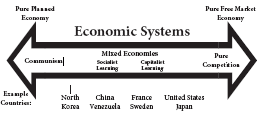
Draw the chart depicting various systems of economy
75.
Write any four functions of WTO.
76.
Write a short note on Capital Gains.
77.
What is financial planning?
78.
Write the formula for aggregate supply?
79.
Write a short note on wage-price spiral
80.
Who is the controll authority of socialistic economy?
81.
Give the countries which have communism.
82.
What is Mixed Economy?
83.
84.
What are the kinds of Statistics?
85.
What are the social indicators of economic development?
86.
What do you mean by ecosystem?
87.
Write a short note on zero based budget.
88.
89.
Define Commercial banks.
90.
What is commodity money?
91.
Define average propensity to consume (APC).
92.
What is effective demand?
93.
Define full employment.
94.
What is the difference between NNP and NDP?
95.
‘Circular Flow of Income’ - Define.
96.
Explain the Components of GST.
97.
Differentiate CRR and SLR.
98.
What are the major objectives of WTO?
99.
Explain the concept of Plastic Money.
100.
Distinguish between Fictional and Structural unemployment.
101.
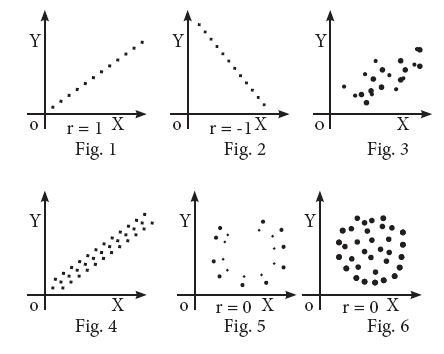
Given the diagrams, find the nature of correlation of various figures.
102.
What are the five types of final goods and services that GNP includes?
103.
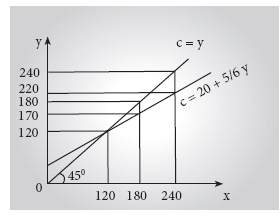
Draw the diagram depicting the psychological law of consumption.
104.
Explain different types of Noise.
105.
What are limitations from which Macro economics suffer?
106.
Write the measures to correct BOP Disequilibrium.
107.
What are the general advantages of International Trade?
108.
What are the main objectives of planning in India?
109.
Specify the objectives of econometrics.
110.
Elucidate major causes of vicious circle of poverty with diagram
111.
What is land pollution? Mention the causes of land pollution.
112.
What is primary deficit?
113.
Mention any three lending programmes of IMF.
114.
Distinguish between Balance of Trade and Balance of Payments.
115.
What are the functions of NABARD?
116.
117.
Specify the limitations of the multiplier.
118.
According to classical theory of employment, how wage reduction solve the problem of unemployment diagramatically explain.
119.
Write briefly about national income and welfare
120.
Indicate the demerits of socialism.
121.
What are the taxes levied and collected by the union but assigned to the states?
122.
Compare and contrast RBI and other Commercial Banks.
123.
Compute the Pearson r for the same sets of data using the raw score method
| X | 9, | 13, | 6, | 18, | 14, | 12, | 11, | 7, | 2, | 6, | 14, | 15, | 5, | 8, |
| Y | 23, | 40, | 10, | 48, | 25, | 30, | 15, | 10, | 5, | 45, | 40, | 35, | 12, | 27 |
124.
Elucidate various measures of economic development.
125.
In each of the following scenarios, classify the individual as frictionally, structurally, or cyclically unemployed. Explain your classification.
(a) There has been a general economic slow down. Because of weak demand, Kumar has lost his portering job at the railway station.
(b) Sathish, a newly qualified dental graduate, is looking for a place to set up practice.
(c) Latha is thrown out of work by the introduction of a more mechanized production process.
(d) Devi, a computer programmer with a large bank, quit her job two months ago in search of a better-paid programming position. She is still looking.
126.
Explain Adam Smith’s Theory of Absolute Cost Advantage.
127.
Explain the three sector model of economy with chart.
128.
Explain Marginal propensity to consume and multiplier, with the help of a diagram.
129.
Discuss the methods of measuring the National Income by Product Method.
130.
Explain the operation of the Accelerator.
1.
(c)
(1) – (iv) (2) – (iii) (3) – (i) (4) – (ii)
2.
(d)
None of the above
3.
(a)
equity
4.
(b)
EU > CM > CU > FTA
5.
(b)
China
6.
(b)
189
7.
(c)
Pigou
8.
(a)
The principle of effective demand
9.
(c)
Low productivity
10.
(c)
Currency Deposit Ratio (CDR)
11.
(a)
crypto currencies
12.
(d)
existing stock of capital goods
13.
(a)
GNI Per Capita Ranging Between $ 906 And $ 11, 115
14.
(a)
four divisions
15.
(c)
Galton
16.
(a)
Qd= f (P, Pc, Ps, t, y)
17.
(b)
It results in double counting of same value
18.
(a)
actual differences in labor productivity between countries
19.
(b)
1 and 2 only
20.
(a)
1-ΔC/ΔY
21.
(a)
Both (A) and (R) are true and (R) is the correct explanation of (A)
22.
(a)
Oxygen
23.
(d)
economy and the environment
24.
(b)
export
25.
(d)
All of the above are macro economic goals
26.
(b)
A.J. Brown
27.
(a)
Consumption expenditure
28.
(b)
190
29.
(a)
Social Accounting
30.
(a)
J.M. Keynes
31.
(a)
classical
32.
(b)
NNP at Market Prices - Indirect taxes + Subsidies.
33.
(a)
Finance
34.
(d)
all the above
35.
(c)
Government of India
36.
(c)
Karl Marx
37.
(b)
Ragnar Frish
38.
(c)
Singular and Plural.
39.
(a)
Prime Minister
40.
(c)
41.
(b)
Traditional stoves
42.
(c)
Biosphere
43.
(c)
Fiscal deficit
44.
(d)
All these
45.
(d)
Customs union
46.
(a)
Washington D.C.
47.
(d)
All of these
48.
(d)
49.
(a)
Re-discounting the first class securities
50.
(a)
Monetary
51.
(a)
Crowther
52.
(a)
Cost-push
53.
(d)
Rate of interest
54.
(a)
C/Y
55.
(d)
Less aggregate demand in relation to productive capacity
56.
(d)
C + S + T + Rf
57.
(a)
April 1 to March 31
58.
(d)
Income
59.
(c)
Inflation
60.
(c)
61.
Modern States have to build the base for the economic development of the country by creating social and economic infrastructure.
62.
i. This method is frequently adopted by the Central Bank to exercise control over the Commercial Banks.
ii. Under this method Central Bank gives advice, then requests and persuades the Commercial Banks to co-operate with the Central Bank in implementing its credit policies.
63.
(i) RBI introduced the Banking Ombudsman Scheme in 1995.
(ii) Under this scheme, the complainants can file their complaints in any form, including online and can also appeal to the Ombudsman against the awards and the other decisions of the Banks.
64.
| Planning by Direction | Planning by Inducement |
|---|---|
| There is a central authority which plans, directs and orders the execution of the plan in accordance with predetermined targets and priorities. | The people are induced to act in a certain way through various monetary and fiscal measures |
65.
M1 = Currency, coins and demand deposits
M2 = M1 + Savings deposits with post office savings banks
M3 = M2 + Time deposits of all commercial and cooperative banks.
M4 = M3 + Total deposits with Post offices.
66.
i. Keynes did not accept the classical view that reduction in money wages led to full employment.
ii. He emphasized that unemployment could be removed by raising the effective demand.
iii. According to Keynes, a cut in money wages applied to the economy as a whole reduces employment rather than increasing it.
67.
The value of total output of goods and services produced in an economy in a year
68.
There are many other packages which are used by econometricians, include Eviews, Gretl, PcGive, Python, RATS, SAS.
69.
(a) Nominal exchange rate
(b) Real exchange rate
(c) Nominal Effective Exchange Rate (NEER) and
(d) Real Effective Exchange Rate (REER)
70.
Gross National Product at market price is Gross Domestic Product at market price plus net factor income from abroad.
GNPMP is the money value of all final goods and services produced in the domestic territory of a country during a year plus Net factor income from abroad. i.e.,
GNPMP = GDPMP + (X - M)
Where,
GNPMP = Gross National Product at market price
GDPMP = Gross Domestic Product at market price
(X - M) = Net factor income from abroad
71.
Positive Multiplier
When an initial increases in an injection (or a decrease in a leakage ) leads to a greater final increase in real GDP.
Negative Multiplier
When an initial increases in an injection (or an increase in a leakage ) leads to a greater final decrease in real GDP.
72.
The SDGs links three dimensions of sustainable development: economic development, social inclusion and environmental sustainability.
73.
| Question | ||
| Income | Consumption | Savings |
| Y | C | S |
| 0 | 20 | -20 |
| 60 | 70 | -10 |
| 120 | 120 | ? |
| 180 | 170 | 10 |
| 240 | 220 | 20 |
| 300 | 270 | 30 |
| 360 | 320 | 40 |
74.
75.
(i) Administering WTO trade agreements.
(ii) Forum for trade negotiations.
(iii) Handling trade disputes
(iv) Monitoring national trade policies.
76.
Capital gains arise when a capital asset such as a house, other property, stocks or shares, etc. is sold at higher price than was paid for it at the time of purchase. Capital gains are excluded from national income.
77.
Financial planning is nothing but techniques of planning in which resources are allocated in terms of money
78.
Aggregate supply = C + S + T + RF = Aggregate income generated in the economy
79.
Wage-price spiral is used to explain the cause and effect relationship between rising wages andsrising prices or inflation
80.
(i) Central planning authority is the controlling authority in a socialistic economy.
(ii) All the decisions are under taken by the central planning authority.
(iii) It means all factors of production are nationalized and managed by public authority.
81.
i) North Korea
ii) China
iii) Venezuela
82.
(i) In economic system both private and public sectors co-exist.
(ii) It work together towards economic development.
83.
84.
There are two major types of statistics.
(i) Descriptive statistics
(ii) Inferential statistics
85.
Basic and collective needs of the people - health, education, sanitation, water, food, housing facilities.
86.
(i) An ecosystem includes all living things (plants, animals and organisms) in a given area, interacting with each other and also with their non-living environments (weather, earth, sun, soil, climate, atmosphere).
(ii) It is the foundation of the Biosphere and determine the health of the earth.
87.
(i) It involves fresh evaluation of expenditure in the Government budget assuming it as a new item.
(ii) A review is made to justify the project based on the socio-economic objectives and priorities of the society.
(iii) Government of India presented Zero Base Budgeting in 1987-88.
88.
89.
A Commercial bank is a financial institution that accepts deposits and advances loans and are profit motivated.
90.
(i) Surplus goods were exchanged for money which in turn was exchanged for other needed goods.
(ii) Goods like furs, skins, salt, rice, wheat, utensils, weapons were used as money
91.
APC is the ratio of consumption expenditure to any particular level of income
APC = \(\frac{C}{Y}\)
92.
(i) Effective demand is the money spent on consumption of goods and services and on investment.
(ii) Employment and output depends on the level of effective demand
(iii) When effective demand increases, employment will increase.
(iv) Effective demand is determined by aggregate supply and aggregate demand.
93.
(i) "Full employment is the absence of involuntary unemployment." - Keynes
(ii) "Full employment is that level of employment at which any further increase in spending would result in an inflationary spiral of wages and prices" - Lerner
94.
(i) NDP = GDP - Depreciation.
(ii) NNP = GNP - Depreciation.
(iii) The difference between NDP and NNP is the net factor income from abroad.
(iv) In NDP it is excluded but in NNP it is included.
95.
(i) Circular flow of income is a model of an economy showing connections between different sectors of an economy.
(ii) It shows flows of income, goods and services and factors of production between economic agents such as firms, households, government and nations.
96.
The component of GST are of 3 types. They are: CGST, SGST & IGST.
(i) CGST: Collected by the Central Government on an intra-state sale (Eg: Within state/ union territory)
(ii) SGST: Collected by the State Government on an intra-state sale (Eg: Within state/ union territory)
(iii) IGST: Collected by the Central Government for inter-state sale (Eg: Maharashtra to Tamil Nadu)
97.
| BASIS | CRR | SLR |
| Meaning | CRR is the percentage of money which the bank has to keep with the Central Bank of India in the form of cash. | The bank has to keep a certain percentage of their Net Time and Demand Liabilities in the form of liquid assets as specified by RBI |
| Form | Cash | Cash and other assets like gold and government securities viz. Central and State government securities. |
| Effect | It controls excess money flow in the economy. | It helps in meeting out the unexpected demand of any depositor by selling the bonds. |
| Maintenance with | Central Bank of India i.e. RBI |
Bank itself. |
| Regulates | Liquidity in the economy | Credit growth in the economy. |
98.
i) To ensure reduction of tariff and other barriers.
ii) To eliminate discrimination in trade.
iii) To facilitate higher standard of living.
iv) To facilitate optimal use of world’s resources.
v) To enable the LDCs to secure fair share in the growth of international trade.
vi) To ensure linkages between trade policies, environmental policies and sustainable development.
99.
(i) The latest type of money is plastic money.
(ii) Plastic money is one of the most evolved forms of financial products. Plastic money is an alternative to the cash or the standard “money”.
(iii) Plastic money is a term that is used predominantly in reference to the hard plastic cards used every day in place of actual bank notes.
(iv) Plastic money can come in many different forms such as Cash cards, Credit cards, Debit cards, Pre-paid Cash cards, Store cards, Forex cards and Smart cards. They aim at removing the need for carrying cash to make transactions.
100.
| S.No | Fictional unemployment | Structural unemployment |
| 1 | Frictional unemployment arises due to imbalance between supply of labour and demand for labour | Structural unemployment is due to drastic change in the structure of the society |
| 2. | This is because of immobility of labour, lack of necessary skills, break down of machinery, shortage of raw materials etc. | Lack of demand for the product or shift in demand to other products cause this type of unemployment |
| 3. | The persons who lose jobs and in search of jobs are also included under frictional unemployment | This kind of unemployment results from massive and deep rooted changes in economic structure |
101.
Fig.1 : Perfect Positive Correlation
Fig.2 : Perfect Negative Correlation
Fig.3 : High Degree of Positive Correlation
Fig.4 : High Degree of Negative Correlation
Fig.5 : No Correlation
Fig.6 : No Correlation
102.
(1) Value of final consumer goods and services produced in a year to satisfy the immediate wants of the people which is referred to as consumption (C);
(2) Gross private domestic investment in capital goods consisting of fixed capital formation, residential construction and inventories of finished and unfinished goods which is called as gross investment (I);
(3) Goods and services produced or purchased by the government which is denoted by (G) ; and
(4) Net exports of goods and services, i.e., the difference between value of exports and imports of goods and services, known as (X - M)
(5) GNP at market prices means the gross value of final goods and services produced annually in a country plus net factor income from abroad (C + I + G + (X - M) + (R - P)).
103.
104.
i. Atmospheric Noise:
Atmospheric noise or static is caused by lightning discharges in thunderstorms and other natural electrical disturbances occurring in the atmosphere.
ii. Industrial Noise:
Industrial noise refers to noise that is created in the factories. Sound becomes noise it becomes unwanted. Heavy industries like shipbuilding, iron, and steel have long been associated with Noise-Induced Hearing Loss (NIHL).
iii. Man-made Noise:
The main sources of man-made noise pollution are ships, aircraft, seismic exploration, marine construction, drilling, and motor boats.
105.
Macro economics suffers from certain limitations. They are:
1. There is a danger of excessive generalisation of the economy as a whole.
2. It assumes homogeneity among the individual units.
3. There is a fallacy of composition. What is good of an individual need not be good for nation and viceversa. And, what is good for a country is not good for another country and at another time.
4. Many non - economic factors determine economic activities; but they do not find place in the usual macroeconomic books.
106.
(i) Depreciation
(ii) Devaluation
(iii) Import Control
(iv) Export Promotion
(v) Exchange Controls
(vi) Production of Import Substitutes
(vii) Monetary Policy
(viii) Capital Import
107.
(i) Availability of variety of goods for consumption.
(ii) Generation of more employment opportunities.
(iii) Industrialization of backward nations.
(iv) Improvement in relationship among countries.
(v) Division of Labour and specialisation.
(vi) Expansion in Transport Facilities.
108.
The main objectives of planning in India may be grouped under four heads, they are
(i) Growth
(ii) Modernization
(iii) Self - reliance and
(iv) Social justice
109.
(i) The general objective of Econometrics is to give empirical content to economic theory
(ii) The specific objectives are :
(i) It helps to explain the behaviour of a forthcoming period that is forecasting economic phenomena.
(ii) It helps to prove the old and established relationships among the variables or between the variables.
(iii) It helps to establish new theories and new relationships.
(iv) It helps to test the hypotheses and estimation of the parameter.
110.
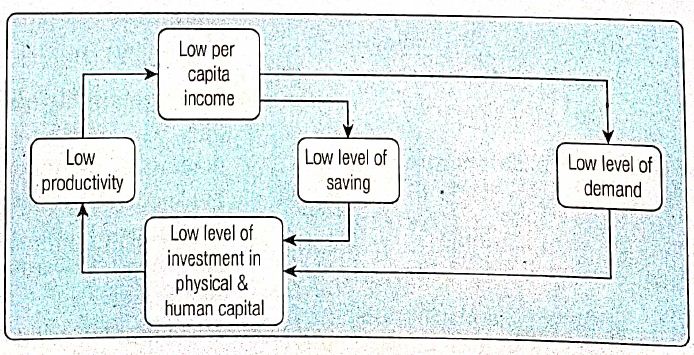
(i) The cause for vicious circle of poverty is demand and supply.
(ii) On the supply side, the low level of real income leads to low level of saving and investment and to deficiency of capital.
(iii) Deficiency of capital leads to low productivity and back to low income.
(iv) On the demand-side, low level of real income leads to low demand so investment is less, therefore deficiency of capital, low productivity and low income.
111.
(i) Land pollution is defined as, "the degradation of land because of the disposal of waste on the land".
(ii) Any substance that is discharged, emitted or deposited in the environment in such a way that it alters the environment causes land pollution.
Causes:
Deforestation and soil erosion:
(i) Deforestation carried out to create dry lands is one concern.
(ii) Land that is once converted into a dry land can never be made fertile again.
Agricultural activities:
(i) With growing human and pet animal population demand for food has increased.
(ii) Farmers use highly toxic fertilizers and pesticides which contaminates and poisons the land.
Mining activities:
(i) During extraction and mining, several land spaces are created beneath the surface.
Landfills:
(i) Garbage like plastic, paper, cloth, wood and hospital waste get accumulated.
(ii) Things that cannot be recycled become a part of the landfills that cause land pollution.
Industrialization:
(i) Due to increasing consumerism more industries are developed which lead to deforestation.
Construction activities:
(i) Due to urbanisation, large amount of construction activities are taking place.
(ii) Waste articles like wood, metal, bricks, are dumped at the outskirts of urban areas that lead to land pollution.
Nuclear waste:
(i) The leftover radioactive materials, harmful and toxic chemicals affect human health.
(ii) They are dumped beneath the earth to avoid any casualty.
112.
(i) Primary deficit is equal to fiscal deficit minus interest payments. PD = Fiscal deficit (FD) - Interest Payment (IP)
(ii) It shows the real burden of the government and it does not include the interest burden on loans taken in the past.
(iii) It shows the borrowing requirement of the government exclusive of interest payments.
113.
1. Basic Credit Facility
2. Extended Fund Facility
3. Compensatory Financing Facility
4. Buffer Stock Facility
5. Supplementary Financing Facility
6. Structural Adjustment Facility
114.
| S.No |
Balance of Trade |
Balance of Payments |
|---|---|---|
| 1 | Only export and import of commodities are included in BoT |
Export and import of commodities and services are included in BoP |
| 2 | i.e. Movement of goods or visible trade | Trade in both visible and non visible items. |
115.
1) NABARD acts as a refinancing institution for all kinds of production and investment credit to agriculture, small-scale industries, cottage and village industries, handicrafts, rural crafts and real artisans to promote integrated rural development.
2) It provides short-term, medium term and long-term credit to state co-operative Banks, RRBs, LDBs and other financial institutions approved by RBI.
3) NABARD gives long-term loans (20 Years) to State Government to enable them to subscribe to the share capital of co-operative credit societies.
4). It gives long-term loans to any institution approved by the Central Government or contribute to the share capital or invests in securities of any institution concerned with agriculture and rural development.
5) NABARD co-ordinates the activities of Central and State Governments, Planning Commission and all India and State level institutions entrusted with the development of small scale industries, village and cottage industries, rural crafts, industries in the tiny and decentralized sectors
6) It has the responsibility to inspect RRBs and CO-operative banks, other than primary co-operative societies.
7) It maintains a Research and Development Fund to promote research in agriculture and rural development
116.
117.
(i) Payment towards past debts
(ii) Purchase of existing wealth
(iii) Import of goods and services
(iv) Non availability of consumer goods
(v) Full employment situation
118.
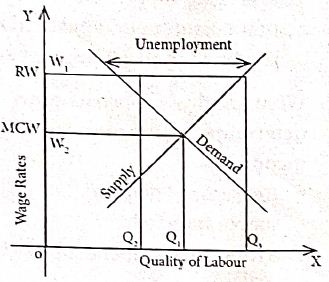
(i) Classical unemployment occurs when real wages are kept above the market clearing wage rate, leading to a surplus of labour supplied.
(ii) Classical unemployment is also called real wage unemployment.
(iii) Unemployment occurs when the worker is willing to accept (Real Wages)(RW) is in excess of those an employer is willing to pay (Market Clearing Wage)(MCW).
(iv) Real wage may be above the equilibrium level because of minimum wage policies or union bargaining.
(v) classical unemployment of Q1-Q2 can be solved by a wage cut.
(vi) If wages are allowed to fall to the market clearing level, unemployment is solved
119.
(i) A country with a high national income enjoys greater economic welfare and higher standard of living.
(ii) But the per capita income as an index of economic welfare has some limitations.
(iii) Welfare depends on the composition of goods and services. If more capital goods over consumer goods are produced welfare will be lesser.
(iv) Higher GDP with greater air, water, soil pollution will affect welfare.
(v) Production of war goods will increase output but not welfare.
(vi) If more women and children are employed or workers are forced to work for long hours economic welfare is affected.
(v) Therefore the Physical Quality of Life Index is a better indicator of economic welfare than national income.
120.
(i) Red tapism and bureaucracy since, approval of many officials is needed.
(ii) Absence of incentive and so productivity is less.
(iii) Limited freedom of choice in the consumption of goods and services.
(iv) The state takes all major decisions. There is concentration and misuse of power.
121.
1. Duties in respect of succession to property other than agricultural land.
2. Estate duty in respect of property other than agricultural land.
3. Taxes on railway fares and freights.
4. Taxes other than stamp duties on transactions in stock exchanges and future markets.
5. Taxes on the sale or purchase of newspapers and on advertisements published therein
6. Terminal taxes on goods or passengers carried by railways, sea or air.
7. Taxes on the sale or purchase of goods other than newspapers where such sale or purchase taxes place in the course of inter-State trade or commerce.
122.
| BASIS | RBI | COMMERCIAL BANK |
| Meaning | The bank which looks after the monetary system of the country is known as Central Bank. | The establishment, which provides banking services to the public is known as Commercial Bank. |
| Role | It is a banker to the banks and the government of the country | It is the banker to the citizens of the nation |
| Established by | Reserve Bank of India Act, 1934 | Banking Regulation Act, 1949. |
| Ownership | Public | Public or Private |
| Monetary Authority | It is the supreme monetary authority with wide powers | No such authority. |
| Objective | Public welfare and economic development. | Earning Profits |
| Money supply | Ultimate source of money supply in the economy. | No such function is performed by it. |
| Right to print and issue currency notes | Yes | No |
| Deals with | Banks and Governments | General Public |
| How many banks are there | Only one | Many |
123.
| S/No | X | Y | XY | X2 | Y2 |
| 1 | 9 | 23 | 207 | 81 | 529 |
| 2 | 13 | 40 | 520 | 169 | 1600 |
| 3 | 6 | 10 | 60 | 36 | 100 |
| 4 | 18 | 48 | 864 | 32 | 2304 |
| 5 | 14 | 25 | 350 | 196 | 625 |
| 6 | 12 | 30 | 360 | 144 | 900 |
| 7 | 11 | 15 | 165 | 121 | 225 |
| 8 | 7 | 10 | 70 | 49 | 100 |
| 9 | 2 | 5 | 10 | 4 | 25 |
| 10 | 6 | 45 | 270 | 36 | 2025 |
| 11 | 14 | 40 | 560 | 196 | 1600 |
| 12 | 15 | 34 | 525 | 225 | 1225 |
| 13 | 5 | 12 | 60 | 25 | 144 |
| 14 | 8 | 27 | 216 | 64 | 729 |
| Σ | 140 | 365 | 4237 | 1670 | 12131 |
Apply the formula
\(r=\frac { n\sum { xy-(\sum { x } )(\sum { y } ) } }{ \sqrt { n{ \sum { x } }^{ 2 }-{ (\sum { x } ) }^{ 2 }n{ \sum { y } }^{ 2 }-{ (\sum { y } ) }^{ 2 } } } \)
\(r=\frac { 14x4237-(140x365) }{ \sqrt { (14x1670-{ 140 }^{ 2 })(14x12131-{ 365 }^{ 2 }) } } \)
\(r=\frac { 59318-51100 }{ \sqrt { (14x1670-{ 140 }^{ 2 })(14x12131-{ 365 }^{ 2 }) } } \)
\(r=\frac { 8218 }{ \sqrt { 13642020 } } =\frac { 8218 }{ \sqrt { 11763.589 } } \)
= 0.70
124.
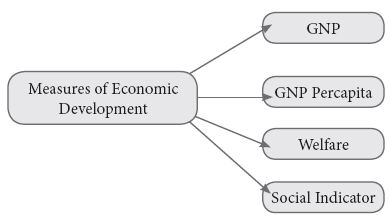
Economic development is measured on the basis of four criteria
Gross National Product (GNP):
(i) GNP is the total market value of all final goods and services produced within a nation in a particular year, plus income earned by its citizens (including income of those located abroad), minus income of non-residents located in that country.
(ii) GNP is one measure of the economic condition of a country, under the assumption that a higher GNP leads to a higher quality of living, all other things being equal.
GNP per capita:
(i) This relates to increasing in the per capita real income of the economy over the long period
(ii) This indicator of economic growth emphasizes that for economic development the rate of increase in real per capita income should be higher than the growth rate of population.
Welfare:
(i) Economic development is regarded as a process whereby there is an increase in the consumption of goods and services by individuals.
(ii) From the welfare perspective, economic development is defined as a sustained improvement in health, literacy, and standard of living
Social Indicators:
(i) Social indicators are normally referred to as basic and collective needs of the people
(ii) The direct provision of basic needs such as health, education, food, water, sanitation, and housing facilities check social backwardness.
| S/N | Basic need | Indicators |
|---|---|---|
| 1 | Health | Life expectancy at birth |
| 2 | Education | Literacy signifying primary school enrolment as a percent of the population. |
| 3 | Food | Calorie Supply per head |
| 4 | Water supply | Infant mortality and percentage of the population with access to potable water |
| 5 | Sanitation | Infant mortality and percentage of the population with access to sanitation. |
125.
(a) Kumar is cyclically unemployed. He has lost his job as a result of the general economic recession.
(b) Sathish is frictionally unemployed. Job openings exist for him. It is merely a case of tracking down a position.
(c) Latha is structurally unemployed. Unemployment due to technological change in an industry is classified as structural.
(d) Devi, is frictionally unemployed. Job openings exist for her.
126.
Adam Smith argued that all nations can be benefitted when there is free trade and specialisation in terms of their absolute cost advantage
The Theory
(i) According to Adam Smith, the basis of international trade was absolute cost advantage.
(ii) Trade between two countries would be mutually beneficial when one country produces a commodity at an absolute cost advantage over the other country which in turn produces another commodity at an absolute cost advantage over the first country.
Assumptions
1. There are two countries and two commodities (2 x 2 model).
2. Labour is the only factor of production
3. Labour units are homogeneous
4. The cost or price of a commodity is measured by the amount of labour required to produce it.
5. There is no transport cost.
Illustration
Absolute cost advantage theory can be illustrated with the help of the following example.
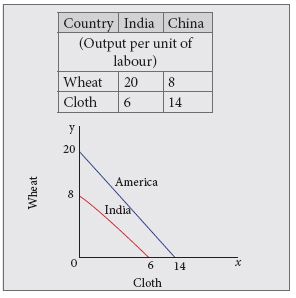
(iii) From the illustration, it is clear that India has an absolute advantage in the production of wheat over China and China has an absolute advantage in the production of cloth over India
(iv) Therefore, India should specialize in the production of wheat and import cloth from China. China should specialize in the production of cloth and import wheat from India
(v) This kind of trade would be mutually beneficial to both India and China.
127.
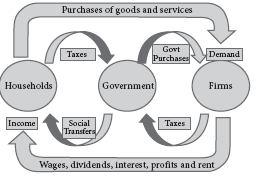
1. In addition to household and firms, inclusion of the government sector makes this model a three-sector model.
2. The government levies taxes on households and firms, purchases goods and services from firms, and receive factors of production from household sector.
3. On the other hand, the government also makes social transfers such as pension, relief, subsidies to the households.
4. Similarly, Government pays the firms for the purchases of goods and services.
5. The Flow Chart illustrates three- sector economy model
Under three sector model, national income
(Y) is obtained by adding Consumption expenditure (C), Investment expenditure (I) and Government expenditure (G).
Therefore Y = C + I + G
128.
(i) The propensity to consume refers to the portion of income spent on consumption.
MPC = \(\frac{ΔC}{ΔY}\)
(K) = \(\frac{1}{1-MPC}\)
(ii) The multiplier is the reciprocal of one minus marginal propensity to consume.
(iii) Multiplier is 1/MPS
(iv) The multiplier is therefore define as reciprocal of MPS.
(v) Multiplier is inversely related to MPS and directly with MPC.
Numerically, if MPC is 0.75, MPS is 0.25 and K is 4.
Using formula K = \(\frac{1}{1-MPC}\)
⇒\(\frac{1}{1-0.75}\) = 1/0.25 = 4
∴ Multiplier (K) = 4
| MPC | MPS | K |
|---|---|---|
| 1.00 | 1.00 | 1 |
| 0.10 | 1.90 | 1.11 |
| 0.50 | 0.50 | 2.00 |
| 0.75 | 0.25 | 4.00 |
| 0.90 | 0.10 | 10.00 |
| 1.00 | 0.00 | ∝ |
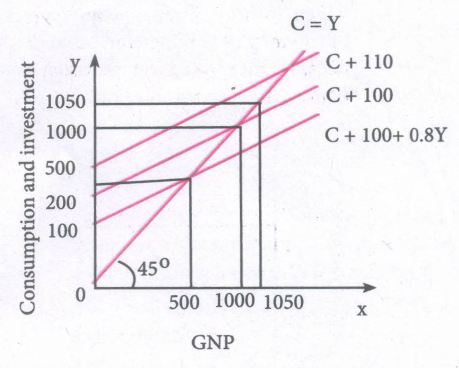
C = 100 + 0.8Y;
I = 10
Y = C + I
= 100 + 0.8 Y +9p00
.JPG)
0.2Y = 1000
∴ Y = 1000
Here, C = 100 + 0.8y
= 100 + 1000 = 900
S = 100 = I
After I is raised by 10, now I = 110
Y = 100 + 0.8y + 110
0.2y = 210
y = \(\frac{210}{0.2}\) = 1050
Here, C = 100 = 0.8 (1050) = 940,
S = 110 = I
(i) It implies the variables in axis-and axis are equal.
(ii) The MPC is assumed to be at 0.8. (C = 100 + 0.8y)
(iii) The aggregate demand (C + I) curve intersects 45° line at point E.
(iv) The new aggregate demand curve is
C + I = 100 + 0.8Y + 100 + 10
Y = \(\frac{210}{0.2}\)
C = 940; S = 110 = Z
129.
Product Method:
(i) Product method measures the output of the country. It is also called inventory method.
(ii) It is obtained for the entire economy during a year.
(iii) The value obtained is actually the GNP at market prices.
(iv) Care must be taken to avoid double counting.
(v) The value of the final product is derived by the summation of all the values added in the productive process.
(vi) To avoid double counting either the value of the final output should be taken in to the estimate of GNP.
(vii) In India the gross value of the farm output is obtained as follows.
(1) The output of each crop is measured by multiplying the area shown by the average yield per hectare.
(2) The total output of each commodity is valued at market prices.
(3) The net value of the agriculture output is measured by making deductions for the cost of seed, manures and fertilisers etc.,
(4) Net value of the output in these sectors is derived by making deductions for cost of materials used in the process of production and depreciation allowances etc., from gross value of output,
(5) For example, value of cotton enters value of yarn as cost and value of yarn in cloth and that of cloth in garments at every stage value added only should be calculated.
130.
Introduction
A systematic development of the simple accelerator model was made by J.M.Clark, It was further developed by Hicks, Samuelson and Harrod.
Definition
Accelerator coefficient is the ratio between induced investment and an initial change in consumption \(\beta=\frac{\Delta \mathrm{I}}{\Delta \mathrm{C}}\)
Operation
Suppose that in order to produce 1000 consumer goods, 100 machines are needed. Working life of a machine is 10 yrs i.e, every year 10 machines have to be replaced. This is called replacement demand
(i) Suppose that demand for consumer goods rises by 10 % (i.e, from 1000 to 1100)
(ii) This results in increase in demand for 10 more machines
(iii) The total demand for machines is 20 i.e, 10 % increase in demand for consumer goods causes 100 % increase in demand for machine (from 10 to 20 )
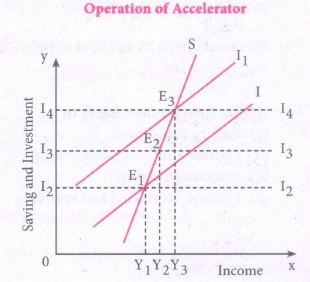
Explanation
(i) SS is the saving curve.
(ii) II is the investment curve.
(iii) At point E1 the economy is in equilibrium with OY1 income.
(iv) S and I are equal at O2.
(v) Now I increased from OI2 to OI4.
(vi) This increases income from OY1 to OY3 at E2 equilibrium.
(vii) If the increase in investment by I2I4 is purely exogenous, then the increase in income by Y1Y3 would be due to multiplier.
(viii) But in this diagram it is assumed that exogenous investment is only by I2I3 and induced investment is by I3I4.
(ix) Therefore, the increase in income by Y1Y2 is due to the multiplier effect and the increase in income by Y2Y3 is due to the accelerator effect.

12th Standard Syllabus & Materials
12th Standard
TN 12th Computer Applications களப்பெயர் முறைமை (DNS) Sample Question Papers Study Material - QB365 Set A
NEW12th Standard
TN 12th Computer Applications வலையமைப்பு எடுத்துக்காட்டுகள் மற்றும் நெறிமுறைகள் Sample Question Papers Study Material - QB365 Set A
NEW12th Standard
TN 12th Computer Applications கணினி வலையமைப்பு ஓர் அறிமுகம் Sample Question Papers Study Material - QB365 Set A
NEW12th Standard
TN 12th Computer Applications PHP-உடன் MySQL-ஐ இணைத்தல் Sample Question Papers Study Material - QB365 Set A



Tamilnadu Stateboard 12th Standard Subjects

Maths

Chemistry

Physics

Biology

Computer Science

Business Maths and Statistics
Economics

Commerce

Accountancy

History

Computer Applications
Biology
Computer Technology
Computer Applications
Computer Science
Business Maths and Statistics
Commerce
Economics
Maths
Chemistry
Physics
Computer Technology
History
Accountancy

Tamil

English

French
Tamilnadu Stateboard Standards
