
 100% FREE ACCESS
12th Standard Syllabus & Materials
12th Standard
TN 12th Computer Applications மின்னணு தரவு பரிமாற்றம் Sample Question Papers Study Material - QB365 Set A
NEW12th Standard
TN 12th Computer Applications மின் - வணிக பாதுகாப்பு அமைப்புகள் Sample Question Papers Study Material - QB365 Set A
NEW12th Standard
TN 12th Computer Applications மின்னணு செலுத்தல் முறைகள் Sample Question Papers Study Material - QB365 Set A
NEW12th Standard
TN 12th Computer Applications மின் - வணிகம் Sample Question Papers Study Material - QB365 Set A
NEW12th Standard
TN 12th Computer Applications திறந்த மூல கருத்துருக்கள் Sample Question Papers Study Material - QB365 Set A
NEW12th Standard
TN 12th Computer Applications வலையமைப்பு வடமிடல் Sample Question Papers Study Material - QB365 Set A

Published on: 12/02/2020
12th standard Economics Book back and Creative Important Question-I-2020
Download Tamil Nadu 12th Standard Economics question papers, model tests, one-mark questions, important questions, and public exam papers in PDF format. Free study materials and answer keys for TN State Board students.
Questions + Answers key
Take MCQ Economics Test
1.
Generally, the nature of indirect tax is ________.
Progressive
Regressive
Proportional
None of the above
2.
Impact of a tax refers to
Final money burden
Immediate money burden
Indirect real burden
None of the above
3.
During the past 67 years of planning, the population of India has increased from 36.1 crore in…………, to 121 crore in………..?
1951 and 2011
1981 and 2011
1991 and 2018
1971 and 2001
4.
A ______ is a payment card issued to users (cardholders) to enable the cardholder to pay a merchant for goods and services.
Debit Card
Swipe card
Punch Card
credit card
5.
Expand PSS.
The Payment and Settlement Systems Act
The Payment and Service Systems Act
The Portfolio and Settlement Systems Act
The Payment and Settlement Sanctions Act
6.
Match the correct codes
| 1 | Modern technology being capital intensive requires slanderousness contributes to technological unemployment. | i | Technical Unemployment |
| 2 | Due to drastic change in the structure of the society | ii | structural unemployment |
| 3. | Occurs when more people are than what is actually required | iii | Seasonal Unemployment |
| 4. | ice cream industry, holiday resorts etc | iv | Disguised unemployment |
(1) – (i) (2) – (ii) (3) – (iv) (4) – (iii)
(1) – (ii) (2) – (iii) (3) – (iv) (4) – (i)
(1) – (iv) (2) – (iii) (3) – (i) (4) – (ii)
(1) – (i) (2) – (ii) (3) – (iii) (4) – (iv)
7.
Match the correct codes
| 1 | J.B. Say’s Market Law | i | A person receives his income from production which is spent on the purchase of goods and services produced by others |
| 2. | Keynes theory of employment | ii | Denotes money actually spent by the people on products of industry |
| 3. | Market Law Meaning | iii | Effective demand signifies the money spent on consumption of goods and services and on investment |
| 4. | Effective demand | iv | Supply creates its own demand |
(1) – (i) (2) – (ii) (3) – (iv) (4) – (iii)
(1) – (ii) (2) – (iii) (3) – (iv) (4) – (i)
(1) – (iv) (2) – (iii) (3) – (i) (4) – (ii)
(1) – (i) (2) – (ii) (3) – (iv) (4) – (iii)
8.
India’s current quota in the IMF is SDRs (Special Drawing Rights)………..?
5,821.5 million
6,821.5 million
5,621.5 million
8,821.5 million
9.
Assertion: Structural unemployment is due to drastic change in the structure of the society.
Reason: Lack of demand for the product or shift in demand to other products cause this type of unemployment.
Both A and R are true and R is the correct explanation of A
Both A and R are true but R is not the correct explanation of A
A is true but R is false
A is false but R is true
10.
In Fisher’s equation of exchange MV=PT, the variation of which produces a proportional change in price:
M
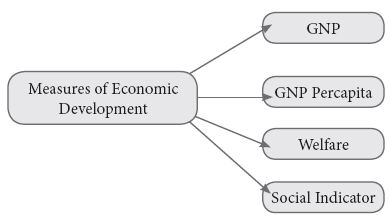
V
P
T
11.
The idea of _____________ was strengthened during the Great Depression in 1930s.
political planning
industrial planning
economic planning
democratic planning
12.
What is the basis of the Credit System?
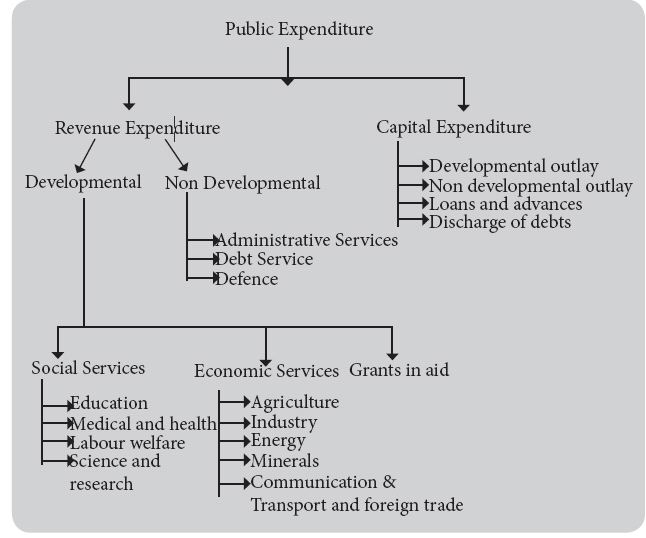
State
Computer
PAYTM
Money
13.
Match the correct codes
| 1 | GNP | i | FC + Indirect Taxes - Subsidies |
| 2 | X-M | ii | MP - Indirect Taxes + Subsidies |
| 3 | MP | iii | C + I + G + (X - M) |
| 4 | FC | iv | Net exports |
(1) – (i) (2) – (ii) (3) – (iv) (4) – (iii)
(1) – (ii) (2) – (iii) (3) – (iv) (4) – (i)
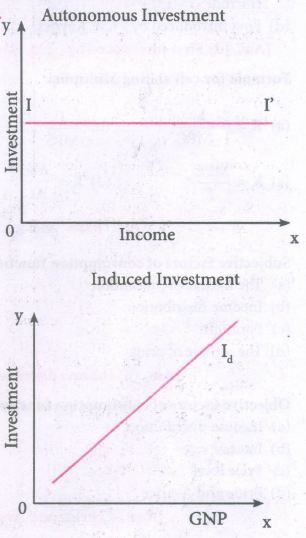
(1) – (iv) (2) – (iii) (3) – (i) (4) – (ii)
(1) – (i) (2) – (ii) (3) – (iii) (4) – (iv)
14.
There are two kinds of measures of dispersion, namely
Absolute measure of dispersion and Relative measure of dispersion
Relative measure of dispersion and Relative measure of dispersion
Absolute measure of dispersion and Absolute measure of dispersion
Relative measure of dispersion and Absolute measure of dispersion
15.
Find the author who said this “Statistics as a science of estimates and probabilities”
Croxten and Crowden
Boddington
Irving Fisher
Lowernce
16.
Evidence from history proves that during the reign of Chandra Gupta Maurya, there existed a system of maintaining ________.
vital statistics
descriptive statistics
inferential statistics
none of the above
17.
Which one of the following is not a macro economic variables
Input – Output ratio
Tax – GDP ratio
Current Account Deficit - GDP ratio
Fiscal Deficit - GDP ratio
18.
Consumption of a pure public good
depletes the supply of the good for others
increases the supply of the good
denies the opportunity to consume the good to others
neither depletes the good nor excludes others from consuming it
19.
If MPC = 4/5, then value of the multiplier is:
20
5
0.80
1.25
20.
According to Keynes, saving is:
Private virtue but not social virtue
Private and social virtue
Is neither private virtue nor social virtue
Is either social virtue or private virtue
21.
_________ means the entry of funds into a nation where foreigners deposit money in a nation’s bank or make purchase in the stock and bond markets, sometimes for speculation.
Foreign Government Investment
Foreign Portfolio Investment
Foreign Institutional Investment
Foreign Direct Investment
22.
What is not a proposition of the Law:
When income increases, consumption expenditure also increases but by a smaller amount.
The increased income will be divided in some proportion between consumption expenditure and saving.
Excess capacity in capital goods industries is assumed
Increase in income always leads to an increase in both consumption and saving
23.
The firm sector generates its _________ by selling goods and services to the household sector.
revenue
sales
expenditure
cost
24.
_____________ is the example of negative consumption externality.
Non-smoker
Smoker
Chain smoker
Rare-smoker
25.
Children are highly vulnerable and expect to and ___________ commonly suffer from pneumonia and asthma.
Air pollutants
Water pollutions
Land Pollution
Noise pollutions
26.
_________ provides long term loan.
BRICS
WTO
World Bank
None of the above
27.
The World Trade Organisations headquarters is in _____.
Africa
Alaska
Uganda
Geneva
28.
Large __________ are driving out foreign investors.
public debt
private debt
public revenue
private revenue
29.
_______ means value of exports is more than that of imports.
Unfavorable trade
International trade
Favorable trade
External trade
30.
Poverty alleviation programmes started by the government from _______ Five Year Plan.
Fourth
Fifth
Sixth
Seven
31.
NNP at factor cost = NNP at Market Price - ________ + Subsidies.
Direct taxes
Canons of taxes
Indirect taxes
None of these
32.
The first Five Year Plan of India was launched in
1947
1951
1956
1961
33.
________ is the monetary authority of the country.
Central bank
RBI
SBI
Both 'a' and 'b'
34.
________system is managed by the Central Monetary Authority.
Plastic money
Metallic Standard
Silver standard
Paper currency
35.
In addition to household and firms, inclusion of the government sector make this model a ________ model.
Single sector model
Two sector model
Three sector model
Four sector model
36.
Micro means __________.
Large
Big
Small
Both 'a' and 'b'
37.
If Y = 2 - O.2X, then the value of Y intercept is equal to
-0.2
2
0.2X
All of the above
38.
The word 'statistics' is used as _______
Singular.
Plural
Singular and Plural.
None of above
39.
Perspective plan is also known as______
Short-term plan
Medium-term plan
Long-term plan
None of the above
40.
Long-term plan is also known as_______
Progressive Plans
Non-progressive Plans
Perspective Plans
Non-perspective Plans
41.
The major contributor of Carbon monoxide is
Automobiles
Industrial process
Stationary fuel combustion
None of the above
42.
The term environment has been derived from a French word _________
Environ
Environs
Environia
Envir
43.
Consider the following statements and identify the correct ones.
(i) Central government does not have exclusive power to impose tax which is not mentioned in state or concurrent list.
(ii) The Constitution also provides for transferring certain tax revenues from union list to states.
i only
ii only
both
none
44.
The tax possesses the following characteristics
Compulsory
No quid pro quo
Failure to pay is offence
All the above
45.
Which of the following does not come under 'Six dialogue partners' of ASEAN?
China
Japan
India
North Korea
46.
The first ministerial meeting of WTO was held at
Singapore
Geneva
Seattle
Doha
47.
Exchange rate for currencies is determined by supply a!ld demand under the-system of
Fixed exchange rate
Flexible exchange rate
Constant
Government regulated
48.
Trade between two countries is known as ____ trade
External
Internal
Inter-regional
Home
49.
ARDC started functioning from
June 3, 1963
July 3, 1963
June 1, 1963
July 1, 1963
50.
A Bank is a
Financial institution
Corporate
An Industry
Service institutions
51.
Fisher’s Quantity Theory of money is based on the essential function of money as
measure of value
store of value
medium of exchange
standard of deferred payment
52.
During depression the level of economic activity becomes extremely
high
bad
low
good
53.
In an open economy import _______ the value of the multiplier
Reduces
increase
does not change
changes
54.
As income increases, consumption will______
fall
not change
fluctuate
increase
55.
_________ Flexibility brings equality between saving and investment
Demand
Supply
Capital
Rate of Interest
56.
J.B. Say is a _______.
Neo Classical Economist
Classical Economist
Modern Economist
New Economist
57.
The financial year in India is__________
April 1 to March 31
March 1 to April 30
March 1 to March 16
January 1 to December 31
58.
Income method is measured by summing up of all forms of__________
Production
Taxes
expenditure
Income
59.
The Circular Flow Model that represents an open Economy
Two Sector Model
Three Sector Model
Four Sector Model
All the above
60.
Identify the flow variable
money supply
assests
income
foreign exchange reserves
61.
What are Sale Taxes?
62.
Write a note on Paytm.
63.
Expansionary policy – Define.
64.
What was proposed in The Brettonwoods Conference?
65.
Differentiate democratic plan with totalitarian plan.
66.
How economic growth and development differs with their respective indicators?
67.
Define the “Statutory Liquidity Ratio”?
68.
What is Monetary Economics?
69.
What is Aggregate supply?
70.
What are the methods of calculating SD?
71.
What is Foreign Portfolio Investment (FPI)
72.
What do you understand by Net Factor Income from Abroad (X-M)?
73.
Assume a consumption function that takes on the following algebraic form: C = Rs.100 + 0.8Y. Assume that Y = Rs.1000 what is the level of consumption at this income level.
74.
List the examples of Private Sectors E-Wastes.
75.
State the Duesenberry hypothesis.
76.
Mention the any three Socialist Learning economies.
77.
What are the major types of economic systems.
78.
What do you mean by Real Income?
79.
What is unemployment?
80.
What are the four components of aggregate demand?
81.
What is Price Mechanism?
82.
Write down the three types of economic systems.
83.
What are the kinds of Statistics?
84.
What is Statistics?
85.
Mention the indicators of development.
86.
What do you mean by ecosystem?
87.
What do you mean by public debt?
88.
What is International Economics?
89.
Write the meaning of Open market operations.
90.
What is commodity money?
91.
Define average propensity to consume (APC).
92.
Give short note on frictional unemployment.
93.
What is the main feature of rural unemployment ?
94.
Define GDP deflator.
95.
Classify the economies based on status of development.
96.
Present chart depicting public expenditure.
97.
Discuss the Agency Functions of RBI.
98.
Write briefly about “Structural Adjustment Facility”
99.
Calculate the standard deviation for the following data by assumed mean method: 43, 48, 65, 57, 31, 60, 37, 48, 78, 59
100.
Explain Effects on Production of Inflation.
101.
Distinguish between Fictional and Structural unemployment.
102.
What is NSSO?
103.
List the “Role of a state” according to mercantilists?
104.
What are the items should not be included while estimating national income through income method?
105.
What are the Merits of Socialism?
106.
Define water pollution.
107.
What are the general advantages of International Trade?
108.
Draw the diagrams for Autonomous investment and induced investment.
109.
Explain NITI Aayog.
110.
111.
How would you break the vicious circle of poverty?
112.
What are the causes of water pollution?
113.
What are the functions of a modern state?
114.
Mention any three lending programmes of IMF.
115.
Describe the subject matter of International Economics.
116.
Bring out the methods of credit control.
117.
What is money supply?
118.
State the propositions of Keynes’s Psychological Law of Consumption
119.
What do you mean by aggregate demand ? Mention its components.
120.
Write briefly about national income and welfare
121.
Indicate the demerits of socialism.
122.
List the Revenue of State Sources.
123.
Distinguish between NBFC and Other Commercial Bank.
124.
Elucidate various measures of economic development.
125.
Classify the following as either employed, unemployed or not in the labor force
| An individual who has been temporarily absent due to caring for an elderly relative whether they are paid or not. | |
| A person 18 years old or older who works without pay for 15 or more hours per week in a family enterprise. | |
| Someone who works for pay in his or her own business. | |
| A woman who spends five hours a week sending bills to her husband's clients. She is not paid for her work. Otherwise she performs non-market work at home. | |
| A retired person | |
| A person who quits one job in favor of looking for work elsewhere but has yet to find work. |
126.
State the importance of the comparative advantage of international trade.
127.
Consider the following are the only transactions take place in an economy:
(i) Industry A imports goods worth Rs. 100. It sells goods worth Rs. 400 to industry B, goods worth Rs. 200 to industry C, and goods worth Rs. 1,000 for private consumption.
(ii) Industry B sells goods worth Rs. 500 to industry C and goods worth Rs. 800 for private consumption.
(iii) Industry C sells goods worth Rs. 600 to private consumption. and exports goods, valued at Rs. 500.
(iv) Depreciation cost during the year amounts to Rs. 100,
(v) Government realises taxes of the value of Rs. 100. Calculate the following with the help of net value added method from the data given above
(a) GNPMP
(b) GNPFC
(c) NNPMP and
(d) NNPFC
128.
Explain Multiplier with help of suitable diagram.
129.
Explain the three sector model of economy with chart.
130.
What are the differences between MEC and MEI.
1.
(a)
Progressive
2.
(d)
None of the above
3.
(a)
1951 and 2011
4.
(d)
credit card
5.
(a)
The Payment and Settlement Systems Act
6.
(a)
(1) – (i) (2) – (ii) (3) – (iv) (4) – (iii)
7.
(a)
(1) – (i) (2) – (ii) (3) – (iv) (4) – (iii)
8.
(a)
5,821.5 million
9.
(a)
Both A and R are true and R is the correct explanation of A
10.
(a)
M
11.
(c)
economic planning
12.
(d)
Money
13.
(b)
(1) – (ii) (2) – (iii) (3) – (iv) (4) – (i)
14.
(a)
Absolute measure of dispersion and Relative measure of dispersion
15.
(b)
Boddington
16.
(a)
vital statistics
17.
(a)
Input – Output ratio
18.
(d)
neither depletes the good nor excludes others from consuming it
19.
(b)
5
20.
(a)
Private virtue but not social virtue
21.
(b)
Foreign Portfolio Investment
22.
(c)
Excess capacity in capital goods industries is assumed
23.
(a)
revenue
24.
(a)
Non-smoker
25.
(a)
Air pollutants
26.
(c)
World Bank
27.
(d)
Geneva
28.
(a)
public debt
29.
(c)
Favorable trade
30.
(b)
Fifth
31.
(c)
Indirect taxes
32.
(b)
1951
33.
(d)
Both 'a' and 'b'
34.
(d)
Paper currency
35.
(c)
Three sector model
36.
(c)
Small
37.
(b)
2
38.
(c)
Singular and Plural.
39.
(c)
Long-term plan
40.
(c)
Perspective Plans
41.
(a)
Automobiles
42.
(c)
Environia
43.
(b)
ii only
44.
(d)
All the above
45.
(d)
North Korea
46.
(a)
Singapore
47.
(b)
Flexible exchange rate
48.
(a)
External
49.
(d)
July 1, 1963
50.
(a)
Financial institution
51.
(c)
medium of exchange
52.
(c)
low
53.
(a)
Reduces
54.
(d)
increase
55.
(d)
Rate of Interest
56.
(b)
Classical Economist
57.
(a)
April 1 to March 31
58.
(d)
Income
59.
(c)
Four Sector Model
60.
(c)
income
61.
Paid by a shopkeeper or retailer, who then shifts the tax burden to customers by charging sales tax on goods and services.
62.
(i) Paytm Payments Bank. In August 2015, Paytm received a license from RBI to launch a payments bank.
(ii) The Paytm Payments Bank is a separate entity in which founder Vijay Shekhar Sharma will hold 51% share, One 97 Communications holds 39% and 10% will be held by a subsidiary of One 97 and Sharma.
63.
(i) Expansionary policy is cheap money policy when a monetary authority uses its tools to stimulate the economy.
(ii) An expansionary policy maintains short-term interest rates at a lower than usual rate or increases the total supply of money in the economy more rapidly than usual.
64.
The Brettonwoods Conference proposed IMF, World Bank and International Trade Organisation (ITO) in 1944.
65.
| Democratic Plan | Totalitarian Plan |
|---|---|
| Democratic planning implies planning within democracy. | Under totalitarian planning, there is central control and direction of all economic activities in accordance with a single plan |
| People are associated at every step in the formulation and implementation of the plan. | In authoritarian planning, the planning authority is the supreme body. |
66.
(i) Economic growth enables an increase in the indicators like GDP, per capita income, etc.
(ii) On the other hand, economic development enables improvement in the life expectancy rate, infant mortality rate, literacy rate, and poverty rates.
67.
SLR or “Statutory Liquidity Ratio” is the fraction of the total demand and time deposits of the commercial banks is the form of specified liquid assets.
68.
Monetary Economics is a branch of economics that provides a framework for analyzing money and its functions as a medium of exchange, store of value and unit of account.
69.
The value of total output of goods and services produced in an economy in a year
70.
There are two methods of calculating Standard deviation in an individual series.
a) Deviations taken from Actual mean
b) Deviation taken from Assumed mean
71.
Foreign Portfolio Investment (FPI) means the entry of funds into a nation where foreigners deposit money in a nation’s bank or make purchase in the stock and bond markets, sometimes for speculation. FPI is part of capital account of BPO.
72.
Net factor income from abroad is the difference between the income received from abroad for rendering factor services by the normal residents of the country to the rest of the world and income paid for the factor services rendered by nonresidents in the domestic territory of a country
73.
C = Rs.100 + 0.8(Rs.1000) = Rs.100 + Rs.800 = Rs.900
74.
(i) PC
(ii) Boilers
(iii) Mixer
(iv) Signal Generators
(v) Incubator
75.
Duesenberry has made two observations regarding the factors affecting consumption.
a. The consumption expenditure depends not only on his current income but also past income and standard of living.
b. Consumption is influenced by demonstration effect. The consumption standards of low income groups are influenced by the consumption standards of high income groups.
76.
1. North Korea
2. China
3. Venezuela
77.
There are three major types of economic systems.
1. Capitalistic Economy (Capitalism),
2. Socialistic Economy (Socialism) and
3. Mixed Economy (Mixedism)
78.
(i) Nominal income is expressed in terms of a general price level of a particular year. In other words, real income is the buying power of nominal income.
(ii) The real income is derived as follows
National Income at constant price = National Income at current price \(\div\) P1/P0
79.
Unemployment is problem faced when there are people, who are willing to work and able to work but can't find suitable job.
80.
(i) Consumption Demand
(ii) Investment Demand
(iii) Government Expenditure
(iv) Net Export (Export - Import)
81.
(i) Price Mechanism is the heart of any capitalistic economy.
(ii) All the economic activities are regulated through price mechanism.
82.
(i) Capitalistic Economy (Capitalism)
(ii) Socialistic Economy (Socialism)
(iii) Mixed Economy (Mixedism)
83.
There are two major types of statistics.
(i) Descriptive statistics
(ii) Inferential statistics
84.
(i) Statistics as a science of estimates and probabilities.
(ii) Statistics is the collection, organisation, presentation, analysis and interpretation of numerical data.
85.
1. Gross national product
2. GNP per capita
3. Welfare
4. Social indicators.
86.
(i) An ecosystem includes all living things (plants, animals and organisms) in a given area, interacting with each other and also with their non-living environments (weather, earth, sun, soil, climate, atmosphere).
(ii) It is the foundation of the Biosphere and determine the health of the earth.
87.
When the responsibilities of the state increase, it supplements traditional revenue sources by borrowing from individuals and institutions within and outside the country. This is public debt.
88.
International Economics is a specialized field of Economics that deals with the economic interdependence among countries and studies the effects of such interdependence and the factors that affect it.
89.
(i) The Central Bank purchases and sells Government securities and proper eligible securities like bills and securities of private concerns.
(ii) This is called Open Market operation.
90.
(i) Surplus goods were exchanged for money which in turn was exchanged for other needed goods.
(ii) Goods like furs, skins, salt, rice, wheat, utensils, weapons were used as money
91.
APC is the ratio of consumption expenditure to any particular level of income
APC = \(\frac{C}{Y}\)
92.
(i) It arises due to imbalance between supply of labour and demand for labour.
(ii) It is because of immobility of labour, lack of necessary skills, breakdown of machinery, shortage of raw materials.
(iii) The persons who lose jobs and in search of jobs are also included.
93.
The major feature of rural unemployment is the existence of unemployment in the form of disguised unemployment and seasonal unemployment.
94.
GDP deflator is an index of price changes of goods and services included in GDP.
\(\text{GDP deflator}=\frac { Nominal\ GDP }{ Real\ GDP } \times 100\)
95.
Economies can be classified into different types based on the Status of Development are
1. Developed
2. Underdeveloped
3. Undeveloped and
4. Developing economies
96.
97.
Agency Functions implies that commercial banks act as agents of customers by performing various functions.
(i) Collecting Cheques Banks collect cheques and bills of exchange on the behalf of their customers through clearing house facilities provided by the central bank.
(ii) Collecting Income Commercial banks collect dividends, pension, salaries, rents, and interests on investments on behalf of their customers. A credit voucher is sent to customers for information when any income is collected by the bank.
(iii) Paying Expenses Commercial banks make the payments of various obligations of customers, such as telephone bills, insurance premium, school fees, and rents. Similar to credit voucher, a debit voucher is sent to customers for information when expenses are paid by the bank.
98.
i. Till 1970, India stood fifth in the Fund and it had the power to appoint a permanent Executive Director. India has been one of the major beneficiaries of the Fund assistance.
ii. It has been getting aid from the various Fund Agencies from time to time and has been regularly repaying its debt.
iii. India’s current quota in the IMF is SDRs (Special Drawing Rights) 5,821.5 million, making it the 13th largest quota holding country at IMF with shareholdings of 2.44%.
iv. Besides receiving loans to meet deficit in its balance of payments, India has benefited in certain other respects from the membership of the Fund
99.
| S.No | (X) | D=X-A(A=57) | (X-\(\bar { X } \))2 |
| 1 | 43 | -14 | 196 |
| 2 | 48 | -9 | 87 |
| 3 | 65 | 8 | 64 |
| 4 | 57 | 0 | 0 |
| 5 | 31 | -26 | 679 |
| 6 | 60 | 3 | 9 |
| 7 | 37 | -20 | 400 |
| 8 | 48 | -9 | 81 |
| 9 | 78 | 21 | 441 |
| 10 | 59 | 2 | 4 |
| N-9 | \(\sum { d } =44\) | \(\sum { d }^2 =1952\) |
\(\sigma =\sqrt { \frac { { \sum { d } }^{ 2 } }{ n } -\frac { { (\sum { d } ) }^{ 2 } }{ (n) } } =\sqrt { \frac { 1952 }{ 10 } -\frac { { (-44) }^{ 2 } }{ (10) } } \)
\(=\sqrt { 195.2-19.36 } =\sqrt { 175.84 } =13.26\)
100.
When the inflation is very moderate, it acts as an incentive to traders and producers. The profit due to rising prices encourages and induces business class to increase their investments in production, leading to generation of employment and income.
(i) However, hyper-inflation results in a serious depreciation of the value of money and it discourages savings.
(ii) When the value of money undergoes considerable depreciation, this may even drain out the foreign capital.
(iii) With reduced capital accumulation, the investment will suffer a serious set-back which may have an adverse effect on the volume of production.
101.
| S.No | Fictional unemployment | Structural unemployment |
| 1 | Frictional unemployment arises due to imbalance between supply of labour and demand for labour | Structural unemployment is due to drastic change in the structure of the society |
| 2. | This is because of immobility of labour, lack of necessary skills, break down of machinery, shortage of raw materials etc. | Lack of demand for the product or shift in demand to other products cause this type of unemployment |
| 3. | The persons who lose jobs and in search of jobs are also included under frictional unemployment | This kind of unemployment results from massive and deep rooted changes in economic structure |
102.
National Sample Survey Organisation (NSSO)
i. The National Sample Survey Organisation, now known as National Sample Survey Office, is an organization under the Ministry of Statistic of the Government of India.
ii. It is the largest organisation in India, conducting regular socio-economic surveys.
103.
i. Stimulate exports and export more goods than import. This approach will provide the gold inflow;
ii. Restrict the importation of goods, especially luxury goods that will provide export balance of trade;
iii. Forbid the production of the final products in its colonies;
iv. Forbid the exportation of raw materials from the parent states to the colonies and allow free importation of raw materials, which are not obtained within the country;
v. Stimulate an export of mainly cheap raw commodities from the colonies;
vi. Forbid any trade of its colonies with other countries, except the parent state, which can resell the colonial goods abroad by itself.
104.
1. Transfer payments are not to be included in estimation of national income as these payments are not received for any services provided in the current year such as pension, social insurance etc.
2. The receipts from the sale of second hand goods should not be treated as part of national income as they do not create new flow of goods or services in the current year.
3. Windfall gains such as lotteries are also not to be included as they do not represent receipts from any current productive activity.
4. Corporate profit tax should not be separately included as it has been already included as a part of company profit.
105.
1. Reduction in Inequalities: No one is allowed to own and use private property to exploit others.
2. Rational Allocation of Resources: The central planning authority allocates the resources in a planned manner. Wastages are minimised and investments are made in a pre planned manner.
3. Absence of Class Conflicts: As inequalities are minimum, there is no conflict between rich and poor class. Society functions in a harmonious manner.
4. End of Trade Cycles: Planning authority takes control over production and distribution of goods and services. Therefore, economic fluctuations can be avoided.
5. Promotes Social Welfare: Absence of exploitation, reduction in economic inequalities, avoidance of trade cycles and increase in productive efficiency help to promote social welfare.
106.
The introduction (directly or indirectly) of substances or energy into the marine environment (including, estuaries) result in deleterious effects to living resources, hazards to human health, hindrance to marine activities.
107.
(i) Availability of variety of goods for consumption.
(ii) Generation of more employment opportunities.
(iii) Industrialization of backward nations.
(iv) Improvement in relationship among countries.
(v) Division of Labour and specialisation.
(vi) Expansion in Transport Facilities.
108.
109.
NIT! Aayog (National Institution for transforming India) was formed on 1st January, 2015 through a Union Cabinet resolution. NITI Aayog is a policy think-tank of the Government of India. It replaced the Planning Commission from 13th August, 2014. The Prime Minister. is the Chairperson of NITIAayog and Union Ministers will be Ex-officio members. The Vice-Chairman of the NITI Aayog is the functional head.
Functions of NITI Aayog
1. Cooperative and Competitive Federalism
2. Shared National Agenda
3. Decentralized Planning
4. Vision and Scenario Planning
5. Network of Expertise
6. Harmonization:
7. Conflict Resolution
8. Coordinating Interface with the World
9. Internal Consultancy
10. Capacity Building
11. Monitoring and Evaluation
110.
111.
(i) On the supply side of the vicious circle of poverty there is low rate of saving and investment.
(ii) In UDCs to increase the rate of investment and capital formation, the marginal rate of savings must be greater than the average rate of savings.
(iii) On the demand side, Nurkse suggested balanced growth.
(iv) If investment is made in several industries simultaneously the workers will become consumers of each other's products creating mutual demand.
112.
Discharge of sewage and waste water:
(i) Sewage, garbage and liquid waste of households, agricultural runoff and effluents from factories are discharged into lakes and rivers.
(ii) These wastes contain harmful chemicals and toxins which make the water poisonous for aquatic animals and plants.
Dumping of solid wastes:
(i) The dumping of solid wastes and litters in water bodies cause huge problems.
Discharge of industrial wastes:
(i) Industrial waste contains asbestos, lead, mercury, grease oil and petrochemicals.
Oil Spill:
(i) Sea water gets polluted due to oil spilled from ships and tankers.
Acid Rain:
(i) When the acidic particles caused by air pollution mix with water vapour, it results in acid rain.
Global warming:
(i) The increase in water temperature affects aquatic plants and animals.
Eutrophication:
(i) The increased level of nutrients in water depletes oxygen in water and this negatively affects fish and other aquatic animal population.
113.
Defence
1. The Government protects the people from external aggression and internal disorder.
2. Through police and military forces it renders protective services.
Judiciary:
1. It provides adequate judicial structure to render justice to all citizens.
Enterprises
1. The regulation and control of private enterprise comes under the government.
Social Welfare:
1. The state provides education, social security, social insurance, health and sanitation for the people.
Infrastructure
1. Modern States build the base for the economic development of the country by creating social and economic infrastructure.
Macro-economic policy
1. The Government follows fiscal policy and monetary policy to achieve macro economic goals.
Social Justice
1. During the process of growth certain sections of the economy gain at the cost of others.
2. Government intervenes with fiscal measures to redistribute income.
Control of Monopoly
1. State intervenes through control of monopolies and restrictive trade practices to curb concentration of economic power.
114.
1. Basic Credit Facility
2. Extended Fund Facility
3. Compensatory Financing Facility
4. Buffer Stock Facility
5. Supplementary Financing Facility
6. Structural Adjustment Facility
115.
Pure Theory of Trade
(i) This component explains the causes for foreign trade, composition, direction and volume of trade, determination of the terms of trade and exchange rate, issues related to balance of trade and balance of payments.
Policy Issues
(i) Policy issues such as free trade vs. protection, methods of regulating trade, capital and technology flows, use of taxation, subsidies and dumping, exchange control and convertibility, foreign aid, external borrowings and foreign direct investment, measures of correcting disequilibrium in BoP are covered.
International Cartels and Trade Blocs
(i) Economic integration, cartels, customs unions, monetary unions, trade blocs, economic unions and multinational corporation are covered
International Financial and Trade Regulatory Institutions
(i) Financial institutions like IMF, IBRD, WTO are part of International Economics.
116.
Quantitative methods
1) Bank Rate Policy:
(i) It is the rate at which the Central Bank rediscount the first class.
(ii) The bank advances loans on approved securities to its member banks.
(iii) If the Central Bank wants to control credit, it will raise the bank rate.
(iv) So deposit rate and other lending rates rise, borrowing is discouraged.
2) Open Marker Operation:
(i) The Central Bank purchases and sells Government securities in the money market.
(ii) When banks or public buy these securities they have to pay to the Central Bank.
3) Variable Cash Reserves Ratio:
(i) The Central Bank controls credit by changing the Cash Reserve Ratio.
(ii) If Commercial Banks have excessive cash reserves and create too much credit, the central bank will raise the CPR.
(iii) If CRR is high, commercial bank's capacity to create credit will be less.
Qualitative Methods
1) Rationing of Credit:
(i) It controls and regulates the purposes for which credit is granted by commercial banks.
(ii) It is of 2 types - variable portfolio ceiling and variable capital asset ratio
2) Direct Action:
(i) Direct action is taken against erring banks
3) Moral Suasion:
(i) Central Bank gives advice, then requests and persuades the Commercial Banks to co-operate with the Central Bank in implementing its credit policies.
4) Publicity:
(i) A policy can be effectively successful only when an effective public opinion is created in its favour.
5) Regulation of Consumer's Credit:
(i) The down payment is raised and the number of installments reduced for credit sale.
6) Changes in the Marginal Requirements on Security Loans:
(i) The margin requirements can be increased to prevent excessive use of credit for stock exchange speculation
117.
(i) Money supply means the total amount of money in an economy.
(ii) It refers to the amount of money which is in circulation in an economy at any given time.
(iii) Money supply determines the price level and interest rates.
(iv) Money supply viewed at a given point of time is a stock and over a period of time it is a flow.
118.
(i) When income incrcases, consumption expenditure also incrcases but by a smaller amount.
(ii) The increased income will be divided in some proportion between consumption expenditure and saving.
(iii) Increase in income always leads to an increase in both consumption and saving.
119.
(i) In the Keynesian model, output is determined mainly by aggregate demand.
(ii) The aggregate demand is the amount of money which entrepreneurs expect to get by selling the output produced by the labourers employed.
(iii) Aggregate demand (spending) is the amount that households, firms, the governments and the foreign purchasers would like to spend on domestic output
Aggregate demand has four components:
1. Consumption demand (C)
2. Investment demand (I)
3. Government expenditure (G)
Net Export ( export - import) (X - M)
AD = C + I + G + (X - M)
120.
(i) A country with a high national income enjoys greater economic welfare and higher standard of living.
(ii) But the per capita income as an index of economic welfare has some limitations.
(iii) Welfare depends on the composition of goods and services. If more capital goods over consumer goods are produced welfare will be lesser.
(iv) Higher GDP with greater air, water, soil pollution will affect welfare.
(v) Production of war goods will increase output but not welfare.
(vi) If more women and children are employed or workers are forced to work for long hours economic welfare is affected.
(v) Therefore the Physical Quality of Life Index is a better indicator of economic welfare than national income.
121.
(i) Red tapism and bureaucracy since, approval of many officials is needed.
(ii) Absence of incentive and so productivity is less.
(iii) Limited freedom of choice in the consumption of goods and services.
(iv) The state takes all major decisions. There is concentration and misuse of power.
122.
1. Capitation tax
2. Duties in respect of succession to agricultural land.
3. Duties of excise on certain goods produced or manufactured in the State, such as alcoholic liquids, opium, etc.
4. Estate duty in respect of agricultural land.
5. Fees in respect of any of the matters in the State List, but not including fees taken in any Court.
6. Land Revenue.
7. Rates of stamp duty in respect of documents other than those specified in the Union List.
8. Taxes on agricultural income.
9. Taxes on land and buildings.
10. Taxes on mineral rights, subject to limitations impose by Parliament relating to mineral development.
11. Taxes on the consumption or sale of electricity.
12. Taxes on the entry of goods into a local area for consumption, use or sale therein.
13. Taxes on the sale and purchase of goods other than newspapers.
14. Taxes on the advertisements other than those published in newspapers.
15. Taxes on goods and passengers carried by road or on inland waterways.
16. Taxes on vehicles.
17. Taxes on animals and boats.
18. Taxes on professions, trades, callings and employments.
19. Taxes on luxuries, including taxes on entertainments, amusements, betting and gambling.
20. Tolls.
123.
| BASIS | NBFC | BANK |
| Meaning | An NBFC is a company that provides banking services to people without holding a bank license. | The bank is a government-authorized financial intermediary that aims at providing banking services to the general public. |
| Demand Deposit | Not Accepted | Accepted |
| Payment and Settlement system | Not a part of a system. | Part of the system. |
| Maintenance of Reserve Ratios | Not required | Compulsory |
| Deposit insurance facility | Not available | Available |
| Credit creation | NBFC do not create credit | Banks create credit. |
| Transaction services | Not provided by NBFC. | Provided by banks. |
124.
Economic development is measured on the basis of four criteria
Gross National Product (GNP):
(i) GNP is the total market value of all final goods and services produced within a nation in a particular year, plus income earned by its citizens (including income of those located abroad), minus income of non-residents located in that country.
(ii) GNP is one measure of the economic condition of a country, under the assumption that a higher GNP leads to a higher quality of living, all other things being equal.
GNP per capita:
(i) This relates to increasing in the per capita real income of the economy over the long period
(ii) This indicator of economic growth emphasizes that for economic development the rate of increase in real per capita income should be higher than the growth rate of population.
Welfare:
(i) Economic development is regarded as a process whereby there is an increase in the consumption of goods and services by individuals.
(ii) From the welfare perspective, economic development is defined as a sustained improvement in health, literacy, and standard of living
Social Indicators:
(i) Social indicators are normally referred to as basic and collective needs of the people
(ii) The direct provision of basic needs such as health, education, food, water, sanitation, and housing facilities check social backwardness.
| S/N | Basic need | Indicators |
|---|---|---|
| 1 | Health | Life expectancy at birth |
| 2 | Education | Literacy signifying primary school enrolment as a percent of the population. |
| 3 | Food | Calorie Supply per head |
| 4 | Water supply | Infant mortality and percentage of the population with access to potable water |
| 5 | Sanitation | Infant mortality and percentage of the population with access to sanitation. |
125.
| An individual who has been temporarily absent due to caring for an elderly relative whether they are paid or not | Employed |
| A person 18 years old or older who works without pay for 15 or more hours per week in a family enterprise | Employed |
| Someone who works for pay in his or her own business | Employed |
| A woman who spends five hours a week sending bills to her husband's clients. She is not paid for her work. Otherwise she performs non-market work at home | Not in the labour force |
| A retired person | Not in the labour force |
| A person who quits one job in favor of looking for work elsewhere but has yet to find work | Unemployed |
126.
(i) The balance of aggregate demand and aggregate supply was first described.
(ii) The cost of goods is determined by the ratio of aggregate demand and supply for them, both domestically and from abroad;
(iii) He theory is true regarding any quantity of goods and any number of countries, as well as for the analysis of trade between different entities.
(iv) In this case, country specialization in some goods depends on the ratio of wage levels in each country;
(v) The theory based the existence of benefits from trade for all countries, taking part in it;
(vi) There become possible to develop foreign economic policy on the scientific foundation.
127.
(A) GNPMP = Sum of net value added by all the industries
(i) value - added by industry A.
= Sale of goods to industry B + Sale of goods to industry C − Value of imports
Sale of goods to consumers = Rs. 400 + Rs. 200 + Rs. 1,000 − Rs. 100
= Rs. 1,590.
(ii) Value - added by industry B
= Sale of goods to industry C + Sale of goods to consumers.− Purchase of goods from industry A
= Rs. 500 + Rs. 800 − Rs. 400
= Rs. 900.
(iii) Value - added by industry C
= Sale of goods to consumers + Exports − (purchase of goods from industry A+purchase of goods from industry B)
= Rs. 600 + Rs. 500 - Rs. 200 - Rs. 500
= Rs. 400.
Gross National Product at market prices, or
GNPMP equals
Rs. 1,500 + Rs. 900 + Rs. 400
= Rs. 2,800
Gross National Product at factor cost or GNPFC equals
GNPMP − Indirect taxes + Subsidies
= Rs. 2,800 − Rs.100 + Rs. 50
= Rs. 2,750.
Net National Product at market prices, or NNPMP equals.
GNPMP − Depreciation
= Rs. 2,800 − Rs. 100
= Rs. 2,700.
Net National Product at factor cost or NNPFC equals
NNPMP - Indirect.taxes + Subsidies
= Rs. 2,700-Rs. 100 + Rs. 50
= 2,650.
as factors of production and include things such as land, labour, capital and entrepreneurship.
1. Producers of goods and services incur a cost for using these factors of production. These costs are ultimately added onto the price of the product.
2. The factor cost refer to the cost of production that is incurred by a firm when producing goods and services.
3. Examples of such production costs include the cost of renting machines, purchasing machinery and land, paying salaries and wages, cost of obtaining capital, and the profit margins that are added by the entrepreneur.
4. The factor cost does not include the taxes that are paid to the government since taxes are not directly involved in the production process and, therefore, are not part of the direct production cost.
5. However, subsidies received are included in the factor cost as subsidies are direct inputs into the production.
128.
Definition
(i) The multiplier is defined as the ratio of the change in national income to change in investment.
(ii) If ΔI stands for increase in investment and ΔY stands for resultant increase in income, the multiplier K =ΔY/ΔI.
Assumptions of Multiplier
1. There is change in autonomous investment.
2. There is no induced investment
3. The marginal propensity to consume is constant.
4. Consumption is a function of current income.
5. There are no time lags in the multiplier process.
6. Consumer goods are available in response to effective demand for them.
7. There is a closed economy unaffected by foreign influences.
8. There are no changes in prices.
9. There is less than full employment level in the economy.
The value of multiplier depends on MPC
Multiplier K = 1/1-MPC
(i) The multiplier is the reciprocal of one minus marginal propensity to consume. Since marginal propensity to save is 1 - MPC. (MPC + MPS = 1).
(ii) Multiplier is 1/ MPS. The multiplier is therefore defined as reciprocal of MPS. Multiplier is inversely related to MPS and directly with MPC.
Numerically, if MPC is 0.75, MPS is 0.25 and k is 4.
Using formula k = 1/1- MPC
1/1-0.75 =1/0.25 =4
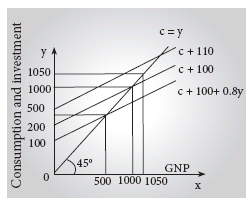
Diagrammatic Explanation.
(1) At 45° line y = C+ S
(2) It implies the variables in axis and axis are equal.
(3) The MPC is assumed to be at 0.8 (C = 100 + 0.8y)
(4) The aggregate demand (C + I) curve intersects 45° line at point E.
(5) The original national income is 500. (C = 100 + 0.8y = 100 + 0.8(500) = 500)
(6) When I is 100, y = 1000, C = 900; S = 100 = I
(7) The new aggregate demand curve is C + I = 100 + 0.8y + 100 +10
(8) Y = 210 / 0.2 = 1050
(9) C = 940; S = 110 = I
129.
1. In addition to household and firms, inclusion of the government sector makes this model a three-sector model.
2. The government levies taxes on households and firms, purchases goods and services from firms, and receive factors of production from household sector.
3. On the other hand, the government also makes social transfers such as pension, relief, subsidies to the households.
4. Similarly, Government pays the firms for the purchases of goods and services.
5. The Flow Chart illustrates three- sector economy model
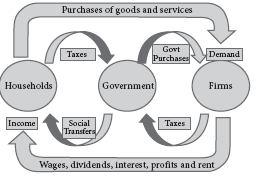
Under three sector model, national income
(Y) is obtained by adding Consumption expenditure (C), Investment expenditure (I) and Government expenditure (G).
Therefore Y = C + I + G
130.
| S. No | Marginal Efficiency of Captial (MEC) | Marginal Efficiency of Investment (MEI) |
|---|---|---|
| 1. | It is based on given supply price for capital. | It is based on the induced change in the price due to change in the demand for capital. |
| 2. | It represents the rate of return on all successive unit of capital without regard to existing capital. | It shows the rate of return on just those units of capital over and above the existing capital stock |
| 3. | The capital stock is taken on the X axis of diagram. | The amount of investment is taken on the X axis of diagram. |
| 4. | It is a 'Stock' concept. | It is a 'Flow' concept. |
| 5. | It determines the optimum capital stock in an economy at each level of interest rate. | It determines the net investment of the economy at each interest rate given the capital stock. |

12th Standard Syllabus & Materials
12th Standard
TN 12th Computer Applications களப்பெயர் முறைமை (DNS) Sample Question Papers Study Material - QB365 Set A
NEW12th Standard
TN 12th Computer Applications வலையமைப்பு எடுத்துக்காட்டுகள் மற்றும் நெறிமுறைகள் Sample Question Papers Study Material - QB365 Set A
NEW12th Standard
TN 12th Computer Applications கணினி வலையமைப்பு ஓர் அறிமுகம் Sample Question Papers Study Material - QB365 Set A
NEW12th Standard
TN 12th Computer Applications PHP-உடன் MySQL-ஐ இணைத்தல் Sample Question Papers Study Material - QB365 Set A



Tamilnadu Stateboard 12th Standard Subjects

Maths

Chemistry

Physics

Biology

Computer Science

Business Maths and Statistics
Economics

Commerce

Accountancy

History

Computer Applications
Biology
Computer Technology
Computer Applications
Computer Science
Business Maths and Statistics
Commerce
Economics
Maths
Chemistry
Physics
Computer Technology
History
Accountancy

Tamil

English

French
Tamilnadu Stateboard Standards
