
 100% FREE ACCESS
12th Standard Syllabus & Materials
12th Standard
TN 12th Computer Applications மின்னணு தரவு பரிமாற்றம் Sample Question Papers Study Material - QB365 Set A
NEW12th Standard
TN 12th Computer Applications மின் - வணிக பாதுகாப்பு அமைப்புகள் Sample Question Papers Study Material - QB365 Set A
NEW12th Standard
TN 12th Computer Applications மின்னணு செலுத்தல் முறைகள் Sample Question Papers Study Material - QB365 Set A
NEW12th Standard
TN 12th Computer Applications மின் - வணிகம் Sample Question Papers Study Material - QB365 Set A
NEW12th Standard
TN 12th Computer Applications திறந்த மூல கருத்துருக்கள் Sample Question Papers Study Material - QB365 Set A
NEW12th Standard
TN 12th Computer Applications வலையமைப்பு வடமிடல் Sample Question Papers Study Material - QB365 Set A

Published on: 12/02/2020
12th Standard Economics Bookback and Important Questions-II-2020
Download Tamil Nadu 12th Standard Economics question papers, model tests, one-mark questions, important questions, and public exam papers in PDF format. Free study materials and answer keys for TN State Board students.
Questions + Answers key
Take MCQ Economics Test
1.
How do you measure Revenue Deficit?
When RE + RR > 0
When RE - RR > 0
When RE - RR < 0
When RE - RR = 0
2.
Which of the following is note related to direct tax?
Progressive
Falls on the same person
Income or wealth of the assesse
Can be shifted
3.
Assertion: Banks issue traveler’s cheques to individuals for traveling outside the country.
Reason: Traveler’s cheques are the safe and easy way to protect money while traveling.
Both A and R are true and R is the correct explanation of A.
Both A and R are true but R is not the correct explanation of A.
A is true but R is false.
A is false but R is true.
4.
In ________BRICS summit in Brazil, the member countries, signed an agreement to create a development bank (New Development Bank) with headquarters at Shangai, China in 2015.
the first
the second
the sixth
the latest
5.
Expand the term ECM
European Common Market
Equal Common Market
East Asian Common Market
England Custom Market
6.
Find the correct answer
I. Financial – Assistance to correct short and medium term deficit in BOP;
II. Regulatory – Counseling and technical consultancy
III. Consultative - Code of conduct and
All are correctly matched
II only correctly matched
All are incorrectly matched
I only correctly matched
7.
In classical theory of employment, there is the possibility of:
Voluntary unemployment
No unemployment
Involuntary unemployment
Disguised unemployment
8.
_______________ is peculiar to the mixed economies.
Financial Planning
Structural Planning
Indicative planning
Physical Planning
9.
Structural unemployment results from massive and deep rooted changes in _______?
political structure
economic structure
social structure
cultural structure
10.
_____ can be possible When prices rise moderately and the annual inflation rate is a single digit ( 3% - 9%).
Walking Inflation
Running Inflation
Creeping Inflation
Hyper Inflation
11.
In Keynes extended equation: n = p (k + rk') or p = n/(k + rk'), which one is wrongly denoted?
n = total money supply
p = price level of consumer goods
k = peoples desire to hold money in hand (in terms of consumer goods) in the total income of them
r = community’s total money deposit in banks, in terms of consumers goods
12.
In regression, the equation that describes how the response variable (y) is related to the explanatory variable (x) is:
the correlation model
the regression model
used to compute the correlation coefficient
None of these alternatives is correct.
13.
Which of the statements do not hold true?
Both regression coefficients cannot be greater than 1
Regression coefficients are unaffected by origin shift and scale shift
Both correlation and regression coefficients are of same sign
Two regression lines coincide if r=±1
14.
The concept "development" refers to the _____________ changes towards betterment.
systematic
seasonal
structural
functional
15.
Find an example of Statistics Regression.
Yi = β0 + β1Xi
Yi = β0 + β1Xi + Ui
Xi = β0 + β1Xi + Ui
Yo = β0 + β1Xi + Uo
16.
Assume that Country A is relatively abundant in labor and Country B is relatively abundant inland. Note that wages are the returns to labor and rents are the returns to land. According to thefactor price equalization theorem, once Country A begins specializing according to comparative advantage and trading with Country B.
wages and rents should fall in Country A
wages and rents should rise in Country A
wages should rise and rents should fall in Country A
wages should fall and rents should rise in Country A
17.
The earliest statement of the principle of comparative advantage is associated with
Adam Smith
David Ricardo
Eli Heckscher
Bertil Ohlin
18.
Which of the following statement is TRUE?
Eco-Systems may vary in size
Eco-Systems are always very large
Eco-Systems are always very small
None of these is true.
19.
Assertion: The multiplier refers to the change in national income resulting from change in investment.
Reason: The value of multiplier itself depends on consumption function or marginal propensity to consume.
Both A and R are true and R is the correct explanation of A
Both A and R are true but R is not the correct explanation of A
A is true but R is false
A is false but R is true
20.
When MPS = 0.2, MPC will be
0.8
0.2
1.2
20
21.
In economic activities of Goods and Service, what the RC + RP mean?
Recycles from Production and Consumption
Residual Discharges from Consumption and Production
Consumption and Production
Final Residual Discharge from Production and Consumption
22.
Arrange the order of accelerator effects Increase in consumer demand Films get close to fill capacity Films invest to meet rising demand
I, II, III
II, I, III
III, II, I
III, I, II
23.
Mercantilism
Is the philosophy of free international trade
Was a system of export promotion and barriers to imports practiced by governments
Was praised by Adam Smith in The Wealth of Nations
Both (a) and (c)
24.
Identify which is not an example of capitalistic economy.
The USA economy
Germany economy
Indian economy
Australia economy
25.
The natural pollution causes both aquatic and
Cancer
Human illness
Children
Asthm(a)
26.
Budget estimates are prepared by _____________
Ministry of Finance
Public finance
Public Revenue
All the above
27.
___________ was set up in July 1982.
ARDC
NABARD
ICICI
Indian Bank
28.
Inventories of finished and unfinished goods are called _________.
Net Investment
Investment
Gross Investment
Both 'a' and 'b'
29.
Goods and services produced in a year to satisfy immediate wants is known as ________.
Production
Consumption
Distribution
Exchange
30.
Perspective Plan covers a period of
5 years
10 years
10 to 30 years
15 years
31.
GDP calculate at market price is known as __________.
GDP at factor price
NDP at factor price
GNP at factor price
GDP at Market price
32.
_________was set up in July 1982
ARDC
NABARD
ICICI
Indian Bank
33.
______is the one of the functions of RBI.
Accepting Deposits
Advancing Loans
Collecting Cheques
Lender of the last resort
34.
Barter system was introduced by________ tribes.
Mesopotamia
Phoenician
Babylonian
Jarwa
35.
Market forces are _________.
Supply and price
Demand and price
Prices of commodity
Supply and demand
36.
Macro economics is also known as __________.
Price theory
Income theory
Business cycle
Poverty and unemployment
37.
The term regression was used by:
Newton
Pearson
Spearman
Galton
38.
39.
Sarvodaya Plan was advocated by__________
Mahatma Gandhi
J.P.Narayan
S.N Agarwal
M.N. Roy
40.
The supply side vicious circle of poverty suggests that poor nations remain poor because
Saving remains low
Investment remains low
There is a lack of effective government
a and b above
41.
The major contributor of Carbon monoxide is
Automobiles
Industrial process
Stationary fuel combustion
None of the above
42.
Environmental goods are ____________
Market goods
Non-market goods
Both
None ofthe above
43.
Which of the following is not a tax under Union list?
Personal Income Tax
Corporation Tax
Agricultural Income Tax
Excise duty
44.
GST is equivalence of
Sales tax
Corporation tax
Income tax
Local tax
45.
The Tenth BRICS Summit was held in July 2018 at
Beijing
Moscow
Johannesburg
Brasilia
46.
The headquarters of ASEAN is
Jaharta
New Delhi
Colombo
Tokyo
47.
If there is an imbalance in the trade balance (more imports than exports), it can be reduced by
decreasing customs duties
increasing export duties
stimulating exports
stimulating imports
48.
Trade between two countries is known as ____ trade
External
Internal
Inter-regional
Home
49.
Monetary policy his formulated by.
Co-operative banks
Commercial banks
Central Bank
Foreign banks
50.
Repo Rate means.
Rate at which the Commercial Banks are willing to lend to RBI
Rate at which the RBI is willing to lend to commercial banks
Exchange rate of the foreign bank
Growth rate of the economy
51.
_____inflation is in no way dangerous to the economy.
walking
running
creeping
galloping
52.
MV stands for
demand for money
supply of legal tender money
Supply of bank money
Total supply of money
53.
As increase in consumption at any given level of income is likely to lead
Higher aggregate demand
An increase in exports
A fall in taxation revenue
A decrease in import spending
54.
If the Keynesian consumption function is C=10+0.8Y then, when disposable income is Rs 100, what is the marginal propensity to consume?
₹ 0.8
₹ 800
₹ 810
₹ 0.81
55.
In Keynes theory , the demand for and supply of money are determined by ________
Rate of interest
Effective demand
Aggregate demand
Aggregate supply
56.
In Keynes theory of employment and income, ___________ is the basic cause of economic depression
Less production
More demand
Inelastic supply
Less aggregate demand in relation to productive capacity
57.
The largest proportion of national income comes from___________
Private sector
Local sector
Public sector
None of the above
58.
Net National product at factor cost is also known as
National Income
Domestic Income
Per capita Income
Salary
59.
Who is referred as ‘Father of Capitalism’?
Adam Smith
Karl Marx
Thackeray
J M Keynes
60.
61.
What are Sale Taxes?
62.
What is a debit card?
63.
Write a note on WTO’s Dispute Settlement Body
64.
Compare the different term plans.
65.
Write a note on the demand-side of the vicious circle of poverty.
66.
Use the graph below to answer the following questions:
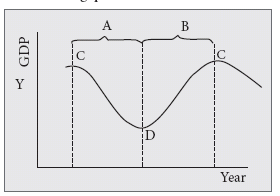
a. Mention the phases of the “points mentioned” in business cycle graph.
A: ___________
B:___________
C: ___________
D: ___________
67.
Write the equation of Aggregate Supply.
68.
What is Cyclical Unemployment?
69.
List the Limitations of statistics.
70.
What is Foreign Institutional Investment (FII)?
71.
What are unpaid services?
72.
State the Duesenberry hypothesis.
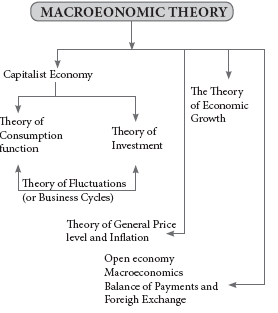
73.
What are the subject matters of macroeconomic theory
74.
What do you mean by pollution?
75.
Distinguish between positive multiplier and negative multiplier.
76.
Write the formula for calculating NDP.
77.
What are the three motives of liquidity preference?
78.
In which year the (ATM) Automated teller Machine was introduced?
79.
What do you mean by Trade cycle?
80.
What is Globalisation?
81.
What is Mixed Economy?
82.
What is Globalism?
83.
What do you mean by Inferential Statistics?
84.
What are the kinds of Statistics?
85.
What are the social indicators of economic development?
86.
State the meaning of environment.
87.
Give two examples for direct tax.
88.
State any two merits of trade.
89.
Write the meaning of Open market operations.
90.
What is gold standard?
91.
Define average propensity to consume (APC).
92.
Give short note on frictional unemployment.
93.
Define full employment.
94.
What do you mean by the term ‘Personal Income’?
95.
What do you mean by Capitalism?
96.
List the Classification of public expenditure Classification on the Basis of Function.
97.
Discuss the Agency Functions of RBI.
98.
Explain the three secondary function of money.
99.
Calculate the AM of 305, 320, 332, 350
100.
List the assumption of Comparative advantage theory of international trade.
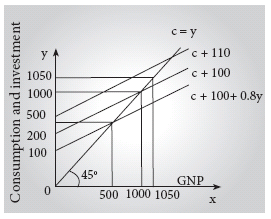
101.
Draw the diagram of Multiplier in an economy.
102.
What are the types of Noise Pollution?
103.
What are the achievements of World Bank?
104.
What are the assumptions of Absolute Cost Advantages?
105.
What is Output method? What is its major challenge?
106.
Distinguish between Economic Development and Growth. (Any Three Points).
107.
Write a short note on effective demand?
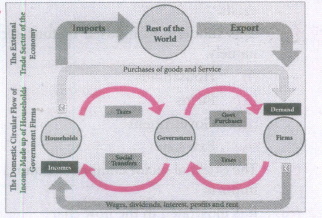
108.
Draw the Circular flow of income in a three sector economy.
109.
Mention the uses of Regression Analysis.
110.
Trace the evolution of economic planning in India.
111.
What are the causes of water pollution?
112.
Describe Canons of Taxation.
113.
Write the agenda of BRICS Summit, 2018.
114.
Describe the subject matter of International Economics.
115.
Distinguish between money market and capital market.
116.
Explain disinflation.
117.
118.
What do you mean by aggregate demand ? Mention its components.
119.
Explain briefly NNP at factor cost.
120.
Briefly explain the two sector circular flow model.
121.
Write the History, Administration and Brief Functions of RBI.
122.
What are the the Formula for computing Karl Pearson’s Coefficient of correlation?
123.
Elucidate various measures of economic development.
124.
Explain the basic concepts of national income.
125.
Use the table below (for a simple economy with no foreign sector or government) to answer the questions that follow.
| (1) Income (Y) |
(2) Consumption (C) |
(3) Investment (l) |
(4) Aggregate Demand AD = C + 1 = Column(2) + Column(3) |
| 0 | 30 | (a) | 50 |
| 300 | 300 | 20 | (b) |
| 400 | (c) | 20 | 410 |
| 500 | 480 | 20 | 500 |
| 600 | (d) | 20 | (e) |
Fill in the missing numbers in the spaces marked (a)-(c). Determine the consumption function, and use the result to fill in the remaining missing numbers (d)-(e). (f) Determine the equilibrium output level.
126.
What are the causes for the increase in public debt?
127.
Explain the causes for Balance of Payment Disequilibrium.
128.
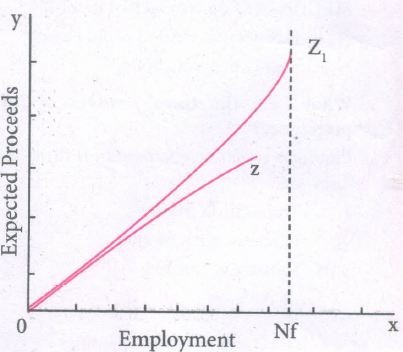
Draw the diagram for Aggregate supply curves diagram.
129.
Explain the Demerits of capitalism.
130.
Explain the operation of the Accelerator.
1.
(b)
When RE - RR > 0
2.
(d)
Can be shifted
3.
(a)
Both A and R are true and R is the correct explanation of A.
4.
(c)
the sixth
5.
(a)
European Common Market
6.
(d)
I only correctly matched
7.
(a)
Voluntary unemployment
8.
(c)
Indicative planning
9.
(b)
economic structure
10.
(a)
Walking Inflation
11.
(d)
r = community’s total money deposit in banks, in terms of consumers goods
12.
(b)
the regression model
13.
(b)
Regression coefficients are unaffected by origin shift and scale shift
14.
(c)
structural
15.
(a)
Yi = β0 + β1Xi
16.
(c)
wages should rise and rents should fall in Country A
17.
(b)
David Ricardo
18.
(a)
Eco-Systems may vary in size
19.
(b)
Both A and R are true but R is not the correct explanation of A
20.
(a)
0.8
21.
(b)
Residual Discharges from Consumption and Production
22.
(a)
I, II, III
23.
(b)
Was a system of export promotion and barriers to imports practiced by governments
24.
(c)
Indian economy
25.
(b)
Human illness
26.
(a)
Ministry of Finance
27.
(b)
NABARD
28.
(c)
Gross Investment
29.
(b)
Consumption
30.
(c)
10 to 30 years
31.
(d)
GDP at Market price
32.
(b)
NABARD
33.
(d)
Lender of the last resort
34.
(a)
Mesopotamia
35.
(d)
Supply and demand
36.
(b)
Income theory
37.
(d)
Galton
38.
(a)
39.
(b)
J.P.Narayan
40.
(d)
a and b above
41.
(a)
Automobiles
42.
(b)
Non-market goods
43.
(c)
Agricultural Income Tax
44.
(a)
Sales tax
45.
(c)
Johannesburg
46.
(a)
Jaharta
47.
(c)
stimulating exports
48.
(a)
External
49.
(c)
Central Bank
50.
(b)
Rate at which the RBI is willing to lend to commercial banks
51.
(c)
creeping
52.
(b)
supply of legal tender money
53.
(a)
Higher aggregate demand
54.
(a)
₹ 0.8
55.
(a)
Rate of interest
56.
(d)
Less aggregate demand in relation to productive capacity
57.
(a)
Private sector
58.
(a)
National Income
59.
(a)
Adam Smith
60.
(b)
61.
Paid by a shopkeeper or retailer, who then shifts the tax burden to customers by charging sales tax on goods and services.
62.
Debit card is a card allowing the holder to transfer money electronically from their bank account when making a purchase.
63.
(i) The Disputes Settlement Body puts an end to procedural delays.
(ii) It is mandatory to settle any dispute within 18 months.
(iii) The disputes are resolved through multilateral trading system.
64.
| Short Term Plan | Medium Term Plan | Long Term Plan |
|---|---|---|
| Short - term up to 1 year | Medium-term 3 - 7 years | Long - term over 10 year |
| Short - term planning concerns the plans in a time period of 1 year - operational planning. | Medium – term planning is considered for a time period of 5 years – tactical planning. | Long – term planning is considered for a time period over 10 years – strategic planning. |
65.
(i) The demand-side of the vicious circle of poverty is that the low level of real income leads to a low level of demand which, in turn, leads to a low rate of investment and hence back to deficiency of capital, low productivity and low income.
(ii) Low Income ⟶ Low Demand Low Investment ⟶ Low Productivity ⟶ Low Income
66.
A: Recession
B: Recovery
C: Prosperity
D: Depression
67.
Aggregate Supply = C + S + T + Rf = Aggregate income generated in the economy
68.
1. Cyclical unemployment exists during the downturn phase of trade cycle in the economy.
2. In a business cycle during the period of recession and depression, income and output fall leading to widespread unemployment.
69.
1. Statistics is not suitable to the study of qualitative phenomenon
2. Statistical laws are not exact:
3. Statistics table may be misused:
4. Statistics is only one of the methods of studying a problem.
70.
(i) Foreign Institutional Investment (FII) is an investment in hedge funds, insurance companies, pension funds and mutual funds.
(ii) Foreign institutional investment is a common term in the financial sector of India
(iii) For example, a mutual fund in the United States can make investment in an Indiabased company
71.
(i) A housewife renders a number of useful services like preparation of meals, serving, tailoring, mending, washing, cleaning, bringing up children, etc.
(ii) She is not paid for them and her services are not directly included in national income. Such services performed by paid servants are included in national income.
(iii) They are called unpaid services.
72.
Duesenberry has made two observations regarding the factors affecting consumption.
a. The consumption expenditure depends not only on his current income but also past income and standard of living.
b. Consumption is influenced by demonstration effect. The consumption standards of low income groups are influenced by the consumption standards of high income groups.
73.
74.
Pollution is the introduction of contaminants into the natural environment that causes and and verse change, in the form of killing of life, toxicity of environment, damage to ecosystem and aesthetics of our surroundings.
75.
| Positive Multiplier | Negative Multiplier |
|---|---|
| When an intial increases in an injection leads to a greater final increase in real GDP. | When an intial increases in an injection leads to a greater final decrease in real GDP. |
76.
Net Domestic Product = GDP - Depreciation.
77.
Liquidity preference is based on three motives. They are,
(i) Transaction motive
(ii) Precautionary motive
(ii) Speculative motive
78.
ATM was first introduced in 1967.
79.
(i) The economic activity in a capitalist economy will have its periodic ups and down.
(ii) The study of these ups and downs is called the study of Business cycle or Trade cycl or Industrial Fluctuation.
80.
Globalisation is nothing but connect the nations together through international trade and aiming at global development.
81.
(i) In economic system both private and public sectors co-exist.
(ii) It work together towards economic development.
82.
Globalism : An economic system where the economic activities of a nation are inter connected and inter dependent on each other nation.
83.
The branch of statistics concerned with using sample data to make an inference about a population of data is called Inferential Statistics.
84.
There are two major types of statistics.
(i) Descriptive statistics
(ii) Inferential statistics
85.
Basic and collective needs of the people - health, education, sanitation, water, food, housing facilities.
86.
(i) Environment means "all the conditions, circumstances, and influences surrounding and affecting the development of an organism or group of organisms".
(ii) It also means that the complex of physical, chemical and biotic factors that act upon an organism or an ecological community ultimately determine its form and survival.
87.
Income tax, wealth tax, corporate tax, capital gains tax.
88.
(i) Availability of variety of goods for consumption.
(ii) Generation of more employment.
(iii) Industrialization of backward nations.
(iv) Division of labour and specialisation.
89.
(i) The Central Bank purchases and sells Government securities and proper eligible securities like bills and securities of private concerns.
(ii) This is called Open Market operation.
90.
(i) The value of the monetary unit is directly linked with a certain weight of gold.
(ii) The purchasing power of a unit of money is maintained equal to the value of a fixed weight of gold.
91.
APC is the ratio of consumption expenditure to any particular level of income
APC = \(\frac{C}{Y}\)
92.
(i) It arises due to imbalance between supply of labour and demand for labour.
(ii) It is because of immobility of labour, lack of necessary skills, breakdown of machinery, shortage of raw materials.
(iii) The persons who lose jobs and in search of jobs are also included.
93.
(i) "Full employment is the absence of involuntary unemployment." - Keynes
(ii) "Full employment is that level of employment at which any further increase in spending would result in an inflationary spiral of wages and prices" - Lerner
94.
It is the total income received by the individuals of a country before payment of direct tax.
Personal Income = National Income
- (Social Security Contribution and undistributed corporate profits)
+ Transfer payments
95.
(i) Capitalism is a system where the means of production are privately owned.
(ii) Market determines the economic activities (e.g.) The USA, Japan.
96.
Adam Smith classified public expenditure on the basis of functions of government in the following main groups.
a) Protection Functions
This group includes public expenditure incurred on the security of the citizens, to protect from external invasion and internal disorder, e.g., defence, police, courts etc.
b) Commercial Functions
This group includes public expenditure incurred on the development of trade and commerce, e.g., development of means of transport and communication etc.
c) Development Functions
This group includes public expenditure incurred for the development infrastructure and industry.
97.
Agency Functions implies that commercial banks act as agents of customers by performing various functions.
(i) Collecting Cheques Banks collect cheques and bills of exchange on the behalf of their customers through clearing house facilities provided by the central bank.
(ii) Collecting Income Commercial banks collect dividends, pension, salaries, rents, and interests on investments on behalf of their customers. A credit voucher is sent to customers for information when any income is collected by the bank.
(iii) Paying Expenses Commercial banks make the payments of various obligations of customers, such as telephone bills, insurance premium, school fees, and rents. Similar to credit voucher, a debit voucher is sent to customers for information when expenses are paid by the bank.
98.
(i) Money as a Store of value: Savings done in terms of commodities were not permanent. But, with the invention of money, this difficulty has now disappeared and savings are now done in terms of money.
(ii) Money as a Standard of Deferred Payments: Borrowing and lending were difficult problems under the barter system. In the absence of money, the borrowed amount could be returned only in terms of goods and services.
(iii) Money as a Means of Transferring Purchasing Power: The field of exchange also went on extending with growing economic development. The exchange of goods is now extended to distant lands.
99.
| X | d=X-320 |
| 305 | -15 |
| 320 | 0 |
| 332 | 12 |
| 350 | 30 |
| 27 |
| \(\bar { X } \) | = | A+ | \(\frac { \sum { d } }{ n } \) |
| = | 320+ | 27 | |
| 4 | |||
| = | 320+6.75 | ||
| = | 326.75 | ||
100.
1. There are only two nations and two commodities (2 x 2 model)
2. Labour is the only element of cost of production.
3. All labourers are of equal efficiency
4. Labour is perfectly mobile within the country but perfectly immobile between countries.
5. Production is subject to the law of constant returns
6. Foreign trade is free from all barriers.
7. No change in technology.
8. No transport cost.
9. Perfect competition.
10. Full employment.
11. No government intervention
101.
102.
i. Atmospheric Noise:
Atmospheric noise or static is caused by lightning discharges in thunderstorms and other natural electrical disturbances occurring in the atmosphere.
ii. Industrial Noise:
Industrial noise refers to noise that is created in the factories. Sound becomes noise it becomes unwanted. Heavy industries like shipbuilding, iron, and steel have long been associated with Noise-Induced Hearing Loss (NIHL).
iii. Man-made Noise:
The main sources of man-made noise pollution are ships, aircraft, seismic exploration, marine construction, drilling, and motor boats.
103.
(i) The World Bank is said to be successful in achieving its primary objectives of reconstruction and development of war ravaged nations.
(ii) It is noted that the bank's membership has increased from the initial number of 30 countries to 68 countries in 1960 to 151 countries in 1988.
(iii) The Bank grants medium and long term loans (i, e, payable over a period of 15 - 20 years) for reconstruction and development purpose to the member countries.
(iv) Initially the World Bank's loans were mainly directed at the European countries for financing their programmes of reconstruction.
(v) The World Bank grants loans to member countries only for productive purposes particularly for agriculture irrigation, power and transport.
(vi) The International Development Association (IDA) the Soft Loan Window of the Bank provides loans to UDCs at very low rate of interest.
104.
(i) There are two countries and two commodities (2 X 2) model.
(ii) Labour is the only factor of production.
(iii) Labour units are homogeneous.
(iv) Price of commodity is measured by the amount of labour required to produce it.
105.
(i) In the output or product method, the measures of GDP are calculated by adding the total value of the output (of goods and services) produced by all activities during any time period, such as a year.
(ii) The major challenge of this method is the problem of double counting.
106.
| S.No | Economic Development | Economic Growth |
|---|---|---|
| (i) | Related to Underdeveloped Countries | Related to developed (or) advanced countries. |
| (ii) | Rising of income levels in poor countries. | Rising of income levels in rich countries |
| (iii) | It is discontinuous and spontaneous changes in the station if any state | It is gradual and steady changes in the long run. |
107.
(i) Effective demand denotes money actually spent by the people on products of industry.
(ii) The money which entrepreneurs receive is paid in the form of rent, wages, interest and profit.
(iii) Therefore effective demand equals national income.
(iv) An increase in the aggregate effective demand would increase the level of employment. A decline in total effective demand would lead to unemployment. Therefore,
(v) Thus the total employment of a country can be determined with the help of total demand of a country.
108.
109.
(i) Besides verification it is used for the prediction of one value, in relation to the other given value.
(ii) Regression coefficient is an absolute figure. If we know the value of the independent variable, we can find the value of the dependent variable.
(iii) It has wider application, as it studies linear and nonlinear relationship between the variables.
(iv) It is widely used for further mathematical treatment.
110.
1. Sir M. Vishveshwarya (1934) made the first attempt in laying foundation for economic planning in India through his book, "Planned Economy of India". It was a 10 year plan.
2. Jawaharlal Nehru (1938) set-up "National Planning Commission" by a committee but due to the World War II it did not materialize.
3. In 1940,8 leading industrialists of Bombay presented a 15 Year Bombay Plan.
4. In 1944 S. N Agarwal gave the Gandhian Plan focusing on the agriculture and rural economy.
5. M.N. Roy in 1945 drafted People's Plan aiming at mechanisation of agricultural production.
6. In 1950 J.P. Narayan advocated Sarvodaya Plan which was inspired by Gandhian Plan and with the idea of Vinoba Bhave.
7. It gave importance to agriculture, small and cottage industries.
8. After considering all the plans in the same year Planning Commission was set up to formulate Five Year Plan in India by Jawaharlal Nehru.
9. Nehru was the first Chairman of Planning Commission, Government of India.
111.
Discharge of sewage and waste water:
(i) Sewage, garbage and liquid waste of households, agricultural runoff and effluents from factories are discharged into lakes and rivers.
(ii) These wastes contain harmful chemicals and toxins which make the water poisonous for aquatic animals and plants.
Dumping of solid wastes:
(i) The dumping of solid wastes and litters in water bodies cause huge problems.
Discharge of industrial wastes:
(i) Industrial waste contains asbestos, lead, mercury, grease oil and petrochemicals.
Oil Spill:
(i) Sea water gets polluted due to oil spilled from ships and tankers.
Acid Rain:
(i) When the acidic particles caused by air pollution mix with water vapour, it results in acid rain.
Global warming:
(i) The increase in water temperature affects aquatic plants and animals.
Eutrophication:
(i) The increased level of nutrients in water depletes oxygen in water and this negatively affects fish and other aquatic animal population.
112.
Canon of Ability
1. The Government should impose tax in such a way that the people have to pay taxes according to their ability.
2. Rich person should pay more tax.
Canon of Certainty
1. There is no uncertainty regarding the rate of tax or the time of payment.
Canon of Convenience
1. The method of tax collection and the timing of the tax payment should be convenient to the people.
Canon of Economy
1. The Government should impose only those taxes whose collection costs are very less and cheap.
113.
Inclusive growth, Trade issues, Global governance, Shared Prosperity, International peace and security.
114.
Pure Theory of Trade
(i) This component explains the causes for foreign trade, composition, direction and volume of trade, determination of the terms of trade and exchange rate, issues related to balance of trade and balance of payments.
Policy Issues
(i) Policy issues such as free trade vs. protection, methods of regulating trade, capital and technology flows, use of taxation, subsidies and dumping, exchange control and convertibility, foreign aid, external borrowings and foreign direct investment, measures of correcting disequilibrium in BoP are covered.
International Cartels and Trade Blocs
(i) Economic integration, cartels, customs unions, monetary unions, trade blocs, economic unions and multinational corporation are covered
International Financial and Trade Regulatory Institutions
(i) Financial institutions like IMF, IBRD, WTO are part of International Economics.
115.
| S. No. |
Money Market |
Capital Market |
|---|---|---|
| (1) | Short term funds are loaned and borrowed | Long term funds are loaned and borrowed |
| (2) | It deals with purchase, sale and transfer of short term credit instruments. | It raises capital by dealing in shares, bonds mortgages and other long term investments. |
| (3) | Commercial banks, acceptance houses, Non Banking Financial Institutions and the Central Bank deals with short term funds | Instruments traded in capital market comprise of equity shares, preference. shares, Debentures, bonds and other long term securities. |
116.
(i) It is the slowing down the rate of inflation by controlling the amount of credit (bank loan, hire purchase) available to consumers without causing more unemployment.
(ii) It is defined as the process of reversing inflation without creating unemployment or reducing output in the company.
117.
118.
(i) In the Keynesian model, output is determined mainly by aggregate demand.
(ii) The aggregate demand is the amount of money which entrepreneurs expect to get by selling the output produced by the labourers employed.
(iii) Aggregate demand (spending) is the amount that households, firms, the governments and the foreign purchasers would like to spend on domestic output
Aggregate demand has four components:
1. Consumption demand (C)
2. Investment demand (I)
3. Government expenditure (G)
Net Export ( export - import) (X - M)
AD = C + I + G + (X - M)
119.
(i) It is the total of income payment made to factors of production.
(ii) From the money value of NNP at market price, we deduct indirect tax and add subsidy.
(iii) \(\mathrm{NNP}_{\mathrm{FC}}=\mathrm{NNP}_{\mathrm{MP}}-\) Indirect taxes + Subsidies
120.
There are only two sectors - household sector and firm sector.
(i) Household Sector
1. It supplies the factors of production and gets income from the firm sector
2. It buys goods and services with its entire income.
(ii) Firms:
1. It hires factors of production from the household sector.
2. It gets revenue by selling goods and services to the household sectors.
3. The production and sales are equal.
Y = C + I
Y is income
C is consumption
I is investment
121.
History:
(i) Formed on April 1, 1935 in accordance with the RBI Act, 1934
(ii) Nationalized on January 1, 1949 (Fully owned by GOI)
(iii) Headquarter moved from Calcutta to Mumbai in 1937
(iv) Osborne Smith was the first Governor of RBI
Administration:
(i) It is the Central Bank/ Regulator for all bank in India
(ii) Also called “Lender of Last Resort”
(iii) Governors and 4 Deputy Governors along with a central board of directors appointed by the GOI.
Functions:
(i) Issues currency
(ii) Banker to the government. {It collects receipts of funds and makes payments on behalf of the government}
(iv) Regulator of Indian Banking system
(v) Custodian of Forex
(vi) Controller of credit
122.
1. \(r=\frac { N\sum { XY-(\sum { X } )(\sum { Y } ) } }{ \sqrt { { N\sum { X } }^{ 2 }-{ (\sum { X } ) }^{ 2 } } \sqrt { { N\sum { Y } }^{ 2 }-{ (\sum { Y } ) }^{ 2 } } } \)
'r' is calculated by Direct Method without taking deviation of terms either from actual mean or assumed mean.
2. r is calculated by taking the Deviation from acutual mean.
\(r=\frac { \sum { xy } }{ { N\sum { X } }^{ 2 }-{ \sum { Y } }^{ 2 } }Where X=(X-\bar { X } ),Y=(\bar { X } )\)
3. 'r' is calculated by taking assumed mean
\(r=\frac { N\sum { dxdy-(\sum { dx } )(\sum { dy } ) } }{ \sqrt { { N\sum { dx } }^{ 2 }-{ (\sum { dx } ) }^{ 2 } } \sqrt { { N\sum { dy } }^{ 2 }-{ (\sum { dy } ) }^{ 2 } } } \)
Where dx refers to deviations of x series from assumed mean (x-x̅), dy refers to
deviations of y series from an assumed mean of (y-y)
1. Σdxdy = Sum of product of the deviations x and y series from their assumed means.
2. Σdx2 = Sum of the squares of the deviations of x series from an assumed mean
3. Σdy2= Sum of the squares of the deviations of y series from an assumed mean
4. Σdx = Sum of the deviation of x series from an assumed mean of x
5. Σdy = Sum of the deviation of y series from an assumed mean of y
123.
Economic development is measured on the basis of four criteria
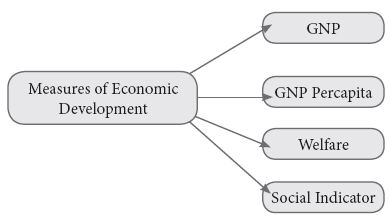
Gross National Product (GNP):
(i) GNP is the total market value of all final goods and services produced within a nation in a particular year, plus income earned by its citizens (including income of those located abroad), minus income of non-residents located in that country.
(ii) GNP is one measure of the economic condition of a country, under the assumption that a higher GNP leads to a higher quality of living, all other things being equal.
GNP per capita:
(i) This relates to increasing in the per capita real income of the economy over the long period
(ii) This indicator of economic growth emphasizes that for economic development the rate of increase in real per capita income should be higher than the growth rate of population.
Welfare:
(i) Economic development is regarded as a process whereby there is an increase in the consumption of goods and services by individuals.
(ii) From the welfare perspective, economic development is defined as a sustained improvement in health, literacy, and standard of living
Social Indicators:
(i) Social indicators are normally referred to as basic and collective needs of the people
(ii) The direct provision of basic needs such as health, education, food, water, sanitation, and housing facilities check social backwardness.
| S/N | Basic need | Indicators |
|---|---|---|
| 1 | Health | Life expectancy at birth |
| 2 | Education | Literacy signifying primary school enrolment as a percent of the population. |
| 3 | Food | Calorie Supply per head |
| 4 | Water supply | Infant mortality and percentage of the population with access to potable water |
| 5 | Sanitation | Infant mortality and percentage of the population with access to sanitation. |
124.
The following are some of the concepts used in measuring national income.
1. GDP
2. NNP
3. NNP at factor cost
4. Personal Income
5. Disposable Income
6. Per capita Income
7. Real Income
8. GDP deflator
Gross Domestic Product (GDP)
GDP is the total market value of final and services produced within the country during a year. This is calculated at market prices and is known as GDP at market prices.
Net Domestic Product (NDP)
1. NDP is the value of net output of the economy during the year. Some of the country’s capital equipment wears out or becomes outdated each year during the production process. Gross National Product (GNP)
2. GNP is the total measure of the flow of final goods and services at market value resulting from current production in a country during a year, including net income from abroad.
Net National Product (NNP)(at Market price)
Net National Product refers to the value of the net output of the economy during the year. NNP is obtained by deducting the value of depreciation, or replacement allowance of the capital assets from the GNP.
NNP at Factor cost
NNP refers to the market value of output. Whereas NNP at factor cost is the total of income payment made to factors of production.
Personal Income
Personal income is the total income received by the individuals of a country from all sources before payment of direct taxes in a year. Personal income is never equal to the national income, because the former includes the transfer payments whereas they are not included in national income
Disposable Income
1. Disposable Income is also known as Disposable personal income. It is the individuals income after the payment of income tax. This is the amount available for households for consumption. Per Capita Income.
2. The average income of a person of a country in a particular year is called Per Capita Income. Per capita income is obtained by dividing national income by population.
Real Income
Nominal income is national income expressed in terms of a general price level of a particular year in other words, real income is the buying power of nominal income.
GDP deflator
GDP deflator is an index of price changes of goods and services included in GDP. It is a price index which is calculated by dividing the nominal GDP in a given year by the real GDP for the same year and multiplying it by 100.
125.
| (1) Income (Y) |
(2) Consumption (C) |
(3) Investment (l) |
(4) Aggregate Demand AD = C + 1 = Column(2) + Column(3) |
| 0 | 30 | (a) | 50 |
| 300 | 300 | 20 | 320 |
| 400 | 390 | 20 | 410 |
| 500 | 480 | 20 | 500 |
| 600 | 570 | 20 | (e) |
Using AD = C + II,
(a) 50 = 30 + 20
(b) 320 = 300 + 20
(c) 410 = 390 + 20 Deriving the consumption function:
Autonomous consumption = 30 (from the first row where Y = 0).
To find the mpc, calculate a change in C (e.g. 390 – 300 = 90), and divide by the corresponding change in Y (400 – 300 = 100).
So the mpc = ΔC/ΔY = 90/100 = 0.9 Hence, the consumption function is C = 30 + 0.9Y To fill in
(d) C = 30 + 9(600) = 30 + 540 = 570.
(e) follows from 590 = 570 + 20.
f. Equilibrium is where Y = AD, which is at 500 (see shaded row).
126.
(i) War and preparation for war:
Waging war has become one of the important causes for incurring debts by the governments.
(ii) Social obligation:
Modern states are considered to be 'welfare states' and they have to undertake many social obligations like public health, sanitation, education, insurance, transport and communications etc.
(iii) Economic development deficit:
(1) The government has to undertake many projects for economic development of the country.
(2) Construction of railways, power projects, irrigation projects, heavy industries etc. Employment: Most of the governments of modern days face the problem of unemployment and has become the duty to solve this by making huge public expenditure.
(v) Controlling inflation:
The government can withdraw excess money from circulation, by raising public debt and thus prevent prices from rising.
(vi) Fighting depression:
During the depression phase, private investment is lacking.
127.
(i) Cyclical Fluctuation:
Cyclical disequilibrium in different countries is caused by their cyclical fluctuations their phases and magnitude.
(ii) Structure Change:
Its caused by the structural changes brought by huge development and investment programmes in the developing countries.
(iii) Development Expenditure:
(1) Its caused by rapid economic development which results in income and price effects.
(2) The less developed countries in the early stage of development are not self sufficient.
(iv) Consumerism:
Balance of payments position of a country is adversely affected by a huge increase in consumption.
v) Demonstration Effect:
Deficit in the balance of payments of developing countries is also caused by demonstration effect.
vi) Borrowing:
International borrowing and investment may cause a deficit in the balance of payments.
(vii) Global Politics:
The rich countries need to sell their weapons to promote their economy and generate employment.
128.
129.
Demerits of Capitalism:
1. Concentration of Wealth and Income :
Capitalism causes concentration of wealth and income in a few hands and thereby increases inequalities of income.
2. Wastage of Resources Large amount of resources are wasted on competitive advertising and duplication of products.
3. Class Struggle: Capitalism leads to class struggle as it divides the society into capitalists and workers.
4. Business Cycle: Free market system leads to frequent violent economic fluctuations and crises.
5. Production of non essential goods: Even the harmful goods are produced if there is possibility to make profit.
130.
Introduction
A systematic development of the simple accelerator model was made by J.M.Clark, It was further developed by Hicks, Samuelson and Harrod.
Definition
Accelerator coefficient is the ratio between induced investment and an initial change in consumption \(\beta=\frac{\Delta \mathrm{I}}{\Delta \mathrm{C}}\)
Operation
Suppose that in order to produce 1000 consumer goods, 100 machines are needed. Working life of a machine is 10 yrs i.e, every year 10 machines have to be replaced. This is called replacement demand
(i) Suppose that demand for consumer goods rises by 10 % (i.e, from 1000 to 1100)
(ii) This results in increase in demand for 10 more machines
(iii) The total demand for machines is 20 i.e, 10 % increase in demand for consumer goods causes 100 % increase in demand for machine (from 10 to 20 )
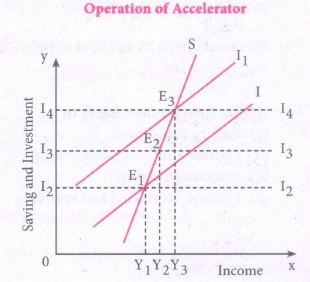
Explanation
(i) SS is the saving curve.
(ii) II is the investment curve.
(iii) At point E1 the economy is in equilibrium with OY1 income.
(iv) S and I are equal at O2.
(v) Now I increased from OI2 to OI4.
(vi) This increases income from OY1 to OY3 at E2 equilibrium.
(vii) If the increase in investment by I2I4 is purely exogenous, then the increase in income by Y1Y3 would be due to multiplier.
(viii) But in this diagram it is assumed that exogenous investment is only by I2I3 and induced investment is by I3I4.
(ix) Therefore, the increase in income by Y1Y2 is due to the multiplier effect and the increase in income by Y2Y3 is due to the accelerator effect.

12th Standard Syllabus & Materials
12th Standard
TN 12th Computer Applications களப்பெயர் முறைமை (DNS) Sample Question Papers Study Material - QB365 Set A
NEW12th Standard
TN 12th Computer Applications வலையமைப்பு எடுத்துக்காட்டுகள் மற்றும் நெறிமுறைகள் Sample Question Papers Study Material - QB365 Set A
NEW12th Standard
TN 12th Computer Applications கணினி வலையமைப்பு ஓர் அறிமுகம் Sample Question Papers Study Material - QB365 Set A
NEW12th Standard
TN 12th Computer Applications PHP-உடன் MySQL-ஐ இணைத்தல் Sample Question Papers Study Material - QB365 Set A



Tamilnadu Stateboard 12th Standard Subjects

Maths

Chemistry

Physics

Biology

Computer Science

Business Maths and Statistics
Economics

Commerce

Accountancy

History

Computer Applications
Biology
Computer Technology
Computer Applications
Computer Science
Business Maths and Statistics
Commerce
Economics
Maths
Chemistry
Physics
Computer Technology
History
Accountancy

Tamil

English

French
Tamilnadu Stateboard Standards
