
 100% FREE ACCESS
12th Standard Syllabus & Materials
12th Standard
TN 12th Computer Applications மின்னணு தரவு பரிமாற்றம் Sample Question Papers Study Material - QB365 Set A
NEW12th Standard
TN 12th Computer Applications மின் - வணிக பாதுகாப்பு அமைப்புகள் Sample Question Papers Study Material - QB365 Set A
NEW12th Standard
TN 12th Computer Applications மின்னணு செலுத்தல் முறைகள் Sample Question Papers Study Material - QB365 Set A
NEW12th Standard
TN 12th Computer Applications மின் - வணிகம் Sample Question Papers Study Material - QB365 Set A
NEW12th Standard
TN 12th Computer Applications திறந்த மூல கருத்துருக்கள் Sample Question Papers Study Material - QB365 Set A
NEW12th Standard
TN 12th Computer Applications வலையமைப்பு வடமிடல் Sample Question Papers Study Material - QB365 Set A

Published on: 01/10/2019
Consumption and Investment Functions
Download Tamil Nadu 12th Standard Economics question papers, model tests, one-mark questions, important questions, and public exam papers in PDF format. Free study materials and answer keys for TN State Board students.
Questions + Answers key
Take MCQ Economics Test
1.
According to Keynes, investment is a function of the MEC and ____.
Demand
Supply
Income
Rate of interest
2.
As income increases, consumption will______
fall
not change
fluctuate
increase
3.
The sum of the MPC and MPS is________.
1
2
0.1
1.1
4.
Lower interest rates are likely to :
Decrease in consumption
increase cost of borrowing
Encourage saving
increase borrowing and spending
5.
If the Keynesian consumption function is C=10+0.8 Y then, and disposable income is ₹ 100, what is the average propensity to consume?
₹ 0.8
₹ 800
₹ 810
₹ 0.9
6.
The average propensity to consume is measured by _____.
C/Y
CxY
Y/C
C+Y
7.
Define Accelerator.
8.
9.
What do you mean by propensity to save?
10.
Define average propensity to consume (APC).
11.
What is consumption function?
12.
Specify the limitations of the multiplier.
13.
Explain any three subjective and objective factors influencing the consumption function.
14.
State the propositions of Keynes’s Psychological Law of Consumption
15.
What are the differences between MEC and MEI.
16.
Explain Keynes psychological law of consumption function with diagram.
17.
Induced Investment
18.
I
19.
APC
20.
MPS
21.
APS
22.
| (a) | Multiplier (K) | ΔI/ΔY |
| (b) | MPS | ΔS/ΔY |
| (c) | Accelerator (β) | ΔI/ΔC |
| (d) | APC | C/Y |
23.
| (a) | Accelerator model | J.M.Clark |
| (b) | Multiplier was developed by | R.F.Khan |
| (c) | MEC | Duesenberry |
| (d) | Investment Multiplier | J.M. Keynes |
24.
Assertion: Keynes propounded the fundamental psychological Law of Consumption.
Reason: The people to spend on consumption less than the full increment of income.
Codes:
(a) Both A and R are true and R is not the correct explanation of A
(b) Both A and R are true and R is the correct explanation of A
(c) R is true but A is false
(d) A is true but R is false
25.
Subjective factors of consumption function
(a) The motive of precaution
(b) Income distribution
(c) Foresight
(d) The motive of pride
26.
The Accelerator Principle
(a) β = \(\frac{ΔI}{ΔC}\)
(b) Ratio between induced investment and an initial change in consumption.
(c) Further developed by Hicks Samuelson and Harrod.
(d) First introduced by - J.M. Keynes
1.
(d)
Rate of interest
2.
(d)
increase
3.
(a)
1
4.
(d)
increase borrowing and spending
5.
(d)
₹ 0.9
6.
(a)
C/Y
7.
Accelerator is the ratio between induced investment and an initial change in consumption.
(β) = \(\frac{ΔI}{ΔC}\)
8.
9.
It is the proportion of total income that the consumers save rather the spend on goods.
10.
APC is the ratio of consumption expenditure to any particular level of income
APC = \(\frac{C}{Y}\)
11.
(i) The consumption function or propensity to consume refers to income consumption relationship.
(ii) It is a "functional relationship between two aggregates viz., total consumption and gross national, income".
12.
(i) Payment towards past debts
(ii) Purchase of existing wealth
(iii) Import of goods and services
(iv) Non availability of consumer goods
(v) Full employment situation
13.
Motive of precaution
To build a reserve against unforeseen contingencies, (c.g.) accidents
Motive of foresight
The desire to provide for anticipated future needs, (c.g.) Old age
Motive of calculation
The desire to enjoy interest and appreciation.
Income Distribution
According to VKRV Rao if income is equally distributed propensity to consume increases
Price level
When price falls, real income rises; people consume more and save more.
Wage level
Consumption expenditure increases with a rise in wages.
14.
(i) When income incrcases, consumption expenditure also incrcases but by a smaller amount.
(ii) The increased income will be divided in some proportion between consumption expenditure and saving.
(iii) Increase in income always leads to an increase in both consumption and saving.
15.
| S. No | Marginal Efficiency of Captial (MEC) | Marginal Efficiency of Investment (MEI) |
|---|---|---|
| 1. | It is based on given supply price for capital. | It is based on the induced change in the price due to change in the demand for capital. |
| 2. | It represents the rate of return on all successive unit of capital without regard to existing capital. | It shows the rate of return on just those units of capital over and above the existing capital stock |
| 3. | The capital stock is taken on the X axis of diagram. | The amount of investment is taken on the X axis of diagram. |
| 4. | It is a 'Stock' concept. | It is a 'Flow' concept. |
| 5. | It determines the optimum capital stock in an economy at each level of interest rate. | It determines the net investment of the economy at each interest rate given the capital stock. |
16.
Law
According to Keynes, "men are disposed as a rule and on the average to increase their consumption as their income increases but not by as much as the increáse in their income".
Propositions
1. When income increases, consumption expenditure also increases, but by a smaller amount
(a) When income increases from 120 to 180; consumption also increases from 120 to 170 but the increase in consumption is less than the increase in income, 10 is saved.
2. The increased income will be divided in some proportion between consumption expenditure and saving
(a) When income increases to 180 and 240, it is divided between consumption (170 and 220) and saving (10 and 20)
3. Incrcascs in income always lead to in incrcase in both consumption and saving
(a) Increases in income to 180) and 240; lead to increased consumption 170 and 220; increased saving 10 and 20.
(b) It is clear from the widening area below the C curve and the saving gap between 45o line and C curve.
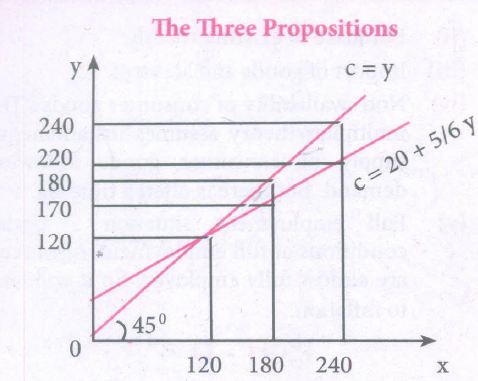
| Y | C | S |
|---|---|---|
| 120 | 120 | 0 |
| 180 | 170 | 10 |
| 240 | 220 | 20 |
17.
Profit motive
18.
f(r)
19.
Average propensity to consume
20.
ΔS/ΔY
21.
S/Y
22.
(a) Multiplier (K) - ΔI/ΔY
23.
(c) MEC - Duesenberry
24.
(b) Both A and R are true and R is the correct explanation of A
25.
(b) Income distribution
26.
(d) First introduced by - J.M. Keynes

12th Standard Syllabus & Materials
12th Standard
TN 12th Computer Applications களப்பெயர் முறைமை (DNS) Sample Question Papers Study Material - QB365 Set A
NEW12th Standard
TN 12th Computer Applications வலையமைப்பு எடுத்துக்காட்டுகள் மற்றும் நெறிமுறைகள் Sample Question Papers Study Material - QB365 Set A
NEW12th Standard
TN 12th Computer Applications கணினி வலையமைப்பு ஓர் அறிமுகம் Sample Question Papers Study Material - QB365 Set A
NEW12th Standard
TN 12th Computer Applications PHP-உடன் MySQL-ஐ இணைத்தல் Sample Question Papers Study Material - QB365 Set A



Tamilnadu Stateboard 12th Standard Subjects

Maths

Chemistry

Physics

Biology

Computer Science

Business Maths and Statistics
Economics

Commerce

Accountancy

History

Computer Applications
Biology
Computer Technology
Computer Applications
Computer Science
Business Maths and Statistics
Commerce
Economics
Maths
Chemistry
Physics
Computer Technology
History
Accountancy

Tamil

English

French
Tamilnadu Stateboard Standards
