
 100% FREE ACCESS
12th Standard Syllabus & Materials
12th Standard
TN 12th Computer Applications மின்னணு தரவு பரிமாற்றம் Sample Question Papers Study Material - QB365 Set A
NEW12th Standard
TN 12th Computer Applications மின் - வணிக பாதுகாப்பு அமைப்புகள் Sample Question Papers Study Material - QB365 Set A
NEW12th Standard
TN 12th Computer Applications மின்னணு செலுத்தல் முறைகள் Sample Question Papers Study Material - QB365 Set A
NEW12th Standard
TN 12th Computer Applications மின் - வணிகம் Sample Question Papers Study Material - QB365 Set A
NEW12th Standard
TN 12th Computer Applications திறந்த மூல கருத்துருக்கள் Sample Question Papers Study Material - QB365 Set A
NEW12th Standard
TN 12th Computer Applications வலையமைப்பு வடமிடல் Sample Question Papers Study Material - QB365 Set A

Published on: 06/01/2020
Economics of Development and Planning
Download Tamil Nadu 12th Standard Economics question papers, model tests, one-mark questions, important questions, and public exam papers in PDF format. Free study materials and answer keys for TN State Board students.
Questions + Answers key
Take MCQ Economics Test
1.
Economic development depends on
Social
Political
Religious
All the above
2.
Which is not the characteristics of UDCs?
Low per capita
Wide in equality
High rate of unemployment
Price mechanism
3.
Short-term plan is also known as________
Controlling Plans
De-controlling Plans
Rolling Plans
De-rolling Plans
4.
The supply side vicious circle of poverty suggests that poor nations remain poor because
Saving remains low
Investment remains low
There is a lack of effective government
a and b above
5.
Economic growth measures the_______
Growth of productivity
Increase in nominal income
Increase in output
None of the above
6.
Mention the predominant characters of UDCs
7.
What is financial planning?
8.
What is capital accumulation?
9.
Define economic planning
10.
What is GNP?
11.
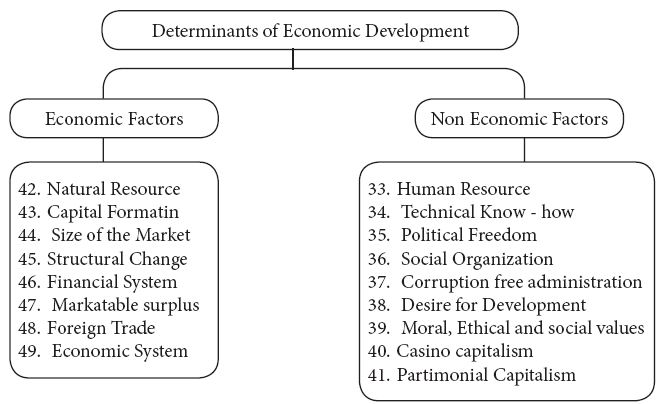
List the economic and non-economic determinants of economic development.
12.
Write short note on second five year plan
13.
Explain NITI Aayog.
14.
Trace the evolution of economic planning in India.
15.
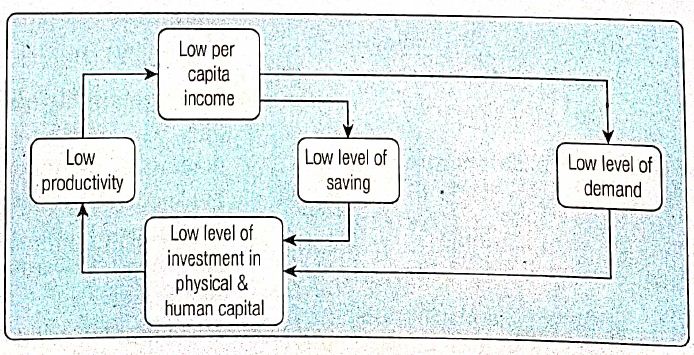
Elucidate major causes of vicious circle of poverty with diagram
16.
Elucidate various measures of economic development.
17.
Compare and contrast the “Planning Commission” and NITI Aayog”.
18.
19.
Discuss the economic determinants of economic development.
1.
(d)
All the above
2.
(d)
Price mechanism
3.
(a)
Controlling Plans
4.
(d)
a and b above
5.
(c)
Increase in output
6.
The UDCs are characterized by a predominance of primary sector i.e. agriculture, low per capita income, widespread poverty, wide inequality in the distribution of income and wealth, over population, low rate of capital formation, high rate of unemployment, technological backwardness, dualism, etc.
7.
Financial planning is nothing but techniques of planning in which resources are allocated in terms of money
8.
The process of addition to the existing stock of capital is called capital accumulation.
9.
Economic Planning in the widest sense is the deliberate direction by persons-in charge of large resources of economic activity towards chosen ends. - Dalton
10.
Gross National Product is the total total market value of all final goods and services produced within a nation in a particular year, plus income earned by its citizens (abroad) minus income of non residents located in that country.
11.
12.
(i) The Second Five Year Plan (1951- 56) aimed at rapid industrialization with particular emphasis on the development of basic and heavy industries.
(ii) It was during the second plan period, the Goverriment embraced the goal of democratic socialism
13.
NIT! Aayog (National Institution for transforming India) was formed on 1st January, 2015 through a Union Cabinet resolution. NITI Aayog is a policy think-tank of the Government of India. It replaced the Planning Commission from 13th August, 2014. The Prime Minister. is the Chairperson of NITIAayog and Union Ministers will be Ex-officio members. The Vice-Chairman of the NITI Aayog is the functional head.
Functions of NITI Aayog
1. Cooperative and Competitive Federalism
2. Shared National Agenda
3. Decentralized Planning
4. Vision and Scenario Planning
5. Network of Expertise
6. Harmonization:
7. Conflict Resolution
8. Coordinating Interface with the World
9. Internal Consultancy
10. Capacity Building
11. Monitoring and Evaluation
14.
1. Sir M. Vishveshwarya (1934) made the first attempt in laying foundation for economic planning in India through his book, "Planned Economy of India". It was a 10 year plan.
2. Jawaharlal Nehru (1938) set-up "National Planning Commission" by a committee but due to the World War II it did not materialize.
3. In 1940,8 leading industrialists of Bombay presented a 15 Year Bombay Plan.
4. In 1944 S. N Agarwal gave the Gandhian Plan focusing on the agriculture and rural economy.
5. M.N. Roy in 1945 drafted People's Plan aiming at mechanisation of agricultural production.
6. In 1950 J.P. Narayan advocated Sarvodaya Plan which was inspired by Gandhian Plan and with the idea of Vinoba Bhave.
7. It gave importance to agriculture, small and cottage industries.
8. After considering all the plans in the same year Planning Commission was set up to formulate Five Year Plan in India by Jawaharlal Nehru.
9. Nehru was the first Chairman of Planning Commission, Government of India.
15.
(i) The cause for vicious circle of poverty is demand and supply.
(ii) On the supply side, the low level of real income leads to low level of saving and investment and to deficiency of capital.
(iii) Deficiency of capital leads to low productivity and back to low income.
(iv) On the demand-side, low level of real income leads to low demand so investment is less, therefore deficiency of capital, low productivity and low income.
16.
Economic development is measured on the basis of four criteria
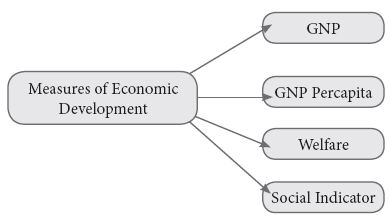
Gross National Product (GNP):
(i) GNP is the total market value of all final goods and services produced within a nation in a particular year, plus income earned by its citizens (including income of those located abroad), minus income of non-residents located in that country.
(ii) GNP is one measure of the economic condition of a country, under the assumption that a higher GNP leads to a higher quality of living, all other things being equal.
GNP per capita:
(i) This relates to increasing in the per capita real income of the economy over the long period
(ii) This indicator of economic growth emphasizes that for economic development the rate of increase in real per capita income should be higher than the growth rate of population.
Welfare:
(i) Economic development is regarded as a process whereby there is an increase in the consumption of goods and services by individuals.
(ii) From the welfare perspective, economic development is defined as a sustained improvement in health, literacy, and standard of living
Social Indicators:
(i) Social indicators are normally referred to as basic and collective needs of the people
(ii) The direct provision of basic needs such as health, education, food, water, sanitation, and housing facilities check social backwardness.
| S/N | Basic need | Indicators |
|---|---|---|
| 1 | Health | Life expectancy at birth |
| 2 | Education | Literacy signifying primary school enrolment as a percent of the population. |
| 3 | Food | Calorie Supply per head |
| 4 | Water supply | Infant mortality and percentage of the population with access to potable water |
| 5 | Sanitation | Infant mortality and percentage of the population with access to sanitation. |
17.
I. Classification on the Basis of Benefit:
| BASIS FOR COMPARISON | PLANNING COMMISSION | NITI AAYOG |
|---|---|---|
| POWERS | Enjoyed the powers to allocate funds to ministries and state governments. | To be an advisory body or a think-tank. The powers to allocate funds might be vested in the finance ministry. |
| STATE’S ROLE | States' role was limited to the National Development Council and annual interaction during Plan meetings. | State governments are expected to play a more significant role than they did in the Planning Commission. |
| MEMBERS | The commission reported to National Development Council that had state chief ministers and lieutenant governors | Governing Council has state chief ministers and lieutenant governors |
| CHAIR-PERSON | Had deputy chairperson, a member secretary, and full-time members | New posts of CEO, of secretary rank, and Vice-Chairperson. Will also have five full-time members and two part-time members. Four cabinet ministers will serve as ex-o official members. |
| POLICY FORMULATION | Policy was formed by the commission and states were then consulted about allocation of funds | Consulting states while making policy and deciding on funds allocation. Final policy would be a result of that. |
| FUNDS ALLOCATION | Had power to decide allocation of government funds for various programs at national and state levels | No power to allocate funds |
| APPROVAL OF PROJECTS |
Imposed policies on states and tied allocation of funds with projects it approved. | NITI is a think-tank and does not have the power to impose policies. |
18.
19.
Natural Resource:
(i) The existence of natural resources in abundance is essential for development.
(ii) But Japan, though it lacks natural resources imports them and achieves faster rate of economic development with the help of technology.
Capital Formation:
(i) Capital formation refers to the net addition to the existing stock of capital goods which are either tangible (plants, machinery) or intangible (health, education).
(ii) Capital formation helps increase productivity of labour, production and income.
(iii) Advanced techniques of production can be used and leads to better utilization of natural resources, industrialization and expansion of markets which are essential for economic progress.
Size of the Market:
(i) Large size of the market would stimulate production, increase employment and raise the National per capita income.
Structural Change:
(ii) Structural change refers to change in the occupational structure of the economy.
(iii) Any economy is divided into primary secondary and tertiary sector.
(iv) Any economy which is predominantly agricultural remains backward.
Financial System:
(i) Financial system implies the existence of an efficient and organized banking system in the country.
(ii) There should be an organized money market to facilitate easy availability of capital.
Marketable Surplus:
(i) It refers to the total amount of farm output cultivated by farmers over and above their family consumption needs.
(ii) This surplus brings income, raises purchasing power, employment and output in other sectors.
Foreign Trade:
(i) A country with favorable balance of trade is always developed.
Economic System:
(i) A country with free market system enjoys better growth rate compared to controlled economies.

12th Standard Syllabus & Materials
12th Standard
TN 12th Computer Applications களப்பெயர் முறைமை (DNS) Sample Question Papers Study Material - QB365 Set A
NEW12th Standard
TN 12th Computer Applications வலையமைப்பு எடுத்துக்காட்டுகள் மற்றும் நெறிமுறைகள் Sample Question Papers Study Material - QB365 Set A
NEW12th Standard
TN 12th Computer Applications கணினி வலையமைப்பு ஓர் அறிமுகம் Sample Question Papers Study Material - QB365 Set A
NEW12th Standard
TN 12th Computer Applications PHP-உடன் MySQL-ஐ இணைத்தல் Sample Question Papers Study Material - QB365 Set A



Tamilnadu Stateboard 12th Standard Subjects

Maths

Chemistry

Physics

Biology

Computer Science

Business Maths and Statistics
Economics

Commerce

Accountancy

History

Computer Applications
Biology
Computer Technology
Computer Applications
Computer Science
Business Maths and Statistics
Commerce
Economics
Maths
Chemistry
Physics
Computer Technology
History
Accountancy

Tamil

English

French
Tamilnadu Stateboard Standards
