
 100% FREE ACCESS
12th Standard Syllabus & Materials
12th Standard
TN 12th Computer Applications மின்னணு தரவு பரிமாற்றம் Sample Question Papers Study Material - QB365 Set A
NEW12th Standard
TN 12th Computer Applications மின் - வணிக பாதுகாப்பு அமைப்புகள் Sample Question Papers Study Material - QB365 Set A
NEW12th Standard
TN 12th Computer Applications மின்னணு செலுத்தல் முறைகள் Sample Question Papers Study Material - QB365 Set A
NEW12th Standard
TN 12th Computer Applications மின் - வணிகம் Sample Question Papers Study Material - QB365 Set A
NEW12th Standard
TN 12th Computer Applications திறந்த மூல கருத்துருக்கள் Sample Question Papers Study Material - QB365 Set A
NEW12th Standard
TN 12th Computer Applications வலையமைப்பு வடமிடல் Sample Question Papers Study Material - QB365 Set A

Published on: 09/03/2020
12th standard Economics English Medium All Chapter Book Back and Creative Five Mark Questions 2020
Download Tamil Nadu 12th Standard Economics question papers, model tests, one-mark questions, important questions, and public exam papers in PDF format. Free study materials and answer keys for TN State Board students.
Questions + Answers key
Take MCQ Economics Test
1.
List the Revenue of State Sources.
2.
Explain the chain of events that results from an expansionary monetary policy.
3.
Compare and contrast RBI and other Commercial Banks.
4.
The data on price and quantity purchased relating to a commodity for 5 months is given below: Find the Pearsonian correlation coefficient between prices and quantity and comment on its sign and magnitude.
| Month | January | Febuary | March | April | May |
| Prices (Rs): | 10 | 10 | 11 | 12 | 12 |
| Quantity (Kg): | 5 | 6 | 4 | 3 | 3 |
5.
Elaborate the WTO Agreements in detail.
6.
Explain in detail about the facilities offered by IMF to its member nations?
7.
Elucidate various measures of economic development.
8.
Solve and discuss the following using Marshall “Cash Balance Approach”.
(i) Suppose money supply in cash and bank deposits (M) = Rs. 1,000.
(ii) The total annual national income (R) = 10,000 units.
(iii) The goods (income) which the community wants to hold in money (K), say one-fifth of Y = 2,000 units.
9.
Consider M = Rs. 1000. M’ = Rs. 500, V = 3, V’ = 2, T = 4000 goods and Find the value of money using Fisher’s quantity theory of
10.
Classify the following as either employed, unemployed or not in the labor force
| An individual who has been temporarily absent due to caring for an elderly relative whether they are paid or not. | |
| A person 18 years old or older who works without pay for 15 or more hours per week in a family enterprise. | |
| Someone who works for pay in his or her own business. | |
| A woman who spends five hours a week sending bills to her husband's clients. She is not paid for her work. Otherwise she performs non-market work at home. | |
| A retired person | |
| A person who quits one job in favor of looking for work elsewhere but has yet to find work. |
11.
Discuss the state of FDI in India.
12.
Explain the concept of super multiplier.
13.
Discuss the Effects of Land Pollution.
14.
What are the causes of land pollution? What are the remedial measures to control land pollution?
15.
What are the advantages of GST?
16.
Explain the any two types of Exchange Rates.
17.
What are the factors on which MEC depends? Also give details on the factors which influence MEC.
18.
Discuss the methods of measuring the National Income by Product Method.
19.
Discuss the method measuring the National Income by Income Method.
20.
Draw the 7 pillars of NITI Aayog.
21.
Draw the diagram ADF.
22.
Explain the Demerits of capitalism.
23.
Explain the merits of socialism.
24.
Describe the application of Econometrics in Economics.
25.
Elucidatethe nature and scope of Statistics.
26.
Bring out the arguments against planning.
27.
28.
Explain the importance of sustainable development and its goals.
29.
Briefly explain the relationship between GDP growth and the quality of environment.
30.
31.
Explain the principles of Federal Finance.
32.
33.
Explain the objectives of IMF.
34.
Explain briefly the Comparative Cost Theory.
35.
Discuss the differences between Internal Trade and International Trade.
36.
Describe the functions of Reserve Bank of India.
37.
Elucidate the functions of Commercial Banks
38.
Describe the phases of Trade cycle.
39.
Illustrate Fisher’s Quantity theory of money.
40.
Briefly explain the subjective and objective factors of consumption function?
41.
Explain Keynes psychological law of consumption function with diagram.
42.
Narrate the equilibrium between ADF and ASF with diagram
43.
Critically explain Say’s law of market.
44.
Discuss the importance of social accounting in economic analysis.
45.
Explain the importance of national income
46.
Compare the features among Capitalism, Secularism and Mixedism
47.
Discuss the scope of Macro Economics.
48.
Calculate the standard deviation for the following data by assumed mean method: 43, 48, 65, 57, 31, 60, 37, 48, 78, 59
1.
1. Capitation tax
2. Duties in respect of succession to agricultural land.
3. Duties of excise on certain goods produced or manufactured in the State, such as alcoholic liquids, opium, etc.
4. Estate duty in respect of agricultural land.
5. Fees in respect of any of the matters in the State List, but not including fees taken in any Court.
6. Land Revenue.
7. Rates of stamp duty in respect of documents other than those specified in the Union List.
8. Taxes on agricultural income.
9. Taxes on land and buildings.
10. Taxes on mineral rights, subject to limitations impose by Parliament relating to mineral development.
11. Taxes on the consumption or sale of electricity.
12. Taxes on the entry of goods into a local area for consumption, use or sale therein.
13. Taxes on the sale and purchase of goods other than newspapers.
14. Taxes on the advertisements other than those published in newspapers.
15. Taxes on goods and passengers carried by road or on inland waterways.
16. Taxes on vehicles.
17. Taxes on animals and boats.
18. Taxes on professions, trades, callings and employments.
19. Taxes on luxuries, including taxes on entertainments, amusements, betting and gambling.
20. Tolls.
2.
1. The money supply increases which places downward pressure on the interest rate.
\(\downarrow \)
2. The lower interest rate stimulates planned investment and aggregate output.
\(\downarrow \)
3. This in turn increases the amount of money demand.
\(\downarrow \)
4. This in turn may cause interest rates to fall by less than they otherwise would had there been
\(\downarrow \)
5. No feedback effect from the increased demand for money hence forth.
3.
| BASIS | RBI | COMMERCIAL BANK |
| Meaning | The bank which looks after the monetary system of the country is known as Central Bank. | The establishment, which provides banking services to the public is known as Commercial Bank. |
| Role | It is a banker to the banks and the government of the country | It is the banker to the citizens of the nation |
| Established by | Reserve Bank of India Act, 1934 | Banking Regulation Act, 1949. |
| Ownership | Public | Public or Private |
| Monetary Authority | It is the supreme monetary authority with wide powers | No such authority. |
| Objective | Public welfare and economic development. | Earning Profits |
| Money supply | Ultimate source of money supply in the economy. | No such function is performed by it. |
| Right to print and issue currency notes | Yes | No |
| Deals with | Banks and Governments | General Public |
| How many banks are there | Only one | Many |
4.
Let price of the commodity be denoted by X and quantity be denoted by Y
Calculations for Coefficient of Correlation
| Month | X | Y | X2 | Y2 | XY |
| 1 | 10 | 5 | 100 | 25 | 50 |
| 2 | 10 | 6 | 100 | 36 | 60 |
| 3 | 11 | 4 | 121 | 16 | 44 |
| 4 | 12 | 3 | 144 | 9 | 36 |
| 5 | 12 | 3 | 144 | 9 | 36 |
| ΣX=55 | ΣY=21 | ΣX2=609 | ΣY2=95 | ΣXY=226 |
\({ r }_{ xy }=\frac { N\sum { XY-\sum { X\sum { Y } } } }{ \sqrt { N{ \sum { X } }^{ 2 }-{ (\sum { X } ) }^{ 2 } } \sqrt { N{ \sum { Y } }^{ 2 }-{ \left( \sum { Y } \right) }^{ 2 } } } \)
\({ r }_{ xy }=\frac { 5x226-55x21 }{ \sqrt { (5x609-55x55)(5x95-21x21) } } \)
\({ r }_{ xy }=\frac { 1130-1155 }{ \sqrt { 20x34 } } \)
\({ r }_{ xy }=\frac { 25 }{ \sqrt { 680 } } \)
\({ r }_{ xy }=-0.98\)
The negative sign of r indicate negative correlation and its large magnitude indicate a very
1. high degree of correlation.
2. So there is a high degree of negative correlation between pricesand quantity demanded.
5.
1. Agreement on Trade Related Intellectual Property Rights (TRIPs)
(i) Intellectual Property Rights include copy right, trade marks, patents, geographical indications, trade secrets, industrial designs, etc.
(ii) TRIPS Agreement provides for granting product patents instead of process patents.
(iii) The period of protection will be 20 years for patents, 50 years for copy rights, 7 years for trade marks and 10 years for layout designs.
(iv) As a result of TRIPS, the dependence of LDCs on advanced countries for seeds, drugs, fertilizers and pesticides has increased.
(v) Farmers are depending on the industrial firm for their seeds
2. Agreement on Trade Related Investment Measures (TRIMs)
(i) TRIMs are related to conditions or restrictions in respect of foreign investment in the country.
(ii) It calls for introducing equal treatment for foreign companies on par with national companies. TRIMs were widely employed by developing countries.
3. General Agreement on Trade in Services (GATS)
(i) GATS is the first multilateral set of rules covering trade in services like banking, insurance, transportation, communication, etc.,
(ii) All members countries are supposed to extend MFN (Most Favoured Nation) status to all other countries without any discrimination
(iii) Transparency should be maintained by publishing all relevant laws and regulations over services
4. Phasing out of Multi Fibre Agreement (MFA)
(i) The multi fibre agreement governed the world trade in textiles and garments since 1974.
(ii) It imposed quotas on export of textiles by developing nations to the developed countries
(iii) This quota system was to be phased out over a period of ten years. This was beneficial to India.
5. Agreement on Agriculture (AoA)
(i) Agriculture was included for the first time under GATT.
(ii) The important aspects of the agreement are Tariffication, Tariff cuts and Subsidy reduction.
6.
(i) Basic Credit Facility:
The IMF provides financial assistance to its member nations to overcome their temporary difficulties relating to balance of payments. A member nation can The IMF provides financial assistance to its member nations to overcome their temporary difficulties relating to balance of payments. A member nation can purchase from the Fund other currencies or SDRs, in exchange for its own currency, to finance payment deficits. from the Fund other currencies or SDRs, in exchange for its own currency, to finance payment deficits.
(ii) Extended Fund Facility
Under this arrangement, the IMF provides additional borrowing facility up to 140% of the member’s quota, over and above the basic credit facility.
(iii) Compensatory Financing Facility
IMF established compensatory financing facility to provide additional financial assistance to the member countries, particularly primary producing countries facing shortfall in export earnings.
(iv) Buffer Stock Facility
The purpose of this scheme was to help the primary goods (food grains) producing countries to finance contributions to buffer stock arrangements for the stabilisation of primary product prices.
(v) Supplementary Financing Facility
Under the supplementary financing facility, the IMF makes temporary arrangements to provide supplementary financial assistance to member countries facing payments problems relating to their present quota sizes.
(vi) Structural Adjustment Facility
The purpose of Structural Adjustment Facility (SAF) and Enhanced Structural Adjustment Facility (ESAF) is to force the poor countries to undertake strong macroeconomic and structural programmes to improve their balance of payments positions and promote economic growth.
7.
Economic development is measured on the basis of four criteria
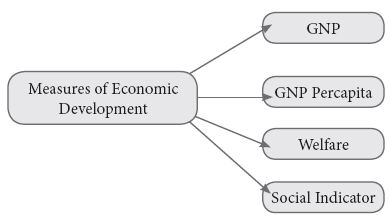
Gross National Product (GNP):
(i) GNP is the total market value of all final goods and services produced within a nation in a particular year, plus income earned by its citizens (including income of those located abroad), minus income of non-residents located in that country.
(ii) GNP is one measure of the economic condition of a country, under the assumption that a higher GNP leads to a higher quality of living, all other things being equal.
GNP per capita:
(i) This relates to increasing in the per capita real income of the economy over the long period
(ii) This indicator of economic growth emphasizes that for economic development the rate of increase in real per capita income should be higher than the growth rate of population.
Welfare:
(i) Economic development is regarded as a process whereby there is an increase in the consumption of goods and services by individuals.
(ii) From the welfare perspective, economic development is defined as a sustained improvement in health, literacy, and standard of living
Social Indicators:
(i) Social indicators are normally referred to as basic and collective needs of the people
(ii) The direct provision of basic needs such as health, education, food, water, sanitation, and housing facilities check social backwardness.
| S/N | Basic need | Indicators |
|---|---|---|
| 1 | Health | Life expectancy at birth |
| 2 | Education | Literacy signifying primary school enrolment as a percent of the population. |
| 3 | Food | Calorie Supply per head |
| 4 | Water supply | Infant mortality and percentage of the population with access to potable water |
| 5 | Sanitation | Infant mortality and percentage of the population with access to sanitation. |
8.
Marshall’s Equation
1. The Marshall equation is expressed as:
2. M = KPY the price level P = M/KY or the value of money = The reciprocal of price level is 1/P = KY/M the value of money (one rupee) = 2,000 units = (KY/M) = two units of goods, or Prices level P = (M/KY) = 1/2 = 0.50 paise per unit.
3. It is, therefore, clear that the value of money (its purchasing power) is found by dividing the total amount of goods, which the community wants to hold out of the total income (KY), by the amount of the supply of the money held by the public (M), and the price level (P) is found out by dividing the money supply (M) by the amount of goods which the community wants to hold (KY), as the price level is the opposite of the value of money.
9.
P = \(\frac { MV+{ M }^{ 1 }{ V }^{ 1 } }{ T } \)
P = \(\frac { (1000\times 3)+(500\times 2) }{ 4000 } \)
= Rs. 1 Per good
Value of money (1/p) = 1
If the supply of money is double
P = \(\frac { (2000\times 3)+(1000\times 2) }{ 4000 } \)
= Rs. 2 Per good
Value of money (1/p) = 1/2
Thus, when money supply in doubled, i.e., increases from Rs. 4000 to 8000, the price level is doubled. i.e., from Re. 1 per good to Rs. 2 per good and the value of money is halved, i.e., from 1 to 1/2.
P = \(\frac { (500\times 3)+(250\times 2) }{ 4000 } \)
= Rs. 1 Per good
Value of money (1/p) = 1/2
Thus, when money supply is halved, i.e., decreases from Rs. 4000 to 2000, the price level is halved, i.e., from 1 to 1/2, and the value of money is doubled, i.e., from 1 to
10.
| An individual who has been temporarily absent due to caring for an elderly relative whether they are paid or not | Employed |
| A person 18 years old or older who works without pay for 15 or more hours per week in a family enterprise | Employed |
| Someone who works for pay in his or her own business | Employed |
| A woman who spends five hours a week sending bills to her husband's clients. She is not paid for her work. Otherwise she performs non-market work at home | Not in the labour force |
| A retired person | Not in the labour force |
| A person who quits one job in favor of looking for work elsewhere but has yet to find work | Unemployed |
11.
Introduction
(i) The early 1990s witnessed reforms in the economic policy. This helped to open up Indian markets to FDI
(ii) FDI in India has increased over the years
(iii) In India, FDI has been advantageous in terms of free flow of capital, improved technology, management expertise and access to international markets
The major sectors benefited from FDI in India are:
(i) financial sector (banking and nonbanking)
(ii) insurance
(iii) telecommunication
(iv) hospitality and tourism
(v) pharmaceuticals and
(vi) software and information technology
FDI is not permitted in the industrial sectors like
(i) Arms and ammunition
(ii) atomic energy,
(iii) railways,
(iv) coal and lignite and
(v) mining of iron, manganese, chrome, gypsum, sulphur, gold, diamonds, copper etc.,
Latest trend of FDI in India
i. FDI inflow in India has increased from $97 million in 1990-91 to $5,535 million in 2004-2005.
ii. It amounted to $32,955 million in 2011-2012.
iii. UNCTAD’s World Investment Report 2018 reveals that FDI to India declined to $40 billion in 2017 from $44 billion in 2016
12.
Meaning of Super Multiplier
(i) In order to measure the total effect of initial investment on income, Hicks has combined the k and β mathematically and given it the name of the Super Multiplier.
(ii) The super multiplier is worked out by combining both induced consumption and induced investment. The combined name of the super multiplier and the accelerator is also called the leverage effect
Components of Super Multiplier
(i) The super multiplier is greater than simple multiplier which includes only autonomous investment and no induced investment, while super multiplier includes induced investment.
(ii) The super multiplier is greater than simple multiplier which includes only autonomous investment and no induced investment, while super multiplier includes induced investment.
The Leverage Effect
The combined effect of the multiplier and the accelerator is also called the leverage effect which may lead the economy to very high or low level of income propagation.
Symbolically,
Y= C + IA + IP
Y = Aggregate income.
C = Consumption expenditure
IA = autonomous investment
IP = induced private investment
The super – multiplier, tells us that if there is an initial increase in autonomous investment, income will increase by K times the autonomous investment.
13.
1. Soil pollution:
Soil pollution is another form of land pollution, where the upper layer of the soil is damaged. This is caused by the overuse of chemical fertilizers and pesticides. This leads to the loss of fertile land. Pesticides kill not only pests and also human beings.
2. Health Impact:
The land when contaminated with toxic chemicals and pesticides lead to problem of skin cancer and the human respiratory system. The toxic chemicals can reach our body through foods and vegetables.
3. Cause for Air pollution:
Landfills and waste dumping lead to air pollution. The abnormal toxic substances spread in the atmosphere cause transmit respiratory diseases among the masses.
4. Effect on wildlife:
The animal kingdom has suffered mostly in the past decades. They face a serious threat with regards to loss of habitat and natural environment. The constant human activity on land is leaving.
14.
Causes of Land Pollution:
(i) Deforestation and soil erosion: Deforestation carried out to create drylands is one of the major concerns.
(ii) Agricultural activities: With growing human and pet animal population, demand for food has increased considerably; Farmers often use highly toxic fertilizers and pesticides to get rid off insects, fungi and bacteria from their crops. However the overuse of these chemicals, results in contamination and poisoning of land.
(iii) Mining activities: During extraction and mining activities, several land spaces are created beneath the surface.
(iv) Landfills: Each household produces tones of garbage each year due to changing economic lifestyle of the people. Garbage like plastic, paper, cloth, wood and hospital waste get accumulated.
(v) Industrialization: Due to increasing consumerism more industries were developed which led to deforestation.
(vi) Construction activities: Due to urbanization, large amount of construction activities are taking place. This has resulted in large waste articles like wood, metal, bricks, plastic. These are dumped at the outskirts of urban areas that lead to land pollution.
(vii) Nuclear waste: The leftover radioactive materials, harmful and toxic chemicals affect human health. They are dumped beneath the earth to avoid any casualty.
Remedial measures to control Land Pollution
1. Making people aware about the concept of a Reduce, Recycle and Reuse
2. Buying biodegradable products
3. Minimizing the usage of pesticides
4. Shifting cultivation
5. Disposing unwanted garbage properly either by burning or by burying under the soil.
6. Minimizing the usage of plastics.
15.
(i) GST will mainly remove the cascading effect on the sale of goods and services.
(ii) Removal of cascading effect will directly impact of the cost of goods.
(iii) Tax is eliminated in this regime, the cost of goods decreases.
(iv) GST is also mainly technologically driven.
(v) All activities like registration, return filing, application for refund and response to notice need to be done online on the GST portal. This will speed up the processes.
16.
Types of Exchange Rate:
(i) Nominal Exchange Rate
(ii) Real Exchange Rate
(iii) Nominal Effective Exchange Rate
(iv) Real Effective Exchange Rate If 1US Dollar = Rs.75
(i) Nominal Exchange Rate:
Nominal Exchange Rate =\(\cfrac { 75 }{ 1 } \)
This is the bilateral nominal exchange rate.
(ii) Real Exchange Rate:
(1) Real Exchange Rate = \(\cfrac { { eP }_{ r } }{ P } \)
P = Price level in India
PF = Price level in abroad (say US)
e = Nominal Exchange Rate
(2) If a pen costs Rs.50 in India and it costs 5 USD in the US.
\(\therefore \text {Real Exchange Rate}=\cfrac { 75\times 5 }{ 50 } =7.5\)
(3) If real exchange rate is equal to 1, the currencies are at purchasing power parity.
(4) If the price of the pen in US is 0:66 USD, then the real exchange rate
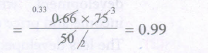
Then it could be said that the USD and Indian rupee are at purchasing power parity.
17.
MEC depends on the following 2 factors :
(1) The prospective yield from a capital asset.
(2) The supply price of a capital asset. The marginal efficiency of capital is influenced by short-run as well as long run factors.
(a) Short - Run factors:
(i) Demand for the product:
If the market for a particular good is expected to grow and its costs are likely to fall, the rate of return from investment will be high.
(ii) Liquid assets:
If the entrepreneurs are holding large volume of working capital, they can take advantage of the investment opportunities that come in their way. The MEC will be high.
(iii) Sudden changes in incomes:
If the business community gets windfall profits, or tax concession the MEC will be high. On the other hand, MEC falls with the decrease in income.
(iv) Current rate of investment:
If in a particular industry, much investment has already taken place and the rate of investment currently going on in that industry is also very large, then the marginal efficiency of capital will be low.
(v) Wales of optimism and pessimism:
If businessmen are optimistic about future, the MEC will be likely to be high. During periods of pessimism the MEC is under estimated and so will be low.
(b) Long - Run Factors:
(i) Rate of growth of population:
If population is growing at a rapid speed, it is usually believed that the demand of various types of goods will increase.
(ii) Technological progress:
If investment and technological development take place in the industry, the prospects of increase in the net yield brightens up.
(iii) Monetary and fiscal policies:
Cheap money policy and liberal tax policy pave the way for greater profit margin and so MEC is likely to be high.
(iv) Political environment :
Political stability, smooth administration, maintenance of law and order help to improve MEC.
(v) Resource avaiqability:
Cheap and abundant supply of natural resources, efficient labour and stock of capital enhance the MEC.
18.
Product Method:
(i) Product method measures the output of the country. It is also called inventory method.
(ii) It is obtained for the entire economy during a year.
(iii) The value obtained is actually the GNP at market prices.
(iv) Care must be taken to avoid double counting.
(v) The value of the final product is derived by the summation of all the values added in the productive process.
(vi) To avoid double counting either the value of the final output should be taken in to the estimate of GNP.
(vii) In India the gross value of the farm output is obtained as follows.
(1) The output of each crop is measured by multiplying the area shown by the average yield per hectare.
(2) The total output of each commodity is valued at market prices.
(3) The net value of the agriculture output is measured by making deductions for the cost of seed, manures and fertilisers etc.,
(4) Net value of the output in these sectors is derived by making deductions for cost of materials used in the process of production and depreciation allowances etc., from gross value of output,
(5) For example, value of cotton enters value of yarn as cost and value of yarn in cloth and that of cloth in garments at every stage value added only should be calculated.
19.
(i) Income by Income Method. Income method approaches National Income from the distribution side.
(ii) National income is calculated by adding up all the incomes generated in the course of producing national product.
(iii) Factor incomes are grouped under labour income, capital income and mixed income.
(iv) national income is calculated as domestic factor income plus net factor incomes from abroad. In short,
Y = w + r + i + π + (R-P)
w = wages
r = rent
i = interest
π = profits
R = Exports
P = Imports
(v) This method is adopted for estimating the contributions of the remaining sector, viz.
(vi) Data on income from abroad (the rest of) the world sector or foreign sector are obtained from the account of the balance of payment of the country.
Items no to be included:
(1) Transfer payments are not to be included in estimation of national income.
(2) The receipts from the sale of second hand goods should not be treated as part of national income.
Item to be included:
(1) Imputed value of rent for self occupied house or offices is to be included.
(2) Imputed value of services provided by owners of production unit (family labour) is to be included.
20.
7 pillars of effective governance:
NITI AAYOG
| Pro-People | Fulfills aspirations of society as well as individuals |
| Pro-Activity | in anticipation response to citizen needs |
| Participation | involvement of citizenry |
| Empowering | Women in all aspects |
| Inclusion of all | SC, ST, OBC, minorities, gareeb, gaon, kisaan |
| Equality | of opportunity for the youth |
| Transparency | making government visible and responsive. |
21.
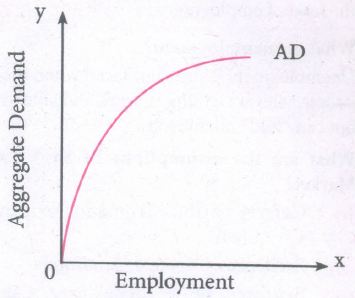
22.
Demerits of Capitalism:
1. Concentration of Wealth and Income :
Capitalism causes concentration of wealth and income in a few hands and thereby increases inequalities of income.
2. Wastage of Resources Large amount of resources are wasted on competitive advertising and duplication of products.
3. Class Struggle: Capitalism leads to class struggle as it divides the society into capitalists and workers.
4. Business Cycle: Free market system leads to frequent violent economic fluctuations and crises.
5. Production of non essential goods: Even the harmful goods are produced if there is possibility to make profit.
23.
Merits of Socialism:
1. Reduction m Inequalities:
No one is allowed to own and use private property to exploit others.
2. Rational Allocation of Resources:
The central planning authority allocates the resources in a planned manner. Wastages are minimised and investments are made in a pre planned manner.
3. Absence of Class conflicts:
As inequalities are minimum, there is no conflict between rich and poor class. Society functions in a harmonious manner.
4. End of rade Cycles :
Planning authority takes control over production and distribution of goods and services. Therefore, economic fluctuations can be avoided.
5. Promotes Social Welfare:
Absence of exploitation, reduction in economic inequalities, avoidance of trade cycles and increase in productive efficiency help to promote social welfare.
24.
Econometrics is the statistical and mathematical analysis of economic relationships, often serving as a basis for economic forecasting. It is used by economists to study relationships between economic variables Econometrics is interesting because it provides the tools to enable us to extract useful information about important economic policy issues from the available data. It is used to understand economic issues and test theories. Without evidence economic theories are abstract and has no bearing on reality. Econometrics is a set of tools we can use to confront theory with real world data. A study' could estimate a key parameter such as the price elasticity of demand for it or econometric techniques could be used to generate forecasts. It is used to develop, estimate and evaluate models which relate economic or financial variables.
25.
Nature of Statistics
(i) Different Statisticians and Economists differ in views about the nature of statistics.
(ii) Some call it a science and some say it is an art
(iii) Tippet considers Statistics both as a science as well as an art.
Scope of statistics
(i) Statistics is applied in every sphere of human activity social and physical.
Statistics and Economics
(i) Statistical data and techniques are immensely useful in solving many economic problems.
Statistics and Firms
(i) Statistics is used in many firms to find whether the product is conforming to specifications or not.
Statistics and Commerce
(i) Market survey helps to find the present conditions and to forecast the likely changes in future.
Statistics and Education
- Statistics is necessary for the formulation of policies to start new course.
- Public and private educational institutions do research and development work to test the past knowledge and evolving knowledge.
Statistics and Planning
(i) In the modern world, a "world of planning" almost all the organisations in the government are using planning for efficient working, for the formulation of policy decisions and execution of the same.
(ii) In India, statistics play an important role in planning both at the central and the state government levels, but the quality of data is highly unscientific.
Statistics and Medicine
(i) t-test is used to compare the efficiency of two medicines.
Statistics and Modern applications
(i) Recent developments in computer and information technology have enabled statistics to integrate their models and thus make statistics a part of decision making procedures of many organisations.
(ii) There are many software packages available for solving simulation problems.
26.
Introduction:
(i) Planning may retard private initiatives, hamper freedom of choice, involve huge cost of administration and stop automatic adjustment of price mechanism.
(i) Loss of freedom
1. Regulations and restrictions are the backbone of a planned economy.
2. Economic freedom consists of freedom of consumption, freedom of choice of occupation, freedom to produce and the freedom to fix prices for the products.
3. Under planning, crucial decisions are made by the Central Planning Authority.
4. The consumers, producers and the workers enjoy no freedom of choice.
5. Hayek in his book 'Road to Serfdom' explains that centralized planning leads to loss of personal freedom and ends in economic stagnation.
(ii) Elimination of Initiative
1. Planning follows routine proocedure and may cause stagnation in growth.
2. Absence of private ownership and profit discourages entrepreneurs from risk taking.
3. Attractive profit is the incentive for searching new ideas, new methods.
4. All enjoy equal reward under planned economy irrespective of their effort, efficiency.
5. So, nobody is interested in undertaking new and risky ventures.
6. The bureaucracy and red tapism cause procedural delay and time loss.
7. So, even socialist countries like Russia and China offer incentives to private firms.
(iii) High cost of Management
1. Plan formulation and implementation involve an army of staff for data collection and administration.
2. Lewis remarks, "The better we try to plan, the more planners we need".
3. Inadequate data, faulty estimations and improper implementation of plans result in wastage of resources and cause either surplus or shortages.
(iv) Difficulty in advance
calculations
1. Advance calculations in a precise manner is impossible with regard to consumption and production.
2. It is also difficult to put the calculations into practice under planning.
Conclusion
1. The arguments against planning are mostly concerned with centralized and totalitarian planning.
27.
28.
Introduction:
(i) Sustainable development is concerned with the welfare of the present and future generation.
(ii) It aims at satisfying the luxury wants of the rich and the basic necessities of the poor.
Definition:
(i) Sustainable development is development that meets the needs of the present without compromising the ability of future generations to meet their own needs.
Goals:
(i) It is crucial to harmonize three core elements such as economic growth, social inclusion and environmental protection.
(ii) A set of 17 goals for the world's future can be achieved before 2030 with three unanimous principles fixed by United Nations such as Universality, Integration and Transformation.
1) End poverty in all its forms everywhere.
2) End hunger, achieve food security and improved nutrition and promote sustainable agriculture.
3) Ensure healthy lives and promote wellbeing for all at all ages.
4) Ensure inclusive and quality education for all and promote lifelong learning.
5) Achieve gender equality and empower women and girls.
6) Ensure access to water and sanitation for all.
7) Ensure access to affordable, reliable, sustainable and modern energy for all.
8) Promote inclusive and sustainable economic growth, employment and decent work for all.
9) Build resilient infrastructure, promote, sustainable industrialization and foster innovation.
10) Reduce inequality within and among countries.
11) Make cities inclusive, safe, resilient and sustainable.
12) Ensure sustainable consumption and production pattern.
13) Take urgent action to combat climate change and its impacts
14) Conserve and sustainably use the oceans, seas and marine resources.
15) Sustainably manage forests, combat desertification, stop and reverse land degradation, stop biodiversity loss.
16) Promote just, peaceful and inclusive societies.
17) Revitalize the global partnership for sustainable development.
29.
(i) Strong economic growth or high GDP growth leads to excessive use of resources.
(ii) Natural resources are essential inputs for production in many sectors;
(iii) Production and consumption lead to pollution and other pressures on the environments.
(iv) Poor environmental quality affects economic growth and well being by lowering the quantity and quality of resources or due to health impact.
(v) There is the need to balance growth and the sustainability of eco system.
(vi) So we have to ensure our sustainable existence, consume less and curb economic growth.
30.
31.
Principle of Independence
(i) A Government should be autonomous and free about the internal financial matters concerned.
(ii) Each Government should have separate sources of revenue, authority to levy taxes, to borrow money and to meet the expenditure.
Principle of Equity
(i) The resources should be distributed among the different states so that each state receives a fair share of revenue.
Principle of Uniformity
(i) Each state should contribute equal tax payments for federal finance.
Principle of Adequacy of Resources
(i) The resources of each Government should be adequate to carry out its functions effectively to meet current and future needs.
(ii) Resources should be elastic to meet the growing needs and unforeseen expenditure.
Principle of Fiscal Access
(i) The Central and State Governments must be able to develop new source of revenue.
Principle of Integration and coordination
(i) There should be perfect coordination among different layers of the financial system.
Principle of Efficiency
(i) The financial system should be well organized and efficiently administered.
(ii) There should be no scope for evasion and fraud.
(iii) Double taxation should be avoided.
Principle of Administrative
Economy
(i) The cost of collection should be at the minimum level and the major portion of revenue should be made available for the other expenditure outlays of the Governments.
Principle of Accountability
(i) Each Government should be accountable to its own legislature for its financial decisions.
32.
33.
(i) To promote international monetary cooperation among the member nations.
(ii) To facilitate faster and balanced growth of international trade.
(iii) To ensure exchange rate stability by curbing competitive exchange depreciations.
(iv) To reduce exchange controls imposed by member nations.
(v) To establish multilateral trade and payment system in respect of current transactions.
(vi) To promote the flow of capital from developed to developing nations.
(vii) To solve the problem of international liquidity.
34.
Introduction
1. David Ricardo formulated comparative cost theory.
2. J. S. Mill, Marshall, Taussig refined it.
Theory
1. Trade can take place even if absolute cost difference is absent but there is comparative cost difference.
Illustration
2. Ricardo's theory is explained with an example of production costs of cloth and wheat in America and India.
(Units of labour needed to produce one unit)
| Country | Cloth | Wheat | Domestic Exchange Ratios |
| America | 100 | 120 | 1 Wheat = 1.2 Cloth |
| India | 90 | 80 | 1 Wheat = 0.88 Cloth |
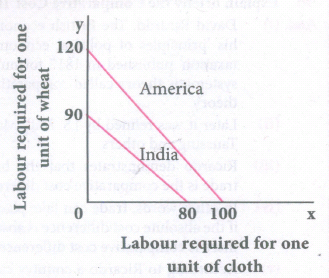
(i) India has absolute advantage in production of both cloth and wheat.
(ii) But, India will produce wheat where she enjoys comparative cost advantage (80 / 120<90 / 100).
(iii) For America the comparative cost disadvantage is lesser in cloth production.
(iv) So America will specialize in cloth production and export it to India in exchange for wheat.
(v) Both nations gains.
(vi) With trade India can get 1 unit of cloth and 1 unit of wheat by using 160 labour units (80+80). With no trade India has to use 170 units of labour (80+90).
(vii) The same explanation applies to America too.
Criticisms
(i) Labour cost is a small portion of the total cost. So the theory based on labour cost is unrealistic,
(ii) Labourers in different countries are not equal in efficiency.
35.
| S.No |
Internal Trade |
International Trade |
|---|---|---|
| 1 | Trade takes place between different individual and firms within the same nation. | Trade takes place between different individual and firms in different countries. |
| 2 | Labour and capital move freely from one region to another. | Labour and capital do not move easily from one nation to another. |
| 3 | Free flow of goods and services since there are no restrictions. | Goods and services do not easily move from one country to another because of tariff and quota. |
| 4 | There is only one common currency. | There are different currencies. |
| 5 | Physical and geographical conditions of a country are similar. | There are differences in physical and geographical conditions of the two countries. |
| 6 | Trade and financial regulations are same. | Trade and financial regulations, interest rate, trade laws differ between countries. |
| 7 | No difference in political affiliations, customs and habits of the people and government policies. | There are lot of differences in political affiliation, habits, customs of the people and government policies. |
36.
Introduction
(i) The Reserve Bank of India is India's central banking institution
(ii) It commenced its operations on 1 April 1935 and it was nationalised on 1 Jan, $1949 .$
1) Monetary Authority
(i) It controls the supply of money in the economy to stabilize exchange rate, maintain healthy balance of payment, attain financial stability, control inflation, strengthen banking system.
2) Issuer of currency
(i) It is the sole authority to issue currency
(ii) It also takes action to control the circulation of fake currency.
3) Issuer of Banking License
(i) Every bank has to obtain a banking license from RBI to conduct banking business in India.
4) Banker to the Government
(i) It is the banker to the central and the state governments.
(ii) It provides short term credit, manages all need issues of government loans, services the government debt outstanding
(iii) It advises the government on banking and financial matters.
5) Banker's Bank
(i) It is the bank of all banks in India as it provides loan to banks, accepts the deposit of banks and rediscounts the bills of banks.
6) Lender of last resort
(i) The banks can borrow from RBI by keeping eligible securities as collateral at the time of need when there is no other source.
7) Act as clearing house
(i) For settlement of banking transactions, RBI manages 14 clearing houses.
(ii) It facilitates the exchange of instruments and processing of payment instructions.
8) Custodian of foreign exchange reserves
(i) It administers and enforces the provision of Foreign Exchange Management Acr, 1999.
(ii) RBI buys and sells foreign currency to maintain the exchange rate of Indian rupee vs foreign currencies.
9) Regulator of Economy
(i) It controls the money supply in the system, monitors GDP, Inflation
10) Managing Government securities
(i) RBI administers investments in institutions when they invest specified minimum proportions of their total assets/liabilities in government securities.
11) Regulator and Supervisor of Payment and Settlement Systems
(i) RBI oversees the payment and settlement systems in the country.
(ii) It focuses on the development and functioning of safe, secure and efficient payment and settlement mechanisms.
12) Developmental Role
(i) It develops the quality of banking system in India and ensures that credit is available to the productive sectors of the economy.
(ii) It provides a wide range of promotional functions to support national objectives.
(iii) It establishes institutions which build the financial infrastructure.
(iv) It also helps in expanding access to affordable financial services and promotes financial education and literacy.
13) Publisher of monetary data
(i) It maintains and provides all essential bánking and other economic "data, formulating and critically evaluating the economic policies in India.
(ii) RBI collects, collates and publishes data regularly.
14) Exchange manager and controller
(i) RBI represents India as a member of the International Monetary Fund.
(ii) Most of thé commercial banks are authorized dealers of RBI.
15) Banking Ombudsman Scheme
(i) RBI introduced this Scheme in 1995
(ii) Those who have complaints including online, can appeal to the Ombudsman against the awards and the other decisions of the Banks.
16) Banking Codes and Standards Board of India
(i) To measure the performance of banks against Codes and Standards based on established global practices, the RBI has set up the Banking Codes and Standards Board of India.
37.
Introduction
The functions of commercial banks are broadly classified into primary, and secondary functions
1) Primary Functions:
Accepting Deposits
Demand Deposits
1. It refers to deposits that can be withdrawn by individuals without any prior notice to the bank.
2. Depositors can withdraw money at any time by writing a withdrawal slip or a cheque or from ATM centres
Time Deposits
1. It refers to deposits that are made for certain committed period of time.
2. It has higher interest.
3. Deposits can be withdrawn only after a specific time period
Advancing Loans
1. Banks grant loans to individuals and businesses in the form of overdraft, cash credit and discounting bills of exchange.
2) Secondary Functions
Agency Functions
1. Commercial banks act as agents of customers by performing various functións.
Collecting Cheques
1. Banks collect cheques and bills of exchange on behalf of their customers through clearing house facilities provided by the central bank.
Collecting Income
1. Banks collect dividends, pension, salaries, rents and interests on investment on behalf of their customers.
2. A credit voucher is sent to customers for information when any income is collected by the bank.
Paying Expenses
1. Telephone bills, insurance premium, school fees and rents can be paid through banks.
2. A debit voucher is sent to customers for information when expenses are paid by the bank.
3) General Utility Functions
Providing Locker Facilities
1. Locker is provided for safe custody of jewellery, shares, debentures and other valuable items.
2. This minimizes the risk of loss due to theft at home.
Issuing Traveller's Cheques
1. Banks issue traveller's cheques to individuals for travelling outside the country.
2. These cheques are safe and easy way to protect money.
Dealing in Foreign Exchange
1. Banks provide foreign exchange to businessmen dealing in exports and imports.
2. But they need to take the permission of the Central Bank for dealing in foreign exchange.
4) Transferring Funds
1. Funds are transferred by means of draft, telephonic transfer and electronic transfer.
5) Letter of Credit
1. Commercial banks issue letters of credit to their customers to certify their credit worthiness.
Underwriting Securities
1. As public have full faith in the credit worthiness of banks, public do not hesitate in buying the securities underwritten by banks.
Electronic Banking
1. It includes services, such as debit cards, credit cards and Internet banking.
6) Other Functions
Money Supply
E.g: A bank lends Rs.5 lakh to an individual and opens a demand deposit in the name of that individual.
1. Bank makes a credit entry of 25 lakh in that account.
2. This leads to creation of demand deposits in that account.
3. Thus, without printing additional money, the supply of money is increased.
Credit Creation
1. It means the multiplication of loans and advances
2. Banks receive deposits from the public and use these deposits to give loans.
3. However, loans offered are many times more than the deposits received by banks.
Collection of Statistics
1. Banks collect and publish statistics relating to trade, commerce and industry and advice customers and public authorities on financial matters.
38.
Boom or Prosperity:
1. The employment and the movement of the economy beyond full employment is the characterized features of boom.
2. There is hectic activity, money wages rise, profits increase, interest rates go up, demand for bank credit increases.
3. There is all round optimism.
Recession:
1. The turning point from boom condition is recession.
2. Failure of a company or bank brings a phase of recession.
3. Investments are drastically reduced, production falls, income and profits decline.
4. There is panic in the stock market and business is dull.
5. Liquidity preference of the people rises and money market becomes tight.
Depression:
1. The level of economic activity becomes extremely low.
2. Firms incur loss and close down resulting in unemployment.
3. Interest rate, profits, wages are low.
4. Agricultural class and wage carners are badly affected.
5. Banks do not lend to businessmen.
6. The extreme point of depression is called as "trough".
7. Keynes said that autonomous investment of the government can help the economy to come out of depression.
Recovery:
1. After depression, recovery sets in the upswing.
2. It begins with the revival of demand for capital goods.
3. The demand slowly picks up and in due course there is more production, profit, income, wages and employment.
4. Recovery may be initiated by innovation or investment or by government.
39.
Introduction:
(i) It was first propounded in 1588 by an Italian economist Davanzatti. It was popularised by an Americill economist, Irving Fisher is his book, "The Purchasing Power of Money" in 1911. He gave it a quantitative form in terms of "Equation of Exchange".
Equations:
MV = PT
(i) The Supply of Money = Demand for Money
M = Money Supply
V = Velocity of Money
P = Price level
T = Volume of Transaction.
(ii) The total quantity of money will be equal to the total value of all goods and services bought and sold.
\(P=\frac{M V}{T}\)
(iii) The quantity of money determines the price level and the price level varies directly with the quantity of money provided 'V' and 'T' remain constant.
(iv) Later Fisher extended his exchange to include bank deposits M1 and its velocity V1.
\(P T =M V+M^{\prime} V^{\prime} \)
\(P =\frac{M V+M^{\prime} V^{\prime}}{T}\)
- The price level is determined by
(a) quantity of money in circulation M
(b) velocity of circulation of money V
(c) volume of bank credit money M1
(d) velocity of circulation of credit money V1
(c) Volume of trade ('T')
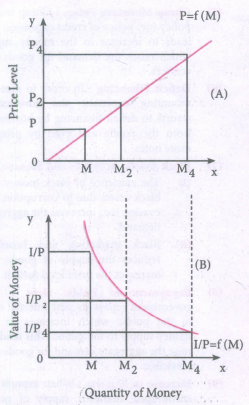
(i) It show's the effect of changes in the quantity of money on the price level.
(ii) When quantity of money is OM1, the price level is OP1.
(iii) When the quantity of money is doubled to OM2, the price level is also doubled to OP2.
(iv) When quantity of money is increased four-fold to OM4, the price level also increases by 4 times to OP4 his relationship is shown by the curve OP = f(M) from the origin at 45o.
Quantity of money
(i) Fig B shows the inverse relation between the quantity of money and the value of money.
(ii) Value of money is taken on the vertical axis.
(iii) When the quantity of money is OM1, the value of money is OI / P1.
(iv) When quantity of money is doubled to OM2, the value of money becomes one half of what it was before (OI / P2)
(v) When quantity of money increases by the four fold to OM4, the value of among is reduced by OI / P4
(vi) This inverse relationship between the quantity of money and the value of money is shown by downward sloping curve 1 / OP= f(M).
40.
Introduction
J.M Keynes has divided factors influencing the consumption function into two namely Subjective factors and Objective factors
Subjective Factors
These factors are internal and related to psychological feelings. Keynes lists 8 motives which lead individuals to refrain from spending
Motive of precaution
To build a reserve against unforeseen contingencies. (eg.) Accidents
Motive of foresight
The desire to provide for anticipated future needs. (eg.) Old age
Motive of calculation
The desire to enjoy interest and appreciation.
Motive of improvernent
(i) The desire to enjoy for improving standard of living.
(ii) Motive of financial independence
(iii) Motive of enterprise - desire to do forward trading
(iv) Motive of pride - desire to leave a fortune
(v) Motive of avarice - miserly instinct
(vi) The government institutions, business corporations and firms may also consume mainly because of:
Motive of enterprise
The desire to get resources to carry out further capital investment without debt.
Motive of liquidity
The desire to secure liquid resources to meet emergency
Motive of improvement
The desire to secure a rising income and to demonstrate successful management
Motive of financial prudence
The desire to ensure adequate financial provision against depreciation, obsolescence and to discharge debt.
Objective Factors
They are the external factors which are real and measurable. They can be easily changed in the long run;
Income Distribution
According to VKRV Rao if incone is equally distributed propensity to consume increases
Price level
When price falls, real income rises; people consume more and save more.
Wage level
Consumption expenditure increases with a rise in wages.
Interest rate
Higher interest rate will encourage people to save more money and reduces consumption.
Fiscal Policy
When government reduces tax, disposable income rises and propensity to consume increases.
Consumer credit
The availability of consumer credit at easy installments will encourage people to buy consumer durables like car, fridge, computer
Demographic factors
(i) Size of family, stage in family life cycle, place of residence and occupation affect the consumption pattern
Duesenberry hypothesis
(i) Consumption expenditure depends on current income, past income and standard of living
(ii) As individuals are accustomed to a particular standard of living, they continue to spend the same amount on consumption
(iii) Consumption of the poor people is influenced by the rich. This is called Demonstration effect.
Windfall gain and loss
Unexpected changes in the stock market leads to gain or loss, so consumption function shifts upward or downward.
Conclusion
According to Keynes only the subjective factors do not change in the short-run, so consumption function remains stable in the short period.
41.
Law
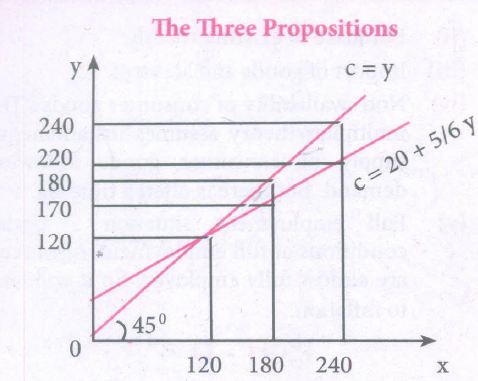
According to Keynes, "men are disposed as a rule and on the average to increase their consumption as their income increases but not by as much as the increáse in their income".
Propositions
1. When income increases, consumption expenditure also increases, but by a smaller amount
(a) When income increases from 120 to 180; consumption also increases from 120 to 170 but the increase in consumption is less than the increase in income, 10 is saved.
2. The increased income will be divided in some proportion between consumption expenditure and saving
(a) When income increases to 180 and 240, it is divided between consumption (170 and 220) and saving (10 and 20)
3. Incrcascs in income always lead to in incrcase in both consumption and saving
(a) Increases in income to 180) and 240; lead to increased consumption 170 and 220; increased saving 10 and 20.
(b) It is clear from the widening area below the C curve and the saving gap between 45o line and C curve.
| Y | C | S |
|---|---|---|
| 120 | 120 | 0 |
| 180 | 170 | 10 |
| 240 | 220 | 20 |
42.
Introduction
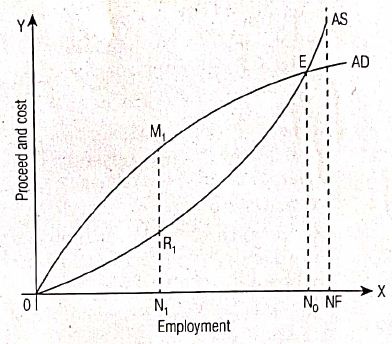
Under the Keynes theory of employment, a simple two sector economy consisting of the household sector and the business sector is taken to understand the equilibrium between ADF and ASF.
Explanation
1. AD and AS reach equilibrium at E. The employment level is No
2. At ON1employment, the aggregate supply is N1R1. But the aggregate demand is M1N1.
3. The expected level of profit is M1R1.
4. To attain this level of profit, entrepreneurs will employ more labourers, till they reach point E i.e. ONo.
5. Beyond ONo, the aggregate demand curve is below the aggregate supply curve showing loss.
6. So they will never employ more than ONo labour.
7. The equilibrium level of employment need not be the full employment level (No).
8. The difference between No - N1 is the level of unemployment.
Conclusion
Thus the concept of effective demand becomes significant in explaining the under employment equilibrium.
43.
Introduction
According to J. B. Say "Supply creates its own demand"
Explanation
A person receives his income from production which is spent on the purchase of goods and services produced by others. For the economy as a whole, therefore, total production equals total income.
Criticisms
(i) According to Keynes, supply does not. create its demand. It is not applicable where demand does not increase as much as production increases.
(ii) Automatic adjustment process will not remove unemployment. Unemployment can be removed by increase in the rate of investment.
(iii) Money is not neutral. Individuals hold money for unforeseen contingencies, businessmen keep cash reserve for future activities.
(iv) Say's law is supply creates its own demand and there is no over production. Keynes said that over production is possible
(v) Keynes regards full employment as a special case because there is underemployment in capitalist economies.
(vi) State intervention is needed when there is over production and mass unemployment.
44.
Introduction:
National income can be measured by the social accounting method. Under this method, the transactions among various sectors such as firms, households, government are recorded and their interrelationships traced.
Firms:
undertake productive activities. They employ factors of production to produce goods and services.
Households:
Households are consuming entities. They represent the factors of production, who receive payment for services rendered by them to firms. (i) Households consume the goods produced by the firms. There is a circular flow of money between these two groups.
Government:
The Government sector refers to the economic transactions of public bodies at all levels-centre, state and local. Their purchases may be financed through taxation, public borrowings. The government provides public health, education. They satisfy the collective wants of society. But Post Offices and railways are separated from the Government sector and included as "Firms".
Rest of the world:
It relates to international economic transactions - income, export, import external loan transaction, and allied overseas investment income and payments.
Capital sector:
(i) Capital sector refers to saving and investment activities. It includes the transactions of banks, insurance corporations, financial houses. These are not included under "Firms".
(ii) The economy is also divided into primary, secondary tertiary and quaternary sectors.
Conclusion:
The social accounting framework is useful for economists as well as policy makers, because it represents the major economic flows and statistical relationships among various sectors of the economic system. It is possible to forecast the trends of economy more accurately.
45.
(i) National income is of great importance for the economy of a country.
(ii) National income helps us to know the relative importance and contribution of each sector. We could find how income is produced, how it is distributed, how much is spent, saved or taxed.
(iii) National income data is used to formulate monetary policy, fiscal policy and other policies.
(iv) Data regarding gross income, output, saving and consumption is uscd in economic planning.
(v) National income data is used to build economic models in short run and long run.
(vi) It is used to make international comparison, inter regional comparison and inter temporal comparison of growth of the economy during different periods.
(vii) If income is equally distributed, the per capita income will reflect the economic welfare of the country.
46.
| S.No | Features | Capitalism | Socialism | Mixedism |
|---|---|---|---|---|
| 1. | Ownership of Means of Production | Private Ownership | Public Ownership | Private Ownership and Public Ownership |
| 2. | Economic Motive | Profit | Social Welfare | Social Welfare and Profit Motive |
| 3. | Solution of Central Problems | Free Market System | Central Planning System | Central Planning System and Free Market System |
| 4. | Government Role | Internal Regulation only | Complete Involvement | Limited Role |
| 5. | Income Distribution | Unequal | Equal | Less unequal |
| 6. | Nature of Enterprise | Private Enterprise | Government Enterprise | Both Private and State Enterprises |
| 7. | Economic Freedom | Complete Freedom | Lack of Freedom | Limited Freedom |
| 8 | Major Problem | Inequally | Inefficiency | Inequality and Inefficiency |
47.
National Income:
(i) Measurement of national income and its composition by sectors are the basic aspects of macro economic analysis.
(ii) It gives a long term understanding of the growth process of an economy.
Inflation:
(i) Estimating the general price level based on wholesale price, index, consumer price.
Business Cycle:
(i) Cyclical movements can be studied based on aggregate economic variables.
Poverty and Unemployment:
(i) Clear understanding about the magnitude of poverty and unemployment helps allocation of resources and adapting corrective measures.
Economic Growth:
(i) The growth and development of an economy and the factors determining them could be understood only through macro analysis.
Economic Policies:
(i) Macro Economics is used to frame economic policies.
(ii) Economic policies are used to solve the basic problems, to overcome the obstacles and to achieve growth.
48.
| S.No | (X) | D=X-A(A=57) | (X-\(\bar { X } \))2 |
| 1 | 43 | -14 | 196 |
| 2 | 48 | -9 | 87 |
| 3 | 65 | 8 | 64 |
| 4 | 57 | 0 | 0 |
| 5 | 31 | -26 | 679 |
| 6 | 60 | 3 | 9 |
| 7 | 37 | -20 | 400 |
| 8 | 48 | -9 | 81 |
| 9 | 78 | 21 | 441 |
| 10 | 59 | 2 | 4 |
| N-9 | \(\sum { d } =44\) | \(\sum { d }^2 =1952\) |
\(\sigma =\sqrt { \frac { { \sum { d } }^{ 2 } }{ n } -\frac { { (\sum { d } ) }^{ 2 } }{ (n) } } =\sqrt { \frac { 1952 }{ 10 } -\frac { { (-44) }^{ 2 } }{ (10) } } \)
\(=\sqrt { 195.2-19.36 } =\sqrt { 175.84 } =13.26\)

12th Standard Syllabus & Materials
12th Standard
TN 12th Computer Applications களப்பெயர் முறைமை (DNS) Sample Question Papers Study Material - QB365 Set A
NEW12th Standard
TN 12th Computer Applications வலையமைப்பு எடுத்துக்காட்டுகள் மற்றும் நெறிமுறைகள் Sample Question Papers Study Material - QB365 Set A
NEW12th Standard
TN 12th Computer Applications கணினி வலையமைப்பு ஓர் அறிமுகம் Sample Question Papers Study Material - QB365 Set A
NEW12th Standard
TN 12th Computer Applications PHP-உடன் MySQL-ஐ இணைத்தல் Sample Question Papers Study Material - QB365 Set A



Tamilnadu Stateboard 12th Standard Subjects

Maths

Chemistry

Physics

Biology

Computer Science

Business Maths and Statistics
Economics

Commerce

Accountancy

History

Computer Applications
Biology
Computer Technology
Computer Applications
Computer Science
Business Maths and Statistics
Commerce
Economics
Maths
Chemistry
Physics
Computer Technology
History
Accountancy

Tamil

English

French
Tamilnadu Stateboard Standards
