
 100% FREE ACCESS
12th Standard Syllabus & Materials
12th Standard
TN 12th Maths Applications of Matrices and Determinants Sample Question Papers Study Material - QB365 Set A
NEW12th Standard
TN 12th Computer Applications மின்னணு தரவு பரிமாற்றம் Sample Question Papers Study Material - QB365 Set A
NEW12th Standard
TN 12th Computer Applications மின் - வணிக பாதுகாப்பு அமைப்புகள் Sample Question Papers Study Material - QB365 Set A
NEW12th Standard
TN 12th Computer Applications மின்னணு செலுத்தல் முறைகள் Sample Question Papers Study Material - QB365 Set A
NEW12th Standard
TN 12th Computer Applications மின் - வணிகம் Sample Question Papers Study Material - QB365 Set A
NEW12th Standard
TN 12th Computer Applications திறந்த மூல கருத்துருக்கள் Sample Question Papers Study Material - QB365 Set A

Published on: 02/09/2022
QB365 provides a detailed and simple solution for every Possible Creative Questions in Class 12 Economics Subject - Consumption and Investment Functions , English Medium. It will help Students to get more practice questions, Students can Practice these question papers in addition to score best marks.
Download Tamil Nadu 12th Standard Economics question papers, model tests, one-mark questions, important questions, and public exam papers in PDF format. Free study materials and answer keys for TN State Board students.
Questions + Answers key
Take MCQ Economics Test
1.
Mention any five Determinants of Investment Function.
2.
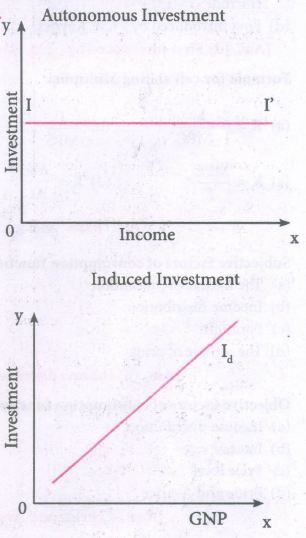
Draw the diagram of induced investment and autonomous investment.
3.
State Duesenberry hypothesis.
4.
Given the diagram, write the proposition for consumptions function.
5.
Given the table, write the proposition for consumptions function (value in crores).
6.
Draw the diagram depicting the psychological law of consumption.
7.
Draw the diagram of consumption function.
8.
Write a note on Multiplier.
9.
Specify the limitations of accelerator.
10.
Explain the uses of multiplier
11.
Explain any three limltations of leakages of multiplier.
12.
Mention the assumptions of multiplier.
13.
Draw the diagrams for Autonomous investment and induced investment.
14.
Write the formula for APC, MPC, APS, MPS.
15.
When Y = 180, C = 170, find saving and APS.
1.
1. Rate of interest
2. Level of uncertainty
3. Political environment
4. Rate of growth of population
5. Stock of capital goods
6. Necessity of new products
7. Level of income of investors
8. Inventions and innovations
9. Consumer demand
10. Policy of the state
11. Availability of capital
12. Liquid assets of the investors.
2.
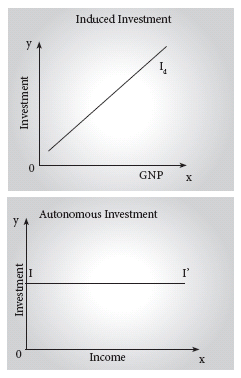
3.
Duesenberry has made two observations regarding the factors affecting consumption.
a) The consumption expenditure depends not only on his current income but also past income and standard of living. As the individuals are accustomed to a particular standard of living, they continue to spend the same amount on consumption even though the current income is reduced.
b) Consumption is influenced by demonstration effect. The consumption standards of low income groups are influenced by the consumption standards of high income groups. In other words, the poor people want to imitate the consumption pattern of rich. This results in spending beyond their income level.
4.
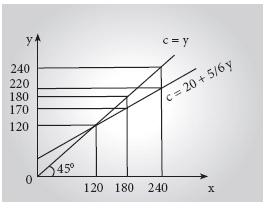
Proposition (1):
When income increases from 120 to 180 consumption also increases from 120 to 170 but the increase in consumption is less than the increase in income, 10 is saved.
Proposition (2):
When income increases to 180 and 240, it is divided in some proportion between consumption by 170 and 220 and saving by 10 and 20 respectively.
Proposition (3):
Increases in income to 180 and 240 lead to increased consumption 170 and 220 and increased saving 20 and 10 than before. It is clear from the widening area below the С curve and the saving gap between 45° line and С curve.
5.
| Income | Consumption | Savings |
| 120 | 120 | 0 |
| 180 | 170 | 10 |
| 240 | 220 | 20 |
Proposition (1):
Income increases by Rs. 60 crores and the increase in consumption is by Rs. 50 crores.
Proposition (2):
The increased income of Rs. 60 crores in each case is divided in some proportion between consumption and saving respectively. (i.e., Rs. 50 crores and Rs. 10 crores).
Proposition (3):
As income increases consumption as well as saving increase. Neither consumption nor saving has fallen.
6.
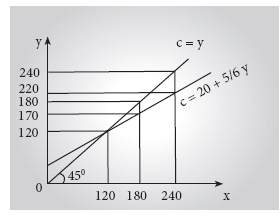
7.
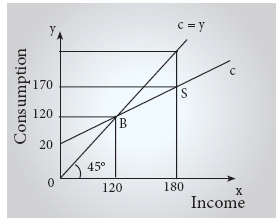
8.
(i) Multiplier expresses the relationship between an initial investment and the final increment in the GNP.
(ii) The magnified or amplified effect of initial investment on income is called as the multiplier effect.
(iii) Multiplier (K) = \(\frac{Change \ in \ equilibrium \ income}{Change \ in \ expenditure}\)
(or) K = \(\frac{ΔY}{ΔI}\) (or) K = \(\frac{1}{1-MPC}\) (or) \(\frac{1}{MPS}\)
9.
(i) Constant capital output ratio is unrealistic.
(ii) Resources are available only before full employment.
(iii) Excess capacity in capital goods industries is assumed.
(iv) It will work only when credit is available easily.
10.
(i) Multiplier highlights the importance of investment in income and employment theory.
(ii) The process throws light on the different stages of trade cycle.
(iii) It also helps in bringing the equality between S and I.
(iv) It helps to reduce unemployment and achieve full employment.
11.
(i) Payfent towards past debts:
If a portion of the additional income is used for repayment of old loan, the MPC is reduced.
(ii) Non availability of consumer goods:
The multiplier theory assumes instantaneous supply of consumer goods following demand. But there is often a time lag.
(iii) Full employment situation:
Under conditions of full employment, resources are almost fully employed.
(iv) So additional investment will lead to inflation only rather than generation of additional real income.
12.
Keynes's theory of the multiplier works under certain assumptions.
(i) There is change in autonomous investment.
(ii) There is no induced investment.
(iii) The Marginal Propensity to Consume (MPC) is constant.
(iv) Consumption is a function of current income.
(v) No time lags in the multiplier-process.
(vi) Consumer goods are available in response to effective demand for them
(vii) There is a closed economy unaffected by foreign influences.
(viii) No changes in prices.
(ix) Less than full employment level in the economy.
13.
14.
(i) The Average Propensity to Consume = \(\frac{C}{Y}\)
(ii) The Marginal Propensity to Consume = \(\frac{ΔC}{ΔY}\)
(iii) The Average Propensity to Save = \(\frac{S}{Y}\)
(iv) The Marginal Propensity to Save = \(\frac{ΔS}{ΔY}\)
15.
Saving = Y - C
S = 1806 - 170
∴ S = 10
Formula for calculating
APS = \(\frac{S}{Y}\)
S = 10, Y = 180
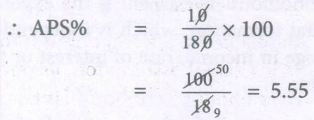
∴ APS% = 5.56

12th Standard Syllabus & Materials
12th Standard
TN 12th Computer Applications வலையமைப்பு வடமிடல் Sample Question Papers Study Material - QB365 Set A
NEW12th Standard
TN 12th Computer Applications களப்பெயர் முறைமை (DNS) Sample Question Papers Study Material - QB365 Set A
NEW12th Standard
TN 12th Computer Applications வலையமைப்பு எடுத்துக்காட்டுகள் மற்றும் நெறிமுறைகள் Sample Question Papers Study Material - QB365 Set A
NEW12th Standard
TN 12th Computer Applications கணினி வலையமைப்பு ஓர் அறிமுகம் Sample Question Papers Study Material - QB365 Set A



Tamilnadu Stateboard 12th Standard Subjects

Maths

Chemistry

Physics

Biology

Computer Science

Business Maths and Statistics
Economics

Commerce

Accountancy

History

Computer Applications
Biology
Computer Technology
Computer Applications
Computer Science
Business Maths and Statistics
Commerce
Economics
Maths
Chemistry
Physics
Computer Technology
History
Accountancy

Tamil

English

French
Tamilnadu Stateboard Standards
