
 100% FREE ACCESS
12th Standard Syllabus & Materials
12th Standard
TN 12th Computer Applications மின்னணு தரவு பரிமாற்றம் Sample Question Papers Study Material - QB365 Set A
NEW12th Standard
TN 12th Computer Applications மின் - வணிக பாதுகாப்பு அமைப்புகள் Sample Question Papers Study Material - QB365 Set A
NEW12th Standard
TN 12th Computer Applications மின்னணு செலுத்தல் முறைகள் Sample Question Papers Study Material - QB365 Set A
NEW12th Standard
TN 12th Computer Applications மின் - வணிகம் Sample Question Papers Study Material - QB365 Set A
NEW12th Standard
TN 12th Computer Applications திறந்த மூல கருத்துருக்கள் Sample Question Papers Study Material - QB365 Set A
NEW12th Standard
TN 12th Computer Applications வலையமைப்பு வடமிடல் Sample Question Papers Study Material - QB365 Set A

Published on: 02/09/2022
QB365 provides a detailed and simple solution for every Possible Creative Questions in Class 12 Economics Subject - Consumption and Investment Functions , English Medium. It will help Students to get more practice questions, Students can Practice these question papers in addition to score best marks.
Download Tamil Nadu 12th Standard Economics question papers, model tests, one-mark questions, important questions, and public exam papers in PDF format. Free study materials and answer keys for TN State Board students.
Questions + Answers key
Take MCQ Economics Test
1.
Give an account of the classification and leakages of multiplier.
2.
What are the factors that determine MEC?
3.
Use the table below (for a simple economy with no foreign sector or government) to answer the questions that follow.
| (1) Income (Y) |
(2) Consumption (C) |
(3) Investment (l) |
(4) Aggregate Demand AD = C + 1 = Column(2) + Column(3) |
| 0 | 30 | (a) | 50 |
| 300 | 300 | 20 | (b) |
| 400 | (c) | 20 | 410 |
| 500 | 480 | 20 | 500 |
| 600 | (d) | 20 | (e) |
Fill in the missing numbers in the spaces marked (a)-(c). Determine the consumption function, and use the result to fill in the remaining missing numbers (d)-(e). (f) Determine the equilibrium output level.
4.
Derive the value of the multiplier assuming the basic form of the consumption function as C = a + bY where "a" is autonomous consumption and "b" is the marginal propensity to consume. You may assume a two-sector economy.
5.
Explain the short and long run factors of MEC.
6.
State the Relationship between rate of interest and Investment:
7.
Explain Multiplier with help of suitable diagram.
8.
Explain the concept of super multiplier.
9.
Draw a consumption table where autonomous consumption is Rs.200 and the marginal propensity to consume is .8. Make sure to start with an income level of Rs.0 and increase by Rs.100 each time up to an income level of Rs.400. Without completing the table any further determine the level of income where consumption and income are equal. Prove this algebraically.
10.
Explain Marginal propensity to consume and multiplier, with the help of a diagram.
11.
What are the factors on which MEC depends? Also give details on the factors which influence MEC.
12.
What are the determinants of investment function?
13.
Explain consumption function with the help of diagram.
1.
Classification of Multiplier
(i) Static multiplier is otherwise known as simultaneous multiplier, timeless multiplier and logical multiplier.
(ii) Under static multiplier the change in investment and the resulting change in income are simultaneous.
(iii) There is no time lag. There is also no change in MPC as the economy moves from one equilibrium position to another.
(iv) Dynamic multiplier is also known as 'sequence multiplier'. In real life, income level does not increase instantly with investment.
(v) In fact, there is a time lag between increase in income and consumption expenditure.
Leakages of Multiplier
Payment towards past debts:
If a portion of the additional income is used for repayment of old loan, the MPC is reduced and K (multiplier effect) falls.
Purchase of existing wealth:
If income is used to buy land, building and shares money is circulated among people and never enters into C (consumption). So K is affected.
Import of goods and services:
Income spent on imports flows out of the country. So value of K falls.
Non availability of consumer goods:
K assumes that when there is demand, there is immediate supply of consumer goods. But there is a time lag. During this gap inflation takes places. So C decreases and K falls.
Full employment situation:
Under full employment, resources are almost fully employed. So, additional investment leads to inflation.
2.
Introduction
MEC was first introduced by J.M Keynes in 1936.
Meaning
MEC is the rate of discount which makes the discounted present value of expected income stream equal to the cost of capital, Short run factors
Demand for the product
If the market for a particular good is expected to grow and its costs are likely to fall, the rate of return from investment wil be high.
Liquid Asset
If the entrepreneurs hold large volume of working capital, they can take advantage of the investment opportunities that come in their waay MEC will be high.
Sudden changes in income
If the business community gets windfall profits or tax concession the MEC will be high.
Current rate of investment
If in a particular industry, much investment has already taken place and the rate of investment currently going on in that industry is also very large, then the MEC is low.
Optimism and pessimism
If businessmen are optimistic about future, MEC is high.
Long - Run Factors
Rate of growth of population
A rapid rise in growth of population increase demand and so MEC.
Technological progress
Inventions and technological improvements encourage investment in various projects and increase MEC.
Monetary and Fiscal policies
Cheap money policy and liberal tax policy bring greater profit so MEC is high
Political environment
Political stability, smooth administration, maintenance of law, and order help to improve MEC.
Resource availability
Cheap and abundant supply of natural resources, efficient labour and stock of capital increase the MEC.
3.
| (1) Income (Y) |
(2) Consumption (C) |
(3) Investment (l) |
(4) Aggregate Demand AD = C + 1 = Column(2) + Column(3) |
| 0 | 30 | (a) | 50 |
| 300 | 300 | 20 | 320 |
| 400 | 390 | 20 | 410 |
| 500 | 480 | 20 | 500 |
| 600 | 570 | 20 | (e) |
Using AD = C + II,
(a) 50 = 30 + 20
(b) 320 = 300 + 20
(c) 410 = 390 + 20 Deriving the consumption function:
Autonomous consumption = 30 (from the first row where Y = 0).
To find the mpc, calculate a change in C (e.g. 390 – 300 = 90), and divide by the corresponding change in Y (400 – 300 = 100).
So the mpc = ΔC/ΔY = 90/100 = 0.9 Hence, the consumption function is C = 30 + 0.9Y To fill in
(d) C = 30 + 9(600) = 30 + 540 = 570.
(e) follows from 590 = 570 + 20.
f. Equilibrium is where Y = AD, which is at 500 (see shaded row).
4.
Since Y = C + I we can write Y = a + bY + I.
This equation can be rearranged to yield
Y - bY = a + I
Y(1 - b) = a + I
We can then solve for Y in terms of I by dividing through by (1 - b):
Y = (a + I) (1/1 - b)
Now we can see that an increase in I will increase Y by
ΔY = ΔI x (1/1 - b)
Since b D MPC, the expression becomes
ΔY = ΔI x 1/(1 - MPC)
Therefore, the multiplier is 1/1 - MPC or 1/MPS.
5.
a) Short - Run Factors
(i) Demand for the product:
If the market for a particular good is expected to grow and its costs are likely to fall, the rate of return from investment will be high. If entrepreneurs expect a fall in demand for goods and a rise in cost, the investment will decline.
(ii) Liquid assets:
If the entrepreneurs are holding large volume of working capital, they can take advantage of the investment opportunities that come in their way. The MEC will be high.
(iii) Sudden changes in income:
The MEC is also influenced by sudden changes in income of the entrepreneurs. If the business community gets windfall profits, or tax concession the MEC will be high and hence investment in the country will go up. On the other hand, MEC falls with the decrease in income.
(iv) Current rate of investment:
Another factor which influences MEC is the current rate of investment in a particular industry. If in a particular industry, much investment has already taken place and the rate of investment currently going on in that industry is also very large, then the marginal efficiency of capital will be low.
(v) Waves of optimism and pessimism:
The marginal efficiency of capital is also affected by waves of optimism and pessimism in the business cycle. If businessmen are optimistic about future, the MEC will be likely to be high. During periods of pessimism the MEC is under estimated and so will be low.
b) Long - Run Factors
The long run factors which influence the marginal efficiency of capital are as follows
(i) Rate of growth of population:
Marginal efficiency of capital is also influenced by the rate of growth of population. If population is growing at a rapid speed, it is usually believed that the demand of various types of goods will increase. So a rapid rise in the growth of population will increase the marginal efficiency of capital and a slowing down in its rate of growth will discourage investment and thus reduce marginal efficiency of capital.
(ii) Technological progress:
If investment and technological development take place in the industry, the prospects of increase in the net yield brightens up. For example, the development of automobiles in the 20th century has greatly stimulated the rubber industry, the steel and oil industry etc. So we can say that inventions and technological improvements encourage investment in various projects and increase marginal efficiency of capital.
(iii) Monetary and Fiscal policies:
Cheap money policy and liberal tax policy pave the way for greater profit margin and so MEC is likely to be high.
(iv) Political environment:
Political stability, smooth administration, maintenance of law and order help to improve MEC.
(v) Resource availability:
Cheap and abundant supply of natural resources, efficient labour and stock of capital enhance the MEC.
6.
(i) Higher interest rates reduce investment, because higher rates increase the cost of borrowing and require investment to have a higher rate of return to be profitable.
(ii) If interest rates rise from 5% to 8 %, then we get a fall in the amount of investment.
(iii) from Rs. 100 cr to Rs. 80 cr.
(iv) If interest rates are increased then it will tend to discourage investment because investment has a higher opportunity cost.
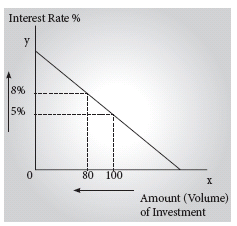
If interest rates are increased then it will tend to discourage investment because investment has a higher opportunity cost.
1. With higher rates, it is more expensive to borrow money from a bank.
2. Saving money in a bank gives a higher rate of return. Therefore, using savings to finance investment has an opportunity cost of lower interest payments.
If interest rates rise, firms will need to gain a better rate of return to justify the cost of borrowing using savings.
7.
Definition
(i) The multiplier is defined as the ratio of the change in national income to change in investment.
(ii) If ΔI stands for increase in investment and ΔY stands for resultant increase in income, the multiplier K =ΔY/ΔI.
Assumptions of Multiplier
1. There is change in autonomous investment.
2. There is no induced investment
3. The marginal propensity to consume is constant.
4. Consumption is a function of current income.
5. There are no time lags in the multiplier process.
6. Consumer goods are available in response to effective demand for them.
7. There is a closed economy unaffected by foreign influences.
8. There are no changes in prices.
9. There is less than full employment level in the economy.
The value of multiplier depends on MPC
Multiplier K = 1/1-MPC
(i) The multiplier is the reciprocal of one minus marginal propensity to consume. Since marginal propensity to save is 1 - MPC. (MPC + MPS = 1).
(ii) Multiplier is 1/ MPS. The multiplier is therefore defined as reciprocal of MPS. Multiplier is inversely related to MPS and directly with MPC.
Numerically, if MPC is 0.75, MPS is 0.25 and k is 4.
Using formula k = 1/1- MPC
1/1-0.75 =1/0.25 =4
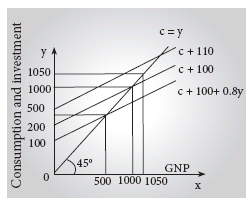
Diagrammatic Explanation.
(1) At 45° line y = C+ S
(2) It implies the variables in axis and axis are equal.
(3) The MPC is assumed to be at 0.8 (C = 100 + 0.8y)
(4) The aggregate demand (C + I) curve intersects 45° line at point E.
(5) The original national income is 500. (C = 100 + 0.8y = 100 + 0.8(500) = 500)
(6) When I is 100, y = 1000, C = 900; S = 100 = I
(7) The new aggregate demand curve is C + I = 100 + 0.8y + 100 +10
(8) Y = 210 / 0.2 = 1050
(9) C = 940; S = 110 = I
8.
Meaning of Super Multiplier
(i) In order to measure the total effect of initial investment on income, Hicks has combined the k and β mathematically and given it the name of the Super Multiplier.
(ii) The super multiplier is worked out by combining both induced consumption and induced investment. The combined name of the super multiplier and the accelerator is also called the leverage effect
Components of Super Multiplier
(i) The super multiplier is greater than simple multiplier which includes only autonomous investment and no induced investment, while super multiplier includes induced investment.
(ii) The super multiplier is greater than simple multiplier which includes only autonomous investment and no induced investment, while super multiplier includes induced investment.
The Leverage Effect
The combined effect of the multiplier and the accelerator is also called the leverage effect which may lead the economy to very high or low level of income propagation.
Symbolically,
Y= C + IA + IP
Y = Aggregate income.
C = Consumption expenditure
IA = autonomous investment
IP = induced private investment
The super – multiplier, tells us that if there is an initial increase in autonomous investment, income will increase by K times the autonomous investment.
9.
| Income | Consumption |
| Rs.0 | Rs.200 |
| Rs.100 | 280 |
| Rs.200 | 360 |
| Rs.300 | 440 |
| Rs.400 | 520 |
(i) The consumption function is C = 200 + .8Y
(ii) Therefore if C = Y we can write Y = 200 + 8Y.
(iii) After rearranging terms this yields 2Y = 200.
(iv) Solving for Y gives us 1000.
10.
(i) The propensity to consume refers to the portion of income spent on consumption.
MPC = \(\frac{ΔC}{ΔY}\)
(K) = \(\frac{1}{1-MPC}\)
(ii) The multiplier is the reciprocal of one minus marginal propensity to consume.
(iii) Multiplier is 1/MPS
(iv) The multiplier is therefore define as reciprocal of MPS.
(v) Multiplier is inversely related to MPS and directly with MPC.
Numerically, if MPC is 0.75, MPS is 0.25 and K is 4.
Using formula K = \(\frac{1}{1-MPC}\)
⇒\(\frac{1}{1-0.75}\) = 1/0.25 = 4
∴ Multiplier (K) = 4
| MPC | MPS | K |
|---|---|---|
| 1.00 | 1.00 | 1 |
| 0.10 | 1.90 | 1.11 |
| 0.50 | 0.50 | 2.00 |
| 0.75 | 0.25 | 4.00 |
| 0.90 | 0.10 | 10.00 |
| 1.00 | 0.00 | ∝ |
C = 100 + 0.8Y;
I = 10
Y = C + I
= 100 + 0.8 Y +9p00
.JPG)
0.2Y = 1000
∴ Y = 1000
Here, C = 100 + 0.8y
= 100 + 1000 = 900
S = 100 = I
After I is raised by 10, now I = 110
Y = 100 + 0.8y + 110
0.2y = 210
y = \(\frac{210}{0.2}\) = 1050
Here, C = 100 = 0.8 (1050) = 940,
S = 110 = I
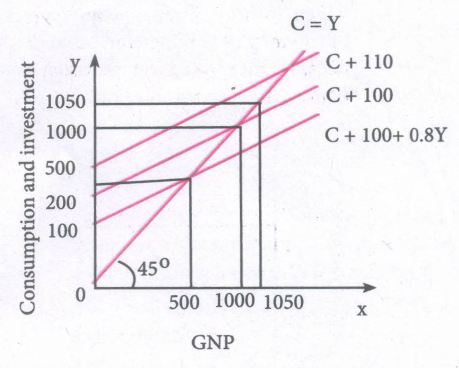
(i) It implies the variables in axis-and axis are equal.
(ii) The MPC is assumed to be at 0.8. (C = 100 + 0.8y)
(iii) The aggregate demand (C + I) curve intersects 45° line at point E.
(iv) The new aggregate demand curve is
C + I = 100 + 0.8Y + 100 + 10
Y = \(\frac{210}{0.2}\)
C = 940; S = 110 = Z
11.
MEC depends on the following 2 factors :
(1) The prospective yield from a capital asset.
(2) The supply price of a capital asset. The marginal efficiency of capital is influenced by short-run as well as long run factors.
(a) Short - Run factors:
(i) Demand for the product:
If the market for a particular good is expected to grow and its costs are likely to fall, the rate of return from investment will be high.
(ii) Liquid assets:
If the entrepreneurs are holding large volume of working capital, they can take advantage of the investment opportunities that come in their way. The MEC will be high.
(iii) Sudden changes in incomes:
If the business community gets windfall profits, or tax concession the MEC will be high. On the other hand, MEC falls with the decrease in income.
(iv) Current rate of investment:
If in a particular industry, much investment has already taken place and the rate of investment currently going on in that industry is also very large, then the marginal efficiency of capital will be low.
(v) Wales of optimism and pessimism:
If businessmen are optimistic about future, the MEC will be likely to be high. During periods of pessimism the MEC is under estimated and so will be low.
(b) Long - Run Factors:
(i) Rate of growth of population:
If population is growing at a rapid speed, it is usually believed that the demand of various types of goods will increase.
(ii) Technological progress:
If investment and technological development take place in the industry, the prospects of increase in the net yield brightens up.
(iii) Monetary and fiscal policies:
Cheap money policy and liberal tax policy pave the way for greater profit margin and so MEC is likely to be high.
(iv) Political environment :
Political stability, smooth administration, maintenance of law and order help to improve MEC.
(v) Resource avaiqability:
Cheap and abundant supply of natural resources, efficient labour and stock of capital enhance the MEC.
12.
(i) The classical economists believed that investment depended exclusively on rate of interest.
(ii) Investment decision depends on a number of factors.
(iii) They are as follows:
(1) Rate of interest
(2) Level of uncertainty
(3) Political environment
(4) Rate of growth of population
(5) Stock of capital goods
(6) Necessity of new products
(7) Level of income of investors
(8) Inventions and innovations
(9) Consumer demand
(10 ) Policy of the state
(11) Available of capital
(12) Liquid assets of the investors
13.
Meaning of consumption function.
(i) Propensity to consume refers to income consumption relationship.
(ii) Consumption function is a "functional relationship between two aggregates viz. total consumption and gross national income."
(iii) C = f(Y)
(iv) C = Consumption
Y = Income
f = Function
(v) Thus the consumption function indicates a functional relationship between C and Y.
(vi) C is the dependent variable and Y is the independent variable. i.e. C is determined by Y.
(vii) Based on the ceteris paribus (other things being same) assumption, as only income consumption relationship is considered.
(viii) All possible influences on consumption are held constant.
(ix) A hypothetical consumption schedule is given in table.
Income - Consumption Schedule (Rs.Cores)
| Income Y | Consumption C | Savings S |
|---|---|---|
| 0 | 20 | -20 |
| 60 | 70 | -10 |
| 120 | 120 | 0 |
| 180 | 170 | 10 |
| 240 | 220 | 20 |
| 300 | 270 | 30 |
| 360 | 320 | 40 |
If we take C = 100 + 0.8Y, then MPC = 0.8
Here if Y = 0, C = 100; if Y = 100, C = 180
If Y = 200, C = 260
If Y =300, C = 340 (MPC = \(\frac{ΔC}{ΔY}\) = 0.8)
In mathematical terms
C = a + b Y or C = 20 + 0.8Y
Where a > 0 and b < 1
C = Consumptiona = Constant or intercept = 20
Y = Income
b = MPC (Marginal prosperity to consume)
8.0 = \(\frac{ΔC}{ΔY}\)
(x) The above table shows that consumption is an increasing function of income because consumption expenditure increases with increase in income.
(xi) When income is zero, people spend out of their past savings on consumption because they must eat in order to live (Autonomous consumption).
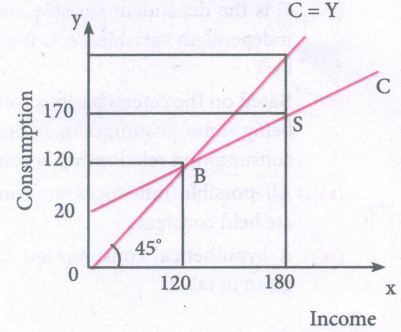
Here, when Y = 120, C = 120 (point B in the diagram)
When Y = 180, C = 170, S = 10 (point S in the diagram)
If oY increases to 360, C = 320, S = 40
(xii) In the diagram, income is measured horizontally.
(xiii) Consumption is measured vertically.
(xiii) In 45 line at all levels income and consumption are equal.
(xv) The consumption function measures not only the amount spent on consumption but also the amount saved.
(xvi) The propensity to save is merely the propensity not to consume.

12th Standard Syllabus & Materials
12th Standard
TN 12th Computer Applications களப்பெயர் முறைமை (DNS) Sample Question Papers Study Material - QB365 Set A
NEW12th Standard
TN 12th Computer Applications வலையமைப்பு எடுத்துக்காட்டுகள் மற்றும் நெறிமுறைகள் Sample Question Papers Study Material - QB365 Set A
NEW12th Standard
TN 12th Computer Applications கணினி வலையமைப்பு ஓர் அறிமுகம் Sample Question Papers Study Material - QB365 Set A
NEW12th Standard
TN 12th Computer Applications PHP-உடன் MySQL-ஐ இணைத்தல் Sample Question Papers Study Material - QB365 Set A



Tamilnadu Stateboard 12th Standard Subjects

Maths

Chemistry

Physics

Biology

Computer Science

Business Maths and Statistics
Economics

Commerce

Accountancy

History

Computer Applications
Biology
Computer Technology
Computer Applications
Computer Science
Business Maths and Statistics
Commerce
Economics
Maths
Chemistry
Physics
Computer Technology
History
Accountancy

Tamil

English

French
Tamilnadu Stateboard Standards
