
 100% FREE ACCESS
12th Standard Syllabus & Materials
12th Standard
TN 12th Maths Applications of Matrices and Determinants Sample Question Papers Study Material - QB365 Set A
NEW12th Standard
TN 12th Computer Applications மின்னணு தரவு பரிமாற்றம் Sample Question Papers Study Material - QB365 Set A
NEW12th Standard
TN 12th Computer Applications மின் - வணிக பாதுகாப்பு அமைப்புகள் Sample Question Papers Study Material - QB365 Set A
NEW12th Standard
TN 12th Computer Applications மின்னணு செலுத்தல் முறைகள் Sample Question Papers Study Material - QB365 Set A
NEW12th Standard
TN 12th Computer Applications மின் - வணிகம் Sample Question Papers Study Material - QB365 Set A
NEW12th Standard
TN 12th Computer Applications திறந்த மூல கருத்துருக்கள் Sample Question Papers Study Material - QB365 Set A

Published on: 03/09/2022
QB365 provides a detailed and simple solution for every Possible Book Back Questions in Class 12 Economics Subject - Economics of Development and Planning , English Medium. It will help Students to get more practice questions, Students can Practice these question papers in addition to score best marks.
Download Tamil Nadu 12th Standard Economics question papers, model tests, one-mark questions, important questions, and public exam papers in PDF format. Free study materials and answer keys for TN State Board students.
Questions + Answers key
Take MCQ Economics Test
1.
What are the functions of NITI Aayog?
2.
Distinguish between functional and structural planning.
3.
Describe the case for planning
4.
Trace the evolution of economic planning in India.
5.
How would you break the vicious circle of poverty?
6.
What are the non-economic factors determining development?
7.
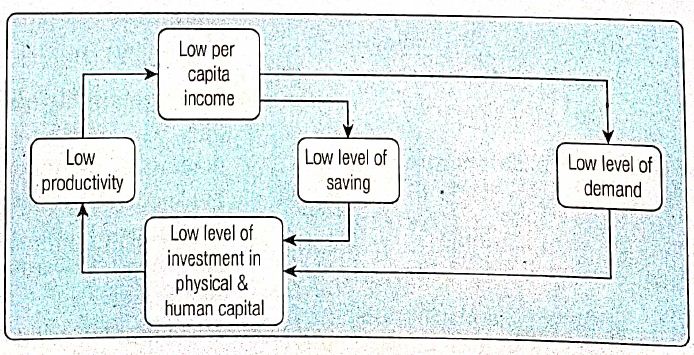
Elucidate major causes of vicious circle of poverty with diagram
1.
1. Co-operative and competitive federalism to enable the States to have active participation.
2. Shared national agenda for development priorities and strategies.
3. Decentralized planning to restructure the planning process into a bottom up model.
4. Vision and scenario planning to design medium and long-term plans.
5. Network of expertise
6. Harmonization of actions across different layers of government.
7. Conflict resolution for mutual consensus to intersectoral, inter departmental, inter state and centre state issues.
8. Coordinating interface with the world to harness global expertise and resources.
9. Internal consultancy to central and State governments on policy and programmes.
10. Capacity building and technology up-gradation and providing managerial and technical know how.
11. Monitoring and evaluation of policies and progammes.
2.
Functional Planning:
(i) It refers to that planning which seeks to remove economic difficulties by directing all the planning activities within the existing economic and social structure.
Structural Planning:
(i) It refers to a good deal of changes in the socioeconomic framework of the country.
(ii) Under developed countries follow this type of planning.
3.
To accelerate and strengthen market mechanism:
1. The market mechanism works imperfectly because of ignorance and unfamiliarity with it.
2. There is non monetized sector, unorganized factor, product, money and capital markets.
3. Therefore a planned economy is a better substitute for free economy.
To remove unemployment:
1. Capital is scarce, labour abundant so there is unemployment and disguised unemployment in UDCs.
2. So planning is needed.
To achieve bàlanced development:
1. For rapid economic development UDC needs planning to develop agriculture, industrial, establish socio and economic overheads and expand domestic and foreign trade.
Development of agriculture and industries:
1. Reorganization of agriculture releases surplus labour force which is absorbed by the industrial sector.
2. Development of agriculture is essential to supply raw materials for industries.
Development of infrastructure:
1. Canals, roads, railways, power stations are needed for agriculture and industries.
2. These economic and social overheads need huge capital investment and have long gestation period and low rate of return.
3. Only the state can provide this through planning.
Development of money and capital market:
1. Planning alone can provide sound money market and capital market.
To remove poverty and inequalities:
1. Planning raises national and per capita income, reduces inequalities and poverty and increases employment opportunities.
4.
1. Sir M. Vishveshwarya (1934) made the first attempt in laying foundation for economic planning in India through his book, "Planned Economy of India". It was a 10 year plan.
2. Jawaharlal Nehru (1938) set-up "National Planning Commission" by a committee but due to the World War II it did not materialize.
3. In 1940,8 leading industrialists of Bombay presented a 15 Year Bombay Plan.
4. In 1944 S. N Agarwal gave the Gandhian Plan focusing on the agriculture and rural economy.
5. M.N. Roy in 1945 drafted People's Plan aiming at mechanisation of agricultural production.
6. In 1950 J.P. Narayan advocated Sarvodaya Plan which was inspired by Gandhian Plan and with the idea of Vinoba Bhave.
7. It gave importance to agriculture, small and cottage industries.
8. After considering all the plans in the same year Planning Commission was set up to formulate Five Year Plan in India by Jawaharlal Nehru.
9. Nehru was the first Chairman of Planning Commission, Government of India.
5.
(i) On the supply side of the vicious circle of poverty there is low rate of saving and investment.
(ii) In UDCs to increase the rate of investment and capital formation, the marginal rate of savings must be greater than the average rate of savings.
(iii) On the demand side, Nurkse suggested balanced growth.
(iv) If investment is made in several industries simultaneously the workers will become consumers of each other's products creating mutual demand.
6.
Human Resources:
(i) Human power increases productivity and thus national income.
(ii) A healthy, educated and skilled labour force is the most important productive asset.
Technical Know-how:
(i) As the scientific and technological knowledge advances, more sophisticated techniques steadily raise the productivity in all sectors.
Political Freedom:
(i) Development is linked with political freedom.
(ii) Dadabhai Naoroji said the drain of wealth from India under British rule is the major cause of increase in poverty in India.
Social Organization:
(i) Mass participation in development programs is a pre condition for accelerating development
(ii) When some groups enjoy the benefits of growth and majority of the poor do not participate in the process of development it is called crony capitalism.
Corruption free administration:
(i) Tax evasion breeds corruption and prevents progress.
Desire for development:
(i) If the level of consciousness is low and the people have accepted poverty as their fate, there is little scope for development.
Moral, ethical and social values:
(i) If people are dishonest, market cannot function.
Casino Capitalism:
(i) If people spend larger propotion of their income on entertainment liquor, illegal activities, production suffers. This is called casino capitalism.
Patrimonial Capitalism:
(i) If assets are inherited by children, they would not work hard because they do not know the value of the assets. So, production is low.
7.
(i) The cause for vicious circle of poverty is demand and supply.
(ii) On the supply side, the low level of real income leads to low level of saving and investment and to deficiency of capital.
(iii) Deficiency of capital leads to low productivity and back to low income.
(iv) On the demand-side, low level of real income leads to low demand so investment is less, therefore deficiency of capital, low productivity and low income.

12th Standard Syllabus & Materials
12th Standard
TN 12th Computer Applications வலையமைப்பு வடமிடல் Sample Question Papers Study Material - QB365 Set A
NEW12th Standard
TN 12th Computer Applications களப்பெயர் முறைமை (DNS) Sample Question Papers Study Material - QB365 Set A
NEW12th Standard
TN 12th Computer Applications வலையமைப்பு எடுத்துக்காட்டுகள் மற்றும் நெறிமுறைகள் Sample Question Papers Study Material - QB365 Set A
NEW12th Standard
TN 12th Computer Applications கணினி வலையமைப்பு ஓர் அறிமுகம் Sample Question Papers Study Material - QB365 Set A



Tamilnadu Stateboard 12th Standard Subjects

Maths

Chemistry

Physics

Biology

Computer Science

Business Maths and Statistics
Economics

Commerce

Accountancy

History

Computer Applications
Biology
Computer Technology
Computer Applications
Computer Science
Business Maths and Statistics
Commerce
Economics
Maths
Chemistry
Physics
Computer Technology
History
Accountancy

Tamil

English

French
Tamilnadu Stateboard Standards
