
 100% FREE ACCESS
12th Standard Syllabus & Materials
12th Standard
TN 12th Maths Applications of Matrices and Determinants Sample Question Papers Study Material - QB365 Set A
NEW12th Standard
TN 12th Computer Applications மின்னணு தரவு பரிமாற்றம் Sample Question Papers Study Material - QB365 Set A
NEW12th Standard
TN 12th Computer Applications மின் - வணிக பாதுகாப்பு அமைப்புகள் Sample Question Papers Study Material - QB365 Set A
NEW12th Standard
TN 12th Computer Applications மின்னணு செலுத்தல் முறைகள் Sample Question Papers Study Material - QB365 Set A
NEW12th Standard
TN 12th Computer Applications மின் - வணிகம் Sample Question Papers Study Material - QB365 Set A
NEW12th Standard
TN 12th Computer Applications திறந்த மூல கருத்துருக்கள் Sample Question Papers Study Material - QB365 Set A

Published on: 03/09/2022
QB365 provides a detailed and simple solution for every Possible Creative Questions in Class 12 Economics Subject - Economics of Development and Planning , English Medium. It will help Students to get more practice questions, Students can Practice these question papers in addition to score best marks.
Download Tamil Nadu 12th Standard Economics question papers, model tests, one-mark questions, important questions, and public exam papers in PDF format. Free study materials and answer keys for TN State Board students.
Questions + Answers key
Take MCQ Economics Test
1.
Distinguish between Economic Development and Growth. (Any Three Points).
2.
What are the six basic characteristics of under developed economy?
3.
Explain the concept "economic development".
4.
What is vicious circle of poverty?
5.
Write short note on second five year plan
6.
Write short notes on National planning commission.
7.
What are the main objectives of planning in India?
8.
Explain NITI Aayog.
9.
Tabulate the details of short, medium and long term planning.
10.
Write a note on loss of freedom.
11.
What are the Economics factors of determinants of economics development?
12.
Classify the various countries on the basis of gross national income (GNI) per capita?
13.
List out the types of Planning.
14.
What are the characteristics of under developed countries?
15.
Explain about traditional approach.
1.
| S.No | Economic Development | Economic Growth |
|---|---|---|
| (i) | Related to Underdeveloped Countries | Related to developed (or) advanced countries. |
| (ii) | Rising of income levels in poor countries. | Rising of income levels in rich countries |
| (iii) | It is discontinuous and spontaneous changes in the station if any state | It is gradual and steady changes in the long run. |
2.
(1) Primary production
(2) Population Pressures
(3) Underemployment
(4) Economic backwardness
(5) Capital deficiency
(6) Foreign trade orientation
3.
(i) Development means, people must have higher incomes, better education, better health care and nutrition, less poverty and more equality of opportunity.
(ii) According to Michael P. Todaro and Stephen C. Smith, "development must beconceived of as multidimensional process involving major changes in social structure, popular attitudes and national institutions, as well as the acceleration of economic growth, the reductions of inequality and the eradications of poverty".
4.
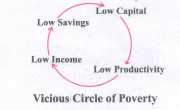
According to Ragnar Nurkse, low capital formation is one of the basic causes of poverty in UDCs. Low capital formation leads to low productivity. Low productivity results in low income and low income result in low savings and low saving leads to low capital formation. Thus, it forms a vicious circle of poverty.
5.
(i) The Second Five Year Plan (1951- 56) aimed at rapid industrialization with particular emphasis on the development of basic and heavy industries.
(ii) It was during the second plan period, the Goverriment embraced the goal of democratic socialism
6.
(i) The National planning commission was set up in India in 1950.
(ii) A major function of the planning commission was to formulate a plan for the most effective and balanced utilization of the country's resources".
(iii) The planning commission formulated the First Five Year Plan for the period 1951 - 56.
7.
The main objectives of planning in India may be grouped under four heads, they are
(i) Growth
(ii) Modernization
(iii) Self - reliance and
(iv) Social justice
8.
NIT! Aayog (National Institution for transforming India) was formed on 1st January, 2015 through a Union Cabinet resolution. NITI Aayog is a policy think-tank of the Government of India. It replaced the Planning Commission from 13th August, 2014. The Prime Minister. is the Chairperson of NITIAayog and Union Ministers will be Ex-officio members. The Vice-Chairman of the NITI Aayog is the functional head.
Functions of NITI Aayog
1. Cooperative and Competitive Federalism
2. Shared National Agenda
3. Decentralized Planning
4. Vision and Scenario Planning
5. Network of Expertise
6. Harmonization:
7. Conflict Resolution
8. Coordinating Interface with the World
9. Internal Consultancy
10. Capacity Building
11. Monitoring and Evaluation
9.
| Planning | ||
|---|---|---|
| Long-term over 10 year | Medium-term 3-7 years | Short-term up to 1 year |
| Long-term planning is considered for a time period over 10 years | Medium-term, planning is considered for a time period of 5 years | Short-term planning concerns the plans in a time period of 1 year. |
| Strategic planning. | Tactical planning. | Operational planning. |
10.
(i) The absence of freedom in decision making, may act as an obstacle for economic growth.
(ii) Regulations and restrictions are the backbone of a planned economy.
(iii) The consumers, producers and the workers enjoy no freedom of choice.
(iv) Therefore Hayek explains in his book Road to Serfdom that centralized planning leads to loss of personal freedom and ends in economic stagnation.
11.
| Economic Factors | Non-Economic Factorss | |
|---|---|---|
| 1. | Natural resource | Human resource |
| 2. | Capital formation | Technical know-how |
| 3. | Size of the market | Political freedom |
| 4. | Structural change | Social organization |
| 5. | Financial system | Corruption free administration |
| 6. | Marketable surplus | Desire for development |
| 7. | Foreign trade | Moral, ethical and social values |
| 8. | Economic system | Patrimonial capitalism |
12.
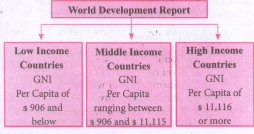
(i) The WorlthBank in its World Development Report classified various countries on the basis of Gross National Income (GNI) per capita.
(ii) Various countries on the basis of Gross National Income (GNI) per capita.
13.
Types of planning:
1. Democratic
2. Totalitarian
3. Planning by Direction
4. Inducement
5. Short, Medium and Long term
6. Functional
7. Structural
8. Centralized
9. Decentralized
10. Indicative
11. Imperative
12. Financial
13. Physical
14. Comprehensive
15. Partial
14.
Characteristics of under developed couriers are,
(i) Predominance of primary sector(ie) agriculture.
(ii) Low per capital income
(iii) Widespread poverty
(iv) Wide inequality in distribution of income and wealth.
(v) Over Population.
(vii) Low rate of capital formation.
(viii) High rate of unemployment.
(ix) Technological backwardness
(x) Dualism
15.
Explain about traditional approach.
(i) The Traditional approach defines development strictly in economic terms.
(ii) The increase in GNP is accompanied by decline in share of agriculture in output and employment while those of manufacturing and service sectors increase.
(iii) It emphasizes the importance of industrialization.
(iv) It was assumed that growth in GNP per capital would trickle down to people at the bottom.

12th Standard Syllabus & Materials
12th Standard
TN 12th Computer Applications வலையமைப்பு வடமிடல் Sample Question Papers Study Material - QB365 Set A
NEW12th Standard
TN 12th Computer Applications களப்பெயர் முறைமை (DNS) Sample Question Papers Study Material - QB365 Set A
NEW12th Standard
TN 12th Computer Applications வலையமைப்பு எடுத்துக்காட்டுகள் மற்றும் நெறிமுறைகள் Sample Question Papers Study Material - QB365 Set A
NEW12th Standard
TN 12th Computer Applications கணினி வலையமைப்பு ஓர் அறிமுகம் Sample Question Papers Study Material - QB365 Set A



Tamilnadu Stateboard 12th Standard Subjects

Maths

Chemistry

Physics

Biology

Computer Science

Business Maths and Statistics
Economics

Commerce

Accountancy

History

Computer Applications
Biology
Computer Technology
Computer Applications
Computer Science
Business Maths and Statistics
Commerce
Economics
Maths
Chemistry
Physics
Computer Technology
History
Accountancy

Tamil

English

French
Tamilnadu Stateboard Standards
