
 100% FREE ACCESS
12th Standard Syllabus & Materials
12th Standard
TN 12th Maths Applications of Matrices and Determinants Sample Question Papers Study Material - QB365 Set A
NEW12th Standard
TN 12th Computer Applications மின்னணு தரவு பரிமாற்றம் Sample Question Papers Study Material - QB365 Set A
NEW12th Standard
TN 12th Computer Applications மின் - வணிக பாதுகாப்பு அமைப்புகள் Sample Question Papers Study Material - QB365 Set A
NEW12th Standard
TN 12th Computer Applications மின்னணு செலுத்தல் முறைகள் Sample Question Papers Study Material - QB365 Set A
NEW12th Standard
TN 12th Computer Applications மின் - வணிகம் Sample Question Papers Study Material - QB365 Set A
NEW12th Standard
TN 12th Computer Applications திறந்த மூல கருத்துருக்கள் Sample Question Papers Study Material - QB365 Set A

Published on: 03/09/2022
QB365 provides a detailed and simple solution for every Possible Creative Questions in Class 12 Economics Subject - Fiscal Economics, English Medium. It will help Students to get more practice questions, Students can Practice these question papers in addition to score best marks.
Download Tamil Nadu 12th Standard Economics question papers, model tests, one-mark questions, important questions, and public exam papers in PDF format. Free study materials and answer keys for TN State Board students.
Questions + Answers key
Take MCQ Economics Test
1.
What are the objectives of Fiscal Policy?
2.
Bring out the sources of Revenue of Corporations.
3.
What are the sources of revenue of Municipalities?
4.
Bring out the sources of revenue of district boards.
5.
What are the types of budget?
6.
What are the main sources of internal public debt?
7.
Compare the nature of Sales Tax, VAT and GST.
8.
Draw the diagram from the functions of modern state.
9.
What are external public debt?
10.
What is internal public debt?
11.
What do you mean by Government subsidies?
12.
List out the several types of indirect taxes.
13.
Write any six principles of Federal Finance.
14.
Point out any three differences between direct tax and indirect tax.
15.
State any three characteristics of taxation.
1.
(i) Full employment
(ii) Price stability
(iii) Economic growth
(iv) Equitable distribution
(v) External stability
(vi) Capital formation
(vii) Regional balance
2.
(i) Tax on Property.
(ii) Tax on Vehicles and Animals
(iii) Taxes on Trades and Employment
(iv) Theatre and show tax
(v) Taxes on advertisement
(vi) Octroi and terminal tax etc.
(vii) Taxes on goods brought into the cities for sale.
3.
(i) Taxes on property.
(ii) Taxes on Vehicles and Animals
(iii) Taxes on goods particularly octroi and terminal tax.
(iv) Personal Taxes, Taxes on Profession, Trades and Employment.
(v) Theatre (or) show tax
(vi) Grands - in - aid from State Government.
4.
(i) Grants - in- aid from the state government.
(ii) Land cesses
(iii) Toll, fees etc.
(iv) Income from the property and loans from the State Government.
(v) Income from fairs and exhibitions.
(vi) Property tax and other taxes
(vii) Grants for the centrally sponsored schemes relating to development work.
5.
(i) Revenue and capital budget
(ii) Supplementary budget
(iii) Zero base budget
(iv) Performance budget
(v) Balance and Unbalanced budget
(vi) Unbalanced budget
(a) Deficit budget
(b) Surplus budget
6.
(i) Individuals purchase government bonds and securities.
(ii) Banks, both private and public buy bonds from the government.
(iii) Non financial institutions like UTI, LIC, GIC etc. also buy the government bonds.
(iv) Central Bank can lend the government in the form of money supply.
7.
(i) Sales tax was a multi point tax with cascading effect.
(ii) VAT was multi point tax without cascading effect.
(iii) GST is one point tax without cascading effect.
8.
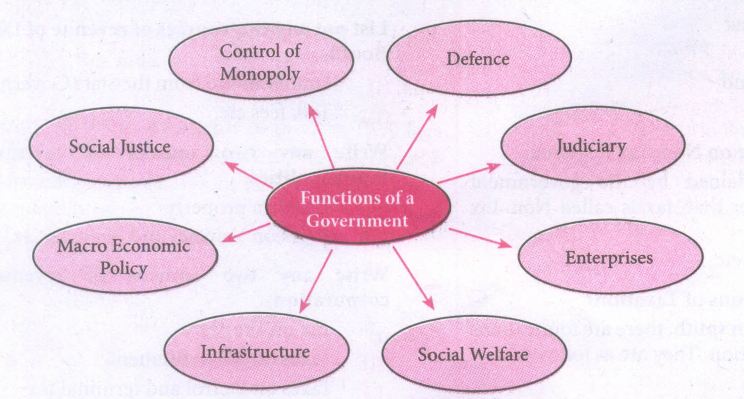
9.
(i) When a loan is taken from abroad or from an international organisation it is called external public debt.
(ii) The main sources of external public debt are IMP, World Bank, IDA and ADB etc.
(iii) Loan from other countries and the governments.
10.
(i) An internal public debt is a loan taken by the Government from the citizens or from different institution within the country.
(ii) An internal public debt only involves transfer of wealth.
11.
The Government of India has been providing subsidies on a number of items such as food, fertilizers, interest on priority sector lending, exports, education, etc. Because of the massive amounts of subsidies, the public expenditure has increased manifold
12.
Types of Indirect Taxes:
Excise Duty: Payable by the manufacturer who shifts the tax burden to retailers and wholesalers.
Sales Tax: Paid by a shopkeeper or retailer, who then shifts the tax burden to customers by charging sales tax on goods and services.
Custom Duty: Import duties levied on goods from outside the country, ultimately paid for by consumers and retailers.
Entertainment Tax: Liability is on the cinema theatre owners, who transfer the burden to cinema goers.
13.
Principles of federal finance:
(1) Principle of Indiependence
(2) Principle of Equity
(3) Principle of Uniformity
(4) Principle of Adequacy
(5) Principle of Fiscal Access
(6) Principle of Accountability
14.
| SI.No | Direct Tax | Indirect Tax |
|---|---|---|
| 1. | Direct tax is levied on person's income and wealth and is paid directly to the government. | It is levied on a person who consumes the goods and services and is paid indirectly to government. |
| 2. | Progressive in nature | Regressive in nature |
| 3. | Falls on the same person. | Falls on different persons. |
| 4. | Burden cannot be shifted. | can be shifted |
| 5. | Tax evasion is possible. | Included in the price of the goods. |
15.
(i) A tax is a compulsory payment made to the government. Refusal to pay the tax is punishable.
(ii) There is no quid pro quo between a taxpayer and public authorities.
(iii) Tax payer cannot claim any specific benefit against the payment of a tax.
(iv) Every tax involves some sacrifice on the part of the tax payer.
(v) A tax is not levied as a fine or penalty for breaking law.

12th Standard Syllabus & Materials
12th Standard
TN 12th Computer Applications வலையமைப்பு வடமிடல் Sample Question Papers Study Material - QB365 Set A
NEW12th Standard
TN 12th Computer Applications களப்பெயர் முறைமை (DNS) Sample Question Papers Study Material - QB365 Set A
NEW12th Standard
TN 12th Computer Applications வலையமைப்பு எடுத்துக்காட்டுகள் மற்றும் நெறிமுறைகள் Sample Question Papers Study Material - QB365 Set A
NEW12th Standard
TN 12th Computer Applications கணினி வலையமைப்பு ஓர் அறிமுகம் Sample Question Papers Study Material - QB365 Set A



Tamilnadu Stateboard 12th Standard Subjects

Maths

Chemistry

Physics

Biology

Computer Science

Business Maths and Statistics
Economics

Commerce

Accountancy

History

Computer Applications
Biology
Computer Technology
Computer Applications
Computer Science
Business Maths and Statistics
Commerce
Economics
Maths
Chemistry
Physics
Computer Technology
History
Accountancy

Tamil

English

French
Tamilnadu Stateboard Standards
