
 100% FREE ACCESS
12th Standard Syllabus & Materials
12th Standard
TN 12th Computer Applications மின்னணு தரவு பரிமாற்றம் Sample Question Papers Study Material - QB365 Set A
NEW12th Standard
TN 12th Computer Applications மின் - வணிக பாதுகாப்பு அமைப்புகள் Sample Question Papers Study Material - QB365 Set A
NEW12th Standard
TN 12th Computer Applications மின்னணு செலுத்தல் முறைகள் Sample Question Papers Study Material - QB365 Set A
NEW12th Standard
TN 12th Computer Applications மின் - வணிகம் Sample Question Papers Study Material - QB365 Set A
NEW12th Standard
TN 12th Computer Applications திறந்த மூல கருத்துருக்கள் Sample Question Papers Study Material - QB365 Set A
NEW12th Standard
TN 12th Computer Applications வலையமைப்பு வடமிடல் Sample Question Papers Study Material - QB365 Set A

Published on: 01/09/2020
12th Standard Economics English Medium Important 3 Mark Creative Questions (New Syllabus) 2020
Download Tamil Nadu 12th Standard Economics question papers, model tests, one-mark questions, important questions, and public exam papers in PDF format. Free study materials and answer keys for TN State Board students.
Questions + Answers key
Take MCQ Economics Test
1.
What are the main elements of a budget?
2.
How does the IFCI provides assistance to the industrial?
3.
Distinguish between IMF and World Bank
4.
List the important objectives of IMF
5.
Explain “The Keynes Equation” Keynes equation is expressed as:
6.
Aggregate Demand Function (ADF) – Explain.
7.
State the types of correction on the basis of number of variables studied.
8.
Write note on MOSPI.
9.
Write a brief note on HO - Factor endowment model theorem.
10.
How the gross value of the farm output is obtained In India?
11.
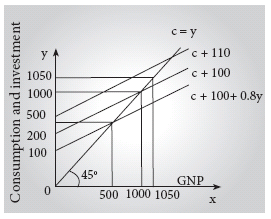
Draw the diagram of Multiplier in an economy.
12.
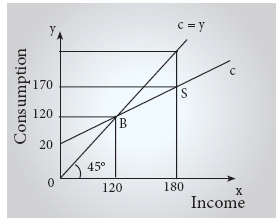
Draw the diagram of consumption function.
13.
Discuss the Effects of Noise Pollution.
14.
Write the basis how Economies can be classified into different types.
15.
Define water pollution.
16.
Write a functions of WTO.
17.
What are the objectives of Fiscal Policy?
18.
What do you mean by Government subsidies?
19.
What are the general advantages of International Trade?
20.
Write the formula for APC, MPC, APS, MPS.
21.
Write down the some of the statistical problems?
22.
Explain the concept "economic development".
23.
List out the types of Planning.
24.
Write a short note on effective demand?
25.
What are the Objectives of the ARDC.
26.
Explain the history of Barter System.
27.
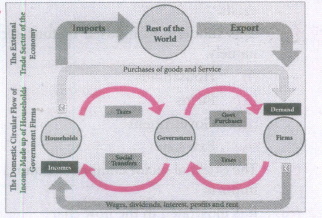
Draw the Circular flow of income in a three sector economy.
1.
(i) It is a statement of estimates of government receipts and expenditure.
(ii) Budget estimates pertain to a fixed period, generally a year.
(iii) Expenditure and sources of finance are planned in accordance with the objectives of the government.
(iv) It requires to be approved (passed) by Parliament or Assembly or some other authority before its implementation.
2.
(i) Long-term loans; both in rupees and foreign currencies.
(ii) Underwriting of equity, preference and debenture issues.
(iii) Subscribing to equity, preference and debenture issues.
(iv) Guaranteeing the deferred payments in respect of machinery imported from abroad or purchased in India; and
(v) Guaranteeing of loans raised in foreign currency from foreign financial institutions.
3.
| BASIS FOR COMPARISON | IMF | WORLD BANK |
| Meaning | An international organization maintaining the global monetary system is the International Monetary Fund. | A global organization established to finance and advice the developing nations, in order to make them economically developed is World Bank |
| Focus on | Economic Stability | Economic Growth |
| Organizational Structure | It is a single organization with four credit lines | It has two major institutions, namely International Bank for Reconstruction and Development (IBRD) and the International Development Association (IDA). |
| Operations | Provides assistance | Facilitates lending |
| Objective | To deal with all the issues related to the financial sector and macro economics. | To lessen poverty and promote the long term development of the economy. |
4.
i) To promote international monetary cooperation among the member nations.
ii) To facilitate faster and balanced growth of international trade.
iii) To ensure exchange rate stability by curbing competitive exchange depreciations.
iv) To eliminate or reduce exchange controls imposed by member nations.
5.
n = pk (or) p = n / k
Where
n is the total supply of money
p is the general price level of consumption goods
k is the total quantity of consumption units the people decide to keep in the form of cash.
because it is measured in terms of consumer goods.
According to Keynes, peoples desire to hold money is unaltered by monetary authority. So, price level and value of money can be stabilized through regulating quantity of money (n) by the monetary authority.
Later, Keynes extended his equation in the following form:
n = p (k + rk') or p = n/(k + rk')
Where,
n = total money supply
p = price level of consumer goods
k = peoples' desire to hold money in hand (in terms of consumer goods) in the total income of them
r = cash reserve ratio
k' = community’s total money deposit in banks, in terms of consumers goods.
6.
1. In the Keynesian model, output is determined mainly by aggregate demand.
2. The aggregate demand is the amount of money which entrepreneurs expect to get by selling the output produced by the number of labourers employed.
Aggregate demand has the following four components:
1. Consumption demand
2. Investment demand
3. Government expenditure and
4. Net Export (export – import)
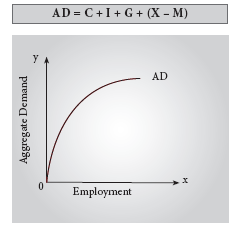
i. Figure explains that aggregate demand price increases or decreases with an increase or decrease in the volume of employment.
ii. Aggregate demand curve increases at an increasing rate in the beginning and then increases at a decreasing rate.
7.
There are three types based upon the number of variables studied as
a) Simple Correlation
b) Multiple Correlation
c) Partial Correlation
Simple Correlation:
If only two variables are taken for study then it is said to be simple correlation. Ex. Y= a + bx
Multiple Correlations:
If three or more than three variables are studied simultaneously, then it is termed as multiple correlation.
Ex: Determinants of Quantity demanded
Qd = f (P, Pc, Ps, t, y)
Where Qd stands for Quantity demanded, f stands for function.
P is the price of the goods,
Pc is the price of competitive goods
Ps is the price of substituting goods
t is the taste and preference
y is the income.
Partial Correlation:
If there are more than two variables but only two variables are considered keeping the other variables constant, then the correlation is said to be Partial Correlation
8.
1. The Ministry of Statistics and Programme Implementation (MOSPI) came into existence as an Independent Ministry in 1999 after the merging of the Department of Statistics and the Department of Programme Implementation.
2. The Ministry has two wings, Statistics and Programme Implementation. The Statistics Wing called the National Statistical Office (NSO) consists of the Central Statistical Office (CSO), the Computer Centre and the National Sample Survey Office (NSSO).
9.
(i) Developed by Heckscher and Ohlin
(ii) Countries with a relative factor abundance can specialise and trade
(iii) Abundance of skilled labour → specialisation → export → exchange for goods are services produced by countries with abundance of unskilled labour
(iv) Exports embody the abundant factor
(v) Imports embody the scarce factor
(vi) Assumes a high degree of factor mobility
10.
(i) Total production of 64 agriculture commodities is estimated. The output of each crop is measured by multiplying the area sown by the average yield per hectare.
(ii) The total output of each commodity is valued at market prices.
(iii) The aggregate value of total output of these 64 commodities is taken to measure the gross value of agricultural output.
(iv) The net value of the agricultural output is measured by making deductions for the cost of seed, manures and fertilisers, market charges, repairs and depreciation from the gross value
11.
12.
13.
a. Hearing Loss:
Chronic exposure to noise may cause noise-induced hearing loss. Older people are exposed to significant occupational noise and thereby reduced hearing sensitivity.
b. Damage Physiological and Psychological health:
Unwanted noise can damage physiological and psychological health. For example, annoyance and aggression, hypertension, and high-stress levels.
c. Cardiovascular effects:
High noise levels can contribute to cardiovascular problems and exposure to blood pressure.
d. Detrimental effect on animals and aquatic life:
Noise can have a detrimental effect on animals, increasing the risk of death.
e. Effects on wildlife and aquatic animals:
It creates hormone imbalance, chronic stress, panic and escapes behavior and injury.
14.
1. Status of Development: Developed, underdeveloped, undeveloped and developing economies.
2. System of Activities: Socialistic and Mixed Economies.
3. Scale of Activities: Small and Large Economies.
4. Nature of Functioning: Static and Dynamic Economies.
5. Nature of Operation: Closed and Open Economies.
6. Nature of Advancement: Traditional and Modern Economies.
7. Level of National Income: Low Income, Middle Income and High Income Economiesapitalistic
15.
The introduction (directly or indirectly) of substances or energy into the marine environment (including, estuaries) result in deleterious effects to living resources, hazards to human health, hindrance to marine activities.
16.
(i) It facilitates the implementation and administration and operation of the objectives of the Agreement and the Multilateral Trade Agreements.
(ii) It provides a forum for negotiations among its members, concerning their multilateral trade relations in matters relating to the agreements.
(iii) It administers the understanding the rules and procedures governing the settlement of disputes.
(iv) It co-operates with the IMF and the World Bank and its affiliated agencies with a view to achieving greater coherence in global economic policy making.
17.
(i) Full employment
(ii) Price stability
(iii) Economic growth
(iv) Equitable distribution
(v) External stability
(vi) Capital formation
(vii) Regional balance
18.
The Government of India has been providing subsidies on a number of items such as food, fertilizers, interest on priority sector lending, exports, education, etc. Because of the massive amounts of subsidies, the public expenditure has increased manifold
19.
(i) Availability of variety of goods for consumption.
(ii) Generation of more employment opportunities.
(iii) Industrialization of backward nations.
(iv) Improvement in relationship among countries.
(v) Division of Labour and specialisation.
(vi) Expansion in Transport Facilities.
20.
(i) The Average Propensity to Consume = \(\frac{C}{Y}\)
(ii) The Marginal Propensity to Consume = \(\frac{ΔC}{ΔY}\)
(iii) The Average Propensity to Save = \(\frac{S}{Y}\)
(iv) The Marginal Propensity to Save = \(\frac{ΔS}{ΔY}\)
21.
(i) Accurate and reliable data are not adequate as farm output in the subsistence sector is not completely informed.
(ii) In animal husbandry there are no authentic production data available.
(iii) Different languages, customs, etc., also create problems in computing estimates.
(iv) People in India are indifferent to the official inquiries. They are in most cases non-cooperative also.
(v) Most of the statistical staff are untrained and inefficient.
(vi) Therefore, national income estimates in our country are not very accurate or adequate.
22.
(i) Development means, people must have higher incomes, better education, better health care and nutrition, less poverty and more equality of opportunity.
(ii) According to Michael P. Todaro and Stephen C. Smith, "development must beconceived of as multidimensional process involving major changes in social structure, popular attitudes and national institutions, as well as the acceleration of economic growth, the reductions of inequality and the eradications of poverty".
23.
Types of planning:
1. Democratic
2. Totalitarian
3. Planning by Direction
4. Inducement
5. Short, Medium and Long term
6. Functional
7. Structural
8. Centralized
9. Decentralized
10. Indicative
11. Imperative
12. Financial
13. Physical
14. Comprehensive
15. Partial
24.
(i) Effective demand denotes money actually spent by the people on products of industry.
(ii) The money which entrepreneurs receive is paid in the form of rent, wages, interest and profit.
(iii) Therefore effective demand equals national income.
(iv) An increase in the aggregate effective demand would increase the level of employment. A decline in total effective demand would lead to unemployment. Therefore,
(v) Thus the total employment of a country can be determined with the help of total demand of a country.
25.
(I) To provide necessary funds by way of refinance to eligible institutions such as
(i) Central land development banks
(ii) State cooperative banks
(ill) Schedule banks
(II) To subscribe to the debentures floated by
(i) The central land development banks.
(ii) State cooperative banks
(ill) Scheduled banks
(iv) Provided and approved by the RBI.
26.
Barter System:
(i) Goods exchange for goods is known as Barter System.
(ii) In olden days goods were exchanged for goods and not for cash.
(iii) Barter system was introduced by Mesopotamia tribes.
(iv) Babylonian's also developed an improved barter system, where goods were exchanged for goods.
27.

12th Standard Syllabus & Materials
12th Standard
TN 12th Computer Applications களப்பெயர் முறைமை (DNS) Sample Question Papers Study Material - QB365 Set A
NEW12th Standard
TN 12th Computer Applications வலையமைப்பு எடுத்துக்காட்டுகள் மற்றும் நெறிமுறைகள் Sample Question Papers Study Material - QB365 Set A
NEW12th Standard
TN 12th Computer Applications கணினி வலையமைப்பு ஓர் அறிமுகம் Sample Question Papers Study Material - QB365 Set A
NEW12th Standard
TN 12th Computer Applications PHP-உடன் MySQL-ஐ இணைத்தல் Sample Question Papers Study Material - QB365 Set A



Tamilnadu Stateboard 12th Standard Subjects

Maths

Chemistry

Physics

Biology

Computer Science

Business Maths and Statistics
Economics

Commerce

Accountancy

History

Computer Applications
Biology
Computer Technology
Computer Applications
Computer Science
Business Maths and Statistics
Commerce
Economics
Maths
Chemistry
Physics
Computer Technology
History
Accountancy

Tamil

English

French
Tamilnadu Stateboard Standards
