
 100% FREE ACCESS
12th Standard Syllabus & Materials
12th Standard
TN 12th Computer Applications மின்னணு தரவு பரிமாற்றம் Sample Question Papers Study Material - QB365 Set A
NEW12th Standard
TN 12th Computer Applications மின் - வணிக பாதுகாப்பு அமைப்புகள் Sample Question Papers Study Material - QB365 Set A
NEW12th Standard
TN 12th Computer Applications மின்னணு செலுத்தல் முறைகள் Sample Question Papers Study Material - QB365 Set A
NEW12th Standard
TN 12th Computer Applications மின் - வணிகம் Sample Question Papers Study Material - QB365 Set A
NEW12th Standard
TN 12th Computer Applications திறந்த மூல கருத்துருக்கள் Sample Question Papers Study Material - QB365 Set A
NEW12th Standard
TN 12th Computer Applications வலையமைப்பு வடமிடல் Sample Question Papers Study Material - QB365 Set A

Published on: 30/09/2020
12th Standard Economics English Medium Important 5 Mark Book Back Questions (New Syllabus 2020)
Download Tamil Nadu 12th Standard Economics question papers, model tests, one-mark questions, important questions, and public exam papers in PDF format. Free study materials and answer keys for TN State Board students.
Questions + Answers key
Take MCQ Economics Test
1.
Elucidatethe nature and scope of Statistics.
2.
3.
State and explain instruments of fiscal policy.
4.
Discuss the role of WTO in India’s socio-economic development.
5.
Discuss the differences between Internal Trade and International Trade.
6.
Describe the phases of Trade cycle.
7.
Explain the operation of the Accelerator.
8.
Narrate the equilibrium between ADF and ASF with diagram
9.
Discuss the various methods of estimating the national income of a country.
10.
Discuss the scope of Macro Economics.
1.
Nature of Statistics
(i) Different Statisticians and Economists differ in views about the nature of statistics.
(ii) Some call it a science and some say it is an art
(iii) Tippet considers Statistics both as a science as well as an art.
Scope of statistics
(i) Statistics is applied in every sphere of human activity social and physical.
Statistics and Economics
(i) Statistical data and techniques are immensely useful in solving many economic problems.
Statistics and Firms
(i) Statistics is used in many firms to find whether the product is conforming to specifications or not.
Statistics and Commerce
(i) Market survey helps to find the present conditions and to forecast the likely changes in future.
Statistics and Education
- Statistics is necessary for the formulation of policies to start new course.
- Public and private educational institutions do research and development work to test the past knowledge and evolving knowledge.
Statistics and Planning
(i) In the modern world, a "world of planning" almost all the organisations in the government are using planning for efficient working, for the formulation of policy decisions and execution of the same.
(ii) In India, statistics play an important role in planning both at the central and the state government levels, but the quality of data is highly unscientific.
Statistics and Medicine
(i) t-test is used to compare the efficiency of two medicines.
Statistics and Modern applications
(i) Recent developments in computer and information technology have enabled statistics to integrate their models and thus make statistics a part of decision making procedures of many organisations.
(ii) There are many software packages available for solving simulation problems.
2.
3.
(i) Fiscal Policy is implemented through fiscal instruments also called 'fiscal tools' or fiscal levers - Government expenditure, taxation and borrowing are the instruments of fiscal policy.
Taxation:
(i) Taxes transfer income from the people to the Government.
(ii) Taxes are direct or indirect.
(iii) An increase in tax reduces disposable income.
(iv) So tax should be raised to control inflation.
(v) During depression, taxes are to be reduced.
Public Expenditure:
(i) Public expenditure raises wages and salaries of the employees and so aggregate demand for goods rises.
(ii) So, public expenditure is raised during recession and reduced during inflation.
Public debt:
(i) When Government borrows by floating a loan, there is transfer of funds from the public to the Government.
(ii) At the time of interest payment and repayment of public debt, funds are transferred from Government to public.
4.
Introduction:
1. India is the founding member of the WTO.
2. India favours multilateral trade approach and enjoys MFN status.
3. India benefited from WTO on following grounds:
4. By reducing tariff rates on raw materials, components and capital goods, it was able to import more for meeting her developmental needs.
5. India's imports go on increasing.
6. India gets market access in several countries without any bilateral trade agreements.
7. Advanced technology has been obtained at cheaper cost.
8. India is in a better position to get quick redressal from the trade disputes.
9. Indian exporters benefited from wider market information.
5.
| S.No |
Internal Trade |
International Trade |
|---|---|---|
| 1 | Trade takes place between different individual and firms within the same nation. | Trade takes place between different individual and firms in different countries. |
| 2 | Labour and capital move freely from one region to another. | Labour and capital do not move easily from one nation to another. |
| 3 | Free flow of goods and services since there are no restrictions. | Goods and services do not easily move from one country to another because of tariff and quota. |
| 4 | There is only one common currency. | There are different currencies. |
| 5 | Physical and geographical conditions of a country are similar. | There are differences in physical and geographical conditions of the two countries. |
| 6 | Trade and financial regulations are same. | Trade and financial regulations, interest rate, trade laws differ between countries. |
| 7 | No difference in political affiliations, customs and habits of the people and government policies. | There are lot of differences in political affiliation, habits, customs of the people and government policies. |
6.
Boom or Prosperity:
1. The employment and the movement of the economy beyond full employment is the characterized features of boom.
2. There is hectic activity, money wages rise, profits increase, interest rates go up, demand for bank credit increases.
3. There is all round optimism.
Recession:
1. The turning point from boom condition is recession.
2. Failure of a company or bank brings a phase of recession.
3. Investments are drastically reduced, production falls, income and profits decline.
4. There is panic in the stock market and business is dull.
5. Liquidity preference of the people rises and money market becomes tight.
Depression:
1. The level of economic activity becomes extremely low.
2. Firms incur loss and close down resulting in unemployment.
3. Interest rate, profits, wages are low.
4. Agricultural class and wage carners are badly affected.
5. Banks do not lend to businessmen.
6. The extreme point of depression is called as "trough".
7. Keynes said that autonomous investment of the government can help the economy to come out of depression.
Recovery:
1. After depression, recovery sets in the upswing.
2. It begins with the revival of demand for capital goods.
3. The demand slowly picks up and in due course there is more production, profit, income, wages and employment.
4. Recovery may be initiated by innovation or investment or by government.
7.
Introduction
A systematic development of the simple accelerator model was made by J.M.Clark, It was further developed by Hicks, Samuelson and Harrod.
Definition
Accelerator coefficient is the ratio between induced investment and an initial change in consumption \(\beta=\frac{\Delta \mathrm{I}}{\Delta \mathrm{C}}\)
Operation
Suppose that in order to produce 1000 consumer goods, 100 machines are needed. Working life of a machine is 10 yrs i.e, every year 10 machines have to be replaced. This is called replacement demand
(i) Suppose that demand for consumer goods rises by 10 % (i.e, from 1000 to 1100)
(ii) This results in increase in demand for 10 more machines
(iii) The total demand for machines is 20 i.e, 10 % increase in demand for consumer goods causes 100 % increase in demand for machine (from 10 to 20 )
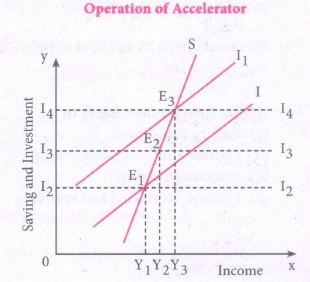
Explanation
(i) SS is the saving curve.
(ii) II is the investment curve.
(iii) At point E1 the economy is in equilibrium with OY1 income.
(iv) S and I are equal at O2.
(v) Now I increased from OI2 to OI4.
(vi) This increases income from OY1 to OY3 at E2 equilibrium.
(vii) If the increase in investment by I2I4 is purely exogenous, then the increase in income by Y1Y3 would be due to multiplier.
(viii) But in this diagram it is assumed that exogenous investment is only by I2I3 and induced investment is by I3I4.
(ix) Therefore, the increase in income by Y1Y2 is due to the multiplier effect and the increase in income by Y2Y3 is due to the accelerator effect.
8.
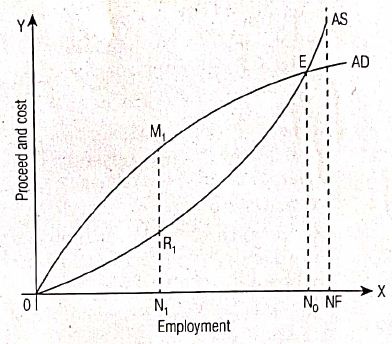
Introduction
Under the Keynes theory of employment, a simple two sector economy consisting of the household sector and the business sector is taken to understand the equilibrium between ADF and ASF.
Explanation
1. AD and AS reach equilibrium at E. The employment level is No
2. At ON1employment, the aggregate supply is N1R1. But the aggregate demand is M1N1.
3. The expected level of profit is M1R1.
4. To attain this level of profit, entrepreneurs will employ more labourers, till they reach point E i.e. ONo.
5. Beyond ONo, the aggregate demand curve is below the aggregate supply curve showing loss.
6. So they will never employ more than ONo labour.
7. The equilibrium level of employment need not be the full employment level (No).
8. The difference between No - N1 is the level of unemployment.
Conclusion
Thus the concept of effective demand becomes significant in explaining the under employment equilibrium.
9.
Introduction:
(i) Whatever is produced is either used for consumption or for saving. So, national output can be computed at any of three levels, ie., production, income and expenditure.
(ii) Therefore there are three methods to measure national income.
Product Method (inventory method):
(i) This method measures the output of the country. Gross value of output from different sectors like agriculture, industry, trade, commerce is obtained by the summation of all the values added in the productive process.
(ii) In India, the gross value of the farm output is obtained as follows:
(iii) Total production of 64 agriculture commodities is estimated. The output of each crop is measured by multiplying the area sown by the average yield per hectare.
(iv) Total output of each commodity is valued at market prices.
(v) The aggregate value of total output of these 64 commodities is taken to measure the gross value of agricultural output.
(vi) The net value of the agricultural output is measured by making deductions for the cost of seed, manures and fertilizers, market charges.
(vii) Net value of each sector is measured in this way.
(viii) Double counting should be avoided.
(ix) Value of output used for self consumption should be counted but sale and purchase of second hand durable goods should be excluded.
Income Method (Factor Earning Method):
(i) National income is calculated by adding up all the incomes generated while producing national product.
(ii) Enterprises are classified into industrial groups.
(iii) Factor incomes are grouped under labour income (wages, salaries, fringe benefits), capital income (profit, interest, dividend) and mixed income (farming, sole proprietorship).
\(\mathrm{Y}=\mathrm{w}+\mathrm{r}+\mathrm{i}+\pi+(\mathrm{R}-\mathrm{P})\)
(iv) Transfer payment, receipt from sale of second hand goods, windfall gains and corporate profit tax must not be included.
(v) Imputed value of rent for self occupied houses or offices and Imputed value of services provided by owners of production units are to be included.
Expenditure method (outlay method):
(i) The total expenditure incurred by the society in a particular year is added together.
(ii) It includes personal consumption expenditure (C), net domestic investment (I), Government expenditure on consumption (G) and net exports (X-M).
\(\mathrm{GNP}=\mathrm{C}+\mathrm{I}+\mathrm{G}+(\mathrm{X}-\mathrm{M})\)
(iii) Expenditure on second hand goods, purchase of shares and bonds, transfer payments and expenditure on intermediate goods should not be included.
Conclusion:
Output = Income = Expenditure
(i) This is because the three methods are circular in nature. So, if the 3 methods are done correctly this equation must hold.
10.
National Income:
(i) Measurement of national income and its composition by sectors are the basic aspects of macro economic analysis.
(ii) It gives a long term understanding of the growth process of an economy.
Inflation:
(i) Estimating the general price level based on wholesale price, index, consumer price.
Business Cycle:
(i) Cyclical movements can be studied based on aggregate economic variables.
Poverty and Unemployment:
(i) Clear understanding about the magnitude of poverty and unemployment helps allocation of resources and adapting corrective measures.
Economic Growth:
(i) The growth and development of an economy and the factors determining them could be understood only through macro analysis.
Economic Policies:
(i) Macro Economics is used to frame economic policies.
(ii) Economic policies are used to solve the basic problems, to overcome the obstacles and to achieve growth.

12th Standard Syllabus & Materials
12th Standard
TN 12th Computer Applications களப்பெயர் முறைமை (DNS) Sample Question Papers Study Material - QB365 Set A
NEW12th Standard
TN 12th Computer Applications வலையமைப்பு எடுத்துக்காட்டுகள் மற்றும் நெறிமுறைகள் Sample Question Papers Study Material - QB365 Set A
NEW12th Standard
TN 12th Computer Applications கணினி வலையமைப்பு ஓர் அறிமுகம் Sample Question Papers Study Material - QB365 Set A
NEW12th Standard
TN 12th Computer Applications PHP-உடன் MySQL-ஐ இணைத்தல் Sample Question Papers Study Material - QB365 Set A



Tamilnadu Stateboard 12th Standard Subjects

Maths

Chemistry

Physics

Biology

Computer Science

Business Maths and Statistics
Economics

Commerce

Accountancy

History

Computer Applications
Biology
Computer Technology
Computer Applications
Computer Science
Business Maths and Statistics
Commerce
Economics
Maths
Chemistry
Physics
Computer Technology
History
Accountancy

Tamil

English

French
Tamilnadu Stateboard Standards
