
 100% FREE ACCESS
12th Standard Syllabus & Materials
12th Standard
TN 12th Computer Applications மின்னணு தரவு பரிமாற்றம் Sample Question Papers Study Material - QB365 Set A
NEW12th Standard
TN 12th Computer Applications மின் - வணிக பாதுகாப்பு அமைப்புகள் Sample Question Papers Study Material - QB365 Set A
NEW12th Standard
TN 12th Computer Applications மின்னணு செலுத்தல் முறைகள் Sample Question Papers Study Material - QB365 Set A
NEW12th Standard
TN 12th Computer Applications மின் - வணிகம் Sample Question Papers Study Material - QB365 Set A
NEW12th Standard
TN 12th Computer Applications திறந்த மூல கருத்துருக்கள் Sample Question Papers Study Material - QB365 Set A
NEW12th Standard
TN 12th Computer Applications வலையமைப்பு வடமிடல் Sample Question Papers Study Material - QB365 Set A

Published on: 30/09/2020
12th Standard Economics English Medium Important 5 Mark Creative Questions (New Syllabus 2020)
Download Tamil Nadu 12th Standard Economics question papers, model tests, one-mark questions, important questions, and public exam papers in PDF format. Free study materials and answer keys for TN State Board students.
Questions + Answers key
Take MCQ Economics Test
1.
Compare and contrast RBI and other Commercial Banks.
2.
Differentiate the GATT with WTO by the help of a table
3.
Compare and contrast inflation and deflation.
4.
Discuss the state of FDI in India.
5.
Explain any 5 causes of water pollution.
6.
Explain the classification of public expenditure.
7.
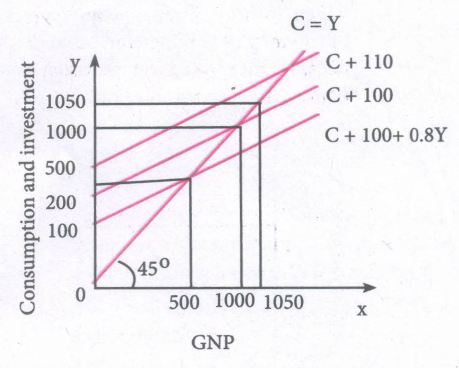
Explain Marginal propensity to consume and multiplier, with the help of a diagram.
8.
Discuss the Iimitations of National Income as an index of economic welfare.
9.
Draw the 7 pillars of NITI Aayog.
10.
List out all assumption of say's law of market?
11.
Explain the four sector circular flow model.
12.
Calculate the standard deviation from the following data by Actual Mean Method: 25, 15, 23, 42, 27, 25, 23, 25, and 20.
1.
| BASIS | RBI | COMMERCIAL BANK |
| Meaning | The bank which looks after the monetary system of the country is known as Central Bank. | The establishment, which provides banking services to the public is known as Commercial Bank. |
| Role | It is a banker to the banks and the government of the country | It is the banker to the citizens of the nation |
| Established by | Reserve Bank of India Act, 1934 | Banking Regulation Act, 1949. |
| Ownership | Public | Public or Private |
| Monetary Authority | It is the supreme monetary authority with wide powers | No such authority. |
| Objective | Public welfare and economic development. | Earning Profits |
| Money supply | Ultimate source of money supply in the economy. | No such function is performed by it. |
| Right to print and issue currency notes | Yes | No |
| Deals with | Banks and Governments | General Public |
| How many banks are there | Only one | Many |
2.
| BASIS FOR COMPARISON | GATT | WTO |
| Meaning | GATT can be described as a set of rules, multilateral trade agreement, that came into force, to encourage international trade and remove crosscountry trade barriers. | WTO is an international organization, that came into existence to oversee and liberalize trade between countries. |
| Institution | It does not have any institutional existence, but have a small secretariat. | It has permanent institution along with a secretariat. |
| Participant nations | Contracting parties | Members |
| Application | The rules of GATT are only for trade in goods. | The rules of WTO includes services and aspects of intellectual property along with the goods. |
| Agreement | Its agreement are originally multilateral, but plurilateral agreement are added to it later. | Its agreements are purely multilateral. |
| Domestic Legislation | Allowed to continue | Not allowed to continue |
| Dispute Settlement System | Slow and ineffective | Fast and effective |
3.
| BASIS FOR COMPARISON | INFLATION | DEFLATION |
| Meaning | When the value of money decreases in the international market, then this situation is termed as inflation. | Deflation is a situation, when the value of money increases in the international market. |
| Effects | Increase in the general price level | Decrease in the general price level |
| National income | Does not declines | Declines |
| Gold price | Falls | Rises |
| Classification | Demand pull inflation, cost push inflation and stagflation. |
Debt deflation, money supply side deflation, credit deflation. |
| Good for | Producers | Consumers |
| Consequences | Unequal distribution of income. |
Rise in the level of unemployment. |
| Which is Good | A little bit of inflation is a symbol of economic growth of the country. | Deflation is not good for an economy. |
4.
Introduction
(i) The early 1990s witnessed reforms in the economic policy. This helped to open up Indian markets to FDI
(ii) FDI in India has increased over the years
(iii) In India, FDI has been advantageous in terms of free flow of capital, improved technology, management expertise and access to international markets
The major sectors benefited from FDI in India are:
(i) financial sector (banking and nonbanking)
(ii) insurance
(iii) telecommunication
(iv) hospitality and tourism
(v) pharmaceuticals and
(vi) software and information technology
FDI is not permitted in the industrial sectors like
(i) Arms and ammunition
(ii) atomic energy,
(iii) railways,
(iv) coal and lignite and
(v) mining of iron, manganese, chrome, gypsum, sulphur, gold, diamonds, copper etc.,
Latest trend of FDI in India
i. FDI inflow in India has increased from $97 million in 1990-91 to $5,535 million in 2004-2005.
ii. It amounted to $32,955 million in 2011-2012.
iii. UNCTAD’s World Investment Report 2018 reveals that FDI to India declined to $40 billion in 2017 from $44 billion in 2016
5.
Causes of Water Pollution:
1. Discharge of sewage and waste water: Sewage, garbage and liquid waste of households, agricultural runoff and effluents from factories are discharged into lakes and rivers. These wastes contain harmful chemicals and toxins which make the water poisonous for aquatic animals and plants.
2. Dumping of solid wastes: The dumping of solid wastes and litters in water bodies cause huge problems.
3. Discharge of industrial sastes: Industrial waste contains pollutants like asbestos, lead, mercury, grease oil and petrochemicals, which are extremely harmful to both people and environment.
4. Oil Spill: Sea water gets polluted due to oil spilled from ships and tankers while travelling. The spilled oil does not dissolve in water and forms a thick sludge polluting the water.
5. Acid rain: Acid rain is pollution of water caused by air pollution. When the acidic particles caused by air pollution in the atmosphere mix with water vapor, it results in acid rain.
6.
Classification of public expenditure are as follows:
1. Classification on the Basis of Benefit:
(a) Public expenditure benefiting the entire society, e.g., the expenditure on general administration, defense, education, public health, transport.
(b) Public expenditure conferring a special benefit on certain people and at the same time common benefit on the entire community, e.g, administration of justice etc.
(c) Public expenditure directly benefiting particular group of persons and indirectly the entire society, e.g. social security, public welfare, pension, unemployment relief etc. (d) Public expenditure conferring a special benefit on some individuals, e.g., subsidy granted to a particular industry.
2. Classification on the Basis of Function:
(a) Protection Functions: This group includes public expenditure incurred on the security of the citizens, to protect from external invasion and internal disorder, e.g., defence, police, courts etc.
(b) Commercial Functions: This group includes public expenditure incurred on the development of trade and commerce, e.g., development of means of transport and communication etc.
7.
(i) The propensity to consume refers to the portion of income spent on consumption.
MPC = \(\frac{ΔC}{ΔY}\)
(K) = \(\frac{1}{1-MPC}\)
(ii) The multiplier is the reciprocal of one minus marginal propensity to consume.
(iii) Multiplier is 1/MPS
(iv) The multiplier is therefore define as reciprocal of MPS.
(v) Multiplier is inversely related to MPS and directly with MPC.
Numerically, if MPC is 0.75, MPS is 0.25 and K is 4.
Using formula K = \(\frac{1}{1-MPC}\)
⇒\(\frac{1}{1-0.75}\) = 1/0.25 = 4
∴ Multiplier (K) = 4
| MPC | MPS | K |
|---|---|---|
| 1.00 | 1.00 | 1 |
| 0.10 | 1.90 | 1.11 |
| 0.50 | 0.50 | 2.00 |
| 0.75 | 0.25 | 4.00 |
| 0.90 | 0.10 | 10.00 |
| 1.00 | 0.00 | ∝ |
C = 100 + 0.8Y;
I = 10
Y = C + I
= 100 + 0.8 Y +9p00
.JPG)
0.2Y = 1000
∴ Y = 1000
Here, C = 100 + 0.8y
= 100 + 1000 = 900
S = 100 = I
After I is raised by 10, now I = 110
Y = 100 + 0.8y + 110
0.2y = 210
y = \(\frac{210}{0.2}\) = 1050
Here, C = 100 = 0.8 (1050) = 940,
S = 110 = I
(i) It implies the variables in axis-and axis are equal.
(ii) The MPC is assumed to be at 0.8. (C = 100 + 0.8y)
(iii) The aggregate demand (C + I) curve intersects 45° line at point E.
(iv) The new aggregate demand curve is
C + I = 100 + 0.8Y + 100 + 10
Y = \(\frac{210}{0.2}\)
C = 940; S = 110 = Z
8.
(i) The economic welfare depends upon the composition of a goods and services provided.
(ii) Higher GDP with greater environmental hazards such as air, water and soil pollution will be little economic welfare.
(iii) The production of war goods will show the increase in national output but not welfare.
(iv) An increase in per capita income may be due to. employment of women and children Dr forcing workers to. work for long hours. But it will not promote economic welfare.
(v) Therefore the physical quality of life index (PQLI) is considered a better indicator of economic welfare.
9.
7 pillars of effective governance:
NITI AAYOG
| Pro-People | Fulfills aspirations of society as well as individuals |
| Pro-Activity | in anticipation response to citizen needs |
| Participation | involvement of citizenry |
| Empowering | Women in all aspects |
| Inclusion of all | SC, ST, OBC, minorities, gareeb, gaon, kisaan |
| Equality | of opportunity for the youth |
| Transparency | making government visible and responsive. |
10.
Assumption of the Say's law of market:
(i) No single buyer (or) seller of commodity or an input can affect price.
(ii) Full employment.
(iii) People are motivated by self interest and self-interest determines economic decisions.
(iv) The laissez fair policy is essential for an automatic and self adjusting process full employment.
(v) There will be a perfect competition.
(vi) There is wage - price flexibility.
(vii) Money acts only as a medium of exchange.
(viii) Long run analysis.
(ix) There is no possibility for over production or unemployment.
(x) Unutilized resources used until reaches full employment.
(xi) No Government intervention automatic Price adjustment mechanism operated.
11.
(1) Circular flow of income in a four sector economy.
(2) In a four sector economy. in addition to household, firms and government, a fourth sector namely, external sector is included.
(3) In real life, only four-sector economy is exists.
(4) This model is composed of four sectors namely.
(i) Households
(ii) Firms
(iii) Government
(iv) External
(5) The external sector comprises exports and imports.
(6) It is illustrated in the flow chart.
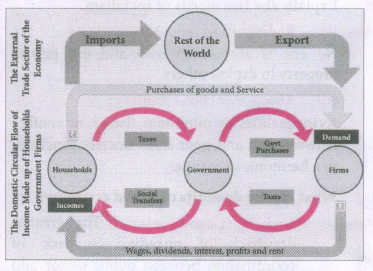
(7) In four sector economy, expenditure for the entire economy include domestic expenditure.
(C + I + G) and net exports (X-M)
(8) Therefore four sector model expressed as
y = C + I + G + (X-M)
12.
Deviations from actual mean.
| S.No | X | (x-x) | (x-\(\bar { x } \))2 |
| 1 | 25 | 25-25=0 | 0 |
| 2 | 15 | 15-25=10 | 100 |
| 3 | 23 | 23-25=-2 | 1 |
| 4 | 42 | 42-25=17 | 289 |
| 5 | 27 | 27-25=2 | 4 |
| 6 | 25 | 25-25=0 | 0 |
| 7 | 23 | 23-25=-2 | 4 |
| 8 | 25 | 25-25=0 | 0 |
| 9 | 20 | 20-25=-5 | 25 |
| N-9 | 225 | 0 | 126 |
\(\bar { X } =\frac { 225 }{ 9 } =25\)
\(\sigma =\sqrt { \frac { { \sum { (x-\bar { X } ) } }^{ 2 } }{ N } } \)
\(=\sqrt { \frac { 426 }{ 9 } } \)
\(=\sqrt { 47.33 } \)
\(\sigma =6.88\)

12th Standard Syllabus & Materials
12th Standard
TN 12th Computer Applications களப்பெயர் முறைமை (DNS) Sample Question Papers Study Material - QB365 Set A
NEW12th Standard
TN 12th Computer Applications வலையமைப்பு எடுத்துக்காட்டுகள் மற்றும் நெறிமுறைகள் Sample Question Papers Study Material - QB365 Set A
NEW12th Standard
TN 12th Computer Applications கணினி வலையமைப்பு ஓர் அறிமுகம் Sample Question Papers Study Material - QB365 Set A
NEW12th Standard
TN 12th Computer Applications PHP-உடன் MySQL-ஐ இணைத்தல் Sample Question Papers Study Material - QB365 Set A



Tamilnadu Stateboard 12th Standard Subjects

Maths

Chemistry

Physics

Biology

Computer Science

Business Maths and Statistics
Economics

Commerce

Accountancy

History

Computer Applications
Biology
Computer Technology
Computer Applications
Computer Science
Business Maths and Statistics
Commerce
Economics
Maths
Chemistry
Physics
Computer Technology
History
Accountancy

Tamil

English

French
Tamilnadu Stateboard Standards
