
 100% FREE ACCESS
12th Standard Syllabus & Materials
12th Standard
TN 12th Computer Applications மின்னணு தரவு பரிமாற்றம் Sample Question Papers Study Material - QB365 Set A
NEW12th Standard
TN 12th Computer Applications மின் - வணிக பாதுகாப்பு அமைப்புகள் Sample Question Papers Study Material - QB365 Set A
NEW12th Standard
TN 12th Computer Applications மின்னணு செலுத்தல் முறைகள் Sample Question Papers Study Material - QB365 Set A
NEW12th Standard
TN 12th Computer Applications மின் - வணிகம் Sample Question Papers Study Material - QB365 Set A
NEW12th Standard
TN 12th Computer Applications திறந்த மூல கருத்துருக்கள் Sample Question Papers Study Material - QB365 Set A
NEW12th Standard
TN 12th Computer Applications வலையமைப்பு வடமிடல் Sample Question Papers Study Material - QB365 Set A

Published on: 31/12/2022
QB365 provides a detailed and simple solution for every Possible Questions in Class 12 Economics Subject - Important 5 Mark English Medium. It will help Students to get more practice questions, Students can Practice these question papers in addition to score best marks.
Download Tamil Nadu 12th Standard Economics question papers, model tests, one-mark questions, important questions, and public exam papers in PDF format. Free study materials and answer keys for TN State Board students.
Questions + Answers key
Take MCQ Economics Test
1.
Explain the effects and remedial measures to control water pollution.
2.
numerate the factors are taken into account while preparing the budget
3.
Write the History, Administration and Brief Functions of RBI.
4.
Explain in detail about the facilities offered by IMF to its member nations?
5.
Explain the evolution of money.
6.
Discuss the concept of “Factor Cost”.
7.
Derive the value of the multiplier assuming the basic form of the consumption function as C = a + bY where "a" is autonomous consumption and "b" is the marginal propensity to consume. You may assume a two-sector economy.
8.
Explain the four sector model of economy with chart.
9.
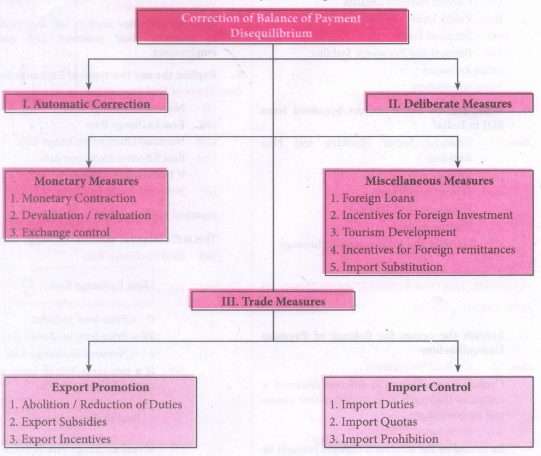
Draw the flow chart for correction of Balance Payment Disequilibrium
10.
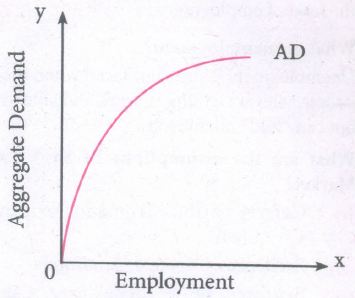
Draw the diagram ADF.
11.
Describe the application of Econometrics in Economics.
12.
Elucidatethe nature and scope of Statistics.
13.
Bring out the arguments against planning.
14.
Discuss the economic determinants of economic development.
15.
16.
Explain the principles of Federal Finance.
17.
Discuss the role of WTO in India’s socio-economic development.
18.
Explain the objectives of IMF.
19.
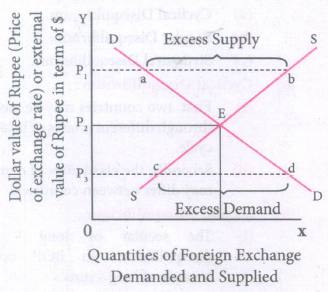
How the Rate of Exchange is determined? Illustrate.
20.
21.
Describe the functions of Reserve Bank of India.
22.
What are the causes and effects of inflation on the economy?
23.
Explain the functions of money
24.
Explain the operation of the Accelerator.
25.
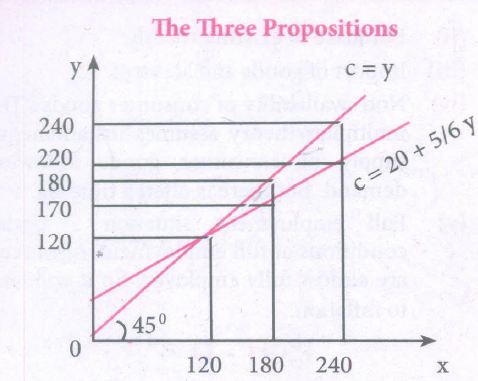
Explain Keynes psychological law of consumption function with diagram.
26.
Describe the types of unemployment.
27.
28.
Compare the features among Capitalism, Secularism and Mixedism
29.
1.
Introduction:
(i) Water pollution adversely affects the health and life of man, animals and plants alike.
(ii) Polluted water is harmful for agriculture as it affects crops and soil fertility. Pollution of sea water damages the ocean life.
(iii) Many water bodies near urban areas are highly polluted.
Death of aquatic animals:
(i) Pollution kills organisms that depend on water bodies.
(ii) Dead fish, crabs, birds and sea gulls, dolphins lie dead on beaches, killed by pollutants.
Disruption of food-chains:
(i) Pollutants like lead and cadmium are eaten by tiny animals.
(ii) These animals are consumed by fish and the food chain continues disrupted at all higher levels.
Diseases:
(i) The discharge of untreated and under-treated effluent causes severe ecological degradation.
(ii) Open defecation, solid waste dumping, discharge of drainage water are responsible for pathogenic bacteria water-borne diseases like Hepatitis-A, Typhoid, Malaria, Dysentery, Jaundice, Dengue fever, Viral fever, Worm infections.
Destruction of Bcosystem:
(i) Ecosystem is severcly destroyed by water pollution.
(ii) Many areas are now being affected by careless human pollution, and this pollution is coming back to hurt humans in many ways.
Remedial measures to control Water Pollution:
1) Comprehensive water management plan.
2) Construction of proper storm drains and settling ponds.
3) Maintenance of drain line.
4) Effluent and sewage treatment plant.
5) Regular monitoring of water and waste water.
6) Stringent actions towards illegal dumping of waste into the water bodies.
2.
(i) The macro economic targets to be achieved within a plan period;
(ii) The basic strategy of the budget;
(iii) The financial requirements of different projects;
(iv) Estimates of the revenue expenditures (includes defence expenditure, subsidy, interest payment on debt etc.);
(v) Estimates of the capital expenditures (includes development of railways, roadways, irrigations etc.);
(vi) Estimates of revenue receipts from tax and non-tax revenues;
(vii) Estimates of capital receipts from the recovery of loans, disinvestment of public sector units, market borrowings etc.
(viii) Estimates of the gap between revenue receipts and revenue expenditure; and
(ix) Estimates of fiscal deficit, primary deficit, and revenue deficit.
(x) Finance commission is a quasi-judicial body set up under Article 280 of the Indian Constitution. It was established in the year 1951, to define the fiscal relationship framework between the Centre and the state.
3.
History:
(i) Formed on April 1, 1935 in accordance with the RBI Act, 1934
(ii) Nationalized on January 1, 1949 (Fully owned by GOI)
(iii) Headquarter moved from Calcutta to Mumbai in 1937
(iv) Osborne Smith was the first Governor of RBI
Administration:
(i) It is the Central Bank/ Regulator for all bank in India
(ii) Also called “Lender of Last Resort”
(iii) Governors and 4 Deputy Governors along with a central board of directors appointed by the GOI.
Functions:
(i) Issues currency
(ii) Banker to the government. {It collects receipts of funds and makes payments on behalf of the government}
(iv) Regulator of Indian Banking system
(v) Custodian of Forex
(vi) Controller of credit
4.
(i) Basic Credit Facility:
The IMF provides financial assistance to its member nations to overcome their temporary difficulties relating to balance of payments. A member nation can The IMF provides financial assistance to its member nations to overcome their temporary difficulties relating to balance of payments. A member nation can purchase from the Fund other currencies or SDRs, in exchange for its own currency, to finance payment deficits. from the Fund other currencies or SDRs, in exchange for its own currency, to finance payment deficits.
(ii) Extended Fund Facility
Under this arrangement, the IMF provides additional borrowing facility up to 140% of the member’s quota, over and above the basic credit facility.
(iii) Compensatory Financing Facility
IMF established compensatory financing facility to provide additional financial assistance to the member countries, particularly primary producing countries facing shortfall in export earnings.
(iv) Buffer Stock Facility
The purpose of this scheme was to help the primary goods (food grains) producing countries to finance contributions to buffer stock arrangements for the stabilisation of primary product prices.
(v) Supplementary Financing Facility
Under the supplementary financing facility, the IMF makes temporary arrangements to provide supplementary financial assistance to member countries facing payments problems relating to their present quota sizes.
(vi) Structural Adjustment Facility
The purpose of Structural Adjustment Facility (SAF) and Enhanced Structural Adjustment Facility (ESAF) is to force the poor countries to undertake strong macroeconomic and structural programmes to improve their balance of payments positions and promote economic growth.
5.
BARTER SYSTEM
(i) Exchange of goods for goods was known as “Barter Exchange” or “Barter System”.
(ii) In a barter system, the commodities and services were directly exchanged for other commodities and services.
(iii) Goods like furs, skins, salt, rice, wheat, utensils, weapons, etc. were commonly used as money.
METALLIC MONEY
(i) Under metallic standard, some kind of metal either gold or silver is used to determine the standard value of the money and currency.
(ii) Standard coins made out of the metal are the principal coins used under the metallic standard.
(iii) These standard coins are full bodied or full weighted legal tender. Their face value is equal to their intrinsic metal value.
GOLD STANDARD
(i) Gold Standard is a system in which the value of the monetary unit or the standard currency is directly linked with gold.
(ii) The monetary unit is defined in terms of a certain weight of gold.
SILVER STANDARD
(i) The silver standard is a monetary system in which the standard economic unit of account is a fixed weight of silver.
(ii) The silver standard is a monetary arrangement in which a country’s Government allows conversion of its currency into fixed amount of silver.
PAPER CURRENCY
The paper currency standard refers to the monetary system in which the paper currency notes issued by the Treasury or the Central Bank or both circulate as unlimited legal tender.
PLASTIC MONEY
(i) The latest type of money is plastic money.
(ii) Plastic money is a term that is used predominantly in reference to the hard plastic cards used every day in place of actual bank notes.
(iii) Plastic money can come in many different forms such as Cash cards, Credit cards, Debit cards, Pre-paid Cash cards, Store cards, Forex cards and Smart cards.
CRYPTO CURRENCIES
Decentralised crypto currencies such as Bitcoin now provide an outlet for Personal Wealth that is beyond restriction and confiscation.
6.
1. There are a number of inputs that are included into a production process when producing goods and services. These inputs are commonly known as factors of production and include things such as land, labour, capital and entrepreneurship.
2. Producers of goods and services incur a cost for using these factors of production. These costs are ultimately added onto the price of the product.
3. The factor cost refer to the cost of production that is incurred by a firm when producing goods and services.
4. Examples of such production costs include the cost of renting machines, purchasing machinery and land, paying salaries and wages, cost of obtaining capital, and the profit margins that are added by the entrepreneur.
5. The factor cost does not include the taxes that are paid to the government since taxes are not directly involved in the production process and, therefore, are not part of the direct production cost.
6. However, subsidies received are included in the factor cost as subsidies are direct inputs into the production.
7.
Since Y = C + I we can write Y = a + bY + I.
This equation can be rearranged to yield
Y - bY = a + I
Y(1 - b) = a + I
We can then solve for Y in terms of I by dividing through by (1 - b):
Y = (a + I) (1/1 - b)
Now we can see that an increase in I will increase Y by
ΔY = ΔI x (1/1 - b)
Since b D MPC, the expression becomes
ΔY = ΔI x 1/(1 - MPC)
Therefore, the multiplier is 1/1 - MPC or 1/MPS.
8.
(i) In a four-sector economy, in addition households, firms and government, a fourth sector namely, external sector is included.
(ii) In the real life, only four-sector economy exists. This model is composed of four sectors namely,
1. Households
2. Firms
3. Government
4. External Sector
The external sector comprises exports and imports. It is illustrated in the Flow Chart
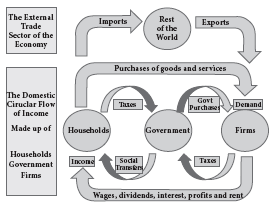
In four-sector economy, expenditure for the entire economy include domestic expenditure (C + I + G) and net exports (X - M). Therefore,
Y = C + I + G + (X - M)
9.
10.
11.
Econometrics is the statistical and mathematical analysis of economic relationships, often serving as a basis for economic forecasting. It is used by economists to study relationships between economic variables Econometrics is interesting because it provides the tools to enable us to extract useful information about important economic policy issues from the available data. It is used to understand economic issues and test theories. Without evidence economic theories are abstract and has no bearing on reality. Econometrics is a set of tools we can use to confront theory with real world data. A study' could estimate a key parameter such as the price elasticity of demand for it or econometric techniques could be used to generate forecasts. It is used to develop, estimate and evaluate models which relate economic or financial variables.
12.
Nature of Statistics
(i) Different Statisticians and Economists differ in views about the nature of statistics.
(ii) Some call it a science and some say it is an art
(iii) Tippet considers Statistics both as a science as well as an art.
Scope of statistics
(i) Statistics is applied in every sphere of human activity social and physical.
Statistics and Economics
(i) Statistical data and techniques are immensely useful in solving many economic problems.
Statistics and Firms
(i) Statistics is used in many firms to find whether the product is conforming to specifications or not.
Statistics and Commerce
(i) Market survey helps to find the present conditions and to forecast the likely changes in future.
Statistics and Education
- Statistics is necessary for the formulation of policies to start new course.
- Public and private educational institutions do research and development work to test the past knowledge and evolving knowledge.
Statistics and Planning
(i) In the modern world, a "world of planning" almost all the organisations in the government are using planning for efficient working, for the formulation of policy decisions and execution of the same.
(ii) In India, statistics play an important role in planning both at the central and the state government levels, but the quality of data is highly unscientific.
Statistics and Medicine
(i) t-test is used to compare the efficiency of two medicines.
Statistics and Modern applications
(i) Recent developments in computer and information technology have enabled statistics to integrate their models and thus make statistics a part of decision making procedures of many organisations.
(ii) There are many software packages available for solving simulation problems.
13.
Introduction:
(i) Planning may retard private initiatives, hamper freedom of choice, involve huge cost of administration and stop automatic adjustment of price mechanism.
(i) Loss of freedom
1. Regulations and restrictions are the backbone of a planned economy.
2. Economic freedom consists of freedom of consumption, freedom of choice of occupation, freedom to produce and the freedom to fix prices for the products.
3. Under planning, crucial decisions are made by the Central Planning Authority.
4. The consumers, producers and the workers enjoy no freedom of choice.
5. Hayek in his book 'Road to Serfdom' explains that centralized planning leads to loss of personal freedom and ends in economic stagnation.
(ii) Elimination of Initiative
1. Planning follows routine proocedure and may cause stagnation in growth.
2. Absence of private ownership and profit discourages entrepreneurs from risk taking.
3. Attractive profit is the incentive for searching new ideas, new methods.
4. All enjoy equal reward under planned economy irrespective of their effort, efficiency.
5. So, nobody is interested in undertaking new and risky ventures.
6. The bureaucracy and red tapism cause procedural delay and time loss.
7. So, even socialist countries like Russia and China offer incentives to private firms.
(iii) High cost of Management
1. Plan formulation and implementation involve an army of staff for data collection and administration.
2. Lewis remarks, "The better we try to plan, the more planners we need".
3. Inadequate data, faulty estimations and improper implementation of plans result in wastage of resources and cause either surplus or shortages.
(iv) Difficulty in advance
calculations
1. Advance calculations in a precise manner is impossible with regard to consumption and production.
2. It is also difficult to put the calculations into practice under planning.
Conclusion
1. The arguments against planning are mostly concerned with centralized and totalitarian planning.
14.
Natural Resource:
(i) The existence of natural resources in abundance is essential for development.
(ii) But Japan, though it lacks natural resources imports them and achieves faster rate of economic development with the help of technology.
Capital Formation:
(i) Capital formation refers to the net addition to the existing stock of capital goods which are either tangible (plants, machinery) or intangible (health, education).
(ii) Capital formation helps increase productivity of labour, production and income.
(iii) Advanced techniques of production can be used and leads to better utilization of natural resources, industrialization and expansion of markets which are essential for economic progress.
Size of the Market:
(i) Large size of the market would stimulate production, increase employment and raise the National per capita income.
Structural Change:
(ii) Structural change refers to change in the occupational structure of the economy.
(iii) Any economy is divided into primary secondary and tertiary sector.
(iv) Any economy which is predominantly agricultural remains backward.
Financial System:
(i) Financial system implies the existence of an efficient and organized banking system in the country.
(ii) There should be an organized money market to facilitate easy availability of capital.
Marketable Surplus:
(i) It refers to the total amount of farm output cultivated by farmers over and above their family consumption needs.
(ii) This surplus brings income, raises purchasing power, employment and output in other sectors.
Foreign Trade:
(i) A country with favorable balance of trade is always developed.
Economic System:
(i) A country with free market system enjoys better growth rate compared to controlled economies.
15.
16.
Principle of Independence
(i) A Government should be autonomous and free about the internal financial matters concerned.
(ii) Each Government should have separate sources of revenue, authority to levy taxes, to borrow money and to meet the expenditure.
Principle of Equity
(i) The resources should be distributed among the different states so that each state receives a fair share of revenue.
Principle of Uniformity
(i) Each state should contribute equal tax payments for federal finance.
Principle of Adequacy of Resources
(i) The resources of each Government should be adequate to carry out its functions effectively to meet current and future needs.
(ii) Resources should be elastic to meet the growing needs and unforeseen expenditure.
Principle of Fiscal Access
(i) The Central and State Governments must be able to develop new source of revenue.
Principle of Integration and coordination
(i) There should be perfect coordination among different layers of the financial system.
Principle of Efficiency
(i) The financial system should be well organized and efficiently administered.
(ii) There should be no scope for evasion and fraud.
(iii) Double taxation should be avoided.
Principle of Administrative
Economy
(i) The cost of collection should be at the minimum level and the major portion of revenue should be made available for the other expenditure outlays of the Governments.
Principle of Accountability
(i) Each Government should be accountable to its own legislature for its financial decisions.
17.
Introduction:
1. India is the founding member of the WTO.
2. India favours multilateral trade approach and enjoys MFN status.
3. India benefited from WTO on following grounds:
4. By reducing tariff rates on raw materials, components and capital goods, it was able to import more for meeting her developmental needs.
5. India's imports go on increasing.
6. India gets market access in several countries without any bilateral trade agreements.
7. Advanced technology has been obtained at cheaper cost.
8. India is in a better position to get quick redressal from the trade disputes.
9. Indian exporters benefited from wider market information.
18.
(i) To promote international monetary cooperation among the member nations.
(ii) To facilitate faster and balanced growth of international trade.
(iii) To ensure exchange rate stability by curbing competitive exchange depreciations.
(iv) To reduce exchange controls imposed by member nations.
(v) To establish multilateral trade and payment system in respect of current transactions.
(vi) To promote the flow of capital from developed to developing nations.
(vii) To solve the problem of international liquidity.
19.
(i) The equilibrium rate of exchange is determined in the foreign exchange market according to the general theory of value, by the interaction of demand and supply,
(ii) Y axis represents exchange rate, be cos value of rupee in terms of dollars
(iii) X axis represents demand and supply of forex.
(iv) E is the equilibrium point where DD intersects SS. The exchange rate is P2.
20.
21.
Introduction
(i) The Reserve Bank of India is India's central banking institution
(ii) It commenced its operations on 1 April 1935 and it was nationalised on 1 Jan, $1949 .$
1) Monetary Authority
(i) It controls the supply of money in the economy to stabilize exchange rate, maintain healthy balance of payment, attain financial stability, control inflation, strengthen banking system.
2) Issuer of currency
(i) It is the sole authority to issue currency
(ii) It also takes action to control the circulation of fake currency.
3) Issuer of Banking License
(i) Every bank has to obtain a banking license from RBI to conduct banking business in India.
4) Banker to the Government
(i) It is the banker to the central and the state governments.
(ii) It provides short term credit, manages all need issues of government loans, services the government debt outstanding
(iii) It advises the government on banking and financial matters.
5) Banker's Bank
(i) It is the bank of all banks in India as it provides loan to banks, accepts the deposit of banks and rediscounts the bills of banks.
6) Lender of last resort
(i) The banks can borrow from RBI by keeping eligible securities as collateral at the time of need when there is no other source.
7) Act as clearing house
(i) For settlement of banking transactions, RBI manages 14 clearing houses.
(ii) It facilitates the exchange of instruments and processing of payment instructions.
8) Custodian of foreign exchange reserves
(i) It administers and enforces the provision of Foreign Exchange Management Acr, 1999.
(ii) RBI buys and sells foreign currency to maintain the exchange rate of Indian rupee vs foreign currencies.
9) Regulator of Economy
(i) It controls the money supply in the system, monitors GDP, Inflation
10) Managing Government securities
(i) RBI administers investments in institutions when they invest specified minimum proportions of their total assets/liabilities in government securities.
11) Regulator and Supervisor of Payment and Settlement Systems
(i) RBI oversees the payment and settlement systems in the country.
(ii) It focuses on the development and functioning of safe, secure and efficient payment and settlement mechanisms.
12) Developmental Role
(i) It develops the quality of banking system in India and ensures that credit is available to the productive sectors of the economy.
(ii) It provides a wide range of promotional functions to support national objectives.
(iii) It establishes institutions which build the financial infrastructure.
(iv) It also helps in expanding access to affordable financial services and promotes financial education and literacy.
13) Publisher of monetary data
(i) It maintains and provides all essential bánking and other economic "data, formulating and critically evaluating the economic policies in India.
(ii) RBI collects, collates and publishes data regularly.
14) Exchange manager and controller
(i) RBI represents India as a member of the International Monetary Fund.
(ii) Most of thé commercial banks are authorized dealers of RBI.
15) Banking Ombudsman Scheme
(i) RBI introduced this Scheme in 1995
(ii) Those who have complaints including online, can appeal to the Ombudsman against the awards and the other decisions of the Banks.
16) Banking Codes and Standards Board of India
(i) To measure the performance of banks against Codes and Standards based on established global practices, the RBI has set up the Banking Codes and Standards Board of India.
22.
Causes:
Increase in Money Supply:
1. Increase in money supply leads to increase in aggregate demand.
2. The higher the growth rate of nominal money supply, the higher is the rate of inflation.
Increase in Disposable Income:
1. When disposable income increases, it raises their demand for goods and services.
2. Disposable income may increase with the rise in national income or reduction in taxes or saving of the people.
Increase in Public Expenditure:
1. Government activities have been expanding due to developmental activities and social welfare programmes.
2. This is also a cause for price rise.
Increase in Consumer Spending:
1. The demand for goods and services increases when they are given credit to buy goods on hire-purchase and instalment basis.
Cheap Monetary Policy:
1. Cheap monetary policy leads to increase in the money supply which raises demand for goods and services.
Deficit Financing:
1. To meet the expenses, government resorts to deficit financing by borrowing from the public and even by printing more notes.
2. This raises aggregate demand leading to inflation.
Black Assets, Activities and Money:
1. It leads to corruption, tax evasion.
2. People spend black money lavishly.
3. Black marketing and hoarding reduces the supply of goods and increases.
Repayment of Public Debt:
1. Whenever government repays its past internal debt to the public, money supply increases.
Increase in Exports:
1. When exports are encouraged, domestic supply of goods decline, prices rise.
Effects:
On Production:
1. When inflation is very moderate it is an incentive to traders and producers.
2. When profit increases the business men increase their investments in production leading to more employment and income.
3. Hyper inflation leads to depreciation of the value of money and discourages savings.
4. It may even drain out the foreign capital already invested in the country.
5. The reduced capital accumulation, discourage entrepreneurs and business men from taking business risk.
6. Inflation also leads to hoarding of essential goods by traders and consumers leading to still higher inflation rate.
7. Encourages investment in speculative activities rather than productive purposes.
On Distribution:
Debtors and Creditors:
1. During inflation debtors are the gainers.
2. Debtors had borrowed when the purchasing power of money was high and now repay the loans when the purchasing power of money is low due to rising prices.
Fixed-income Groups:
1. They are worst hit because their incomes being fixed has no relationship with the rising cost of living.
Entrepreneurs:
1. Inflation is a boon to manufacturers, traders, merchants, businessmen, because it serves as a tonic for business enterprise.
2. They get windfall gains as the prices of their stocks suddenly go up.
Investors:
1. Those who invest in fixed interest yielding bonds and securities lose during inflation.
2. Those who invest in shares stand to gain by rich dividends and appreciation in value of shares.
23.
(i) Primary Functions:
Medium of exchange:
(i) Money has general acceptability and all exchanges take place in terms of money.
(ii) First, money is got through sale of goods or services.
(iii) Later, money is used to buy goods and services.
(iv) Thus, in the modern exchange system money acts as the intermediary in sales and purchases.
Measure of value
(i) Money measures the value of goods and services.
(ii) Prices of all goods and services are expressed in terms of money.
(iii) Since all the values are expressed in terms of money, it is easier to determine the rate of exchange between various types of goods in the community.
(ii) Secondary Functions:
Store of value:
(i) Savings is done in terms of money.
(ii) Money is a store of wealth, as it can be easily converted into other marketable assets such as land, machinery, plant.
Standard of Deferred Payments:
(i) Borrowing and lending is done in money.
Means of Transferring Purchasing Power:
(i) The field of exchange went on extending with growing economic development.
(ii) The exchange of goods is now. extended to distant lands.
(iii) So it is necessary to transfer purchasing power from one place to another.
(iii) Contingent Functions:
Basis of the Credit System:
(i) Business transactions are either in cash or on credit.
(ii) A depositor uses cheques only when there are sufficient funds in his account.
(iii) The commercial banks create credit on the basis of adequate cash reserves.
(iv) Money is at the back of all credit.
Money facilitates distribution of National Income:
(i) Money is used in the distribution of income as rent, wage, interest and profit.
Equalize Marginal Utilities and Marginal Productivities:
(i) Consumer gets maximum utility only if he incurs expenditure on various commodities in such a manner as to equalize marginal utilities accruing from them.
(ii) Here, money plays an important role, because the prices of all commodities are expressed in money.
(iii) Money helps to equalize marginal productivities of various factors of production.
Increases Productivity of Capital:
(i) Money is the most liquid form of capital.
(ii) It can be put to any use.
(iii) So it can be transferred from the less productive to the more productive uses.
(iv) Other Functions:
Maintains Repayment Capacity:
(i) Money has general acceptability.
(ii) To maintain its repayment capacity, every firm has to keep assets in the form of money.
(iii) Firms, banks, insurance companies and governments have to keep some liquid money (i.e., cash) to maintain their repayment capacity.
Represents Generalized
Purchasing Power:
(i) Purchasing power kept in terms of money can be put to any use.
Gives liquidity to Capital:
(i) Money is the most liquid form of capital & so can be put to any use.
24.
Introduction
A systematic development of the simple accelerator model was made by J.M.Clark, It was further developed by Hicks, Samuelson and Harrod.
Definition
Accelerator coefficient is the ratio between induced investment and an initial change in consumption \(\beta=\frac{\Delta \mathrm{I}}{\Delta \mathrm{C}}\)
Operation
Suppose that in order to produce 1000 consumer goods, 100 machines are needed. Working life of a machine is 10 yrs i.e, every year 10 machines have to be replaced. This is called replacement demand
(i) Suppose that demand for consumer goods rises by 10 % (i.e, from 1000 to 1100)
(ii) This results in increase in demand for 10 more machines
(iii) The total demand for machines is 20 i.e, 10 % increase in demand for consumer goods causes 100 % increase in demand for machine (from 10 to 20 )
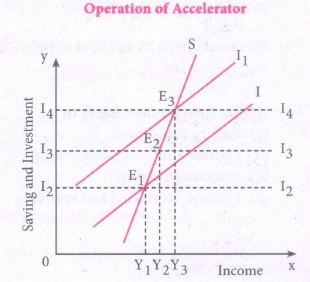
Explanation
(i) SS is the saving curve.
(ii) II is the investment curve.
(iii) At point E1 the economy is in equilibrium with OY1 income.
(iv) S and I are equal at O2.
(v) Now I increased from OI2 to OI4.
(vi) This increases income from OY1 to OY3 at E2 equilibrium.
(vii) If the increase in investment by I2I4 is purely exogenous, then the increase in income by Y1Y3 would be due to multiplier.
(viii) But in this diagram it is assumed that exogenous investment is only by I2I3 and induced investment is by I3I4.
(ix) Therefore, the increase in income by Y1Y2 is due to the multiplier effect and the increase in income by Y2Y3 is due to the accelerator effect.
25.
Law
According to Keynes, "men are disposed as a rule and on the average to increase their consumption as their income increases but not by as much as the increáse in their income".
Propositions
1. When income increases, consumption expenditure also increases, but by a smaller amount
(a) When income increases from 120 to 180; consumption also increases from 120 to 170 but the increase in consumption is less than the increase in income, 10 is saved.
2. The increased income will be divided in some proportion between consumption expenditure and saving
(a) When income increases to 180 and 240, it is divided between consumption (170 and 220) and saving (10 and 20)
3. Incrcascs in income always lead to in incrcase in both consumption and saving
(a) Increases in income to 180) and 240; lead to increased consumption 170 and 220; increased saving 10 and 20.
(b) It is clear from the widening area below the C curve and the saving gap between 45o line and C curve.
| Y | C | S |
|---|---|---|
| 120 | 120 | 0 |
| 180 | 170 | 10 |
| 240 | 220 | 20 |
26.
Cyclical unemployment:
(i) During the downturn phase (recession and depression) of trade cycle, income and output fall leading to cyclical unemployment.
(ii) It is caused by deficiency of effective demand
Structural unemployment:
(i) Unemployment due to massive and deep rooted changes in economic structure leads to structural unemployment.
(ii) Lack of demand for the product or shift in demand to other products cause this type of unemployment.
(iii) (e.g.) rise in demand for mobile phones has adversely affected the demand for cameras, tape recorders
Disguised unemployment:
(i) It occurs in agriculture when more people are there than required. Even if some workers are withdrawn, production does not suffer.
Actual marginal productivity is zero, less or negative.
(i) Seasonal unemployment
1. In agriculture and agro based industries like sugar, production activities are carried out only in some seasons.
2. These industries offer employment only during that season in a year.
3. People remain unemployed during the off season.
4. Seasonal unemployment takes place from demand side also (eg) ice cream industry, holiday resorts
(ii) Frictional unemployment (Temporary unemployment)
1. It arises due to imbalance between supply of labour and demand for labour.
2. It is because of immobility of labour, lack of necessary skills, break down of machinery, shortage of raw materials.
3. The persons who lose jobs and in search of jobs also come under frictional unemployment
(iii) Educated unemployment
1. Educated people are underemployed or unemployed when qualification does not match the job.
2. Faulty education system, lack of employable skills, mass student turnout and preference for white collar jobs are highly responsible for educated unemployment.
27.
28.
| S.No | Features | Capitalism | Socialism | Mixedism |
|---|---|---|---|---|
| 1. | Ownership of Means of Production | Private Ownership | Public Ownership | Private Ownership and Public Ownership |
| 2. | Economic Motive | Profit | Social Welfare | Social Welfare and Profit Motive |
| 3. | Solution of Central Problems | Free Market System | Central Planning System | Central Planning System and Free Market System |
| 4. | Government Role | Internal Regulation only | Complete Involvement | Limited Role |
| 5. | Income Distribution | Unequal | Equal | Less unequal |
| 6. | Nature of Enterprise | Private Enterprise | Government Enterprise | Both Private and State Enterprises |
| 7. | Economic Freedom | Complete Freedom | Lack of Freedom | Limited Freedom |
| 8 | Major Problem | Inequally | Inefficiency | Inequality and Inefficiency |
29.

12th Standard Syllabus & Materials
12th Standard
TN 12th Computer Applications களப்பெயர் முறைமை (DNS) Sample Question Papers Study Material - QB365 Set A
NEW12th Standard
TN 12th Computer Applications வலையமைப்பு எடுத்துக்காட்டுகள் மற்றும் நெறிமுறைகள் Sample Question Papers Study Material - QB365 Set A
NEW12th Standard
TN 12th Computer Applications கணினி வலையமைப்பு ஓர் அறிமுகம் Sample Question Papers Study Material - QB365 Set A
NEW12th Standard
TN 12th Computer Applications PHP-உடன் MySQL-ஐ இணைத்தல் Sample Question Papers Study Material - QB365 Set A



Tamilnadu Stateboard 12th Standard Subjects

Maths

Chemistry

Physics

Biology

Computer Science

Business Maths and Statistics
Economics

Commerce

Accountancy

History

Computer Applications
Biology
Computer Technology
Computer Applications
Computer Science
Business Maths and Statistics
Commerce
Economics
Maths
Chemistry
Physics
Computer Technology
History
Accountancy

Tamil

English

French
Tamilnadu Stateboard Standards
