
 100% FREE ACCESS
12th Standard Syllabus & Materials
12th Standard
TN 12th Computer Applications மின்னணு தரவு பரிமாற்றம் Sample Question Papers Study Material - QB365 Set A
NEW12th Standard
TN 12th Computer Applications மின் - வணிக பாதுகாப்பு அமைப்புகள் Sample Question Papers Study Material - QB365 Set A
NEW12th Standard
TN 12th Computer Applications மின்னணு செலுத்தல் முறைகள் Sample Question Papers Study Material - QB365 Set A
NEW12th Standard
TN 12th Computer Applications மின் - வணிகம் Sample Question Papers Study Material - QB365 Set A
NEW12th Standard
TN 12th Computer Applications திறந்த மூல கருத்துருக்கள் Sample Question Papers Study Material - QB365 Set A
NEW12th Standard
TN 12th Computer Applications வலையமைப்பு வடமிடல் Sample Question Papers Study Material - QB365 Set A

Published on: 03/09/2022
QB365 provides a detailed and simple solution for every Possible Creative Questions in Class 12 Economics Subject - International Economic Organisations, English Medium. It will help Students to get more practice questions, Students can Practice these question papers in addition to score best marks.
Download Tamil Nadu 12th Standard Economics question papers, model tests, one-mark questions, important questions, and public exam papers in PDF format. Free study materials and answer keys for TN State Board students.
Questions + Answers key
Take MCQ Economics Test
1.
Write briefly about “Structural Adjustment Facility”
2.
Write briefly about “Structural Adjustment Facility”
3.
List the important objectives of IMF
4.
Explain the achievements of WTO.
5.
How India benefited with WTO?
6.
Mention any two objectives of SAARC.
7.
Specify the two achievements of BRICS.
8.
Mention any two functions of the ASEAN.
9.
Draw the diagram for World Bank group.
10.
Write a short note on SDRs.
11.
Write the objectives for BRICS
12.
Write a functions of WTO.
13.
Explain the achievements of WTO.
14.
What are the achievements of World Bank?
15.
What are the Objectives of the IBRD?
1.
i. Till 1970, India stood fifth in the Fund and it had the power to appoint a permanent Executive Director. India has been one of the major beneficiaries of the Fund assistance.
ii. It has been getting aid from the various Fund Agencies from time to time and has been regularly repaying its debt.
iii. India’s current quota in the IMF is SDRs (Special Drawing Rights) 5,821.5 million, making it the 13th largest quota holding country at IMF with shareholdings of 2.44%.
iv. Besides receiving loans to meet deficit in its balance of payments, India has benefited in certain other respects from the membership of the Fund
2.
(i) The IMF established Structural Adjustment Facility (SAF) in March 1986 to provide additional balance of payments assistance on concessional terms to the poorer member countries.
(ii) In December 1987, the Enhanced Structural Adjustment Facility (ESAF) was set up to augment the availability of concessional resources to low income countries.
(iii) The purpose of SAF and ESAF is to force the poor countries to undertake strong macroeconomic and structural programmes to improve their balance of payments positions and promote economic growth
3.
i) To promote international monetary cooperation among the member nations.
ii) To facilitate faster and balanced growth of international trade.
iii) To ensure exchange rate stability by curbing competitive exchange depreciations.
iv) To eliminate or reduce exchange controls imposed by member nations.
4.
i) Use of restrictive measures for BoP problems has declined markedly.
ii) Services trade has been brought in to the multilateral system and many countries.
5.
i) By reducing tariff rates on raw materials components and capital goods it was able to import more for meeting her developmental requirements.
ii) India gets market access in several countries without any bilateral agreement.
6.
i) To promote the welfare of the people of South Asia and improve their quality of life.
ii) To accelerate economic growth, social progress and cultural development in the region.
7.
i) The establishment of the Contingent Reserve Arrangement (CRA).
ii) In the sixth BRICS summit in Brazil the member countries, signed an agreement to create a development bank (New Development.
8.
i) It paves way for market and investment opportunities for the member nations.
ii) It fosters co-operations in many areas including industry and trade.
9.
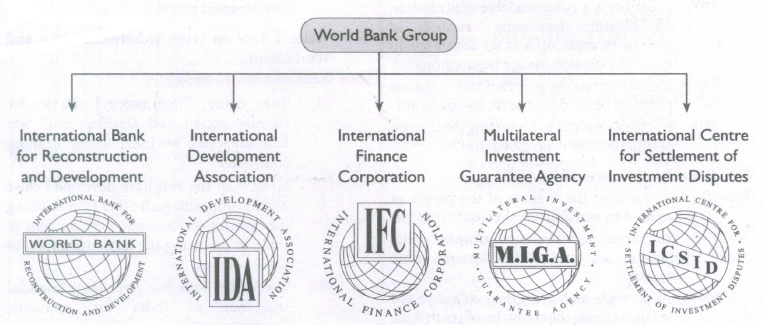
10.
i) SDRs (Special Drawing Rights) otherwise called 'Paper Gold'.
ii) SDRs are the form of international reserves created by the IMF in 1969.
iii) SDRs solve the problem of international liquidity.
11.
i) To increase trade co-operation by making an exclusive trade block.
ii) To increase regional co-operation.
iii) To create a separate trade block made for developing countries for trade cooperation.
12.
(i) It facilitates the implementation and administration and operation of the objectives of the Agreement and the Multilateral Trade Agreements.
(ii) It provides a forum for negotiations among its members, concerning their multilateral trade relations in matters relating to the agreements.
(iii) It administers the understanding the rules and procedures governing the settlement of disputes.
(iv) It co-operates with the IMF and the World Bank and its affiliated agencies with a view to achieving greater coherence in global economic policy making.
13.
(i) Use of restrictive measures for BoP problems has declined markedly.
(ii) Services trade has been brought into the multilateral system and many countries.
(iii) The trade policy review mechanism has created as process of continuous monitoring of trade policy developments.
14.
(i) The World Bank is said to be successful in achieving its primary objectives of reconstruction and development of war ravaged nations.
(ii) It is noted that the bank's membership has increased from the initial number of 30 countries to 68 countries in 1960 to 151 countries in 1988.
(iii) The Bank grants medium and long term loans (i, e, payable over a period of 15 - 20 years) for reconstruction and development purpose to the member countries.
(iv) Initially the World Bank's loans were mainly directed at the European countries for financing their programmes of reconstruction.
(v) The World Bank grants loans to member countries only for productive purposes particularly for agriculture irrigation, power and transport.
(vi) The International Development Association (IDA) the Soft Loan Window of the Bank provides loans to UDCs at very low rate of interest.
15.
Objectives of the world Bank:
(i) Reconstruction and Development.
(ii) Encouragement to capital investment.
(iii) Encouragement to international trade.
(iv) Establishment of peace - Time economy.
(v) Environmental protection.

12th Standard Syllabus & Materials
12th Standard
TN 12th Computer Applications களப்பெயர் முறைமை (DNS) Sample Question Papers Study Material - QB365 Set A
NEW12th Standard
TN 12th Computer Applications வலையமைப்பு எடுத்துக்காட்டுகள் மற்றும் நெறிமுறைகள் Sample Question Papers Study Material - QB365 Set A
NEW12th Standard
TN 12th Computer Applications கணினி வலையமைப்பு ஓர் அறிமுகம் Sample Question Papers Study Material - QB365 Set A
NEW12th Standard
TN 12th Computer Applications PHP-உடன் MySQL-ஐ இணைத்தல் Sample Question Papers Study Material - QB365 Set A



Tamilnadu Stateboard 12th Standard Subjects

Maths

Chemistry

Physics

Biology

Computer Science

Business Maths and Statistics
Economics

Commerce

Accountancy

History

Computer Applications
Biology
Computer Technology
Computer Applications
Computer Science
Business Maths and Statistics
Commerce
Economics
Maths
Chemistry
Physics
Computer Technology
History
Accountancy

Tamil

English

French
Tamilnadu Stateboard Standards
