
 100% FREE ACCESS
12th Standard Syllabus & Materials
12th Standard
TN 12th Computer Applications மின்னணு தரவு பரிமாற்றம் Sample Question Papers Study Material - QB365 Set A
NEW12th Standard
TN 12th Computer Applications மின் - வணிக பாதுகாப்பு அமைப்புகள் Sample Question Papers Study Material - QB365 Set A
NEW12th Standard
TN 12th Computer Applications மின்னணு செலுத்தல் முறைகள் Sample Question Papers Study Material - QB365 Set A
NEW12th Standard
TN 12th Computer Applications மின் - வணிகம் Sample Question Papers Study Material - QB365 Set A
NEW12th Standard
TN 12th Computer Applications திறந்த மூல கருத்துருக்கள் Sample Question Papers Study Material - QB365 Set A
NEW12th Standard
TN 12th Computer Applications வலையமைப்பு வடமிடல் Sample Question Papers Study Material - QB365 Set A

Published on: 03/09/2022
QB365 provides a detailed and simple solution for every Possible Book Back Questions in Class 12 Economics Subject - International Economics , English Medium. It will help Students to get more practice questions, Students can Practice these question papers in addition to score best marks.
Download Tamil Nadu 12th Standard Economics question papers, model tests, one-mark questions, important questions, and public exam papers in PDF format. Free study materials and answer keys for TN State Board students.
Questions + Answers key
Take MCQ Economics Test
1.
Explain the relationship between Foreign Direct Investment and Economic development.
2.
How the Rate of Exchange is determined? Illustrate.
3.
Discuss the various types of disequilibrium in the balance of payments.
4.
Bring out the components of balance of payments account.
5.
Explain the types of Terms of Trade given by Viner.
6.
7.
Explain briefly the Comparative Cost Theory.
8.
Discuss the differences between Internal Trade and International Trade.
1.
1. FDI is an important factor in global
2. Foreign trade and FDI are closely related.
3. In developing countries like India FDI in tie natural resource sector like plantations, increases rade.
4. Foreign production by FDI is useful to substitute foreign trade.
5. FDI is also influenced by the income generated from the trade and regional integration schemes.
6. FDI accelerates the economic growth by facilitating essential imports needed for development programs like capital goods, technical know-how, raw materials, other inputs and even scarce consumer goods.
7. When the export earnings of a country are not sufficient to finance for imports, FDI may be required to fill the trade gap.
8. FDI is encouraged by foreign exchange shortage, desire to create employment and acceleration of the pace of economic development.
9. Many developing countries strongly prefer foreign investment to imports.
2.
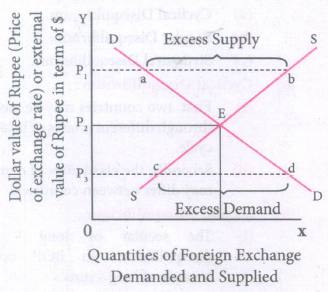
(i) The equilibrium rate of exchange is determined in the foreign exchange market according to the general theory of value, by the interaction of demand and supply,
(ii) Y axis represents exchange rate, be cos value of rupee in terms of dollars
(iii) X axis represents demand and supply of forex.
(iv) E is the equilibrium point where DD intersects SS. The exchange rate is P2.
3.
Cyclical Disequilibrium
Cyclical Disequilibrium occurs because of:
(i) Two countries may be passing through different phases of business cycle.
(ii) The elasticities of demand may differ between countries.
Secular Disequilibrium
(i) It occurs because of long-run and deep rooted changes in an economy as it advances from one stage of growth to another.
(ii) In the initial stages of development, domestic investment exceeded domestic savings and imports exceeded exports, as it happened in India since $1951.
Structural disequilibrium
(i) Structural changes in line economy may also cause BoP disequibrium
(ii) Structural changes include development of alternative sources of supply, development of better substitutes, exhaustion of protective resources or changes in transport routes and costs.
4.
Introduction
(i) The credit and debit items are shown vertically in the BoP account of a country.
(ii) Horizontally, they are divided into 3 components.
Current Account
(i) It includes all international trade transactions of goods and services, international service transactions (tourism, transportation, royalty fees) and international unilateral transfers (gifts, foreign aid).
Capital Account
(i) Financial transactions consisting of direct investment and purchases of interest bearing financial instruments, non interest bearing demand deposits and gold are included.
Official Reserve Assets Account
(i) Consist of movements of international reserves by governments and official agencies to accommodate imbalances arising from the current and capital accounts.
(ii) The official reserve assets include its gold stock, holdings of its convertible foreign currencies, SDR and its net position in the IMIF.
5.
Single Factoral Terms of Trade
(i) According to Viner, the single factoral terms of trade is an improvement over the commodity terms of trade.
(ii) It represents the ratio of export. price index to the import price index adjusted for changes in the productivity of factors in the production of exports.
\(\mathrm{T}_{\mathrm{f}}=\left(\mathrm{P}_{\mathrm{x}} / \mathrm{P}_{\mathrm{m}}\right) \mathrm{F}_{\mathrm{x}}\)
(iii) Tf is single factoral terms of trade index.
(iv) Fx is productivity in exports.
Double Factoral Terms of Trade
\(\mathrm{T}_{\mathrm{ff}}=\left(\mathrm{P}_{\mathrm{x}} / \mathrm{P}_{\mathrm{m}}\right)\left(\mathrm{F}_{\mathrm{x}} / \mathrm{F}_{\mathrm{m}}\right)\)
(i) It takes into account the productivity in country's exports and productivity of foreign factors.
(ii) Fm is import index (which is measured as index cost in terms of quantity of factors of production employed per unit) of imports.
6.
7.
Introduction
1. David Ricardo formulated comparative cost theory.
2. J. S. Mill, Marshall, Taussig refined it.
Theory
1. Trade can take place even if absolute cost difference is absent but there is comparative cost difference.
Illustration
2. Ricardo's theory is explained with an example of production costs of cloth and wheat in America and India.
(Units of labour needed to produce one unit)
| Country | Cloth | Wheat | Domestic Exchange Ratios |
| America | 100 | 120 | 1 Wheat = 1.2 Cloth |
| India | 90 | 80 | 1 Wheat = 0.88 Cloth |
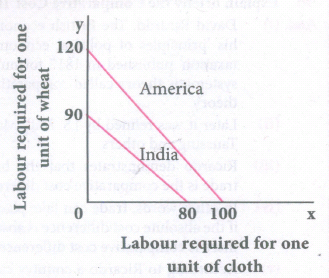
(i) India has absolute advantage in production of both cloth and wheat.
(ii) But, India will produce wheat where she enjoys comparative cost advantage (80 / 120<90 / 100).
(iii) For America the comparative cost disadvantage is lesser in cloth production.
(iv) So America will specialize in cloth production and export it to India in exchange for wheat.
(v) Both nations gains.
(vi) With trade India can get 1 unit of cloth and 1 unit of wheat by using 160 labour units (80+80). With no trade India has to use 170 units of labour (80+90).
(vii) The same explanation applies to America too.
Criticisms
(i) Labour cost is a small portion of the total cost. So the theory based on labour cost is unrealistic,
(ii) Labourers in different countries are not equal in efficiency.
8.
| S.No |
Internal Trade |
International Trade |
|---|---|---|
| 1 | Trade takes place between different individual and firms within the same nation. | Trade takes place between different individual and firms in different countries. |
| 2 | Labour and capital move freely from one region to another. | Labour and capital do not move easily from one nation to another. |
| 3 | Free flow of goods and services since there are no restrictions. | Goods and services do not easily move from one country to another because of tariff and quota. |
| 4 | There is only one common currency. | There are different currencies. |
| 5 | Physical and geographical conditions of a country are similar. | There are differences in physical and geographical conditions of the two countries. |
| 6 | Trade and financial regulations are same. | Trade and financial regulations, interest rate, trade laws differ between countries. |
| 7 | No difference in political affiliations, customs and habits of the people and government policies. | There are lot of differences in political affiliation, habits, customs of the people and government policies. |

12th Standard Syllabus & Materials
12th Standard
TN 12th Computer Applications களப்பெயர் முறைமை (DNS) Sample Question Papers Study Material - QB365 Set A
NEW12th Standard
TN 12th Computer Applications வலையமைப்பு எடுத்துக்காட்டுகள் மற்றும் நெறிமுறைகள் Sample Question Papers Study Material - QB365 Set A
NEW12th Standard
TN 12th Computer Applications கணினி வலையமைப்பு ஓர் அறிமுகம் Sample Question Papers Study Material - QB365 Set A
NEW12th Standard
TN 12th Computer Applications PHP-உடன் MySQL-ஐ இணைத்தல் Sample Question Papers Study Material - QB365 Set A



Tamilnadu Stateboard 12th Standard Subjects

Maths

Chemistry

Physics

Biology

Computer Science

Business Maths and Statistics
Economics

Commerce

Accountancy

History

Computer Applications
Biology
Computer Technology
Computer Applications
Computer Science
Business Maths and Statistics
Commerce
Economics
Maths
Chemistry
Physics
Computer Technology
History
Accountancy

Tamil

English

French
Tamilnadu Stateboard Standards
