
 100% FREE ACCESS
12th Standard Syllabus & Materials
12th Standard
TN 12th Maths Applications of Matrices and Determinants Sample Question Papers Study Material - QB365 Set A
NEW12th Standard
TN 12th Computer Applications மின்னணு தரவு பரிமாற்றம் Sample Question Papers Study Material - QB365 Set A
NEW12th Standard
TN 12th Computer Applications மின் - வணிக பாதுகாப்பு அமைப்புகள் Sample Question Papers Study Material - QB365 Set A
NEW12th Standard
TN 12th Computer Applications மின்னணு செலுத்தல் முறைகள் Sample Question Papers Study Material - QB365 Set A
NEW12th Standard
TN 12th Computer Applications மின் - வணிகம் Sample Question Papers Study Material - QB365 Set A
NEW12th Standard
TN 12th Computer Applications திறந்த மூல கருத்துருக்கள் Sample Question Papers Study Material - QB365 Set A

Published on: 03/09/2022
QB365 provides a detailed and simple solution for every Possible Creative Questions in Class 12 Economics Subject - International Economics , English Medium. It will help Students to get more practice questions, Students can Practice these question papers in addition to score best marks.
Download Tamil Nadu 12th Standard Economics question papers, model tests, one-mark questions, important questions, and public exam papers in PDF format. Free study materials and answer keys for TN State Board students.
Questions + Answers key
Take MCQ Economics Test
1.
What are the causes for BoP disequilibrium?
2.
Explain briefly the theory of absolute cost advantage.
3.
What are the advantages of FDI?
4.
Enumerate the assumptions of the theory of comparative cost advantage.
5.
List the offers of International specialization.
6.
Compare and contrast fixed and flexible exchange rates.
7.
Elaborate various Gains from International Trade?
8.
Explain Adam Smith’s Theory of Absolute Cost Advantage.
9.
State the importance of the comparative advantage of international trade.
10.
Discuss the state of FDI in India.
11.
Explain the determinants of Equilibrium Exchange Rate.
12.
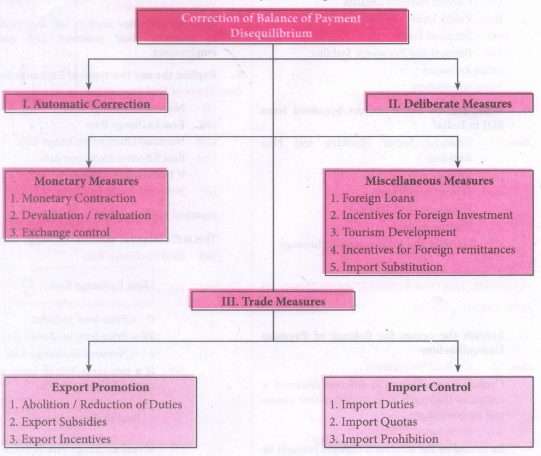
Draw the flow chart for correction of Balance Payment Disequilibrium
13.
Explain the disadvantages of FDI.
14.
Explain the any two types of Exchange Rates.
15.
Explain the causes for Balance of Payment Disequilibrium.
1.
Cyclical Fluctuation:
World trade shrinks during depression and flourishes during prosperity.
Structural Changes:
Structural changes arc brought by large development and investment programmes in the developing economies.
Development Expenditure:
(i) Rapid economic development results in income and price effects.
(ii) Less developed countries in the early stage of development are not self sufficient.
(iii) They depend upon developed countries for import of commodities, capital and technology.
(iv) Export potential is low and import intensity is high.
Consumerism
Huge increase in consumption increases the need for imports and decreases the capacity to export.
Demonstration Effect
(i) People in UDCs imitate western styled goods.
(ii) This will raise the propensity to import.
Borrowing
When international borrowing is heavy, a country's BoP is adverse since it repays loans with interest.
Technological Backwardness
(i) People are unable to use the energy (Solar) available with them.
(ii) So, they import huge petroleum products increasing the trade deficit.
Global Politics
(i) The rich countries need to sell their weapons to promote their economy
(ii) So they stimulate wars between countries.
(iii) In order to win the wars, poor countries are forced to buy the weapons from the rich countries, using their export earnings and creating trade deficit.
2.
Introduction
(i) Adam Smith said that all nations can benefit when there is free trade and specialisations in terms of their absolute cost advantage.
Theory
(i) Trade between two countries would be mutually beneficial when one country produces a commodity at an absolute cost advantage over the other country which in turn produces another commodity at an absolute cost advantage over the first country.
Assumptions
(i) There are two countries and two commodities (2 x 2 model).
(ii) Labour is the only factor of production.
(iii) Labour units are homogeneous
(iv) The cost of in commodity is measured by the amount of labour required to produce it.
(v) There is no transport cost.
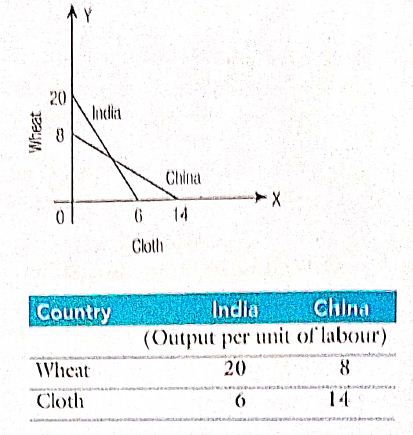
(vi) India has absolute advantage in the production of wheat over Chana.
(vii) China has an absolute advantage in the production of cloth over India.
(ix) Therefore India should specialize in the production of wheat and import cloth from China.
(x) China should specialize in the production of cloth and import wheat from India.
(xi) This kind of trade would be mutually beneficial to both India and China.
3.
(i) FDI may help to increase the investment level and thereby the income and employment.
(ii) FDI may help transfer of technology to the recipient country.
(iii) FDI brings revenue to the government of host country when it taxes profits of foreign firms or gets royalties from concession agreements.
(iv) A part of profit from FDI may be ploughed back into the exPansion, modernization or development of related industries.
(v) It may kindle a managerial revolution in the recipient country through professional management and sophisticated management techniques.
(vi) Foreign capital may help the country to increase its exports and reduce import requirements.
(vii) Foreign investment helps increase competition and break domestic monopolies.
(viii) If FDI adds more value to output in the recipient country than the return on capital from foreign investment, then the social returns are greater than the private returns on foreign investment.
(ix) By bringing caPital and foreign exchange FDI may help in filling the savings gap and the foreign exchange gap in order to achieve the goal of national economic development.
(x) Foreign investments may stimulate domestic enterprises to invest in ancillary industries in collaboration with foreign enterprises.
(xi) FDI flowing into a developing country may encourage its entrepreneurs to invest in the other LDCs.
4.
(i) There are only two nations and two commodities (2 x 2 model).
(ii) Labour is the only element of cost of production.
(iii) All labourers are of equal efficiency.
(iv) Labour is perfectly mobile within the country but perfectly immobile between countries.
(v) Law of constant returns operates.
(vi) Foreign trade is free from all barriers.
(vii) No change in technology.
(viii) No transport cost.
(ix) Perfect competition.
(x) Full emPloYment.
(xi) No government intervention.
5.
1. Better utilization of resources.
2. Concentration in the production of goods in which it has a comparative advantage.
3. Saving in time.
4. Perfection of skills in production.
5. Improvement in the techniques of production.
6. Increased production.
7. Higher standard of living in the trading countries
6.
| BASIS FOR COMPARISON | FIXED EXCHANGE RATE | FLEXIBLE EXCHANGE RATE |
| Meaning | Fixed exchange rate refers to a rate which the government sets and maintains at the same level. | Flexible exchange rate is a rate that varies according to the market forces. |
| Determined by | Government or central bank | Demand and Supply forces |
| Changes in currency price | Devaluation and Revaluation | Depreciation and Appreciation |
| Speculation | Takes place when there is rumor about change in government policy. | Operates to remove external instability by change in Forex rate. |
| Self adjusting mechanism | Operates through variation in supply of money, domestic interest rate and price. | No |
7.
Introduction
(i) International trade helps a country to export its surplus goods to other countries and secure a better market for it.
(ii) Similarly, international trade helps a country to import the goods which cannot be produced at all or can be produced at a higher cost.
(iii) The gains from international trade may be categorized under four heads.
I. Efficient Production
International trade enables each participatory country to specialize in the production of goods in which it has absolute or comparative advantages. International specialization offers the following gains.
1. Better utilization of resources.
2. Concentration in the production of goods in which it has a comparative advantage.
3. Saving in time.
4. Perfection of skills in production.
5. Improvement in the techniques of production.
6. Increased production.
7. Higher standard of living in the trading countries
II. Equalization of Prices between Countries
International trade may help to equalize prices in all the trading countries
1. Prices of goods are equalized between the countries (However, in reality it has not happened).
2. The difference is only with regard to the cost of transportation.
3. Prices of factors of production are also equalized (However, in reality it has not happened).
III. Equitable Distribution of Scarce Materials
International trade may help the trading countries to have equitable distribution of scarce resources.
IV. General Advantages of International Trade
1. Availability of variety of goods for consumption.
2. Generation of more employment opportunities.
3. Industrialization of backward nations.
4. Improvement in relationship among countries (However, in reality it has not happened).
5. Division of labour and specialisation.
6. Expansion in transport facilities
8.
Adam Smith argued that all nations can be benefitted when there is free trade and specialisation in terms of their absolute cost advantage
The Theory
(i) According to Adam Smith, the basis of international trade was absolute cost advantage.
(ii) Trade between two countries would be mutually beneficial when one country produces a commodity at an absolute cost advantage over the other country which in turn produces another commodity at an absolute cost advantage over the first country.
Assumptions
1. There are two countries and two commodities (2 x 2 model).
2. Labour is the only factor of production
3. Labour units are homogeneous
4. The cost or price of a commodity is measured by the amount of labour required to produce it.
5. There is no transport cost.
Illustration
Absolute cost advantage theory can be illustrated with the help of the following example.
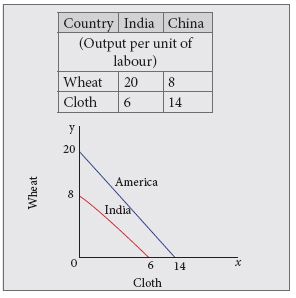
(iii) From the illustration, it is clear that India has an absolute advantage in the production of wheat over China and China has an absolute advantage in the production of cloth over India
(iv) Therefore, India should specialize in the production of wheat and import cloth from China. China should specialize in the production of cloth and import wheat from India
(v) This kind of trade would be mutually beneficial to both India and China.
9.
(i) The balance of aggregate demand and aggregate supply was first described.
(ii) The cost of goods is determined by the ratio of aggregate demand and supply for them, both domestically and from abroad;
(iii) He theory is true regarding any quantity of goods and any number of countries, as well as for the analysis of trade between different entities.
(iv) In this case, country specialization in some goods depends on the ratio of wage levels in each country;
(v) The theory based the existence of benefits from trade for all countries, taking part in it;
(vi) There become possible to develop foreign economic policy on the scientific foundation.
10.
Introduction
(i) The early 1990s witnessed reforms in the economic policy. This helped to open up Indian markets to FDI
(ii) FDI in India has increased over the years
(iii) In India, FDI has been advantageous in terms of free flow of capital, improved technology, management expertise and access to international markets
The major sectors benefited from FDI in India are:
(i) financial sector (banking and nonbanking)
(ii) insurance
(iii) telecommunication
(iv) hospitality and tourism
(v) pharmaceuticals and
(vi) software and information technology
FDI is not permitted in the industrial sectors like
(i) Arms and ammunition
(ii) atomic energy,
(iii) railways,
(iv) coal and lignite and
(v) mining of iron, manganese, chrome, gypsum, sulphur, gold, diamonds, copper etc.,
Latest trend of FDI in India
i. FDI inflow in India has increased from $97 million in 1990-91 to $5,535 million in 2004-2005.
ii. It amounted to $32,955 million in 2011-2012.
iii. UNCTAD’s World Investment Report 2018 reveals that FDI to India declined to $40 billion in 2017 from $44 billion in 2016
11.
Determinants of Exchange Rates
Exchange rates are determined by numerous factors and they are related to the trading relationship between two countries
1. Differentials in Inflation
Inflation and exchange rates are inversely related. A country with a consistently lower inflation rate exhibits a rising currency value, as its purchasing power increases relative to other currencies.
2. Differentials in Interest Rates
There is a high degree of correlation between interest rates, inflation and exchange rates. Central banks can influence over both inflation and exchange rates by manipulating interest rates. Higher interest rates attract foreign capital and cause the exchange rate to rise and vice versa.
3. Current Account Deficits
A deficit in the current account implies excess of payments over receipts. The country resorts to borrowing capital from foreign sources to make up the deficit. Excess demand for foreign currency lowers a country’s exchange rate.
4. Public Debt
Large public debts are driving out foreign investors, because it leads to inflation. As a result, exchange rate will be lower
5. Terms of Trade
A country’s terms of trade also determines the exchange rate. If the price of a country’s exports rises by a greater rate than that of its imports, its terms of trade will improve. Favorable terms of trade imply greater demand for the country’s exports and thus BoP becomes favorable.
6. Political and Economic Stability
If a nation’s political climate is stable and economic performance is good, its currency value will be appreciated by attracting more foreign capital
7. Recession
Interest rates are low during the recession phase. This will decrease inflow of foreign capital. As a result, a currency will be depreciated against other currencies, thereby lowering the exchange rate.
8. Speculation
If a country’s currency value is expected to rise, investors will demand more of that currency in order to make a profit in the near future. This results in appreciation of the exchange rate. Beside the above determinants, relative dominance in the global politics and the power to announce economic sanctions over other countries also determine exchange rates
12.
13.
(i) Private foreign capital tends to flow to the high profit areas rather than to the priority sectors.
(ii) The technologies brought in by the foreign investor may not be appropriate to the consumption needs, size of the domestic market etc.
(iii) Foreign investment, sometimes, have unfavorable effect on the Balance of Payments of a country because when the drain of foreign exchange by way of royalty, dividend, etc. is more than the investment made by the foreign concerns.
(iv) Foreign capital sometimes interferes in the national politics.
(v) Foreign investors sometimes engage in unfair and unethical trade practices.
(vi) Often, there are several costs associated with encouraging foreign investment.
(iv) Foreign investment in some cases leads to the destruction.
14.
Types of Exchange Rate:
(i) Nominal Exchange Rate
(ii) Real Exchange Rate
(iii) Nominal Effective Exchange Rate
(iv) Real Effective Exchange Rate If 1US Dollar = Rs.75
(i) Nominal Exchange Rate:
Nominal Exchange Rate =\(\cfrac { 75 }{ 1 } \)
This is the bilateral nominal exchange rate.
(ii) Real Exchange Rate:
(1) Real Exchange Rate = \(\cfrac { { eP }_{ r } }{ P } \)
P = Price level in India
PF = Price level in abroad (say US)
e = Nominal Exchange Rate
(2) If a pen costs Rs.50 in India and it costs 5 USD in the US.
\(\therefore \text {Real Exchange Rate}=\cfrac { 75\times 5 }{ 50 } =7.5\)
(3) If real exchange rate is equal to 1, the currencies are at purchasing power parity.
(4) If the price of the pen in US is 0:66 USD, then the real exchange rate

Then it could be said that the USD and Indian rupee are at purchasing power parity.
15.
(i) Cyclical Fluctuation:
Cyclical disequilibrium in different countries is caused by their cyclical fluctuations their phases and magnitude.
(ii) Structure Change:
Its caused by the structural changes brought by huge development and investment programmes in the developing countries.
(iii) Development Expenditure:
(1) Its caused by rapid economic development which results in income and price effects.
(2) The less developed countries in the early stage of development are not self sufficient.
(iv) Consumerism:
Balance of payments position of a country is adversely affected by a huge increase in consumption.
v) Demonstration Effect:
Deficit in the balance of payments of developing countries is also caused by demonstration effect.
vi) Borrowing:
International borrowing and investment may cause a deficit in the balance of payments.
(vii) Global Politics:
The rich countries need to sell their weapons to promote their economy and generate employment.

12th Standard Syllabus & Materials
12th Standard
TN 12th Computer Applications வலையமைப்பு வடமிடல் Sample Question Papers Study Material - QB365 Set A
NEW12th Standard
TN 12th Computer Applications களப்பெயர் முறைமை (DNS) Sample Question Papers Study Material - QB365 Set A
NEW12th Standard
TN 12th Computer Applications வலையமைப்பு எடுத்துக்காட்டுகள் மற்றும் நெறிமுறைகள் Sample Question Papers Study Material - QB365 Set A
NEW12th Standard
TN 12th Computer Applications கணினி வலையமைப்பு ஓர் அறிமுகம் Sample Question Papers Study Material - QB365 Set A



Tamilnadu Stateboard 12th Standard Subjects

Maths

Chemistry

Physics

Biology

Computer Science

Business Maths and Statistics
Economics

Commerce

Accountancy

History

Computer Applications
Biology
Computer Technology
Computer Applications
Computer Science
Business Maths and Statistics
Commerce
Economics
Maths
Chemistry
Physics
Computer Technology
History
Accountancy

Tamil

English

French
Tamilnadu Stateboard Standards
