
 100% FREE ACCESS
12th Standard Syllabus & Materials
12th Standard
TN 12th Computer Applications மின்னணு தரவு பரிமாற்றம் Sample Question Papers Study Material - QB365 Set A
NEW12th Standard
TN 12th Computer Applications மின் - வணிக பாதுகாப்பு அமைப்புகள் Sample Question Papers Study Material - QB365 Set A
NEW12th Standard
TN 12th Computer Applications மின்னணு செலுத்தல் முறைகள் Sample Question Papers Study Material - QB365 Set A
NEW12th Standard
TN 12th Computer Applications மின் - வணிகம் Sample Question Papers Study Material - QB365 Set A
NEW12th Standard
TN 12th Computer Applications திறந்த மூல கருத்துருக்கள் Sample Question Papers Study Material - QB365 Set A
NEW12th Standard
TN 12th Computer Applications வலையமைப்பு வடமிடல் Sample Question Papers Study Material - QB365 Set A

Published on: 02/09/2022
QB365 provides a detailed and simple solution for every Possible Creative Questions in Class 12 Economics Subject - Introduction to Macro Economics , English Medium. It will help Students to get more practice questions, Students can Practice these question papers in addition to score best marks.
Download Tamil Nadu 12th Standard Economics question papers, model tests, one-mark questions, important questions, and public exam papers in PDF format. Free study materials and answer keys for TN State Board students.
Questions + Answers key
Take MCQ Economics Test
1.
Briefly explain the three sector circular flow model.
2.
Draw and explain that circular flow of income in a four sector economy.
3.
What are the demerits of capitalism? Concentration of Wealth and Income:
4.
Explain the features of capitalistic economy.
5.
Enumerate the limitations of macro economics.
6.
What are the features of socialism?
7.
Explain the concepts of macro economics.
8.
Discuss the features of Capitalist economy.
9.
Explain the four sector model of economy with chart.
10.
Explain the three sector model of economy with chart.
11.
Explain the merits of Mixed Economy.
12.
Explain the Demerits of capitalism.
13.
Explain the merits of socialism.
14.
Explain the four sector circular flow model.
1.
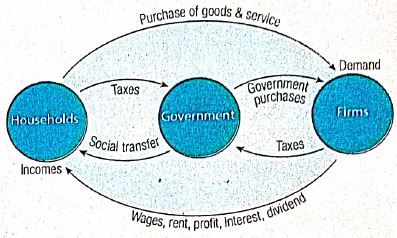
1. In addition to household and firms, inclusion of the government sector makes this model a three-sector model.
2. The government levies taxes on households and firms, purchases goods and services from firms, and receive factors of production from household sector.
3. On the other hand, the government also makes social transfers such as pension, relief, subsidies to the households. Similarly, Government pays the firms for the purchases of goods and services.
4. The Flow Chart illustrates three-Sector economy model:
5. Under three sector model, National income (Y) is obtained by adding Consumption expenditure (C), Investment expenditure (I) and Government expenditure Therefore, Y=C+I+G
2.
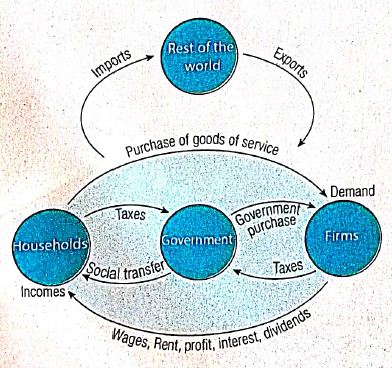
1. In a Four-sector economy, in addition to household, firms and government, a fourth sector namely, external sector is included. In real life, only four-sector economy exists. This model is composed of four sectors namely,
(i) Houscholds
(ii) Firms
(iii) Government
(iv) External sector
2. The external sector comprises exports and imports. It is illustrated in the Flow Chart.
3. In four-sector economy, expenditurc for the entire economy include domestic expenditure (C+I+G) and net exports (X-M). Therefore, Y=C+I+G+(X-M)
3.
(i) Wealth and income are in a few hands and so inequality increases.
Wastage of Resources:
(i) Large amount of resources are wasted on competitive advertising and duplication of products.
Class Struggle:
(i) There is class struggle between the capitalists and workers.
Business Cycle:
(i) There is frequent violent economic fluctuations and crises.
Production of non essential goods:
(i) Even harmful goods are produced if they bring profit.
4.
Private Ownership of Property and Law of Inheritance:
1. Land, capital, machines, mines are owned by private individuals.
2. The individual owns, keeps, sells, transfers or use these resources according to his will.
Freedom of Choice and Enterprise:
1. Individuals can do any job or trade at any place and produce any commodity.
2. Consumer is free to buy any commodity.
Profit Motive:
1. Individuals and organisations produce only those goods which bring high profit.
2. Advanced technology, division of labour and specialisation are followed.
Free Competition:
1. There is free competition in the product and factor market and between buyers and sellers.
Price Mechanism:
1. All economic activities are regulated through price mechanism i.e. market forces of demand and supply.
Role of Government:
1. The government has a limited role to play.
2. It provides basic services like defense, public health, education.
Inequalities of Income:
1. A capitalist society has two classes - 'the haves' and 'have nots'.
2. The 'haves' own property and 'have nots' who do not own property.
3. The rich become richer and poor become poorer.
5.
(i) There is a danger of excessive generalisation of the economy as a whole.
(ii) It assumes homogeneity among the individual units.
(iii) There is a fallacy of composition.
(iv) What is good for an individual need not be good for a nation.
(v) What is good for a country is not good for another country and at another time.
(vi) Many non-economic factors determine economic activities; but they are not explained under macro economics.
6.
Public Ownership of factors:
1. All resources are owned by the government.
2. AII factors of production are nationalized and managed by the public authority.
Central Planning:
AII decisions are undertaken by the central planning authority.
Maximum Social Benefit:
Investments are planned such that the benefits are distributed to the society at large.
Non-existence of Competition:
1. The state has full control over production and distribution of goods and services.
2. The consumers have limited choice.
Absence of Price Mechanism:
The pricing system is under the control and regulation of the central planning authority.
Equality of Income:
1. Economic inequalities are reduced.
2. Private propery and law of inheritance do not exist.
Equality of opportunity:
There is equal opportunity for all through free health, education and professional training.
Classes society:
There is no class conflict since everyone is equal in economic status.
7.
The important concepts used in macro economics are presented below:
(i) Stock and Flow Variables: Variables used in economic analysis are classified as stock and flow. Both stock and flow variables may increase or decrease with time.
(ii) Stock refers to a quantity of a commodity measured at a point of time. In macro economics, money supply, unemployment level, foreign exchange reserves, capital etc are examples of stock variables.
(iii) Flow variables are measured over a period of time. National Income, imports, exports, consumption, production, investment etc are examples of flow variables.
(iv) Economic Models: A model is a simplified representation of real situation. Economists use models to describe economic activities, their relationships and their behaviour. A model is an explanation of how the economy, or part of the economy, works. Most economic models are built with mathematics, graphs and equations, and attempt to explain relationships between economic variables. The commonly used economic models are the supply demand models and circular flow models and Smith models
8.
1. Private Ownership of Property and Law of Inheritance: The basic feature of capitalism is that all resources namely, land, capital, machines, mines etc. are owned by private individuals. The owner has the right to own, keep, sell or use these resources according to his will. The property can be transferred to heirs after death.
2. Freedom of Choice and Enterprise: Each individual is free to carry out any occupation or trade at any place and produce any commodity. Similarly, consumers are free to buy any commodity as per their choice
3. Profit Motive: Profit is the driving force behind all economic activities in a capitalistic economy. Each individual and organization produce only those goods which ensure high profit. Advance technology, division of labour, and specialisation are followed. The golden rule for a producer under capitalism is ‘to maximize profit.’
4. Free Competition: There is free competition in both product and factor market. The government or any authority cannot prevent firms from buying or selling in the market. There is competition between buyers and sellers.
5. Price Mechanism: Price mechanism is the heart of any capitalistic economy. All economic activities are regulated through price mechanism i.e, market forces of demand and supply.
6. Role of Government: As the price mechanism regulates economic activity, the government has a limited role in a capitalistic economy. The government provides basic services such as, defense, public health, education, etc.
7. Inequalities of Income: A capitalist society is divided into two classes – ‘haves’ that is those who own property and ‘have-nots’ who do not own property and work for their living. The outcome of this situation is that the rich become richer and poor become poorer. Here, economic inequality goes on increasing.
9.
(i) In a four-sector economy, in addition households, firms and government, a fourth sector namely, external sector is included.
(ii) In the real life, only four-sector economy exists. This model is composed of four sectors namely,
1. Households
2. Firms
3. Government
4. External Sector
The external sector comprises exports and imports. It is illustrated in the Flow Chart
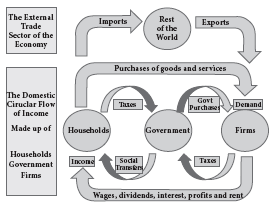
In four-sector economy, expenditure for the entire economy include domestic expenditure (C + I + G) and net exports (X - M). Therefore,
Y = C + I + G + (X - M)
10.
1. In addition to household and firms, inclusion of the government sector makes this model a three-sector model.
2. The government levies taxes on households and firms, purchases goods and services from firms, and receive factors of production from household sector.
3. On the other hand, the government also makes social transfers such as pension, relief, subsidies to the households.
4. Similarly, Government pays the firms for the purchases of goods and services.
5. The Flow Chart illustrates three- sector economy model
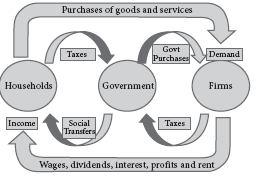
Under three sector model, national income
(Y) is obtained by adding Consumption expenditure (C), Investment expenditure (I) and Government expenditure (G).
Therefore Y = C + I + G
11.
(a) Rapid Economic Growth:
(i) It promotes rapid economic growth.
(ii) Thus both public requirements and private needs are taken care of.
(b) Balanced Economic Growth:
(i) Mixedism promotes balanced growth of the economy.
(ii) It promotes balanced growth between agriculture and industry.
(c) Proper utilization of Resources:
(i) The government can ensure proper utilization of resources.
(ii) The government controls must of the important activities directly.
(d) Economic Equality:
(i) The government uses progressive rates of taxation.
(ii) Income tax to bring about economic equality.
12.
Demerits of Capitalism:
1. Concentration of Wealth and Income :
Capitalism causes concentration of wealth and income in a few hands and thereby increases inequalities of income.
2. Wastage of Resources Large amount of resources are wasted on competitive advertising and duplication of products.
3. Class Struggle: Capitalism leads to class struggle as it divides the society into capitalists and workers.
4. Business Cycle: Free market system leads to frequent violent economic fluctuations and crises.
5. Production of non essential goods: Even the harmful goods are produced if there is possibility to make profit.
13.
Merits of Socialism:
1. Reduction m Inequalities:
No one is allowed to own and use private property to exploit others.
2. Rational Allocation of Resources:
The central planning authority allocates the resources in a planned manner. Wastages are minimised and investments are made in a pre planned manner.
3. Absence of Class conflicts:
As inequalities are minimum, there is no conflict between rich and poor class. Society functions in a harmonious manner.
4. End of rade Cycles :
Planning authority takes control over production and distribution of goods and services. Therefore, economic fluctuations can be avoided.
5. Promotes Social Welfare:
Absence of exploitation, reduction in economic inequalities, avoidance of trade cycles and increase in productive efficiency help to promote social welfare.
14.
(1) Circular flow of income in a four sector economy.
(2) In a four sector economy. in addition to household, firms and government, a fourth sector namely, external sector is included.
(3) In real life, only four-sector economy is exists.
(4) This model is composed of four sectors namely.
(i) Households
(ii) Firms
(iii) Government
(iv) External
(5) The external sector comprises exports and imports.
(6) It is illustrated in the flow chart.
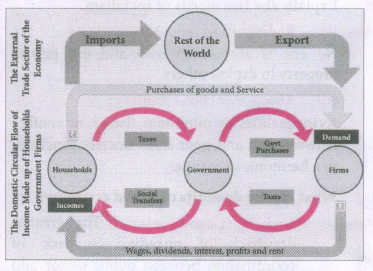
(7) In four sector economy, expenditure for the entire economy include domestic expenditure.
(C + I + G) and net exports (X-M)
(8) Therefore four sector model expressed as
y = C + I + G + (X-M)

12th Standard Syllabus & Materials
12th Standard
TN 12th Computer Applications களப்பெயர் முறைமை (DNS) Sample Question Papers Study Material - QB365 Set A
NEW12th Standard
TN 12th Computer Applications வலையமைப்பு எடுத்துக்காட்டுகள் மற்றும் நெறிமுறைகள் Sample Question Papers Study Material - QB365 Set A
NEW12th Standard
TN 12th Computer Applications கணினி வலையமைப்பு ஓர் அறிமுகம் Sample Question Papers Study Material - QB365 Set A
NEW12th Standard
TN 12th Computer Applications PHP-உடன் MySQL-ஐ இணைத்தல் Sample Question Papers Study Material - QB365 Set A



Tamilnadu Stateboard 12th Standard Subjects

Maths

Chemistry

Physics

Biology

Computer Science

Business Maths and Statistics
Economics

Commerce

Accountancy

History

Computer Applications
Biology
Computer Technology
Computer Applications
Computer Science
Business Maths and Statistics
Commerce
Economics
Maths
Chemistry
Physics
Computer Technology
History
Accountancy

Tamil

English

French
Tamilnadu Stateboard Standards
