
 100% FREE ACCESS
12th Standard Syllabus & Materials
12th Standard
TN 12th Computer Applications மின்னணு தரவு பரிமாற்றம் Sample Question Papers Study Material - QB365 Set A
NEW12th Standard
TN 12th Computer Applications மின் - வணிக பாதுகாப்பு அமைப்புகள் Sample Question Papers Study Material - QB365 Set A
NEW12th Standard
TN 12th Computer Applications மின்னணு செலுத்தல் முறைகள் Sample Question Papers Study Material - QB365 Set A
NEW12th Standard
TN 12th Computer Applications மின் - வணிகம் Sample Question Papers Study Material - QB365 Set A
NEW12th Standard
TN 12th Computer Applications திறந்த மூல கருத்துருக்கள் Sample Question Papers Study Material - QB365 Set A
NEW12th Standard
TN 12th Computer Applications வலையமைப்பு வடமிடல் Sample Question Papers Study Material - QB365 Set A

Published on: 02/09/2022
QB365 provides a detailed and simple solution for every Possible Creative Questions in Class 12 Economics Subject - Monetary Economics , English Medium. It will help Students to get more practice questions, Students can Practice these question papers in addition to score best marks.
Download Tamil Nadu 12th Standard Economics question papers, model tests, one-mark questions, important questions, and public exam papers in PDF format. Free study materials and answer keys for TN State Board students.
Questions + Answers key
Take MCQ Economics Test
1.
What is taxflation and currency inflation?
2.
Write about the money supply in India?
3.
Fill in the following table by indicating whether the proposed Central Bank action will increase or decrease the money supply. If the action is not a Central Bank power then write not applicable.
| Action | Effect on money supply |
| A decrease in central spending | |
| A decrease in the required reserve | |
| A sale of government debt | |
| A lowering of the discount rate | |
| Buying government debt | |
| A decrease in taxe |
4.
What is money? Explain the three functions that money performs. Which one is the primary function of money?
5.
Explain Effects on Production of Inflation.
6.
Explain any three main causes of inflation in India.
7.
Explain “The Keynes Equation” Keynes equation is expressed as:
8.
Draw the diagram of Fisher’s Quantity theory of money.
9.
What are the Contingent Functions?
10.
Explain the three secondary function of money.
11.
Explain the primary function of money.
12.
Explain the concept of Plastic Money.
13.
Write a note on paper currency standard
14.
Explain the history of Barter System.
15.
What are the four measures of Money Supply?
1.
(i) Increase in indirect tax like excise duty, customs duty, sales tax may lead to rise in price called taxflation.
(ii) Currency inflation: The excess supply of money in circulation causes rise in price level.
2.
(i) In India, currency notes are issued by RBI and coins by the Ministry of Finance, Government of India.
(ii) Besides these, the savings or current account deposits held by the public in commercial banks is also considered money.
(iii) Currency notes are also called fiat money and legal tenders.
3.
| Action | Effect on money supply |
| A decrease in central spending | not applicable |
| A decrease in the required reserve | increase |
| A sale of government debt | decrease |
| A lowering of the discount rate | increase |
| Buying government debt | increase |
| A decrease in taxe | not applicable |
4.
(i) Money is anything that is generally accepted as a medium of exchange.
(ii) Money must be able to act as a medium of exchange, a store of value, and a unit of account. For money to act as a medium of exchange, sellers must generally accept and buyers must generally use it to pay for goods and services.
(iii) For money to serve as a store of value, it can be used to transport purchasing power from one period of time to another.
(iv) For money to serve as a unit of account, it must function as a consistent way of quoting prices.
(v) The primary function of money is to serve as a medium of exchange.
5.
When the inflation is very moderate, it acts as an incentive to traders and producers. The profit due to rising prices encourages and induces business class to increase their investments in production, leading to generation of employment and income.
(i) However, hyper-inflation results in a serious depreciation of the value of money and it discourages savings.
(ii) When the value of money undergoes considerable depreciation, this may even drain out the foreign capital.
(iii) With reduced capital accumulation, the investment will suffer a serious set-back which may have an adverse effect on the volume of production.
6.
(i) Increase in Money Supply: Inflation is caused by an increase in the supply of money which leads to increase in aggregate demand.
(ii) Increase in Disposable Income: When the disposable income of the people increases, it raises their demand for goods and services.
(iii) Increase in Public Expenditure: Government activities have been expanding due to developmental activities and social welfare programmes.
7.
n = pk (or) p = n / k
Where
n is the total supply of money
p is the general price level of consumption goods
k is the total quantity of consumption units the people decide to keep in the form of cash.
because it is measured in terms of consumer goods.
According to Keynes, peoples desire to hold money is unaltered by monetary authority. So, price level and value of money can be stabilized through regulating quantity of money (n) by the monetary authority.
Later, Keynes extended his equation in the following form:
n = p (k + rk') or p = n/(k + rk')
Where,
n = total money supply
p = price level of consumer goods
k = peoples' desire to hold money in hand (in terms of consumer goods) in the total income of them
r = cash reserve ratio
k' = community’s total money deposit in banks, in terms of consumers goods.
8.
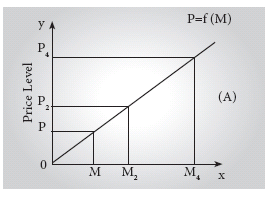
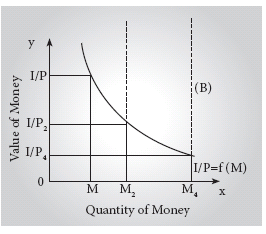
9.
(i) Basis of the Credit System: Money is the basis of the Credit System. Business transactions are either in cash or on credit.
(ii) Money facilitates distribution of National Income: The task of distribution of national income was exceedingly complex under the barter system.
(iii) Money helps to Equalize Marginal Utilities and Marginal Productivities: Consumer can obtain maximum utility only if he incurs expenditure on various commodities in such a manner as to equalize marginal utilities accruing from them.
(iv) Money Increases Productivity of Capital: Money is the most liquid form of capital. In other words, capital in the form of money can be put to any use.
10.
(i) Money as a Store of value: Savings done in terms of commodities were not permanent. But, with the invention of money, this difficulty has now disappeared and savings are now done in terms of money.
(ii) Money as a Standard of Deferred Payments: Borrowing and lending were difficult problems under the barter system. In the absence of money, the borrowed amount could be returned only in terms of goods and services.
(iii) Money as a Means of Transferring Purchasing Power: The field of exchange also went on extending with growing economic development. The exchange of goods is now extended to distant lands.
11.
(i) Money as a medium of exchange: This is considered as the basic function of money. Money has the quality of general acceptability, and all exchanges take place in terms of money.
(ii) Money as a measure of value: The second important function of money is that it measures the value of goods and services.
12.
(i) The latest type of money is plastic money.
(ii) Plastic money is one of the most evolved forms of financial products. Plastic money is an alternative to the cash or the standard “money”.
(iii) Plastic money is a term that is used predominantly in reference to the hard plastic cards used every day in place of actual bank notes.
(iv) Plastic money can come in many different forms such as Cash cards, Credit cards, Debit cards, Pre-paid Cash cards, Store cards, Forex cards and Smart cards. They aim at removing the need for carrying cash to make transactions.
13.
(i) The paper currency standard reffers to the monetary system in which the paper currency notes issued by the treasury of the Central Bank.
(ii) Paper currency is not convertible into any metal.
(iii) Its value is determined independent of the value of gold or any other commodity.
(iv) It also known as managed currency standard.
14.
Barter System:
(i) Goods exchange for goods is known as Barter System.
(ii) In olden days goods were exchanged for goods and not for cash.
(iii) Barter system was introduced by Mesopotamia tribes.
(iv) Babylonian's also developed an improved barter system, where goods were exchanged for goods.
15.
M1 = Currency, Coins and demand deposits.
M2 = M1 + Saving deposits with post office savings banks.
M3 M2 + Time deposits of all commercial and cooperative banks.
M4 = M3 + Total deposits with post offices.
M1 and M2 are known as narrow money.
M3 and M4 are known as broad money.
The graduations are in decreasing order of liquidity.

12th Standard Syllabus & Materials
12th Standard
TN 12th Computer Applications களப்பெயர் முறைமை (DNS) Sample Question Papers Study Material - QB365 Set A
NEW12th Standard
TN 12th Computer Applications வலையமைப்பு எடுத்துக்காட்டுகள் மற்றும் நெறிமுறைகள் Sample Question Papers Study Material - QB365 Set A
NEW12th Standard
TN 12th Computer Applications கணினி வலையமைப்பு ஓர் அறிமுகம் Sample Question Papers Study Material - QB365 Set A
NEW12th Standard
TN 12th Computer Applications PHP-உடன் MySQL-ஐ இணைத்தல் Sample Question Papers Study Material - QB365 Set A



Tamilnadu Stateboard 12th Standard Subjects

Maths

Chemistry

Physics

Biology

Computer Science

Business Maths and Statistics
Economics

Commerce

Accountancy

History

Computer Applications
Biology
Computer Technology
Computer Applications
Computer Science
Business Maths and Statistics
Commerce
Economics
Maths
Chemistry
Physics
Computer Technology
History
Accountancy

Tamil

English

French
Tamilnadu Stateboard Standards
