
 100% FREE ACCESS
12th Standard Syllabus & Materials
12th Standard
TN 12th Computer Applications மின்னணு தரவு பரிமாற்றம் Sample Question Papers Study Material - QB365 Set A
NEW12th Standard
TN 12th Computer Applications மின் - வணிக பாதுகாப்பு அமைப்புகள் Sample Question Papers Study Material - QB365 Set A
NEW12th Standard
TN 12th Computer Applications மின்னணு செலுத்தல் முறைகள் Sample Question Papers Study Material - QB365 Set A
NEW12th Standard
TN 12th Computer Applications மின் - வணிகம் Sample Question Papers Study Material - QB365 Set A
NEW12th Standard
TN 12th Computer Applications திறந்த மூல கருத்துருக்கள் Sample Question Papers Study Material - QB365 Set A
NEW12th Standard
TN 12th Computer Applications வலையமைப்பு வடமிடல் Sample Question Papers Study Material - QB365 Set A

Published on: 30/09/2020
12th Standard Economics English Medium Sample 5 Mark Book Back Questions (New Syllabus 2020)
Download Tamil Nadu 12th Standard Economics question papers, model tests, one-mark questions, important questions, and public exam papers in PDF format. Free study materials and answer keys for TN State Board students.
Questions + Answers key
Take MCQ Economics Test
1.
Find the regression equation Y on X and X on Y for the following data:
| Y | 45 | 48 | 50 | 55 | 65 | 70 | 75 | 72 | 80 | 85 |
| X | 25 | 30 | 35 | 30 | 40 | 50 | 45 | 55 | 60 | 65 |
2.
Discuss the economic determinants of economic development.
3.
Explain the scope of public finance.
4.
5.
Elucidate the functions of Commercial Banks
6.
Illustrate Fisher’s Quantity theory of money.
7.
Explain Keynes psychological law of consumption function with diagram.
8.
Discuss the importance of social accounting in economic analysis.
9.
Compare the features of capitalism and socialism.
1.
| S.No | X | X - X | (X - X)2 | Y | Y - Y | (Y - Y)2 | XY |
| 1 | 45 | -19.5 | 380.25 | 25 | -18.5 | 342.25 | 360.75 |
| 2 | 48 | -16.5 | 272.25 | 30 | -13.5 | 182.25 | 222.75 |
| 3 | 50 | -14.5 | 210.25 | 35 | -8.5 | 72.25 | 123.25 |
| 4 | 55 | -9.5 | 90..25 | 30 | -13.5 | 182.25 | 128.25 |
| 5 | 65 | 0.5 | 0.25 | 40 | -3.5 | 12.25 | -1.75 |
| 6 | 70 | 5.5 | 30.25 | 50 | 6.5 | 42.25 | 35.75 |
| 7 | 75 | 10.5 | 110.25 | 45 | 1.5 | 2.25 | 15.75 |
| 8 | 72 | 7.5 | 56.25 | 55 | 11.5 | 132.25 | 86.25 |
| 9 | 80 | 15.5 | 240.25 | 60 | 16.5 | 272.25 | 255.75 |
| 10 | 85 | 20.5 | 420.25 | 65 | 21.5 | 462.25 | 440.75 |
| 10 | 645 | 1810.50 | 435 | 1702.5 | 1667.5 |
\(\bar{X}=\frac{645}{10}=64.5
\)
\(\sigma x=\sqrt{\frac{\sum(x-\bar{x})^{2}}{n}}
\)
\(=\sqrt{\frac{1810.50}{10}}
\)
\(=\sqrt{181.05}=13.4
\)
\(\bar{\gamma}=\frac{435}{10}=43.5
\)
\(\sigma y=\sqrt{\frac{\sum(y-\bar{y})^{2}}{n}}
\)
\(=\sqrt{\frac{1702.5}{10}}=\sqrt{170.25}=13.05
\)
\(r=\frac{\sum x y^{\prime}}{\sqrt{\sum x^{2}} \sqrt{\sum y^{2}}}
\)
\(=\frac{1667.5}{\sqrt{1810.50} \sqrt{1702.5}}
\)
\(=\frac{1667.5}{42.55 \times 41.25}=\frac{1667}{1755}=0.95
\)
\(\bar{x} =64.5
\)
\(\bar{y} =43.5
\)
\(\sigma y =13.05
\)
\(\sigma x =13.4\)
r =0.95
The regression X on Y is
\(x-\bar{x} =r \times \frac{\sigma x}{\sigma y} \times(y-\bar{y})
\)
\(x-64.5 =0.95 \times\left(\frac{13.4}{13.05}\right) \times y-43.5 \)
x-64.5 =(0.95 x 1.03) x y-43.5
x =0.9785 x (y-43.5)+64.5
x =0.9785 y-42.56+64.5
x =0.9785 y+21.94
The regression Y on X is
\(y-\bar{y}=r \times \frac{v y}{\sigma x} \times(x-\bar{x})
\)
\(y-43.5=0.95 \times \frac{13.05}{13.4} \times x-64.5\)
y=0.95(0.97) x (x-64.5)+43.5
y=0.9215 x (x-64.5)+43.5
y=0.9215 x-59.44 + 43.5
Ans: y=0.9215 x-15.94
2.
Natural Resource:
(i) The existence of natural resources in abundance is essential for development.
(ii) But Japan, though it lacks natural resources imports them and achieves faster rate of economic development with the help of technology.
Capital Formation:
(i) Capital formation refers to the net addition to the existing stock of capital goods which are either tangible (plants, machinery) or intangible (health, education).
(ii) Capital formation helps increase productivity of labour, production and income.
(iii) Advanced techniques of production can be used and leads to better utilization of natural resources, industrialization and expansion of markets which are essential for economic progress.
Size of the Market:
(i) Large size of the market would stimulate production, increase employment and raise the National per capita income.
Structural Change:
(ii) Structural change refers to change in the occupational structure of the economy.
(iii) Any economy is divided into primary secondary and tertiary sector.
(iv) Any economy which is predominantly agricultural remains backward.
Financial System:
(i) Financial system implies the existence of an efficient and organized banking system in the country.
(ii) There should be an organized money market to facilitate easy availability of capital.
Marketable Surplus:
(i) It refers to the total amount of farm output cultivated by farmers over and above their family consumption needs.
(ii) This surplus brings income, raises purchasing power, employment and output in other sectors.
Foreign Trade:
(i) A country with favorable balance of trade is always developed.
Economic System:
(i) A country with free market system enjoys better growth rate compared to controlled economies.
3.
Public Finance
(i) Public finance is a study of the financial aspects of Government.
Public Revenue:
(i) Public revenue deals with the methods of raising revenue such as tax and non-tax, the principles of taxation, rates of taxation, impact, incidence and shifting of taxes and their effects.
Public Expenditure
(i) It studies the fundamental principles that govern the Government expenditure, effects of public expenditure and control of public expenditure.
Public Debt
(i) Public debt deals with the methods of raising loans from internal and external sources.
(ii) The burden, effects and redemption of public debt fall under this head.
Financial Administration
(i) This part deals with the Annual master financial plan of the Government, the budget, the various objectives, steps in preparing a public budget passing or sanctioning, allocation, evaluation and auditing.
Fiscal Policy
(i) Taxes, subsidies, public debt and public expenditure are the instruments of fiscal policy.
4.
5.
Introduction
The functions of commercial banks are broadly classified into primary, and secondary functions
1) Primary Functions:
Accepting Deposits
Demand Deposits
1. It refers to deposits that can be withdrawn by individuals without any prior notice to the bank.
2. Depositors can withdraw money at any time by writing a withdrawal slip or a cheque or from ATM centres
Time Deposits
1. It refers to deposits that are made for certain committed period of time.
2. It has higher interest.
3. Deposits can be withdrawn only after a specific time period
Advancing Loans
1. Banks grant loans to individuals and businesses in the form of overdraft, cash credit and discounting bills of exchange.
2) Secondary Functions
Agency Functions
1. Commercial banks act as agents of customers by performing various functións.
Collecting Cheques
1. Banks collect cheques and bills of exchange on behalf of their customers through clearing house facilities provided by the central bank.
Collecting Income
1. Banks collect dividends, pension, salaries, rents and interests on investment on behalf of their customers.
2. A credit voucher is sent to customers for information when any income is collected by the bank.
Paying Expenses
1. Telephone bills, insurance premium, school fees and rents can be paid through banks.
2. A debit voucher is sent to customers for information when expenses are paid by the bank.
3) General Utility Functions
Providing Locker Facilities
1. Locker is provided for safe custody of jewellery, shares, debentures and other valuable items.
2. This minimizes the risk of loss due to theft at home.
Issuing Traveller's Cheques
1. Banks issue traveller's cheques to individuals for travelling outside the country.
2. These cheques are safe and easy way to protect money.
Dealing in Foreign Exchange
1. Banks provide foreign exchange to businessmen dealing in exports and imports.
2. But they need to take the permission of the Central Bank for dealing in foreign exchange.
4) Transferring Funds
1. Funds are transferred by means of draft, telephonic transfer and electronic transfer.
5) Letter of Credit
1. Commercial banks issue letters of credit to their customers to certify their credit worthiness.
Underwriting Securities
1. As public have full faith in the credit worthiness of banks, public do not hesitate in buying the securities underwritten by banks.
Electronic Banking
1. It includes services, such as debit cards, credit cards and Internet banking.
6) Other Functions
Money Supply
E.g: A bank lends Rs.5 lakh to an individual and opens a demand deposit in the name of that individual.
1. Bank makes a credit entry of 25 lakh in that account.
2. This leads to creation of demand deposits in that account.
3. Thus, without printing additional money, the supply of money is increased.
Credit Creation
1. It means the multiplication of loans and advances
2. Banks receive deposits from the public and use these deposits to give loans.
3. However, loans offered are many times more than the deposits received by banks.
Collection of Statistics
1. Banks collect and publish statistics relating to trade, commerce and industry and advice customers and public authorities on financial matters.
6.
Introduction:
(i) It was first propounded in 1588 by an Italian economist Davanzatti. It was popularised by an Americill economist, Irving Fisher is his book, "The Purchasing Power of Money" in 1911. He gave it a quantitative form in terms of "Equation of Exchange".
Equations:
MV = PT
(i) The Supply of Money = Demand for Money
M = Money Supply
V = Velocity of Money
P = Price level
T = Volume of Transaction.
(ii) The total quantity of money will be equal to the total value of all goods and services bought and sold.
\(P=\frac{M V}{T}\)
(iii) The quantity of money determines the price level and the price level varies directly with the quantity of money provided 'V' and 'T' remain constant.
(iv) Later Fisher extended his exchange to include bank deposits M1 and its velocity V1.
\(P T =M V+M^{\prime} V^{\prime} \)
\(P =\frac{M V+M^{\prime} V^{\prime}}{T}\)
- The price level is determined by
(a) quantity of money in circulation M
(b) velocity of circulation of money V
(c) volume of bank credit money M1
(d) velocity of circulation of credit money V1
(c) Volume of trade ('T')
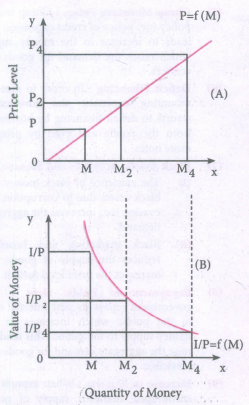
(i) It show's the effect of changes in the quantity of money on the price level.
(ii) When quantity of money is OM1, the price level is OP1.
(iii) When the quantity of money is doubled to OM2, the price level is also doubled to OP2.
(iv) When quantity of money is increased four-fold to OM4, the price level also increases by 4 times to OP4 his relationship is shown by the curve OP = f(M) from the origin at 45o.
Quantity of money
(i) Fig B shows the inverse relation between the quantity of money and the value of money.
(ii) Value of money is taken on the vertical axis.
(iii) When the quantity of money is OM1, the value of money is OI / P1.
(iv) When quantity of money is doubled to OM2, the value of money becomes one half of what it was before (OI / P2)
(v) When quantity of money increases by the four fold to OM4, the value of among is reduced by OI / P4
(vi) This inverse relationship between the quantity of money and the value of money is shown by downward sloping curve 1 / OP= f(M).
7.
Law
According to Keynes, "men are disposed as a rule and on the average to increase their consumption as their income increases but not by as much as the increáse in their income".
Propositions
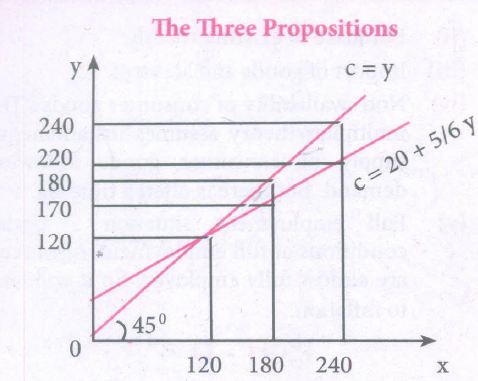
1. When income increases, consumption expenditure also increases, but by a smaller amount
(a) When income increases from 120 to 180; consumption also increases from 120 to 170 but the increase in consumption is less than the increase in income, 10 is saved.
2. The increased income will be divided in some proportion between consumption expenditure and saving
(a) When income increases to 180 and 240, it is divided between consumption (170 and 220) and saving (10 and 20)
3. Incrcascs in income always lead to in incrcase in both consumption and saving
(a) Increases in income to 180) and 240; lead to increased consumption 170 and 220; increased saving 10 and 20.
(b) It is clear from the widening area below the C curve and the saving gap between 45o line and C curve.
| Y | C | S |
|---|---|---|
| 120 | 120 | 0 |
| 180 | 170 | 10 |
| 240 | 220 | 20 |
8.
Introduction:
National income can be measured by the social accounting method. Under this method, the transactions among various sectors such as firms, households, government are recorded and their interrelationships traced.
Firms:
undertake productive activities. They employ factors of production to produce goods and services.
Households:
Households are consuming entities. They represent the factors of production, who receive payment for services rendered by them to firms. (i) Households consume the goods produced by the firms. There is a circular flow of money between these two groups.
Government:
The Government sector refers to the economic transactions of public bodies at all levels-centre, state and local. Their purchases may be financed through taxation, public borrowings. The government provides public health, education. They satisfy the collective wants of society. But Post Offices and railways are separated from the Government sector and included as "Firms".
Rest of the world:
It relates to international economic transactions - income, export, import external loan transaction, and allied overseas investment income and payments.
Capital sector:
(i) Capital sector refers to saving and investment activities. It includes the transactions of banks, insurance corporations, financial houses. These are not included under "Firms".
(ii) The economy is also divided into primary, secondary tertiary and quaternary sectors.
Conclusion:
The social accounting framework is useful for economists as well as policy makers, because it represents the major economic flows and statistical relationships among various sectors of the economic system. It is possible to forecast the trends of economy more accurately.
9.
1. Capitalism and socialism are two extreme and opposite approaches.
2. In capitalism, there is total freedom but in socialism, there is no freedom at all.
3. In capitalism, there is private ownership of means of production but there is public ownership of means of production in socialism.
4. Profit is the driving force behind all economic activities in capitalism but it is social welfare under socialism.
5. Capitalism enjoys free market but in socialism there is central planning.
6. There is unequal income distribution in capitalism but there is equal income distribution in socialism.
7. The major problem in capitalism is inequality but it is inefficiency in socialism.

12th Standard Syllabus & Materials
12th Standard
TN 12th Computer Applications களப்பெயர் முறைமை (DNS) Sample Question Papers Study Material - QB365 Set A
NEW12th Standard
TN 12th Computer Applications வலையமைப்பு எடுத்துக்காட்டுகள் மற்றும் நெறிமுறைகள் Sample Question Papers Study Material - QB365 Set A
NEW12th Standard
TN 12th Computer Applications கணினி வலையமைப்பு ஓர் அறிமுகம் Sample Question Papers Study Material - QB365 Set A
NEW12th Standard
TN 12th Computer Applications PHP-உடன் MySQL-ஐ இணைத்தல் Sample Question Papers Study Material - QB365 Set A



Tamilnadu Stateboard 12th Standard Subjects

Maths

Chemistry

Physics

Biology

Computer Science

Business Maths and Statistics
Economics

Commerce

Accountancy

History

Computer Applications
Biology
Computer Technology
Computer Applications
Computer Science
Business Maths and Statistics
Commerce
Economics
Maths
Chemistry
Physics
Computer Technology
History
Accountancy

Tamil

English

French
Tamilnadu Stateboard Standards
