
 100% FREE ACCESS
12th Standard Syllabus & Materials
12th Standard
TN 12th Computer Applications மின்னணு தரவு பரிமாற்றம் Sample Question Papers Study Material - QB365 Set A
NEW12th Standard
TN 12th Computer Applications மின் - வணிக பாதுகாப்பு அமைப்புகள் Sample Question Papers Study Material - QB365 Set A
NEW12th Standard
TN 12th Computer Applications மின்னணு செலுத்தல் முறைகள் Sample Question Papers Study Material - QB365 Set A
NEW12th Standard
TN 12th Computer Applications மின் - வணிகம் Sample Question Papers Study Material - QB365 Set A
NEW12th Standard
TN 12th Computer Applications திறந்த மூல கருத்துருக்கள் Sample Question Papers Study Material - QB365 Set A
NEW12th Standard
TN 12th Computer Applications வலையமைப்பு வடமிடல் Sample Question Papers Study Material - QB365 Set A

Published on: 30/09/2020
12th Standard Economics English Medium Sample 5 Mark Creative Questions (New Syllabus 2020)
Download Tamil Nadu 12th Standard Economics question papers, model tests, one-mark questions, important questions, and public exam papers in PDF format. Free study materials and answer keys for TN State Board students.
Questions + Answers key
Take MCQ Economics Test
1.
List the Revenue of Union Sources.
2.
Distinguish between NBFC and Other Commercial Bank.
3.
Compare and contrast primary and secondary data.
4.
Compare and contrast the “Planning Commission” and NITI Aayog”.
5.
Explain the supply of Money and determinants of money supply in India.
6.
Discuss the concept of “Factor Cost”.
7.
Explain any three causes of air pollution.
8.
State the objectives of SAARC.
9.
Explain the disadvantages of FDI.
10.
Explain consumption function with the help of diagram.
11.
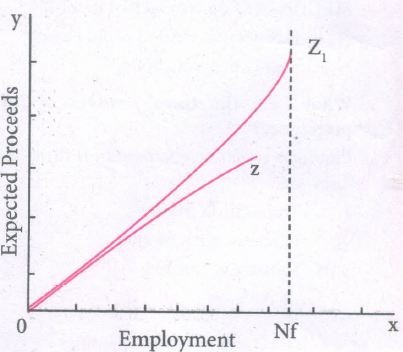
Draw the diagram for Aggregate supply curves diagram.
12.
Explain the Demerits of capitalism.
1.
1. Corporation tax.
2. Currency, coinage and legal tender, foreign exchange.
3. Duties of customs including export duties.
4. Duties of excise on tobacco and certain goods manufactured or produced in India.
5. Estate duty in respect of property other than agricultural land.
6. Fees in respect of any of the matters in the Union List, but not including any fees taken in any Court.
7. Foreign Loans.
8. Lotteries organized by the Government of India or the Government of a State.
9. Post Office Savings Bank.
10. Posts and Telegraphs, telephones, wireless, Broadcasting and other forms of communication.
11. Property of the Union.
12. Public Debt of the Union.
13. Railways.
14. Rates of stamp duty in respect of Bills of Exchange, Cheques, Promissory Notes, etc.
15. Reserve Bank of India.
16. Taxes on income other than agricultural income.
17. Taxes on the capital value of the assets, exclusive of agricultural land of individuals and companies.
18. Taxes other than stamp duties on transactions in stock exchanges and future markets.
19. Taxes on the sale or purchase of newspapers and on advertisements published therein.
20. Terminal taxes on goods or passengers, carried by railways, sea or air.
2.
| BASIS | NBFC | BANK |
| Meaning | An NBFC is a company that provides banking services to people without holding a bank license. | The bank is a government-authorized financial intermediary that aims at providing banking services to the general public. |
| Demand Deposit | Not Accepted | Accepted |
| Payment and Settlement system | Not a part of a system. | Part of the system. |
| Maintenance of Reserve Ratios | Not required | Compulsory |
| Deposit insurance facility | Not available | Available |
| Credit creation | NBFC do not create credit | Banks create credit. |
| Transaction services | Not provided by NBFC. | Provided by banks. |
3.
| BASIS FOR COMPARISON |
PRIMARY DATA | SECONDARY DATA |
| Meaning | Those data which do not ready exist in any form, and thus have to be collected for the first time from the primary source(s). | They already exist in zome form: published or npublished in an identifiable secondary source. |
| Nature | Real time data - first-time collected | Past data - available from published source(s) |
| Process | Very involved | Quick and easy |
| Source | Surveys, observations, experiments, questionnaire, personal interview, etc. |
Government publications, websites, books, journal articles, internal records etc. Eg. Data from CSO, NSSO, RBI |
| Cost-effectiveness | Expensive | Economical |
| Collection time | Long | Short |
| Form | Crude form | Refined form |
| Accuracy and Reliability | More | Relatively less |
4.
I. Classification on the Basis of Benefit:
| BASIS FOR COMPARISON | PLANNING COMMISSION | NITI AAYOG |
|---|---|---|
| POWERS | Enjoyed the powers to allocate funds to ministries and state governments. | To be an advisory body or a think-tank. The powers to allocate funds might be vested in the finance ministry. |
| STATE’S ROLE | States' role was limited to the National Development Council and annual interaction during Plan meetings. | State governments are expected to play a more significant role than they did in the Planning Commission. |
| MEMBERS | The commission reported to National Development Council that had state chief ministers and lieutenant governors | Governing Council has state chief ministers and lieutenant governors |
| CHAIR-PERSON | Had deputy chairperson, a member secretary, and full-time members | New posts of CEO, of secretary rank, and Vice-Chairperson. Will also have five full-time members and two part-time members. Four cabinet ministers will serve as ex-o official members. |
| POLICY FORMULATION | Policy was formed by the commission and states were then consulted about allocation of funds | Consulting states while making policy and deciding on funds allocation. Final policy would be a result of that. |
| FUNDS ALLOCATION | Had power to decide allocation of government funds for various programs at national and state levels | No power to allocate funds |
| APPROVAL OF PROJECTS |
Imposed policies on states and tied allocation of funds with projects it approved. | NITI is a think-tank and does not have the power to impose policies. |
5.
Money Supply in India
Money supply is a stock variable. RBI publishes information for four alternative
measures of Money supply, namely M1, M2, M3 and M4.
M1 = Currency, coins and demand deposits
M2 = M1 + Savings deposits with post office savings banks
M3 = M2 + Time deposits of all commercial and cooperative banks
M4 = M3 + Total deposits with Post offices.
M1 and M2 are known as narrow money
M3 and M4 are known as broad money
Determinants of Money Supply
1. Currency Deposit Ratio (CDR); It is the ratio of money held by the public in currency to that they hold in bank deposits.
2. Reserve deposit Ratio (RDR); Reserve Money consists of two things (a) vault cash in banks and (b) deposits of commercial banks with RBI.
3. Cash Reserve Ratio (CRR); It is the fraction of the deposits the banks must keep with RBI.
4. Statutory Liquidity Ratio (SLR); It is the fraction of the total demand and time deposits of the commercial banks is the form of specified liquid assets.
6.
1. There are a number of inputs that are included into a production process when producing goods and services. These inputs are commonly known as factors of production and include things such as land, labour, capital and entrepreneurship.
2. Producers of goods and services incur a cost for using these factors of production. These costs are ultimately added onto the price of the product.
3. The factor cost refer to the cost of production that is incurred by a firm when producing goods and services.
4. Examples of such production costs include the cost of renting machines, purchasing machinery and land, paying salaries and wages, cost of obtaining capital, and the profit margins that are added by the entrepreneur.
5. The factor cost does not include the taxes that are paid to the government since taxes are not directly involved in the production process and, therefore, are not part of the direct production cost.
6. However, subsidies received are included in the factor cost as subsidies are direct inputs into the production.
7.
1. Vehicle exhaust smoke: Vehicles smoke happens to release high amounts of Carbon monoxide. Millions of vehicles are operated every day in cities, each one leaving behind its own carbon footprint on the environment.
2. Fossil fuel based power plants: Fossil fuels also present a wider scale problem when they are burned for energy in power plants. Chemicals like sulfur dioxide are released during the burning process, which travel straight into the atmosphere. These types of pollutants react with water molecules to yield something known as acid rain.
3. Exhaust from Industrial Plants and Factories: Heavy machineries located inside big factories and industrial plants also emit pollutants into the air.
4. Construction and Agricultural activities: Potential impacts arising from the construction debris would include dust particles and gaseous emissions from the construction sites. Likewise, using of ammonia for agriculture is a frequent by product that happens to be one of the most dangerous gases affecting air.
5. Natural Causes: Earth is one of the biggest polluters itself, through volcanoes, forest fires, and dust storms. They are nature-borne events that dump massive amounts of air pollution into the atmosphere.
6. Household activities: Household activities like cooking, heating and lighting, use of various forms of mosquito repellents, pesticides and chemicals for cleaning at home and use of artificial fragrances are some of the sources that contribute to air pollution.
8.
(i) To promote the Welfare of the people of south Asia and improve their quality of life.
(ii) To accelerate economic growth, social progress and cultural development in the region.
(iii) To promote and strengthen collective self reliance among the countries of south Asia.
(iv) To contribute to mutual trust and understanding and appreciation of another's problems.
(v) To strengthen co-operation with other developing countries
(vi) To strengthen co-operation among themselves in international forums on matters of common interest.
(vii) To co-operate with international and regional organisations with similar aims and purpose.
9.
(i) Private foreign capital tends to flow to the high profit areas rather than to the priority sectors.
(ii) The technologies brought in by the foreign investor may not be appropriate to the consumption needs, size of the domestic market etc.
(iii) Foreign investment, sometimes, have unfavorable effect on the Balance of Payments of a country because when the drain of foreign exchange by way of royalty, dividend, etc. is more than the investment made by the foreign concerns.
(iv) Foreign capital sometimes interferes in the national politics.
(v) Foreign investors sometimes engage in unfair and unethical trade practices.
(vi) Often, there are several costs associated with encouraging foreign investment.
(iv) Foreign investment in some cases leads to the destruction.
10.
Meaning of consumption function.
(i) Propensity to consume refers to income consumption relationship.
(ii) Consumption function is a "functional relationship between two aggregates viz. total consumption and gross national income."
(iii) C = f(Y)
(iv) C = Consumption
Y = Income
f = Function
(v) Thus the consumption function indicates a functional relationship between C and Y.
(vi) C is the dependent variable and Y is the independent variable. i.e. C is determined by Y.
(vii) Based on the ceteris paribus (other things being same) assumption, as only income consumption relationship is considered.
(viii) All possible influences on consumption are held constant.
(ix) A hypothetical consumption schedule is given in table.
Income - Consumption Schedule (Rs.Cores)
| Income Y | Consumption C | Savings S |
|---|---|---|
| 0 | 20 | -20 |
| 60 | 70 | -10 |
| 120 | 120 | 0 |
| 180 | 170 | 10 |
| 240 | 220 | 20 |
| 300 | 270 | 30 |
| 360 | 320 | 40 |
If we take C = 100 + 0.8Y, then MPC = 0.8
Here if Y = 0, C = 100; if Y = 100, C = 180
If Y = 200, C = 260
If Y =300, C = 340 (MPC = \(\frac{ΔC}{ΔY}\) = 0.8)
In mathematical terms
C = a + b Y or C = 20 + 0.8Y
Where a > 0 and b < 1
C = Consumptiona = Constant or intercept = 20
Y = Income
b = MPC (Marginal prosperity to consume)
8.0 = \(\frac{ΔC}{ΔY}\)
(x) The above table shows that consumption is an increasing function of income because consumption expenditure increases with increase in income.
(xi) When income is zero, people spend out of their past savings on consumption because they must eat in order to live (Autonomous consumption).
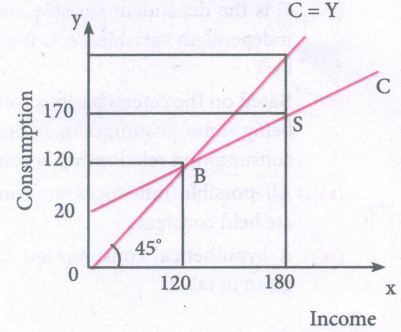
Here, when Y = 120, C = 120 (point B in the diagram)
When Y = 180, C = 170, S = 10 (point S in the diagram)
If oY increases to 360, C = 320, S = 40
(xii) In the diagram, income is measured horizontally.
(xiii) Consumption is measured vertically.
(xiii) In 45 line at all levels income and consumption are equal.
(xv) The consumption function measures not only the amount spent on consumption but also the amount saved.
(xvi) The propensity to save is merely the propensity not to consume.
11.
12.
Demerits of Capitalism:
1. Concentration of Wealth and Income :
Capitalism causes concentration of wealth and income in a few hands and thereby increases inequalities of income.
2. Wastage of Resources Large amount of resources are wasted on competitive advertising and duplication of products.
3. Class Struggle: Capitalism leads to class struggle as it divides the society into capitalists and workers.
4. Business Cycle: Free market system leads to frequent violent economic fluctuations and crises.
5. Production of non essential goods: Even the harmful goods are produced if there is possibility to make profit.

12th Standard Syllabus & Materials
12th Standard
TN 12th Computer Applications களப்பெயர் முறைமை (DNS) Sample Question Papers Study Material - QB365 Set A
NEW12th Standard
TN 12th Computer Applications வலையமைப்பு எடுத்துக்காட்டுகள் மற்றும் நெறிமுறைகள் Sample Question Papers Study Material - QB365 Set A
NEW12th Standard
TN 12th Computer Applications கணினி வலையமைப்பு ஓர் அறிமுகம் Sample Question Papers Study Material - QB365 Set A
NEW12th Standard
TN 12th Computer Applications PHP-உடன் MySQL-ஐ இணைத்தல் Sample Question Papers Study Material - QB365 Set A



Tamilnadu Stateboard 12th Standard Subjects

Maths

Chemistry

Physics

Biology

Computer Science

Business Maths and Statistics
Economics

Commerce

Accountancy

History

Computer Applications
Biology
Computer Technology
Computer Applications
Computer Science
Business Maths and Statistics
Commerce
Economics
Maths
Chemistry
Physics
Computer Technology
History
Accountancy

Tamil

English

French
Tamilnadu Stateboard Standards
