
 100% FREE ACCESS
12th Standard Syllabus & Materials
12th Standard
TN 12th Maths Applications of Matrices and Determinants Sample Question Papers Study Material - QB365 Set A
NEW12th Standard
TN 12th Computer Applications மின்னணு தரவு பரிமாற்றம் Sample Question Papers Study Material - QB365 Set A
NEW12th Standard
TN 12th Computer Applications மின் - வணிக பாதுகாப்பு அமைப்புகள் Sample Question Papers Study Material - QB365 Set A
NEW12th Standard
TN 12th Computer Applications மின்னணு செலுத்தல் முறைகள் Sample Question Papers Study Material - QB365 Set A
NEW12th Standard
TN 12th Computer Applications மின் - வணிகம் Sample Question Papers Study Material - QB365 Set A
NEW12th Standard
TN 12th Computer Applications திறந்த மூல கருத்துருக்கள் Sample Question Papers Study Material - QB365 Set A

Published on: 02/09/2022
QB365 provides a detailed and simple solution for every Possible Creative Questions in Class 12 Economics Subject - Theories of Employment and Income , English Medium. It will help Students to get more practice questions, Students can Practice these question papers in addition to score best marks.
Download Tamil Nadu 12th Standard Economics question papers, model tests, one-mark questions, important questions, and public exam papers in PDF format. Free study materials and answer keys for TN State Board students.
Questions + Answers key
Take MCQ Economics Test
1.
Explain Say's law of market.
2.
Explain the classical theory of employment.
3.
What are the economic costs of unemployment?
4.
Explain how it might be possible for the unemployment rate to decline even though the number of unemployed is growing
5.
Aggregate Demand Function (ADF) – Explain.
6.
Write a note of John Maynard Keynes.
7.
Comment - “Ex ante and Ex post in Says’ Law".
8.
Distinguish between Fictional and Structural unemployment.
9.
What are the components of aggregate supply?
10.
Write the criticism of Say's Law.
11.
Give the factors on which the aggregate demand depends.
12.
Write a short note on effective demand?
13.
Explain the classical theory about unemployment?
1.
1. Say's law of market is the core of the classical theory of employment.
2. J.B. Say, a French Economist and an industrialist was influenced by Adam Smith and David Ricardo.
3. Say's law of market is "Supply creates its own Demand"
4. There cannot be general over production or unemployment.
5. According to Say, "When goods are produced by firms, they pay rewards to the factors of production. The households after receiving rewards for the factors of production, spend the amount on buying goods and services produced by them. Therefore, each product produced in the economy creates demand equal to its value in the market.
6. For the economy as a whole, total production equals total income.
2.
1. There is no single theory which could be labelled as classical theory of employment.
2. The Classical theory is composed of different views of classical economists on the issue of income and employment in the economy.
3. Since the publication of Adam Smith's book Wealth of Nations (1776), the classical theory was developed by David Ricardo, J.S. Mill, J.B. Say and A.C. Pigou.
4. Classical economists assumed full employment without inflation in the long period.
5. They also assumed that wages and prices of goods were flexible and the competitive market existed in the economy.
3.
i. Whenever resources are unemployed there is always some sort of waste.
ii. In the case of unemployment it manifests itself in the potential production of goods and services irretrievably lost.
iii. There are also other costs such as increased burdens to taxpayers to fund unemployment compensation programs and the individual cost in terms of a loss of self esteem and dignit
4.
i. This may be possible if the number of new entrants into the labor force is increasing at a greater rate than the number of people who are becoming unemployed.
ii. Since the unemployment rate is a ratio and the numerator is growing more slowly than the denominator then the unemployment rate will fall.
5.
1. In the Keynesian model, output is determined mainly by aggregate demand.
2. The aggregate demand is the amount of money which entrepreneurs expect to get by selling the output produced by the number of labourers employed.
Aggregate demand has the following four components:
1. Consumption demand
2. Investment demand
3. Government expenditure and
4. Net Export (export – import)
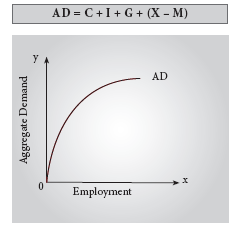
i. Figure explains that aggregate demand price increases or decreases with an increase or decrease in the volume of employment.
ii. Aggregate demand curve increases at an increasing rate in the beginning and then increases at a decreasing rate.
6.
(i) John Maynard Keynes was one of the most influential economists of the 20th century.
(ii) He was born in Cambridge in1883. In addition to his work as an economist he held position as civil servant a director of the Bank of England, and leader of British delegation of negotiators at the Bretton Woods conference at points in his career.
(iii) Economic theory based on his idea is known as Keynesian economics, and remain highly influential today, particularly in the field of macroeconomics.
7.
1. The statement that supply creates own demand or equivalently that the aggregate in investment equals the aggregate saving always holds good in the ex post sense since it is simply an accounting identity.
2. Say’s law of markets, however, states that these two are equal in ex ante sense, i.e the total quantity which people produce i.e., aggregate supply must be equal to the total quantity which they plan to buy i.e., aggregate demand.
8.
| S.No | Fictional unemployment | Structural unemployment |
| 1 | Frictional unemployment arises due to imbalance between supply of labour and demand for labour | Structural unemployment is due to drastic change in the structure of the society |
| 2. | This is because of immobility of labour, lack of necessary skills, break down of machinery, shortage of raw materials etc. | Lack of demand for the product or shift in demand to other products cause this type of unemployment |
| 3. | The persons who lose jobs and in search of jobs are also included under frictional unemployment | This kind of unemployment results from massive and deep rooted changes in economic structure |
9.
The components of aggregate supply are,
(i) Aggregate (desired) consumption expenditure (C).
(ii) Aggregate (desired) private savings (S).
(iii) Net tax payments (T) (Total tax payment to be received by the government minus transfer payments, subsidy and interest payments to be incurred by the government) and
(iv) Personal (desired) transfer payments to the foreigners (Rf) (eg. Donations to international relief efforts)
10.
The following are the criticisms against Say's law:
(i) According to Keynes, supply does not create its demand. It is not applicable where demand does not increase as much as production increases.
(ii) Automatic adjustment process will not remove unemployment. Unemployment can be removed by increase in the rate of investment.
(iii) Money is not neutral. Individuals hold money for unforeseen contingencies while businessmen keep cash reserve for future activities.
11.
The aggregate demand is the amount of money which entrepreneurs expect to get by selling the output produced by the number of labourers employed. Therefore, it is the expected income or revenue from the sale of output at different levels of employment.
Aggregate demand has the following four components:
(i) Consumption demand
(ii) Investment demand
(iii) Government expenditure and
(iv) Net Export (export - import)
12.
(i) Effective demand denotes money actually spent by the people on products of industry.
(ii) The money which entrepreneurs receive is paid in the form of rent, wages, interest and profit.
(iii) Therefore effective demand equals national income.
(iv) An increase in the aggregate effective demand would increase the level of employment. A decline in total effective demand would lead to unemployment. Therefore,
(v) Thus the total employment of a country can be determined with the help of total demand of a country.
13.
(i) The classical theory of employment is composed of different views of classical economists on the issue of income and employment in the economy.
(ii) Classical economists assumed that the economy operates as the live of full employment without inflation in the long period.
(iii) They also assumed that wages and prices of goods were flexible and the competitive market existed in the economy.

12th Standard Syllabus & Materials
12th Standard
TN 12th Computer Applications வலையமைப்பு வடமிடல் Sample Question Papers Study Material - QB365 Set A
NEW12th Standard
TN 12th Computer Applications களப்பெயர் முறைமை (DNS) Sample Question Papers Study Material - QB365 Set A
NEW12th Standard
TN 12th Computer Applications வலையமைப்பு எடுத்துக்காட்டுகள் மற்றும் நெறிமுறைகள் Sample Question Papers Study Material - QB365 Set A
NEW12th Standard
TN 12th Computer Applications கணினி வலையமைப்பு ஓர் அறிமுகம் Sample Question Papers Study Material - QB365 Set A



Tamilnadu Stateboard 12th Standard Subjects

Maths

Chemistry

Physics

Biology

Computer Science

Business Maths and Statistics
Economics

Commerce

Accountancy

History

Computer Applications
Biology
Computer Technology
Computer Applications
Computer Science
Business Maths and Statistics
Commerce
Economics
Maths
Chemistry
Physics
Computer Technology
History
Accountancy

Tamil

English

French
Tamilnadu Stateboard Standards
