
 100% FREE ACCESS
12th Standard Syllabus & Materials
12th Standard
TN 12th Maths Applications of Matrices and Determinants Sample Question Papers Study Material - QB365 Set A
NEW12th Standard
TN 12th Computer Applications மின்னணு தரவு பரிமாற்றம் Sample Question Papers Study Material - QB365 Set A
NEW12th Standard
TN 12th Computer Applications மின் - வணிக பாதுகாப்பு அமைப்புகள் Sample Question Papers Study Material - QB365 Set A
NEW12th Standard
TN 12th Computer Applications மின்னணு செலுத்தல் முறைகள் Sample Question Papers Study Material - QB365 Set A
NEW12th Standard
TN 12th Computer Applications மின் - வணிகம் Sample Question Papers Study Material - QB365 Set A
NEW12th Standard
TN 12th Computer Applications திறந்த மூல கருத்துருக்கள் Sample Question Papers Study Material - QB365 Set A

Published on: 02/09/2022
QB365 provides a detailed and simple solution for every Possible Creative Questions in Class 12 Economics Subject - Theories of Employment and Income , English Medium. It will help Students to get more practice questions, Students can Practice these question papers in addition to score best marks.
Download Tamil Nadu 12th Standard Economics question papers, model tests, one-mark questions, important questions, and public exam papers in PDF format. Free study materials and answer keys for TN State Board students.
Questions + Answers key
Take MCQ Economics Test
1.
Enumerate the determinants of effective demand.
2.
Explain the concept of effective demand
3.
State the ‘Full Employment’ in The Classical view.
4.
In each of the following scenarios, classify the individual as frictionally, structurally, or cyclically unemployed. Explain your classification.
(a) There has been a general economic slow down. Because of weak demand, Kumar has lost his portering job at the railway station.
(b) Sathish, a newly qualified dental graduate, is looking for a place to set up practice.
(c) Latha is thrown out of work by the introduction of a more mechanized production process.
(d) Devi, a computer programmer with a large bank, quit her job two months ago in search of a better-paid programming position. She is still looking.
5.
Classify the following as either employed, unemployed or not in the labor force
| An individual who has been temporarily absent due to caring for an elderly relative whether they are paid or not. | |
| A person 18 years old or older who works without pay for 15 or more hours per week in a family enterprise. | |
| Someone who works for pay in his or her own business. | |
| A woman who spends five hours a week sending bills to her husband's clients. She is not paid for her work. Otherwise she performs non-market work at home. | |
| A retired person | |
| A person who quits one job in favor of looking for work elsewhere but has yet to find work. |
6.
Comparison of Classicism and Keynesianism.
7.
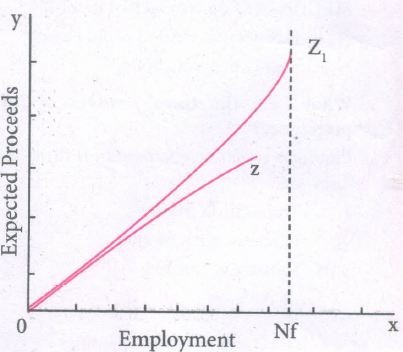
Draw the diagram for Aggregate supply curves diagram.
8.
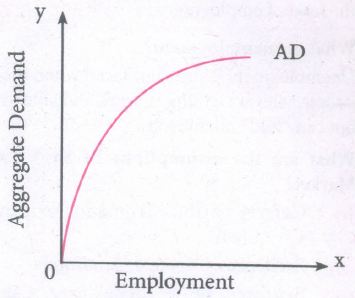
Draw the diagram ADF.
9.
List out all assumption of say's law of market?
10.
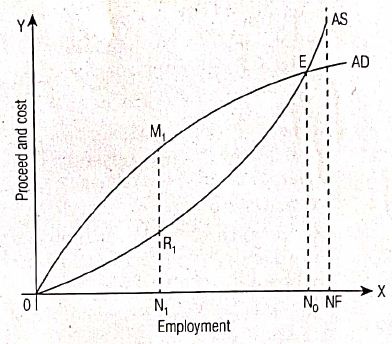
Narrate the equilibrium between ADF and ASF with diagram
1.
1. The effective demand is determined by consumption and investment expenditures.
2. The consumption function depends on the income of the people and marginal propensity to consume.
3. According to Keynes, if income increases, consumption will also increase but by less than the increase in income.
4. The rate of interest and marginal efficiency of capital determine the investment levels.
5. Rate of interest depends on money supply and liquidity preference.
6. Liquidity preference is based on transaction motive, precautionary motive and speculative motive.
7. Marginal Efficiency of Captial depends on Prospective yield of capital asset and supply price of capital.
2.
Introduction
The starting point of Keynes theory of employment and income is the principle of effective demand.
Meaning
Effective demand denotes money actually spent by the people on products of industry. The money which entrepreneurs receive is paid in the form of rent, wages, interest and profit. Effective demand = national income.
Explanation
Effective demand signifies the money spent on consumption of goods and services and on investment. The total expenditure is equal to the national income, which is equal to the national output.
The relationship between employment and output of an economy depends on the level of effective demand
Effective Demand = Y= C+ I = Output = Employment
Effective demand determines the level of employment. When effective demand increases, employment will increase and vice versa
3.
i. The classical economists always believed in the existence of full employment in the economy.
ii. To them full employment was a normal situation and any deviation from this was regarded as something abnormal.
iii. According to Pigou, the greatest exponent of the classical view, the tendency of the economic system was to automatically provide full employment in the labour market.
iv. Full employment exists “when everybody who at the running rate of wages wishes to be employed”.
v. Those who are not prepared to work at the existing wage rate are not unemployed in the Pigovian sense because they are voluntarily unemployed.
vi. There is, however, no possibility of involuntary unemployment in the sense that people are prepared to work but they do not find work
4.
(a) Kumar is cyclically unemployed. He has lost his job as a result of the general economic recession.
(b) Sathish is frictionally unemployed. Job openings exist for him. It is merely a case of tracking down a position.
(c) Latha is structurally unemployed. Unemployment due to technological change in an industry is classified as structural.
(d) Devi, is frictionally unemployed. Job openings exist for her.
5.
| An individual who has been temporarily absent due to caring for an elderly relative whether they are paid or not | Employed |
| A person 18 years old or older who works without pay for 15 or more hours per week in a family enterprise | Employed |
| Someone who works for pay in his or her own business | Employed |
| A woman who spends five hours a week sending bills to her husband's clients. She is not paid for her work. Otherwise she performs non-market work at home | Not in the labour force |
| A retired person | Not in the labour force |
| A person who quits one job in favor of looking for work elsewhere but has yet to find work | Unemployed |
6.
| S.No | Keynesianism | Classicism |
|---|---|---|
| 1. | Short-run equilibrium | Long-run equilibrium |
| 2. | Saving is a vice | Saving is a social virtue |
| 3. | The function of money is a medium of exchange on the one side and a store of value on the other side. | The function of money is to act as a medium of exchange |
| 4. | Macro approach to national problems | Micro foundation to macro problems |
| 5. | State intervention is advocated | Champions of Laissez-fair policy |
| 6. | Applicable to all situations - full employment and less than full employment. | Applicable only to the full employment situation |
| 7. | Capitalism has inherent contradictions | Capitalism is well and good |
| 8. | Budgeting should be adjusted to the requirements of economy. | Balanced budget |
| 9. | The equality between saving and investment is advanced through changes in income. | The equality between saving and investment is achieved through chances of rate of interest. |
| 10. | Rate of interest is determined by the demand for and supply of money. | Rate of interest is determined by saving and investment. |
| 11. | Rate of interest is a flow. | Rate of interest is a stock. |
| 12. | Demand creates its own supply. | Supply creates its own demand. |
| 13. | Rate of interest is a reward for parting with liquidity. | Rate of interest is a reward for saving. |
7.
8.
9.
Assumption of the Say's law of market:
(i) No single buyer (or) seller of commodity or an input can affect price.
(ii) Full employment.
(iii) People are motivated by self interest and self-interest determines economic decisions.
(iv) The laissez fair policy is essential for an automatic and self adjusting process full employment.
(v) There will be a perfect competition.
(vi) There is wage - price flexibility.
(vii) Money acts only as a medium of exchange.
(viii) Long run analysis.
(ix) There is no possibility for over production or unemployment.
(x) Unutilized resources used until reaches full employment.
(xi) No Government intervention automatic Price adjustment mechanism operated.
10.
Introduction
Under the Keynes theory of employment, a simple two sector economy consisting of the household sector and the business sector is taken to understand the equilibrium between ADF and ASF.
Explanation
1. AD and AS reach equilibrium at E. The employment level is No
2. At ON1employment, the aggregate supply is N1R1. But the aggregate demand is M1N1.
3. The expected level of profit is M1R1.
4. To attain this level of profit, entrepreneurs will employ more labourers, till they reach point E i.e. ONo.
5. Beyond ONo, the aggregate demand curve is below the aggregate supply curve showing loss.
6. So they will never employ more than ONo labour.
7. The equilibrium level of employment need not be the full employment level (No).
8. The difference between No - N1 is the level of unemployment.
Conclusion
Thus the concept of effective demand becomes significant in explaining the under employment equilibrium.

12th Standard Syllabus & Materials
12th Standard
TN 12th Computer Applications வலையமைப்பு வடமிடல் Sample Question Papers Study Material - QB365 Set A
NEW12th Standard
TN 12th Computer Applications களப்பெயர் முறைமை (DNS) Sample Question Papers Study Material - QB365 Set A
NEW12th Standard
TN 12th Computer Applications வலையமைப்பு எடுத்துக்காட்டுகள் மற்றும் நெறிமுறைகள் Sample Question Papers Study Material - QB365 Set A
NEW12th Standard
TN 12th Computer Applications கணினி வலையமைப்பு ஓர் அறிமுகம் Sample Question Papers Study Material - QB365 Set A



Tamilnadu Stateboard 12th Standard Subjects

Maths

Chemistry

Physics

Biology

Computer Science

Business Maths and Statistics
Economics

Commerce

Accountancy

History

Computer Applications
Biology
Computer Technology
Computer Applications
Computer Science
Business Maths and Statistics
Commerce
Economics
Maths
Chemistry
Physics
Computer Technology
History
Accountancy

Tamil

English

French
Tamilnadu Stateboard Standards
