
 100% FREE ACCESS
12th Standard Syllabus & Materials
12th Standard
TN 12th Computer Applications மின்னணு தரவு பரிமாற்றம் Sample Question Papers Study Material - QB365 Set A
NEW12th Standard
TN 12th Computer Applications மின் - வணிக பாதுகாப்பு அமைப்புகள் Sample Question Papers Study Material - QB365 Set A
NEW12th Standard
TN 12th Computer Applications மின்னணு செலுத்தல் முறைகள் Sample Question Papers Study Material - QB365 Set A
NEW12th Standard
TN 12th Computer Applications மின் - வணிகம் Sample Question Papers Study Material - QB365 Set A
NEW12th Standard
TN 12th Computer Applications திறந்த மூல கருத்துருக்கள் Sample Question Papers Study Material - QB365 Set A
NEW12th Standard
TN 12th Computer Applications வலையமைப்பு வடமிடல் Sample Question Papers Study Material - QB365 Set A

Published on: 12/02/2020
12th Standard Economics Important Question-II-2019-2020
Download Tamil Nadu 12th Standard Economics question papers, model tests, one-mark questions, important questions, and public exam papers in PDF format. Free study materials and answer keys for TN State Board students.
Questions + Answers key
Take MCQ Economics Test
1.
Find the meaning of following statement. “Paid by a shopkeeper or retailer, who then shifts the tax burden to customers by charging sales tax on goods and services.”
Trade Tax
GST
Sales Tax
Revenue Tax
2.
Find the author of following statement. “Public finance is an investigation into the nature and principles of the state revenue and expenditure”.
Ricardo
Dalton
Marshall
Adam Smith
3.
The RBI uses three policy tools to manipulate the money supply: ______ which affect reserves and the monetary base; changes in _____, which affect reserves and the monetary base by influencing the quantity of discount loans; and changes in _____, which affect the money multiplier.
market operations; the discount rate; margin requirements
open market operations; the discount rate; reserve requirements
the discount rate; open market operations; margin requirements
the discount rate; open market operations; reserve requirements
4.
Expand SIDC
State Industrial Development Company
Small Industrial Development Corporation
State Investment Development Corporation
State Industrial Development Corporation
5.
Expand FEMA.
Factory Exchange Management Act
Foreign Exchange Management Act
Foreign Economic Management Act
Foreign Exchange Maintenance Act
6.
Where is the head-quarter of ASEAN located?
Bangkok
Chili
New Dehli
Shangai
7.
The name “International Bank for Reconstruction and Development” was first suggested by ___________ to the drafting committee.
China
USA
Japan
India
8.
Unemployment means that
People are not willing to work at the going wage rate
At the going wage rate, there are people who want to work but cannot find work.
There are some people who will not work at the going wage rate
There is excess demand in the labour market
9.
Most mixed or capitalist developing countries are limited to an indicative plan, which indicates expectations, aspirations, and intentions
but falls short of authorization
with immediate implementation
of the central bank
of implementation through foreign aid.
10.
Economic development refers to
economic growth
economic growth plus changes in output distribution and economic structure
improvement in the well-being of the urban population
sustainable increases in Gross National Product.
11.
Which is latest member of IMF as 189th member
Czech Republic
Afganistan
Uruguay
Republic of Nauru
12.
Assertion: In developing countries like India, the nature of unemployment is different from that of developed countries.
Reason: In developed countries, the unemployment is purely temporary or cyclical or frictional.
Both A and R are true and R is the correct explanation of A
Both A and R are true but R is not the correct explanation of A
A is true but R is false
A is false but R is true
13.
Which is not a major anti-inflationary fiscal measures are the following
Reduction of Government Expenditure
Public Borrowing
Augmenting Foreign Investment
Enhancing taxation
14.
Assertion: Reduced capital accumulation may discourage entrepreneurs and business men from taking business risk.
Reason: With reduced capital accumulation, the investment will suffer a serious set-back which may have an adverse effect on the volume of production in the country.
Both (A) and (R) are true and (R) is the correct explanation of (A)
Both (A) and (R) are true, but (R) is not the correct explanation of (A)
(A) is true, but (R) is false
(A) is false, but (R) is true
15.
The branch of economics wherein mathematics and statistics are used to measure and analyze economics activities is called _________.
Applied Economics
Econometrics
Statistics
Macro Economics
16.
What is the term given for the following sequence of action?
“Economic theory, Mathematical model of the theory, Economic model of the theory, Data Estimation of econometric model, Hypothesis Testing, Forecasting or prediction Using the model for control or policy purpose”.
Anatomy of Economic Modeling
Anatomy of Mathematical Economic Modeling
Anatomy of Econometric Modeling
None of the above
17.
Who said “Econometrics is concerned with the empirical determination of economic laws”
Galton
H Theil
Fisher
Dalton
18.
(i) Firms, (ii) Households, (iii) Government, (iv) Rest of the world and (v) Capital sector are different elements of _________?
social accounting method
private accounting method
public accounting method
social accounting model
19.
The classical trade theories of Smith and Ricardo predict that
Countries will completely specialize in the production of export goods.
Considerable trade will occur between countries with different levels of technology
Small countries could obtain all of the gains from trade when trading with large countries
All of the above.
20.
The earliest statement of the principle of comparative advantage is associated with
Adam Smith
David Ricardo
Eli Heckscher
Bertil Ohlin
21.
The alkali soils are predominantly located in the _____________
Indo-Gangetic plains
Himalayaas
Southern Peninsula
Western Ghats
22.
Which of the following is not correct:
MPC declines as income increase
MPC is positive but less than one
MPS is always positive
All the above
23.
_____ is also known as ‘sequence multiplier’. In real life, income level does not increase instantly with investment.
Dynamic multiplier
Super multiplier
Static multiplier
Government multiplier
24.
Which is of the following statement is modern theory of trade
It presents a one factor (labour) model
It attributes the differences in the comparative costs to differences in the productive efficiency of workers in the two countries
the phenomenon of international trade on the basis of labour theory of value
It presents a multi - factor (labour and capital) model
25.
In a free-market economy the allocation of resources is determined by:
Votes taken by consumers
A central planning authority
By consumer preferences
The level of profits of firms
26.
Identify which is not an example of capitalistic economy.
The USA economy
Germany economy
Indian economy
Australia economy
27.
The subject Economics is classified into two branches, namely,
Micro Economics and Minor Economics
Micro Economics and Macro Economics
Positive and Normative economics
Deductive and inductive economics
28.
_____________ is the example of negative consumption externality.
Non-smoker
Smoker
Chain smoker
Rare-smoker
29.
__________ are the particles, and gases out comes during the construction and agricultural activates to affect the air.
Dust particles
Gaseous emission
Ammonia
Oxygen gas
30.
Financial operation of the government _____________
Treasury
Bills of payment
Bills of exchange
All the above
31.
K=1/MPS= ____________
\(\frac{ΔP}{ΔQ}\)
\(\frac{C}{4}\times\frac{ΔP}{ΔQ}\)
Value of multiplier
Value of accelerator
32.
Transfer earnings is referred to ______.
Pension payments to retired persons
Income paid as rent to landlord
An interest payments to a capitalist
Medical payments made to an employee of a company
33.
________ plan is made for the period of five years.
Short term plan
Long term plan
Medium term plan
Annual plan
34.
Inventories of finished and unfinished goods are called _________.
Net Investment
Investment
Gross Investment
Both 'a' and 'b'
35.
______________ returns takes place as more workers are employed.
Law of diminishing marginal
Law of equi demand
Law of demand
None of the above
36.
Barter system was introduced by________
Mesopetamia tribes
Babylonian's
Both 'a' and 'b'
None of the above
37.
If Y = 2 - O.2X, then the value of Y intercept is equal to
-0.2
2
0.2X
All of the above
38.
Who stated that statistics as a science of estimates and probabilities.
Horace Secrist
R.A Fisher
Ya-Lun-Chou
Boddington
39.
Short-term plan is also known as________
Controlling Plans
De-controlling Plans
Rolling Plans
De-rolling Plans
40.
41.
42.
Electronic waste is commonly referred as _______
solid waste
composite waste
e-waste
hospital waste
43.
Deficit Budget means
An excess of government's revenue over expenditure
An excess of government's current expenditure over its current revenue
An excess of government's total expenditure over its total revenue
None of above
44.
The direct tax has the following merits except
equity
convenient
certainty
civic consciousness
45.
The term BRIC was coined in
2001
2005
2008
2010
46.
Which of the following is not the member of SAARC?
Pakistan
Sri Lanka
Bhutan
China
47.
48.
In general, a primary reason why nations conduct international trade is because
Some nations prefer to produce one thing while others produce another
Resources are not equally distributed among all trading nations
Trade enhances opportunities to accumulate profits
Interest rates are not identical in all trading nations
49.
Central bank is_____ authority of any country.
Monetary
Fiscal
Wage
National Income
50.
A Commercial Bank is an institution that provides services
Accepting deposits
Providing loans
Both a and b
None of the above
51.
During depression the level of economic activity becomes extremely
high
bad
low
good
52.
MV stands for
demand for money
supply of legal tender money
Supply of bank money
Total supply of money
53.
The sum of the MPC and MPS is________.
1
2
0.1
1.1
54.
The MPC is equal to :
Total spending / total consumption
Total consumption / total income
Change in consumption / change in income
none of the above
55.
The basic concept used in Keynes Theory of Employment and Income is_____.
Aggregate demand
Aggregate supply
Effective demand
Marginal Propensity Consume
56.
________ theory is a turning point in the development of modern economic theory.
Keynes’
Say’s
Classical
Employment
57.
The financial year in India is__________
April 1 to March 31
March 1 to April 30
March 1 to March 16
January 1 to December 31
58.
National income is a measure of the__________ performance of an economy
Industrial
Agricultural
Economic
Consumption
59.
An economy consists of
consumption sector
Production sector
Government sector
All the above
60.
Who is regarded as Father of Modern Macro Economics?
Adam Smith
J M Keynes
Ragnar Frisch
Karl Marx
61.
What the term ‘fiscal economics’ means?
62.
Write a brief note on Bank Rate Policy.
63.
What are The Three Regulatory Pillars of the “World Economic Order”?
64.
What are the differences between centralized and decentralized plan?
65.
Mention the predominant characters of UDCs
66.
Draw the diagram of effective demand
67.
Write any two Criticisms of Say’s Law.
68.
What is Technical Unemployment?
69.
Comment – “Statistics and Education”
70.
How Modern theory of International Trade attributes international differences in comparative costs to?
71.
Mention any two uses of multiplier concept.
72.
What are the “Leakages of Multiplier"? Leakages of multiplier.
73.
List the examples of Home E-Wastes.
74.
Mention the any three Socialist Learning economies.
75.
Mention any two limitations of macroeconomics
76.
What is Net Domestic Product?
77.
What is Gross Domestic Product?
78.
What is meant by Regulation of consumer's credit?
79.
What is Recovery?
80.
What is creeping inflation?
81.
What are the different models of circular flow of income?
82.
What do you mean by Socialism?
83.
What are the kinds of data?
84.
What is Statistics?
85.
Distinguish between economic growth and development.
86.
Define Global warming.
87.
Differentiate tax and fee.
88.
What do you mean by Balance of Payments?
89.
Define Commercial banks.
90.
What is commodity money?
91.
What do you mean by propensity to consume?
92.
What are the components of aggregate supply ?
93.
What is effective demand?
94.
Write the formula for calculating GNP.
95.
Define ‘Economic Model'.
96.
What is the difference between Capital Budget and Revenue Budget?
97.
Write briefly about “Structural Adjustment Facility”
98.
Explain “The Keynes Equation” Keynes equation is expressed as:
99.
State the types of correction on the basis of number of variables studied.
100.
Mention the difference between FDI and FPI.
101.
What are the five types of final goods and services that GNP includes?
102.
Explain the types of water pollution.
103.
List out the limitations of Modern Theory of International Trade?
104.
Write the formula for APC, MPC, APS, MPS.
105.
Explain the concept "economic development".
106.
Write the criticism of Say's Law.
107.
What are the limitation of Macro Economics.
108.
Discuss the important statistical organizations (offices) in India.
109.
Trace the evolution of economic planning in India.
110.
Brief the linkage between economy and environment.
111.
Mention any three methods of redemption of public debt.
112.
Mention the various forms of economic integration.
113.
Explain the Net Barter Terms of Trade and Gross Barter Terms of Trade.
114.
Give a brief note on NBFI.
115.
State Cambridge equations of value of money.
116.
Specify the limitations of the multiplier.
117.
What do you mean by aggregate demand ? Mention its components.
118.
Write briefly about national income and welfare
119.
Distinguish between Capitalism and Globalism.
120.
What are the taxes levied and collected by the union but assigned to the states?
121.
Distinguish between NBFC and Other Commercial Bank.
122.
Explain the steps involved computing the correlation Coefficient.
123.
Discuss the state of FDI in India.
124.
Explain the concepts of macro economics.
125.
Explain Marginal propensity to consume and multiplier, with the help of a diagram.
126.
Discuss the method measuring the National Income by Income Method.
127.
Explain non-economic factors determining development?
128.
Comparison of Classicism and Keynesianism.
129.
Explain Keynes psychological law of consumption function with diagram.
1.
(c)
Sales Tax
2.
(d)
Adam Smith
3.
(b)
open market operations; the discount rate; reserve requirements
4.
(d)
State Industrial Development Corporation
5.
(b)
Foreign Exchange Management Act
6.
(a)
Bangkok
7.
(b)
USA
8.
(b)
At the going wage rate, there are people who want to work but cannot find work.
9.
(a)
but falls short of authorization
10.
(b)
economic growth plus changes in output distribution and economic structure
11.
(d)
Republic of Nauru
12.
(b)
Both A and R are true but R is not the correct explanation of A
13.
(c)
Augmenting Foreign Investment
14.
(a)
Both (A) and (R) are true and (R) is the correct explanation of (A)
15.
(a)
Applied Economics
16.
(a)
Anatomy of Economic Modeling
17.
(b)
H Theil
18.
(a)
social accounting method
19.
(d)
All of the above.
20.
(b)
David Ricardo
21.
(a)
Indo-Gangetic plains
22.
(c)
MPS is always positive
23.
(a)
Dynamic multiplier
24.
(d)
It presents a multi - factor (labour and capital) model
25.
(c)
By consumer preferences
26.
(c)
Indian economy
27.
(b)
Micro Economics and Macro Economics
28.
(a)
Non-smoker
29.
(d)
Oxygen gas
30.
(a)
Treasury
31.
(c)
Value of multiplier
32.
(a)
Pension payments to retired persons
33.
(c)
Medium term plan
34.
(c)
Gross Investment
35.
(a)
Law of diminishing marginal
36.
(a)
Mesopetamia tribes
37.
(b)
2
38.
(d)
Boddington
39.
(a)
Controlling Plans
40.
(c)
41.
(d)
42.
(c)
e-waste
43.
(c)
An excess of government's total expenditure over its total revenue
44.
(b)
convenient
45.
(a)
2001
46.
(d)
China
47.
(d)
48.
(b)
Resources are not equally distributed among all trading nations
49.
(a)
Monetary
50.
(c)
Both a and b
51.
(c)
low
52.
(b)
supply of legal tender money
53.
(a)
1
54.
(c)
Change in consumption / change in income
55.
(c)
Effective demand
56.
(a)
Keynes’
57.
(a)
April 1 to March 31
58.
(c)
Economic
59.
(d)
All the above
60.
(b)
J M Keynes
61.
(i) The term fiscal is derived from Greek word which means basket and symbolizes the public purse.
(ii) Hence the subject ‘Public Finance’ has been newly termed ‘Fiscal Economics’.
62.
(i) The bank rate is the rate at which the Central Bank of a country is prepared to re-discount the first class securities.
(ii) It means the bank is prepared to advance loans on approved securities to its member banks.
63.
The Bretton Woods system gave birth to three international organisations of paramount importance for International Economic affairs
These are:
1. The World Trade Organization (WTO) (the successor of the General Agreement on Tariffs and Trade)
2. The International Monetary Fund (IMF)
3. The World Bank Group These are generally perceived as the three main organisations regulating the international economic order.
64.
| Centralized Plan | Decentralized Plan |
|---|---|
| Under centralized planning, the entire planning process in a country is under a central planning authority. | Under decentralized planning, local organizations and institutions formulate, adapt, execute and supervise the plan without interference by the central authorities. |
| In other words, it is called ‘planning from above’. | In other words, it is called ‘planning from below’. |
65.
The UDCs are characterized by a predominance of primary sector i.e. agriculture, low per capita income, widespread poverty, wide inequality in the distribution of income and wealth, over population, low rate of capital formation, high rate of unemployment, technological backwardness, dualism, etc.
66.
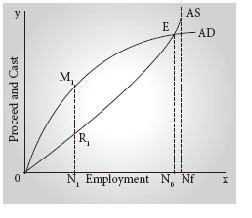
67.
The following are the criticisms against Say’s law:
1. According to Keynes, supply does not create its demand. It is not applicable where demand does not increase as much as production increases.
2. Automatic adjustment process will not remove unemployment. Unemployment can be removed by increase in the rate of investment
68.
i. Modern technology being capital intensive requires lesslabourers and contributes to technological unemployment.
ii. Now a days, invention and innovations lead to the adoption of new techniques there by the existing workers are retrenched
69.
1. Statistics is necessary for the formulation of policies to start new course, according to the changing environment.
2. There are many educational institutions owned by public and private engaged in research and development work to test the past knowledge and evolve new knowledge.
3. These are possible only through statistics.
70.
i) difference in the endowments of factors of production between countries, and
ii) differences in the factor proportions required in production.
71.
1. Multiplier highlights the importance of investment in income and employment theory.
2. The process throws light on the different stages of trade cycle.
3. It also helps in bringing the equality between S and I.
4. It helps in formulating Government policies.
5. It helps to reduce unemployment and achieve full employment.
72.
i. The multiplier assumes that those who earn income are likely to spend a proportion of their additional income on consumption.
ii. But in practice, people tend to spend their additional income on other items. Such expenses are known as leakages.
73.
(i) PC
(ii) Microwave oven
(iii) Television
(iv) CD player
(v) Radio
(vi) Fan
(vii) Cell phones
(viii) Electric Iron
(ix) Washing machine
74.
1. North Korea
2. China
3. Venezuela
75.
Macro economics suffers from certain limitations. They are:
1. There is a danger of excessive generalisation of the economy as a whole
2. It assumes homogeneity among the individual units.
3. There is a fallacy of composition. What is good of an individual need not be good for nation and viceversa. And, what is good for a country is not good for another country and at another time.
4. Many non - economic factors determine economic activities; but they do not find place in the usual macroeconomic books
76.
Net Domestic Product (NDP) is also arrived from GDP by making adjustment with regard to depreciation
GDP - Depreciation = NDP
77.
(i) Gross Domestic Product (GDP) is the total value of output (goods and services) produced by the factors of production located within the country's boundary in a year.
(ii) The factors of production may be owned by anyone-citizens or foreigners.
GDP = GNP - Net income earned from abroad
78.
The down payment is raised and the number of installments reduced for the credit sal
79.
An increase in business activities after the lowest point. (ie) depression
80.
(i) Creeping inflation is slow-moving and very mild.
(ii) The rise in prices will not be perceptible but spread over a long period.
(iii) This is also known as mild inflation or moderate inflation.
81.
There are three models of circular flow of income. They are,
(i) Two sector model
(ii) Three sector model
(iii) Four sector model
82.
(i) Socialism refers to a system of total planning.
(ii) Public ownership and state control on economic activities.
83.
(i) Based on characteristics there are quantitative and qualitative data.
(ii) Qualitative data is classified as nominal data and rank data.
(iii) Based on the data sources there are primary data and secondary data.
84.
(i) Statistics as a science of estimates and probabilities.
(ii) Statistics is the collection, organisation, presentation, analysis and interpretation of numerical data.
85.
| Economic Growth | Economic Development |
|---|---|
| Deals with the problems of develop ed countries |
Deals with the problems of UDCs (Under Developed Countries) |
| Change is gradual and stead | Change is discontinuous and s spontaneous |
| Means more output | Means not only more output but also its composition. |
| Concerns Quantitative aspects i.e. increase in per capita income | Quantitative as well as Qualitative |
| Narrow Concept | Wider Concept Development = Growth + Change. |
86.
Global warming is the current increase in temperature of the earth's surface (both land and water) and its atmosphere.
87.
(i) Both are source of public revenue.
(ii) Tax is a compulsory payment but the tax payer cannot claim any specific benefit by paying a tax.
(iii) Fee does not involve compulsion.
(iv) Government provides certain services (e.g.) driving license and charges a fee for it.
88.
(i) The balance between the values of goods and services exchanged between two countries.
(ii) It is a trade in both visible and non visible items.
89.
A Commercial bank is a financial institution that accepts deposits and advances loans and are profit motivated.
90.
(i) Surplus goods were exchanged for money which in turn was exchanged for other needed goods.
(ii) Goods like furs, skins, salt, rice, wheat, utensils, weapons were used as money
91.
It is the proportion of disposable income which individuals spend on consumption.
92.
(i) Aggregate (desired) consumption expenditure (C)
(ii) Aggregate (desired) private savings (S)
(iii) Net tax payments (T)
(iv) Personal (desired) transfer payments to the foreigners (Rf)
AS = C + S + T + Rf
93.
(i) Effective demand is the money spent on consumption of goods and services and on investment.
(ii) Employment and output depends on the level of effective demand
(iii) When effective demand increases, employment will increase.
(iv) Effective demand is determined by aggregate supply and aggregate demand.
94.
\(\mathrm{GNP}=\mathrm{C}+\mathrm{I}+\mathrm{G}+(\mathrm{X}-\mathrm{M})+(\mathrm{R}-\mathrm{P})\) or \(\mathrm{GNP}_{\mathrm{MP}}=\mathrm{GDP}_{\mathrm{MP}}\) + Net Factor income from Abroad.
95.
(i) A Model is a simplified representation of real situation.
(ii) Economists use models to describe economic activities, their relationships and their behaviour.
96.
| Basis of Difference | Capital Budget | Revenue Budget |
| Meaning | Capital budget assesses the long-term financial viability of investments by comparing future cash inflows and outflows. | Revenue budget is a forecast on revenue that will be generated by the company. |
| Preparation | Different capital budgets are prepared for each investment project | Revenue budget is a main budget that is prepared for the year as a part of the budget process |
| Complexity | Capital budget involves a number of factors that should be considered, thus complex in nature. | Revenue budget is less complicated compared to capital budget. |
97.
(i) The IMF established Structural Adjustment Facility (SAF) in March 1986 to provide additional balance of payments assistance on concessional terms to the poorer member countries.
(ii) In December 1987, the Enhanced Structural Adjustment Facility (ESAF) was set up to augment the availability of concessional resources to low income countries.
(iii) The purpose of SAF and ESAF is to force the poor countries to undertake strong macroeconomic and structural programmes to improve their balance of payments positions and promote economic growth
98.
n = pk (or) p = n / k
Where
n is the total supply of money
p is the general price level of consumption goods
k is the total quantity of consumption units the people decide to keep in the form of cash.
because it is measured in terms of consumer goods.
According to Keynes, peoples desire to hold money is unaltered by monetary authority. So, price level and value of money can be stabilized through regulating quantity of money (n) by the monetary authority.
Later, Keynes extended his equation in the following form:
n = p (k + rk') or p = n/(k + rk')
Where,
n = total money supply
p = price level of consumer goods
k = peoples' desire to hold money in hand (in terms of consumer goods) in the total income of them
r = cash reserve ratio
k' = community’s total money deposit in banks, in terms of consumers goods.
99.
There are three types based upon the number of variables studied as
a) Simple Correlation
b) Multiple Correlation
c) Partial Correlation
Simple Correlation:
If only two variables are taken for study then it is said to be simple correlation. Ex. Y= a + bx
Multiple Correlations:
If three or more than three variables are studied simultaneously, then it is termed as multiple correlation.
Ex: Determinants of Quantity demanded
Qd = f (P, Pc, Ps, t, y)
Where Qd stands for Quantity demanded, f stands for function.
P is the price of the goods,
Pc is the price of competitive goods
Ps is the price of substituting goods
t is the taste and preference
y is the income.
Partial Correlation:
If there are more than two variables but only two variables are considered keeping the other variables constant, then the correlation is said to be Partial Correlation
100.
| BASIS FOR COMPARISON | REPO RATE | REVERSE REPO RATE |
| Meaning | FDI refers to the investment made by the foreign investors to obtain a substantial interest in the enterprise located in a different country. | When an international investor, invests in the passive holdings of an enterprise of another country, i.e. investment in the financial asset, it is known as FPI. |
| Degree of control | High | Very less |
| Term | Long term | Short term |
| Investment in | Physical assets | Financial assets |
| Entry and exit | Difficult | Relatively easy. |
| Results in | Transfer of funds, technology and other resources | Capital inflows |
101.
(1) Value of final consumer goods and services produced in a year to satisfy the immediate wants of the people which is referred to as consumption (C);
(2) Gross private domestic investment in capital goods consisting of fixed capital formation, residential construction and inventories of finished and unfinished goods which is called as gross investment (I);
(3) Goods and services produced or purchased by the government which is denoted by (G) ; and
(4) Net exports of goods and services, i.e., the difference between value of exports and imports of goods and services, known as (X - M)
(5) GNP at market prices means the gross value of final goods and services produced annually in a country plus net factor income from abroad (C + I + G + (X - M) + (R - P)).
102.
(i) Surface water pollution:
Hazardous substances coming into contact with this surface water, dissolving or mixing. Physically with the water can be called surface water pollution.
(ii) Ground water pollution:
Ground water contamination occurs when man-made products such as gasoline, oil and chemical get into the ground water.
(iii) Microbiological pollution:
(1) Natural pollution caused by micro - organism like viruses and bacteria.
(2) This natural pollution causes both aquatic and human illness.
103.
(i) Factor endowment of a country may change over time.
(ii) The efficiency of the same factor may differ in the two countries. For example: America may be labour scarce in terms of no. of workers
104.
(i) The Average Propensity to Consume = \(\frac{C}{Y}\)
(ii) The Marginal Propensity to Consume = \(\frac{ΔC}{ΔY}\)
(iii) The Average Propensity to Save = \(\frac{S}{Y}\)
(iv) The Marginal Propensity to Save = \(\frac{ΔS}{ΔY}\)
105.
(i) Development means, people must have higher incomes, better education, better health care and nutrition, less poverty and more equality of opportunity.
(ii) According to Michael P. Todaro and Stephen C. Smith, "development must beconceived of as multidimensional process involving major changes in social structure, popular attitudes and national institutions, as well as the acceleration of economic growth, the reductions of inequality and the eradications of poverty".
106.
The following are the criticisms against Say's law:
(i) According to Keynes, supply does not create its demand. It is not applicable where demand does not increase as much as production increases.
(ii) Automatic adjustment process will not remove unemployment. Unemployment can be removed by increase in the rate of investment.
(iii) Money is not neutral. Individuals hold money for unforeseen contingencies while businessmen keep cash reserve for future activities.
107.
Macro economics suffers from certain limitation. They are
(i) There is a danger of excessive generalisation of the economy as a whole.
(ii) It assumes homogeneity among the individual units.
(iii) There is a fallacy of composition. What is good of an individual need not be good for nation and viceversa and, what is good for a country is not good for another country and at another time.
108.
Central Statistical Office (CSO)
(i) It is responsible for co-ordination of statistical activities in the country and for evolving and maintaining statistical standards.
(ii) It compiles National Accounts, conducts Annual Survey of Industries and Economic Census, compiles Index of Industrial Production and Consumer Price Indices.
(iii) It deals with social statistics, training, international co-operation, Industrial Classification, etc.
National Sample Survey
Organisation
NSSO has four divisions:
(i) Survey Design and Research Division
(ii) Field Operations. Division
(iii) Data Processing Division
(iv) Co-ordination and Publication Division
The Programme Implementation Wing has 3 Divisions:
(i) Twenty Point Programme
(ii) Infrastructure Monitoring and Project Monitoring
(iii) Member of Parliament Local Area Development Scheme.
1. There is National Statistical Commission and one autonomous Institute, i.e., Indian Statistical Institute.
109.
1. Sir M. Vishveshwarya (1934) made the first attempt in laying foundation for economic planning in India through his book, "Planned Economy of India". It was a 10 year plan.
2. Jawaharlal Nehru (1938) set-up "National Planning Commission" by a committee but due to the World War II it did not materialize.
3. In 1940,8 leading industrialists of Bombay presented a 15 Year Bombay Plan.
4. In 1944 S. N Agarwal gave the Gandhian Plan focusing on the agriculture and rural economy.
5. M.N. Roy in 1945 drafted People's Plan aiming at mechanisation of agricultural production.
6. In 1950 J.P. Narayan advocated Sarvodaya Plan which was inspired by Gandhian Plan and with the idea of Vinoba Bhave.
7. It gave importance to agriculture, small and cottage industries.
8. After considering all the plans in the same year Planning Commission was set up to formulate Five Year Plan in India by Jawaharlal Nehru.
9. Nehru was the first Chairman of Planning Commission, Government of India.
110.
1. Man's life is interconnected with various other living and non-living things.
2. Life also depends on social, political, ethical, philosophical and other aspects of economic system.
3. The life of human beings is shaped by his living environment.
4. The relationship between the economy and the economy is explained in the "Material Balance Model" developed by Alen Kneese and R.V. Ayres.
5. Households and firms are connected to environment, and they are interconnected too.
6. Households and firms depend on nature for resources.
7. They send out residuals of consumption and production to nature.
8. Nature assimilates all forms of waste.
9. Thus the economy and environment are interconnected.
111.
Introduction:
(i) The process of repaying a public debt is called redemption.
(a) Sinking Fund
(i) The Government establishes a separate fund into which every year a fixed amount of money is credited.
(ii) By the time the debt matures, the fund accumulates enough amount to pay off the principal along with interest.
(a) Conversion
(i) An old loan is converted into a new loan.
(ii) A high interest public debt is converted into a low interest public debt.
(c) Budgetary Surplus
(i) When the Government has a surplus budget, it can be used for repaying the debt.
112.
(i) South Asian Association for Regional Co-operation (SAARC)
(ii) Association of South East Asian Nations (ASEAN)
(iii) BRICS; Free Trade Area, Customs Union, Common Market and Economic Union.
113.
Net Barter Terms of Trade
1. This was developed by Taussig in 1927.
2. The ratio between the prices of exports and of imports is called net barter terms of trade.
3. Viner calls it commodity terms of trade.
4. \(\mathrm{T}_{\mathrm{n}}=\left(\mathrm{P}_{\mathrm{x}} / \mathrm{P}_{\mathrm{m}}\right) \times 100\)
5. Tn is Net Barter Terms of Trade
6. Px is Index number of export prices
7. Pm is Index number of import prices
8. This measures the gain from International Trade.
9. If Tn is greater than 100, it is terms of trade which means that for a rupee of export, more of imports can be received by a country.
Gross Barter Terms of Trade
1. Developed by Taussig in 1927 as an improvement over the net terms of trade.
2. It is an index of relationship between total physical quantity of imports and the total physical quantity of exports.
\(\mathrm{Tg}=\left(\mathrm{Q}_{\mathrm{m}} / \mathrm{Q}_{\mathrm{x}}\right) \times 100\)
3. Qm is Index of import quantities
4. Qx is Index of export quantities
5. If for a given quantity of export, more quantity of import can be consumed by a country, the terms of trade are favourable.
114.
(i) A non-banking financial institution or company is a financial institution that does not have a full banking license or is not supervised by the central bank.
(ii) They receive deposits and give loans.
(iii) They mobilize people's savings and use the funds to finance expenditure on investment activities.
(iv) The undertake borrowing and lending in the money and capital markets.
(v) They are classified into Stock Exchange and Other Financial institutions.
(vi) Under other financial institutions come Finance Companies, Finance Corporations, Chit Funds, Building Societies, Issue Houses, Investment Trusts, Unit Trusts and Insurance Companies.
115.
(i) The Marshall equation is
M = KPY where
(ii) M is the quantity of money
(iii) Y is the aggregate real income of the community
(iv) P is purchasing power of money
(v) K is the fraction of the real income which the public desires to hold in the form of money.
P= M / KY
(vi) The value of money is 1 / P = KY / M.
116.
(i) Payment towards past debts
(ii) Purchase of existing wealth
(iii) Import of goods and services
(iv) Non availability of consumer goods
(v) Full employment situation
117.
(i) In the Keynesian model, output is determined mainly by aggregate demand.
(ii) The aggregate demand is the amount of money which entrepreneurs expect to get by selling the output produced by the labourers employed.
(iii) Aggregate demand (spending) is the amount that households, firms, the governments and the foreign purchasers would like to spend on domestic output
Aggregate demand has four components:
1. Consumption demand (C)
2. Investment demand (I)
3. Government expenditure (G)
Net Export ( export - import) (X - M)
AD = C + I + G + (X - M)
118.
(i) A country with a high national income enjoys greater economic welfare and higher standard of living.
(ii) But the per capita income as an index of economic welfare has some limitations.
(iii) Welfare depends on the composition of goods and services. If more capital goods over consumer goods are produced welfare will be lesser.
(iv) Higher GDP with greater air, water, soil pollution will affect welfare.
(v) Production of war goods will increase output but not welfare.
(vi) If more women and children are employed or workers are forced to work for long hours economic welfare is affected.
(v) Therefore the Physical Quality of Life Index is a better indicator of economic welfare than national income.
119.
| S.No. | Capitalism | Globalism |
| 1 | Also called free economy or laissez faire or market economy where the role of the government is minimum | Also called extended capitalism. It connects nations together through international trade |
| 2 | Market determines economic activities within a nation | It aims at global development Manfred |
| 3 | Adam Smith is the father of the capitalism | D. Steger (2002) coined the term |
120.
1. Duties in respect of succession to property other than agricultural land.
2. Estate duty in respect of property other than agricultural land.
3. Taxes on railway fares and freights.
4. Taxes other than stamp duties on transactions in stock exchanges and future markets.
5. Taxes on the sale or purchase of newspapers and on advertisements published therein
6. Terminal taxes on goods or passengers carried by railways, sea or air.
7. Taxes on the sale or purchase of goods other than newspapers where such sale or purchase taxes place in the course of inter-State trade or commerce.
121.
| BASIS | NBFC | BANK |
| Meaning | An NBFC is a company that provides banking services to people without holding a bank license. | The bank is a government-authorized financial intermediary that aims at providing banking services to the general public. |
| Demand Deposit | Not Accepted | Accepted |
| Payment and Settlement system | Not a part of a system. | Part of the system. |
| Maintenance of Reserve Ratios | Not required | Compulsory |
| Deposit insurance facility | Not available | Available |
| Credit creation | NBFC do not create credit | Banks create credit. |
| Transaction services | Not provided by NBFC. | Provided by banks. |
122.
Procedure for Computing the Correlation Coefficient: (For Direct and Deviation from actual mean method).
Step- 1 Calculate the mean of two series ‘X’’Y’
Step- 2 Calculate the deviations ‘X’ and Y in two series from their respective mean.
Step- 3 Square each deviations of ‘X’ and ‘Y’ then obtain the sum of the Squared deviation,
Step- 4 Multiply each deviation under X with each deviation under Y and obtain the product of ‘xy’. Then obtain the sum of the product of X, Y. Then obtain the sum of the product of x,y is Σxy.
Step- 5 Substitute the value in the formula.
123.
Introduction
(i) The early 1990s witnessed reforms in the economic policy. This helped to open up Indian markets to FDI
(ii) FDI in India has increased over the years
(iii) In India, FDI has been advantageous in terms of free flow of capital, improved technology, management expertise and access to international markets
The major sectors benefited from FDI in India are:
(i) financial sector (banking and nonbanking)
(ii) insurance
(iii) telecommunication
(iv) hospitality and tourism
(v) pharmaceuticals and
(vi) software and information technology
FDI is not permitted in the industrial sectors like
(i) Arms and ammunition
(ii) atomic energy,
(iii) railways,
(iv) coal and lignite and
(v) mining of iron, manganese, chrome, gypsum, sulphur, gold, diamonds, copper etc.,
Latest trend of FDI in India
i. FDI inflow in India has increased from $97 million in 1990-91 to $5,535 million in 2004-2005.
ii. It amounted to $32,955 million in 2011-2012.
iii. UNCTAD’s World Investment Report 2018 reveals that FDI to India declined to $40 billion in 2017 from $44 billion in 2016
124.
The important concepts used in macro economics are presented below:
(i) Stock and Flow Variables: Variables used in economic analysis are classified as stock and flow. Both stock and flow variables may increase or decrease with time.
(ii) Stock refers to a quantity of a commodity measured at a point of time. In macro economics, money supply, unemployment level, foreign exchange reserves, capital etc are examples of stock variables.
(iii) Flow variables are measured over a period of time. National Income, imports, exports, consumption, production, investment etc are examples of flow variables.
(iv) Economic Models: A model is a simplified representation of real situation. Economists use models to describe economic activities, their relationships and their behaviour. A model is an explanation of how the economy, or part of the economy, works. Most economic models are built with mathematics, graphs and equations, and attempt to explain relationships between economic variables. The commonly used economic models are the supply demand models and circular flow models and Smith models
125.
(i) The propensity to consume refers to the portion of income spent on consumption.
MPC = \(\frac{ΔC}{ΔY}\)
(K) = \(\frac{1}{1-MPC}\)
(ii) The multiplier is the reciprocal of one minus marginal propensity to consume.
(iii) Multiplier is 1/MPS
(iv) The multiplier is therefore define as reciprocal of MPS.
(v) Multiplier is inversely related to MPS and directly with MPC.
Numerically, if MPC is 0.75, MPS is 0.25 and K is 4.
Using formula K = \(\frac{1}{1-MPC}\)
⇒\(\frac{1}{1-0.75}\) = 1/0.25 = 4
∴ Multiplier (K) = 4
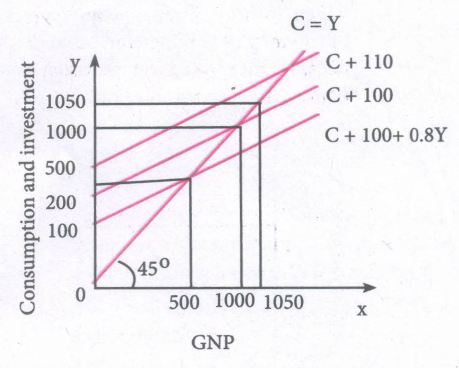
| MPC | MPS | K |
|---|---|---|
| 1.00 | 1.00 | 1 |
| 0.10 | 1.90 | 1.11 |
| 0.50 | 0.50 | 2.00 |
| 0.75 | 0.25 | 4.00 |
| 0.90 | 0.10 | 10.00 |
| 1.00 | 0.00 | ∝ |
C = 100 + 0.8Y;
I = 10
Y = C + I
= 100 + 0.8 Y +9p00
.JPG)
0.2Y = 1000
∴ Y = 1000
Here, C = 100 + 0.8y
= 100 + 1000 = 900
S = 100 = I
After I is raised by 10, now I = 110
Y = 100 + 0.8y + 110
0.2y = 210
y = \(\frac{210}{0.2}\) = 1050
Here, C = 100 = 0.8 (1050) = 940,
S = 110 = I
(i) It implies the variables in axis-and axis are equal.
(ii) The MPC is assumed to be at 0.8. (C = 100 + 0.8y)
(iii) The aggregate demand (C + I) curve intersects 45° line at point E.
(iv) The new aggregate demand curve is
C + I = 100 + 0.8Y + 100 + 10
Y = \(\frac{210}{0.2}\)
C = 940; S = 110 = Z
126.
(i) Income by Income Method. Income method approaches National Income from the distribution side.
(ii) National income is calculated by adding up all the incomes generated in the course of producing national product.
(iii) Factor incomes are grouped under labour income, capital income and mixed income.
(iv) national income is calculated as domestic factor income plus net factor incomes from abroad. In short,
Y = w + r + i + π + (R-P)
w = wages
r = rent
i = interest
π = profits
R = Exports
P = Imports
(v) This method is adopted for estimating the contributions of the remaining sector, viz.
(vi) Data on income from abroad (the rest of) the world sector or foreign sector are obtained from the account of the balance of payment of the country.
Items no to be included:
(1) Transfer payments are not to be included in estimation of national income.
(2) The receipts from the sale of second hand goods should not be treated as part of national income.
Item to be included:
(1) Imputed value of rent for self occupied house or offices is to be included.
(2) Imputed value of services provided by owners of production unit (family labour) is to be included.
127.
1. Human Resources
(i) Human resource is named as human capital because of its power to increase productivity and thereby national income. There is a circular relationship between human development and economic growth.
(ii) If labour is efficient and skilled, its capacity to contribute to growth will be high. For example Japan and China.
2. Technical Know-how: As the scientific and technological knowledge advances, more and more sophisticated techniques steadily raise the productivity levels in all sectors.
3. Political freedom: The process of development is linked with the political freedom.
4. Social organization: People show interest in the development activity only when they feel that the fruits of development will be fairly distributed. Mass participation in development programs is a pre-condition for accelerating the development process.
5. Corruption free administration:
Corruption is a negative factor in the growth process. Unless the countries rootout corruption in their administrative system, the crony capitalists and traders will continue to exploit national resources. The tax evasion tends to breed corruption and hamper economic progress.
6. Desire for development:
The pace of economic growth in any country depends to a great extent on people's desire for development.
7. Moral, ethics and social values:
(i) These determine the efficiency of the market.
(ii) If people are not honest, market cannot function.
8. Casino Capitalism:
If People spend larger proportion of their income and time on entertainment liquor and other illegal activities, productive activities may suffer.
9. Patrimonial Capitalism:
If the assets are simply passed on to children from their parents, the children would not work hard, because the children do not know the value of the assets. Hence productivity will be low.
128.
| S.No | Keynesianism | Classicism |
|---|---|---|
| 1. | Short-run equilibrium | Long-run equilibrium |
| 2. | Saving is a vice | Saving is a social virtue |
| 3. | The function of money is a medium of exchange on the one side and a store of value on the other side. | The function of money is to act as a medium of exchange |
| 4. | Macro approach to national problems | Micro foundation to macro problems |
| 5. | State intervention is advocated | Champions of Laissez-fair policy |
| 6. | Applicable to all situations - full employment and less than full employment. | Applicable only to the full employment situation |
| 7. | Capitalism has inherent contradictions | Capitalism is well and good |
| 8. | Budgeting should be adjusted to the requirements of economy. | Balanced budget |
| 9. | The equality between saving and investment is advanced through changes in income. | The equality between saving and investment is achieved through chances of rate of interest. |
| 10. | Rate of interest is determined by the demand for and supply of money. | Rate of interest is determined by saving and investment. |
| 11. | Rate of interest is a flow. | Rate of interest is a stock. |
| 12. | Demand creates its own supply. | Supply creates its own demand. |
| 13. | Rate of interest is a reward for parting with liquidity. | Rate of interest is a reward for saving. |
129.
Law
According to Keynes, "men are disposed as a rule and on the average to increase their consumption as their income increases but not by as much as the increáse in their income".
Propositions
1. When income increases, consumption expenditure also increases, but by a smaller amount
(a) When income increases from 120 to 180; consumption also increases from 120 to 170 but the increase in consumption is less than the increase in income, 10 is saved.
2. The increased income will be divided in some proportion between consumption expenditure and saving
(a) When income increases to 180 and 240, it is divided between consumption (170 and 220) and saving (10 and 20)
3. Incrcascs in income always lead to in incrcase in both consumption and saving
(a) Increases in income to 180) and 240; lead to increased consumption 170 and 220; increased saving 10 and 20.
(b) It is clear from the widening area below the C curve and the saving gap between 45o line and C curve.
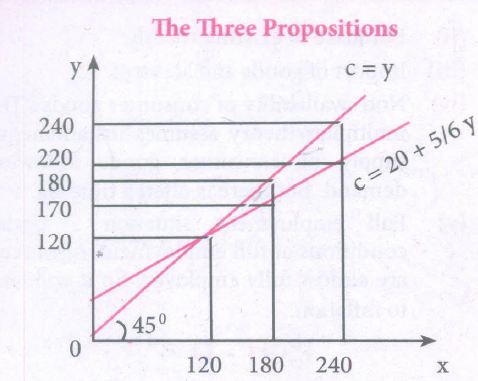
| Y | C | S |
|---|---|---|
| 120 | 120 | 0 |
| 180 | 170 | 10 |
| 240 | 220 | 20 |

12th Standard Syllabus & Materials
12th Standard
TN 12th Computer Applications களப்பெயர் முறைமை (DNS) Sample Question Papers Study Material - QB365 Set A
NEW12th Standard
TN 12th Computer Applications வலையமைப்பு எடுத்துக்காட்டுகள் மற்றும் நெறிமுறைகள் Sample Question Papers Study Material - QB365 Set A
NEW12th Standard
TN 12th Computer Applications கணினி வலையமைப்பு ஓர் அறிமுகம் Sample Question Papers Study Material - QB365 Set A
NEW12th Standard
TN 12th Computer Applications PHP-உடன் MySQL-ஐ இணைத்தல் Sample Question Papers Study Material - QB365 Set A



Tamilnadu Stateboard 12th Standard Subjects

Maths

Chemistry

Physics

Biology

Computer Science

Business Maths and Statistics
Economics

Commerce

Accountancy

History

Computer Applications
Biology
Computer Technology
Computer Applications
Computer Science
Business Maths and Statistics
Commerce
Economics
Maths
Chemistry
Physics
Computer Technology
History
Accountancy

Tamil

English

French
Tamilnadu Stateboard Standards
