
 100% FREE ACCESS
12th Standard Syllabus & Materials
12th Standard
TN 12th Computer Applications மின்னணு தரவு பரிமாற்றம் Sample Question Papers Study Material - QB365 Set A
NEW12th Standard
TN 12th Computer Applications மின் - வணிக பாதுகாப்பு அமைப்புகள் Sample Question Papers Study Material - QB365 Set A
NEW12th Standard
TN 12th Computer Applications மின்னணு செலுத்தல் முறைகள் Sample Question Papers Study Material - QB365 Set A
NEW12th Standard
TN 12th Computer Applications மின் - வணிகம் Sample Question Papers Study Material - QB365 Set A
NEW12th Standard
TN 12th Computer Applications திறந்த மூல கருத்துருக்கள் Sample Question Papers Study Material - QB365 Set A
NEW12th Standard
TN 12th Computer Applications வலையமைப்பு வடமிடல் Sample Question Papers Study Material - QB365 Set A

Published on: 12/02/2020
12th Standard Economics Public Model Question Paper - 2020
Download Tamil Nadu 12th Standard Economics question papers, model tests, one-mark questions, important questions, and public exam papers in PDF format. Free study materials and answer keys for TN State Board students.
Questions + Answers key
Take MCQ Economics Test
1.
Match the correct codes
| 1 | Canon of Ability | i | The method of tax collection and the timing of the tax payment should suit the convenience of the people. |
| 2 | Canon of Certainty | ii | The Government has to spend money for collecting taxes, for example, salaries are given to the persons who are responsible for collecting taxes. |
| 3 | Canon of Convenience | iii | The Government must ensure that there is no uncertainty regarding the rate of tax or the time of payment. |
| 4 | Canon of Economy |
iv | The Government should impose tax in such a way that the people have to pay taxes according to their ability. |
(1) – (i) (2) – (ii) (3) – (iv) (4) – (iii)
(1) – (ii) (2) – (iii) (3) – (iv) (4) – (i)
(1) – (iv) (2) – (iii) (3) – (i) (4) – (ii)
(1) – (i) (2) – (ii) (3) – (iii) (4) – (iv)
2.
Which of the following is the most comprehensive measure of budgetary imbalances?
Fiscal Deficit
Revenue Deficit
Primary Deficit
All of the above
3.
Of the three policy tools that the RBI can use to change the money supply, the one that does not affect the monetary base is
open market operations
changes in the discount rate
changes in the federal funds rate
reserve requirements
4.
The Contractionary monetary policy is _____, which maintains short term interest rates higher than usual or which slows the rate of growth in the money supply or even shrinks it.
dear money policy
federal policy
fiscal policy
monetary policy
5.
Which of the following statements is not correct?
Both the IMF & IBRD have headquarters in Washington
Both IMF & IBRD are the Constituent organizations of United Nations Organization
IBRD is also called World Bank
India's vote share in the International Monetary Fund is 10%
6.
Suppose that tomatoes from India face a 20 percent tariff in the China and a 25 percenttariff in Pakistan. If the China and Pakistan maintain free trade between each other, the these two countries belong to a
free-trade area
customs union
common market
monetary union
7.
Who are ASEAN initial original member countries?
India, China, Russia, Japan and Australia
Indonesia, Malaysia, Philippines, Singapore and Thailand
Pakistan, Srilanka, Bangladesh and Philippines
Brunei Darussalam, Vietnam, Laos and Myanmar and Cambodia joined.
8.
Which of the following was not a classical economist?
Adam Smith
Thomas R. Malthus
John Stuart Mill
John Maynard Keynes
9.
In the Keynesian two sector economy, AD>AS, then
S=I
S>
S<I
S=0
10.
Consider the following statements with regards to ‘Economic Planning’:
1. The concept of Economic planning in India is derived from Russia (the then USSR)
2. It is a process in which limited natural resources are used skillfully so that the desired goals can be achieved.
3. It derives its objectives and social premises from the fundamental rights enshrined in the constitution.
Select the correct answer from the given codes below:
1 and 2
2 only
1 and 2
1, 2, and 3
11.
________________ are/is the Chairperson of NITI Aayog and ___________ will be Ex-officio members.
The Prime Minister and The Finance Commission
The Prime Minister and Union Ministers
The Finance and Union Ministers
Union Ministers and The Prime Minister
12.
Find which is not a an example of Fixed income Groups?
wages
salary
pension
organization
13.
The new symbol of Rupee is an amalgamation of Devanagri ‘Ra’ and the ______ without the stem.
Arial ‘R’
Roman ‘R’
Italian ‘R’
Greek Script ‘R’
14.
__________ is a coefficient to measure the degree of relationship between two sets of data by using ranks of observations
Pearson’s Correlation Coefficient
Rank Correlation Coefficient
Partial Correlation
Multiple Correlation
15.
A statistic is:
a sample characteristic
a population characteristic
unknown
normally distributed
16.
Which of the following is not a kind of correlation based on number of variables?
Simple Correlation
Multiple Correlation
Partial Correlation
Rank Correlation
17.
Assertion: Double counting is to be avoided under value added method.
Reason: Any commodity which is either raw material or intermediate good for the final production should not be included.
Both A and R are true and R is the correct explanation of A.
Both A and R are true but R is not the correct explanation of A
A is true but R is false
A is false but R is true
18.
In a portfolio investment
investors are directly involved in managing the operations.
as in direct investment, investors export goods and services abroad.
investors transfer the technology to local investors.
investors have no control over operations.
19.
Remittances made by NRIs to India in the context of national income accounting is called as _______?
Remittance Income
NRI Income
Factor Payments
All of the above
20.
Assume that Country A is relatively abundant in labor and Country B is relatively abundant inland. Note that wages are the returns to labor and rents are the returns to land. According to thefactor price equalization theorem, once Country A begins specializing according to comparative advantage and trading with Country B.
wages and rents should fall in Country A
wages and rents should rise in Country A
wages should rise and rents should fall in Country A
wages should fall and rents should rise in Country A
21.
Movements of goods (export and imports of commodities) are also known as _________.
invisible trade
visible trade
new trade
conventional trade
22.
Psychological law of consumption states that the value of MPC is lies between zero and
1
2
3
4
23.
Pure public goods pose a ________________?
free-rider problem
environment tax
environment fee
none of the above
24.
In the circular-flow diagram
Firms are sellers in the resource market and the product market
Households are sellers in the resource market
Firms are buyers in the product market
Spending on goods and services flow from firms to households
25.
Assertion: Each individual and organization produce only those goods which ensure high profit.
Reason: Profit is the driving force behind all economic activities in a capitalistic economy
Both A and R are true and R is the correct explanation of A.
Both A and R are true but R is not the correct explanation of A
A is true but R is false
A is false but R is true
26.
What is relevant in the context of MEC?
I. The prospective yield from a capital asset.
II. The supply price of a capital asset.
I only relevant
II only relevant
Both I and II are relevant
Both are irrelevant
27.
Identify which is not a part of classification of economy based on Level of National Income
Foreign Income Economies
Low Income Economies
Middle Income Economies
High Income Economies
28.
____________ is one of the causes of production externalities.
Factory emission
Beehive pollination
Public safety
Noise pollution
29.
____________ is the current increase in temperature of earth's surface.
Land
Global warming
Climate change
Air
30.
'Public finance' includes __________ major sub divisions.
Three
Two
Four
Five
31.
Accelerator (β) = _________
C + I
1/1 - MPC
\(\frac{ΔC}{ΔC}\)
ΔC/ΔY
32.
__________ Framework is useful for economists as well as policy makers.
Social Accounting
Statistics
Capital Gains
None of these
33.
J.M. Keynes was born in _____________
1885
1884
1883
1882
34.
Planning in India is
Centralized planning
Democratic planning
Partial Planning
Indicative planning
35.
"Commercial banks are the institutions that make short term loans to business and in the process create money" was said by_______
Culbertson
Adam smith
Ricardo
J.M. Keynes
36.
Barter system was introduced by________ tribes.
Mesopotamia
Phoenician
Babylonian
Jarwa
37.
A process by which we estimate the value of dependent variable on the basis of one or more independent variables is called
Correlation
Regression
Residual
Slope
38.
The value of the coefficient of correlation r lies between
0 and 1
-1 and 0
-1 and +1
-0.5 and +0.5
39.
40.
Which is not the feature of economic growth?
Concerned with developed nations
Gradual change
Concerned with quantitative aspect
Wider concept
41.
The common source of outdoor air pollution is caused by combustion processes from the following ______________
Heating and cooking
Traditional stoves
Motor vehicles
All the above
42.
Who developed Material Balance Models?
Thomas and Picardy
AlenKneese and R.Y. Ayres
Joan Robinson and J.M. Keynes
Joseph Stiglitz and Edward Chamberiin
43.
The primary purpose of deficit financing is
Economic development
Economic stability
Economic equality
Employment generation
44.
The tax possesses the following characteristics
Compulsory
No quid pro quo
Failure to pay is offence
All the above
45.
Which of the following is not the member of SAARC?
Pakistan
Sri Lanka
Bhutan
China
46.
_______ relates to patents, copyrights, trade secrets, etc.,
TRIPS
TRIMS
GATS
NAMA
47.
Foreign direct investments not permitted in India
Banking
Atomic energy
Pharmaceutical
Insurance
48.
In the case of BOT,
Transactions of goods are recorded.
Transactions of both goods and services are recorded.
Both capital and financial accounts are included.
All of these
49.
Moral suasion refers.
Optimization
Maximization
Persuasion
Minimization
50.
Credit creation means
Multiplication of loans and advances
Revenue
Expenditure
Debt
51.
Fisher’s Quantity Theory of money is based on the essential function of money as
measure of value
store of value
medium of exchange
standard of deferred payment
52.
_________is a decrease in the rate of inflation.
Disinflation
Deflation
Stagflation
Depression
53.
The multiplier tells us how much _______ changes after a shift in _____.
Consumption, income
investment, output
savings, investment
output, aggregate demand
54.
The average propensity to consume is measured by _____.
C/Y
CxY
Y/C
C+Y
55.
Say’s law stressed the operation of________ in the economy
Induced price mechanism
Automatic price mechanism
Induced demand
Induced investment
56.
Keynes theory emphasized on________ equilibrium
Very short run
Short run
Very long run
Long run
57.
PQLI is the indicator of___________.
Economic growth
Economic welfare
Economic welfare
Economic development
58.
__________ is deducted from gross value to get the net value
Income
Depreciation
Expenditure
Value of final goods
59.
An economic system where the economic activities of a nation are done both by the private and public together is termed as__________
Capitalistic Economy
Socialistic Economy
Globalisic Economy
Mixed Economy
60.
Macro economics is a study of_________
individuals
firms
a nation
aggregates
61.
Expansionary policy – Define.
62.
Write a short on - Traveler’s Cheque.
63.
Write about the Supplementary Financing Facility of IMF.
64.
Write a note on “Sarvodaya Plan”.
65.
Explain the term “Demand for Money”
66.
Write about Money Increases Productivity of Capital in short.
67.
What is Aggregate demand?
68.
Mention few names of Classical theory.
69.
State the meaning of different types of data.
70.
What is the features of GDPMP?
71.
Give an example of how real GDP could be increased even though no more output is produced
72.
Define - Favourable BOT
73.
Write the channel of effects of accelerator.
74.
Write a short note on Dynamic multiplier.
75.
Draw the chart depicting classification of externalities
76.
Expand the given equation :Y = C + I + G + (X-M).
77.
What are flow variables?
78.
What is budget?
79.
What are the major sectors benefitted from FDI in India?
80.
What do you mean by development?
81.
What are the assumptions of Say's Law of Market?
82.
What is Price Mechanism?
83.
Who is the controll authority of socialistic economy?
84.
What is Econometrics?
85.
What are the kinds of data?
86.
Mention the indicators of development.
87.
What do you mean by ecosystem?
88.
Write a short note on zero based budget.
89.
State any two merits of trade.
90.
91.
What is Stagflation?
92.
Define average propensity to save (APS).
93.
What is effective demand?
94.
Give short note on frictional unemployment.
95.
Trace the relationship between GNP and NNP.
96.
97.
List the important objectives of IMF
98.
Write a short note on former Indian Planning Commission.
99.
Distinguish between Fictional and Structural unemployment.
100.
Draw the various kinds of scatter diagram.
101.
Discuss the elements of Automatic Correction in trade disequilibrium.
102.
What are the items should not be included while estimating national income through income method?
103.
Given the table, write the proposition for consumptions function (value in crores).
104.
Draw the flow chart of four sector model.
105.
Explain the types of water pollution.
106.
What are external public debt?
107.
List out the functions of Commercial Banks
108.
What are the four measures of Money Supply?
109.
Mention the uses of Regression Analysis.
110.
What are the non-economic factors determining development?
111.
Specify the meaning of material balance principle.
112.
State any three characteristics of taxation.
113.
Mention any three lending programmes of IMF.
114.
What are import quotas?
115.
Bring out the methods of credit control.
116.
What are the determinants of money supply?
117.
Specify the limitations of the multiplier.
118.
Explain about aggregate supply with the help of diagram.
119.
120.
Describe the different types of economic systems.
121.
Distinguish between Balanced and Unbalanced Budget.
122.
Compare and contrast RBI and other Commercial Banks.
123.
The height of a child increases at a rate given in the table below. Fit the straight line using the method of least-square and calculate the average increase and the standard error of estimate.
| Month | 1 | 2 | 3 | 4 | 5 | 6 | 7 | 8 | 9 | 10 |
| Height: | 52.5 | 58.7 | 65 | 70.2 | 75.4 | 81.1 | 87.2 | 95.5 | 102.2 | 108.4 |
124.
Discuss the Non- Economic Factors economic development.
125.
Use the table below (for a simple economy with no foreign sector or government) to answer the questions that follow.
| (1) Income (Y) |
(2) Consumption (C) |
(3) Investment (l) |
(4) Aggregate Demand AD = C + 1 = Column(2) + Column(3) |
| 0 | 30 | (a) | 50 |
| 300 | 300 | 20 | (b) |
| 400 | (c) | 20 | 410 |
| 500 | 480 | 20 | 500 |
| 600 | (d) | 20 | (e) |
Fill in the missing numbers in the spaces marked (a)-(c). Determine the consumption function, and use the result to fill in the remaining missing numbers (d)-(e). (f) Determine the equilibrium output level.
126.
Explain the any two types of Exchange Rates.
127.
Discuss the method measuring the National Income by Income Method.
128.
Draw the diagram for Aggregate supply curves diagram.
129.
Explain the merits of Mixed Economy.
130.
Illustrate the working of Multiplier.
1.
(c)
(1) – (iv) (2) – (iii) (3) – (i) (4) – (ii)
2.
(d)
All of the above
3.
(d)
reserve requirements
4.
(a)
dear money policy
5.
(d)
India's vote share in the International Monetary Fund is 10%
6.
(a)
free-trade area
7.
(b)
Indonesia, Malaysia, Philippines, Singapore and Thailand
8.
(d)
John Maynard Keynes
9.
(c)
S<I
10.
(c)
1 and 2
11.
(b)
The Prime Minister and Union Ministers
12.
(d)
organization
13.
(b)
Roman ‘R’
14.
(b)
Rank Correlation Coefficient
15.
(a)
a sample characteristic
16.
(d)
Rank Correlation
17.
(a)
Both A and R are true and R is the correct explanation of A.
18.
(b)
as in direct investment, investors export goods and services abroad.
19.
(c)
Factor Payments
20.
(c)
wages should rise and rents should fall in Country A
21.
(b)
visible trade
22.
(a)
1
23.
(a)
free-rider problem
24.
(b)
Households are sellers in the resource market
25.
(a)
Both A and R are true and R is the correct explanation of A.
26.
(c)
Both I and II are relevant
27.
(d)
High Income Economies
28.
(a)
Factory emission
29.
(b)
Global warming
30.
(d)
Five
31.
(c)
\(\frac{ΔC}{ΔC}\)
32.
(a)
Social Accounting
33.
(c)
1883
34.
(b)
Democratic planning
35.
(a)
Culbertson
36.
(a)
Mesopotamia
37.
(b)
Regression
38.
(c)
-1 and +1
39.
(c)
40.
(d)
Wider concept
41.
(b)
Traditional stoves
42.
(d)
Joseph Stiglitz and Edward Chamberiin
43.
(a)
Economic development
44.
(d)
All the above
45.
(d)
China
46.
(a)
TRIPS
47.
(b)
Atomic energy
48.
(a)
Transactions of goods are recorded.
49.
(c)
Persuasion
50.
(a)
Multiplication of loans and advances
51.
(c)
medium of exchange
52.
(a)
Disinflation
53.
(d)
output, aggregate demand
54.
(a)
C/Y
55.
(b)
Automatic price mechanism
56.
(b)
Short run
57.
(b)
Economic welfare
58.
(b)
Depreciation
59.
(d)
Mixed Economy
60.
(d)
aggregates
61.
(i) Expansionary policy is cheap money policy when a monetary authority uses its tools to stimulate the economy.
(ii) An expansionary policy maintains short-term interest rates at a lower than usual rate or increases the total supply of money in the economy more rapidly than usual.
62.
Banks issue traveler’s cheques to individuals for traveling outside the country. Traveler’s cheques are the safe and easy way to protect money while traveling.
63.
Under the supplementary financing facility, the IMF makes temporary arrangements to provide supplementary financial assistance to member countries facing payments problems relating to their present quota sizes.
64.
(i) J.P. Narayan (1950) advocated, “Sarvodaya Plan” which was inspired by Gandhian Plan and with the idea of Vinoba Bhave.
(ii) It gave importance not only for agriculture, but encouraged small and cottage industries in the plan.
65.
(i) Demand for money means the demand to hold money, that is, to keep one’s resources in liquid form instead of in some form of investment.
(ii) It means the desire to hold money in liquid cash as against spending the money.
66.
Money is the most liquid form of capital. In other words, capital in the form of money can be put to any use.
67.
The amount that households, firms, the governments and the foreign purchasers would like to spend on domestic output.
68.
David Ricardo, J.S.Mill, J.B.Say and A.C.Pigou. List some limitations of GDP as a measurement of social welfare.
69.
1. Quantitative data are those that can be quantified in definite units of measurement. These refer to characteristics whose successive measurements yield quantifiable observations. Eg. Age, income, number of firms etc.
2. Qualitative data refer to qualitative characteristics of a subject or an object. A characteristic is qualitative in nature when its observations are defined and noted in terms of the presence or absence of a certain attribute in discrete numbers. These data are further classified as nominal and rank data. Eg. Gender, Community, honesty.
70.
The main features of GDPMP are:
1. It includes only final goods and services produced in the domestic territory of a country;
2. It includes consumption of fixed capital (depreciation);
3. It is estimated at the prevailing prices.
| BASIS FOR COMPARISON |
NOMINAL GDP | REAL GDP |
| Meaning | The aggregate market value of the economic output produced in a year within the boundaries of the country is known as Nominal GDP. | Real GDP refers to the value of economic output produced in a given period, adjusted according to the changes in the general price level. |
| What is it? | GDP without the effect of inflation. | Inflation adjusted GDP |
| Expressed in | Current year prices | Base year prices or constant prices |
| Value | Higher | Generally, lower |
71.
(i) Real GDP could be increased even though there is no more output produced if output that is currently produced in the home or in the underground economy is included.
(ii) If activities that are currently illegal are declared legal, real GDP could increase
72.
When the total value of commodity exports of a country exceeds the total value of commodity imports of that country, it is said that the country has a ‘favourable’ balance of trade.
73.
i. Increase in consumer demand
ii. Films get close to fill capacity
iii. Films invest to meet rising demand.
74.
(i) Dynamic multiplier is also known as ‘sequence multiplier’.
(ii) In real life, income level does not increase instantly with investment.
(iii) In fact, there is a time lag between increase in income and consumption expenditure.
75.
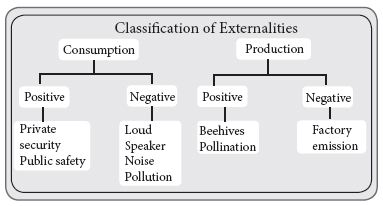
76.
Y = National Income
C = Consumption Expenditure
I = Investment Expenditure
G = Government Expenditure
(X – M) = Net Exports
77.
(i) Flow variables are measured over a period of time.
(ii) National Income, imports, exports, consumption, production, investment etc are examples of flow variables
78.
The word 'budget' is said to have its origin from the French word "Bougett" which refers to 'a small leather bag'. The budget is an annual financial statement which shows the estimated income and expenditure of the Government for the forthcoming financial year.
79.
(i) Financial Sector (Banking and Non Banking)
(ii) Insurance
(iii) Telecommunication
(iv) Hospitality and Tourism
(v) Pharmaceuticals
(vi) Software and Information Technology
80.
The concept "development" refers to the structural changes towards betterment.
81.
(i) Ceteris paribus (constant extraneous variables).
(ii) Existence of Normal Conditions.
(iii) Existence of a Laissez-faire Capitalist Economy.
82.
(i) Price Mechanism is the heart of any capitalistic economy.
(ii) All the economic activities are regulated through price mechanism.
83.
(i) Central planning authority is the controlling authority in a socialistic economy.
(ii) All the decisions are under taken by the central planning authority.
(iii) It means all factors of production are nationalized and managed by public authority.
84.
Econometrics may be defined as the social science in which the tools of economic theory, mathematics and statistical inference are applied to the analysis of economic phenomena.
85.
(i) Based on characteristics there are quantitative and qualitative data.
(ii) Qualitative data is classified as nominal data and rank data.
(iii) Based on the data sources there are primary data and secondary data.
86.
1. Gross national product
2. GNP per capita
3. Welfare
4. Social indicators.
87.
(i) An ecosystem includes all living things (plants, animals and organisms) in a given area, interacting with each other and also with their non-living environments (weather, earth, sun, soil, climate, atmosphere).
(ii) It is the foundation of the Biosphere and determine the health of the earth.
88.
(i) It involves fresh evaluation of expenditure in the Government budget assuming it as a new item.
(ii) A review is made to justify the project based on the socio-economic objectives and priorities of the society.
(iii) Government of India presented Zero Base Budgeting in 1987-88.
89.
(i) Availability of variety of goods for consumption.
(ii) Generation of more employment.
(iii) Industrialization of backward nations.
(iv) Division of labour and specialisation.
90.
91.
Stagflation is a combination of stagnant economic growth, high unemployment and high inflation.
92.
APS is the ratio of saving to income
APS = \(\frac{S}{Y}\)
93.
(i) Effective demand is the money spent on consumption of goods and services and on investment.
(ii) Employment and output depends on the level of effective demand
(iii) When effective demand increases, employment will increase.
(iv) Effective demand is determined by aggregate supply and aggregate demand.
94.
(i) It arises due to imbalance between supply of labour and demand for labour.
(ii) It is because of immobility of labour, lack of necessary skills, breakdown of machinery, shortage of raw materials.
(iii) The persons who lose jobs and in search of jobs are also included.
95.
(i) NNP is obtained deducting the value of depreciation from GNP.
(ii) NNP = GNP - depreciation allowance.
96.
97.
i) To promote international monetary cooperation among the member nations.
ii) To facilitate faster and balanced growth of international trade.
iii) To ensure exchange rate stability by curbing competitive exchange depreciations.
iv) To eliminate or reduce exchange controls imposed by member nations.
98.
(i) On January 26, 1950, the Constitution came into force.
(ii) In logical order, the Planning Commission was created on March 15, 1950.
(iii) The plan era began on April 1, 1951, with the launch of the first five-year plan (1951-56).
(iv) Planning Commission was set up to formulate Five Year Plan in India by Jawaharlal Nehru.
(v) He was the first Chairman of Planning Commission, Government of India.
99.
| S.No | Fictional unemployment | Structural unemployment |
| 1 | Frictional unemployment arises due to imbalance between supply of labour and demand for labour | Structural unemployment is due to drastic change in the structure of the society |
| 2. | This is because of immobility of labour, lack of necessary skills, break down of machinery, shortage of raw materials etc. | Lack of demand for the product or shift in demand to other products cause this type of unemployment |
| 3. | The persons who lose jobs and in search of jobs are also included under frictional unemployment | This kind of unemployment results from massive and deep rooted changes in economic structure |
100.
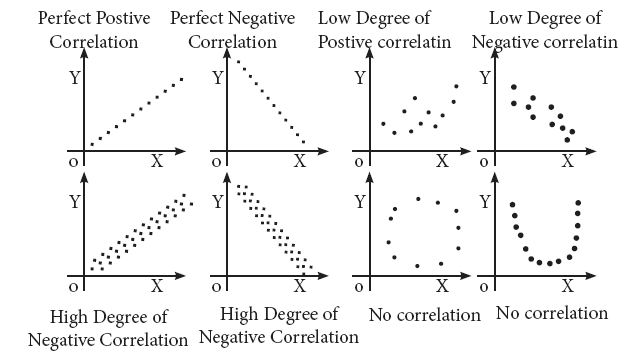
101.
1. Price Adjustments
As a result of foreign exchange outflow from a deficit country to a surplus country, there will be a fall in the money supply in the deficit country and increase in the money supply in the surplus country.
2. Interest Rate Adjustments
The contraction or expansion of money supply resulting from the BoP deficit or surplus leads to a rise or fall in the interest rates. A rise in interest rate in the deficit country will encourage investors to withdraw their funds from abroad and invest in their home country.
3. Income Adjustments
A nation with payments surplus will experience rising income which will increase imports and thereafter equilibrium is restored in Balance of Payments.
4. Capital Flows
Changes in the interest rate consequent to the BoP disequilibrium will encourage capital flows from the surplus nations to deficit nations helping restoration of the BoP equilibrium.
102.
1. Transfer payments are not to be included in estimation of national income as these payments are not received for any services provided in the current year such as pension, social insurance etc.
2. The receipts from the sale of second hand goods should not be treated as part of national income as they do not create new flow of goods or services in the current year.
3. Windfall gains such as lotteries are also not to be included as they do not represent receipts from any current productive activity.
4. Corporate profit tax should not be separately included as it has been already included as a part of company profit.
103.
| Income | Consumption | Savings |
| 120 | 120 | 0 |
| 180 | 170 | 10 |
| 240 | 220 | 20 |
Proposition (1):
Income increases by Rs. 60 crores and the increase in consumption is by Rs. 50 crores.
Proposition (2):
The increased income of Rs. 60 crores in each case is divided in some proportion between consumption and saving respectively. (i.e., Rs. 50 crores and Rs. 10 crores).
Proposition (3):
As income increases consumption as well as saving increase. Neither consumption nor saving has fallen.
104.
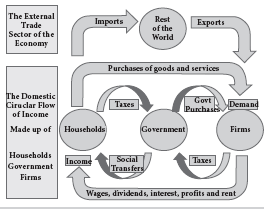
105.
(i) Surface water pollution:
Hazardous substances coming into contact with this surface water, dissolving or mixing. Physically with the water can be called surface water pollution.
(ii) Ground water pollution:
Ground water contamination occurs when man-made products such as gasoline, oil and chemical get into the ground water.
(iii) Microbiological pollution:
(1) Natural pollution caused by micro - organism like viruses and bacteria.
(2) This natural pollution causes both aquatic and human illness.
106.
(i) When a loan is taken from abroad or from an international organisation it is called external public debt.
(ii) The main sources of external public debt are IMP, World Bank, IDA and ADB etc.
(iii) Loan from other countries and the governments.
107.
(I) Primary Function:
(1) Accepting Deposits
(2) Demand Deposits
(3) Time Deposits
(4) Advancing Loans
(II) Secondary Functions:
(1) Agency Functions
(2) Collecting Cheques
(3) Collecting Income
(4) Paying Expenses
(5) General Utility Functions
(6) Providing Locker Facilities
(7) Issuing Traveler's Cheques
(8) Dealing in Foreign Exchange
(9) Transferring Funds
(10) Letter of Credit.
108.
M1 = Currency, Coins and demand deposits.
M2 = M1 + Saving deposits with post office savings banks.
M3 M2 + Time deposits of all commercial and cooperative banks.
M4 = M3 + Total deposits with post offices.
M1 and M2 are known as narrow money.
M3 and M4 are known as broad money.
The graduations are in decreasing order of liquidity.
109.
(i) Besides verification it is used for the prediction of one value, in relation to the other given value.
(ii) Regression coefficient is an absolute figure. If we know the value of the independent variable, we can find the value of the dependent variable.
(iii) It has wider application, as it studies linear and nonlinear relationship between the variables.
(iv) It is widely used for further mathematical treatment.
110.
Human Resources:
(i) Human power increases productivity and thus national income.
(ii) A healthy, educated and skilled labour force is the most important productive asset.
Technical Know-how:
(i) As the scientific and technological knowledge advances, more sophisticated techniques steadily raise the productivity in all sectors.
Political Freedom:
(i) Development is linked with political freedom.
(ii) Dadabhai Naoroji said the drain of wealth from India under British rule is the major cause of increase in poverty in India.
Social Organization:
(i) Mass participation in development programs is a pre condition for accelerating development
(ii) When some groups enjoy the benefits of growth and majority of the poor do not participate in the process of development it is called crony capitalism.
Corruption free administration:
(i) Tax evasion breeds corruption and prevents progress.
Desire for development:
(i) If the level of consciousness is low and the people have accepted poverty as their fate, there is little scope for development.
Moral, ethical and social values:
(i) If people are dishonest, market cannot function.
Casino Capitalism:
(i) If people spend larger propotion of their income on entertainment liquor, illegal activities, production suffers. This is called casino capitalism.
Patrimonial Capitalism:
(i) If assets are inherited by children, they would not work hard because they do not know the value of the assets. So, production is low.
111.
(i) The law of conservation of matter and energy, emphasizes that in any production system "what goes in must come out".
(ii) All resources extracted from the environment eventually become unwanted wastes and pollutants.
(iii) Production of output by firms from inputs results in discharge of solid, liquid and gaseous wastes.
(iv) Waste results from consumption activities by households.
(v) Thus material and energy drawn from environment are used for production and consumption and returned back to the environment as wastes.
(vi) \(\mathrm{R}=\mathrm{W}_{1}+\mathrm{W}_{2}\)
(vii) Input = Output
112.
(i) A tax is a compulsory payment made to the government. Refusal to pay the tax is punishable.
(ii) There is no quid pro quo between a taxpayer and public authorities.
(iii) Tax payer cannot claim any specific benefit against the payment of a tax.
(iv) Every tax involves some sacrifice on the part of the tax payer.
(v) A tax is not levied as a fine or penalty for breaking law.
113.
1. Basic Credit Facility
2. Extended Fund Facility
3. Compensatory Financing Facility
4. Buffer Stock Facility
5. Supplementary Financing Facility
6. Structural Adjustment Facility
114.
(i) It is a trade restriction that sets a limit on the quantity of a good that can be imported into a country in a given period of time.
(ii) Quotas are used to benefit the producers of good in that economy.
115.
Quantitative methods
1) Bank Rate Policy:
(i) It is the rate at which the Central Bank rediscount the first class.
(ii) The bank advances loans on approved securities to its member banks.
(iii) If the Central Bank wants to control credit, it will raise the bank rate.
(iv) So deposit rate and other lending rates rise, borrowing is discouraged.
2) Open Marker Operation:
(i) The Central Bank purchases and sells Government securities in the money market.
(ii) When banks or public buy these securities they have to pay to the Central Bank.
3) Variable Cash Reserves Ratio:
(i) The Central Bank controls credit by changing the Cash Reserve Ratio.
(ii) If Commercial Banks have excessive cash reserves and create too much credit, the central bank will raise the CPR.
(iii) If CRR is high, commercial bank's capacity to create credit will be less.
Qualitative Methods
1) Rationing of Credit:
(i) It controls and regulates the purposes for which credit is granted by commercial banks.
(ii) It is of 2 types - variable portfolio ceiling and variable capital asset ratio
2) Direct Action:
(i) Direct action is taken against erring banks
3) Moral Suasion:
(i) Central Bank gives advice, then requests and persuades the Commercial Banks to co-operate with the Central Bank in implementing its credit policies.
4) Publicity:
(i) A policy can be effectively successful only when an effective public opinion is created in its favour.
5) Regulation of Consumer's Credit:
(i) The down payment is raised and the number of installments reduced for credit sale.
6) Changes in the Marginal Requirements on Security Loans:
(i) The margin requirements can be increased to prevent excessive use of credit for stock exchange speculation
116.
Currency Deposit Ratio (CDR):
It is the ratio of money held by the public in currency to that they hold in bank deposits.
Reserve deposit Ratio (RDR):
Reserve Money consists of vault cash in banks and deposits of commercial banks with RBI.
Cash Reserve Ratio (CRR):
It is the fraction of deposits the banks must keep with RBI.
Statutory Liquidity Ratio (SLR):
It is the fraction of the total demand and time deposits the commercial bank must keep with itself.
117.
(i) Payment towards past debts
(ii) Purchase of existing wealth
(iii) Import of goods and services
(iv) Non availability of consumer goods
(v) Full employment situation
118.
(i) Aggregate supply refers to the value of total output of goods and services produced in an economy in a year ie national product or income.
(ii) The components of aggregate supply are:
(iii) Aggregate (desired) consumption expenditure (C)
(iv) Aggregate (desired) private savings (S)
(v) Net tax payments (T)
(vi) Personal (desired) transfer payments to the foreigners (Rf)
AS = C + S + T + Rf
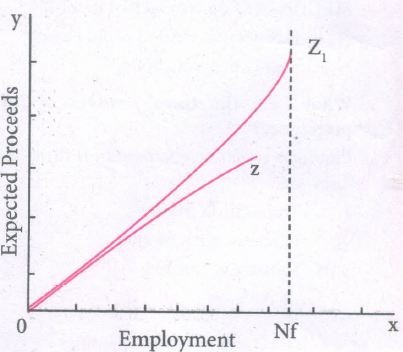
In this figure 2 aggregate supply curves are drawn for the assumption of fixed money wages and variable wages.
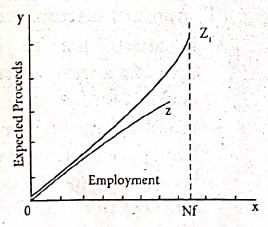
Explanation
(i) Z Curve is linear (fixed money wages)
(ii) Z1 curve is non-linear (wage rate increases with employment)
(iii) When full employment level of Nf is reached output cannot be increased by employing more men.
(iv) So aggregate supply curve becomes inelastic (Vertical straight line).
(v) In reality aggregate supply curve will be like Z1 .
(vi) If prices are high and wages low, the producers will employ more labourers.
(vii) 4YAggregate supply is an important factor in determining the level of economic activity.
119.
120.
Capitalism:
(i) The means of production are privately owned.
(ii) Manufacturers produce goods and services with profit motive.
(iii) Individual can take up any occupation and develop any skill. E.g. USA.
Socialism:
(i) All resources are owned and operated by the government.
(ii) Public welfare is the main motive.
(iii) There is equality in the distribution of income and wealth. E.g. China
Mixedism:
(i) Both private and public sectors co-exist and work together.
(ii) Resources are owned by individuals and the government. E.g. India
121.
| Balanced Budget | Unbalanced Budget |
| 1. In case of balanced budget, the proposed govt. expenditure is equal to the estimated govt. receipts in the budget year. | 1. In case of unbalanced budget, the proposed expenditure and the estimated receipt are unequal during the budget year. |
| 2. Balanced budget reduces unproductive and extravagant expenditure of the govt | 2. Unbalanced (deficit) budget helps the govt. to incur unproductive and extravagant expenditure. |
| 3. It is ineffective during economic instability. | 3. It is effective during economic instability (surplus during inflation and deficit during deflation). |
| 4. It fails to achieve full employment from under-employment equilibrium | 4. Unbalanced (deficit) budget is a powerful instrument to achieve full employment |
| 5. It cannot solve the problems of underdeveloped countries (UDCs). | 5. Unbalanced (deficit) budget is a powerful instrument of resource mobilisation for economic development of UDCs. |
122.
| BASIS | RBI | COMMERCIAL BANK |
| Meaning | The bank which looks after the monetary system of the country is known as Central Bank. | The establishment, which provides banking services to the public is known as Commercial Bank. |
| Role | It is a banker to the banks and the government of the country | It is the banker to the citizens of the nation |
| Established by | Reserve Bank of India Act, 1934 | Banking Regulation Act, 1949. |
| Ownership | Public | Public or Private |
| Monetary Authority | It is the supreme monetary authority with wide powers | No such authority. |
| Objective | Public welfare and economic development. | Earning Profits |
| Money supply | Ultimate source of money supply in the economy. | No such function is performed by it. |
| Right to print and issue currency notes | Yes | No |
| Deals with | Banks and Governments | General Public |
| How many banks are there | Only one | Many |
123.
For Egression Calculations, we draw the following table
| Month(X) | Height(Y) | X2 | XY |
| 1 | 52.5 | 1 | 52.5 |
| 2 | 58.7 | 4 | 117.4 |
| 3 | 65.0 | 9 | 195.0 |
| 4 | 70.2 | 16 | 280.8 |
| 5 | 75.4 | 25 | 377.0 |
| 6 | 81.1 | 36 | 486.6 |
| 7 | 87.2 | 49 | 610.4 |
| 8 | 95.5 | 64 | 764.0 |
| 9 | 102.2 | 81 | 919.8 |
| 10 | 108.4 | 100 | 1084.0 |
| ΣX = 55 | ΣU = 796.2 | ΣX2 = 385 | ΣXY= 4887.5 |
Considering the regression line as Y = a + bX, we can obtain the values of a and b from the above values.
\(a=\frac { \sum { Y } \sum { X } ^{ 2 } }{ { N\sum { X } }^{ 2 }-{ (\sum { X } ) }^{ 2 } } \)
\(a=\frac { 796.2x385-55x4887.5 }{ 10x385-55x55 } \)
\(b=\frac { N\sum { XY-\sum { X } \sum { Y } } }{ N{ \sum { X } }^{ 2 }-{ (\sum { X } ) }^{ 2 } } \)
\(a=\frac { 10x4887.5-55x796.2 }{ 10x385-55x55 } \)
= 6.16
Hence the regression line can be written as
Y = 45.73 + 6.16x
124.
1. Human Resources:
Human resource is named as human capital because of its power to increase productivity and thereby national income. There is a circular relationship between human development and economic growth.
2. Technical Know-how:
As the scientific and technological knowledge advances, more and more sophisticated techniques steadily raise the productivity levels in all sectors. Schumpeter attributed the cause for economic development to innovation.
3. Political Freedom:
The process of development is linked to political freedom. DadabhaiNaoroji explained in his classic work ‘Poverty and Un- British Rule in India’ that the drain of wealth from India under the British rule was the major cause of the increase in poverty in India.
4. Social Organization:
People show interest in the development activity only when they feel that the fruits of development will be fairly distributed.
5. Corruption free administration:
Corruption is a negative factor in the growth process. Unless the countries root-out corruption in their administrative system, the crony capitalists and traders will continue to exploit national resources.
6. A desire for development:
The pace of economic growth in any country depends to a great extent on people’s desire for development
7. Moral, ethical and social values:
These determine the efficiency of the market, according to Douglas C. North. If people are not honest, the market cannot function.
8. Casino Capitalism:
If People spend a larger proportion of their income and time on entertainment liquor and other illegal activities, productive activities may suffer, according to Thomas Piketty.
9. Patrimonial Capitalism:
If the assets are simply passed on to children from their parents, the children would not work hard, because the children do not know the value of the assets.
125.
| (1) Income (Y) |
(2) Consumption (C) |
(3) Investment (l) |
(4) Aggregate Demand AD = C + 1 = Column(2) + Column(3) |
| 0 | 30 | (a) | 50 |
| 300 | 300 | 20 | 320 |
| 400 | 390 | 20 | 410 |
| 500 | 480 | 20 | 500 |
| 600 | 570 | 20 | (e) |
Using AD = C + II,
(a) 50 = 30 + 20
(b) 320 = 300 + 20
(c) 410 = 390 + 20 Deriving the consumption function:
Autonomous consumption = 30 (from the first row where Y = 0).
To find the mpc, calculate a change in C (e.g. 390 – 300 = 90), and divide by the corresponding change in Y (400 – 300 = 100).
So the mpc = ΔC/ΔY = 90/100 = 0.9 Hence, the consumption function is C = 30 + 0.9Y To fill in
(d) C = 30 + 9(600) = 30 + 540 = 570.
(e) follows from 590 = 570 + 20.
f. Equilibrium is where Y = AD, which is at 500 (see shaded row).
126.
Types of Exchange Rate:
(i) Nominal Exchange Rate
(ii) Real Exchange Rate
(iii) Nominal Effective Exchange Rate
(iv) Real Effective Exchange Rate If 1US Dollar = Rs.75
(i) Nominal Exchange Rate:
Nominal Exchange Rate =\(\cfrac { 75 }{ 1 } \)
This is the bilateral nominal exchange rate.
(ii) Real Exchange Rate:
(1) Real Exchange Rate = \(\cfrac { { eP }_{ r } }{ P } \)
P = Price level in India
PF = Price level in abroad (say US)
e = Nominal Exchange Rate
(2) If a pen costs Rs.50 in India and it costs 5 USD in the US.
\(\therefore \text {Real Exchange Rate}=\cfrac { 75\times 5 }{ 50 } =7.5\)
(3) If real exchange rate is equal to 1, the currencies are at purchasing power parity.
(4) If the price of the pen in US is 0:66 USD, then the real exchange rate
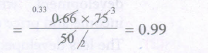
Then it could be said that the USD and Indian rupee are at purchasing power parity.
127.
(i) Income by Income Method. Income method approaches National Income from the distribution side.
(ii) National income is calculated by adding up all the incomes generated in the course of producing national product.
(iii) Factor incomes are grouped under labour income, capital income and mixed income.
(iv) national income is calculated as domestic factor income plus net factor incomes from abroad. In short,
Y = w + r + i + π + (R-P)
w = wages
r = rent
i = interest
π = profits
R = Exports
P = Imports
(v) This method is adopted for estimating the contributions of the remaining sector, viz.
(vi) Data on income from abroad (the rest of) the world sector or foreign sector are obtained from the account of the balance of payment of the country.
Items no to be included:
(1) Transfer payments are not to be included in estimation of national income.
(2) The receipts from the sale of second hand goods should not be treated as part of national income.
Item to be included:
(1) Imputed value of rent for self occupied house or offices is to be included.
(2) Imputed value of services provided by owners of production unit (family labour) is to be included.
128.
129.
(a) Rapid Economic Growth:
(i) It promotes rapid economic growth.
(ii) Thus both public requirements and private needs are taken care of.
(b) Balanced Economic Growth:
(i) Mixedism promotes balanced growth of the economy.
(ii) It promotes balanced growth between agriculture and industry.
(c) Proper utilization of Resources:
(i) The government can ensure proper utilization of resources.
(ii) The government controls must of the important activities directly.
(d) Economic Equality:
(i) The government uses progressive rates of taxation.
(ii) Income tax to bring about economic equality.
130.
Introduction
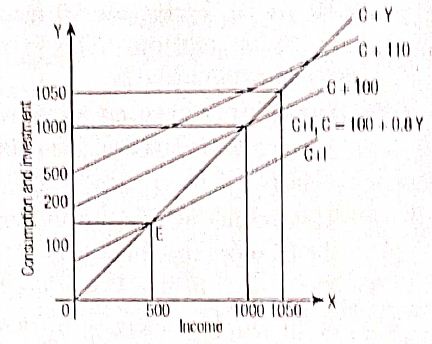
The concept of multiplier Was first developed by R.F. Khan in terms of employment. J.M Keynes redefined it as investment multiplier.
Definition
Multiplier is defined as the ratio of the change in national income to change in investment.
\(K=\Delta Y / \Delta I\)
The value of multiplier depends on MPC.
\(\mathrm{K}=\frac{1}{1-\mathrm{MPC}} \text { since } \mathrm{MPC}+\mathrm{MPS}=1\)
\(k=\frac{1}{N 118}\)
Multiplier is inversely related to MPS and directly with MPC.
If MPC is, 0.75, MPS is 0.25 then K=4.00
\(\frac{1}{1-0.75} \text { or } \frac{1}{0.25}=4\)
| MPC | MPS | k |
| 0.00 | 1.00 | 1 |
| 0.10 | 0.90 | 1.11 |
| 0.50 | 0.50 | 2.00 |
| 0.75 | 0.25 | 4.00 |
Working
(i) Suppose government undertakes investment expenditure equal to र100 cr on public works.
(ii) Income of labourers and suppliers of materials increases by र100 cr
(iii) If MPC is 0.8 that is 80 %. र80 cr is spent on consumption र20 cr salved
(iv) Suppliers of goods get an income of र80 cr. They spend र64 cr (ie 80% of र80 cr).
(v) In this manner consumption expenditure and increase in income act in a chain like manner.

12th Standard Syllabus & Materials
12th Standard
TN 12th Computer Applications களப்பெயர் முறைமை (DNS) Sample Question Papers Study Material - QB365 Set A
NEW12th Standard
TN 12th Computer Applications வலையமைப்பு எடுத்துக்காட்டுகள் மற்றும் நெறிமுறைகள் Sample Question Papers Study Material - QB365 Set A
NEW12th Standard
TN 12th Computer Applications கணினி வலையமைப்பு ஓர் அறிமுகம் Sample Question Papers Study Material - QB365 Set A
NEW12th Standard
TN 12th Computer Applications PHP-உடன் MySQL-ஐ இணைத்தல் Sample Question Papers Study Material - QB365 Set A



Tamilnadu Stateboard 12th Standard Subjects

Maths

Chemistry

Physics

Biology

Computer Science

Business Maths and Statistics
Economics

Commerce

Accountancy

History

Computer Applications
Biology
Computer Technology
Computer Applications
Computer Science
Business Maths and Statistics
Commerce
Economics
Maths
Chemistry
Physics
Computer Technology
History
Accountancy

Tamil

English

French
Tamilnadu Stateboard Standards
