
 100% FREE ACCESS
12th Standard Syllabus & Materials
12th Standard
TN 12th Computer Applications மின்னணு தரவு பரிமாற்றம் Sample Question Papers Study Material - QB365 Set A
NEW12th Standard
TN 12th Computer Applications மின் - வணிக பாதுகாப்பு அமைப்புகள் Sample Question Papers Study Material - QB365 Set A
NEW12th Standard
TN 12th Computer Applications மின்னணு செலுத்தல் முறைகள் Sample Question Papers Study Material - QB365 Set A
NEW12th Standard
TN 12th Computer Applications மின் - வணிகம் Sample Question Papers Study Material - QB365 Set A
NEW12th Standard
TN 12th Computer Applications திறந்த மூல கருத்துருக்கள் Sample Question Papers Study Material - QB365 Set A
NEW12th Standard
TN 12th Computer Applications வலையமைப்பு வடமிடல் Sample Question Papers Study Material - QB365 Set A

Published on: 03/09/2019
Monetary Economics
Download Tamil Nadu 12th Standard Economics question papers, model tests, one-mark questions, important questions, and public exam papers in PDF format. Free study materials and answer keys for TN State Board students.
Questions + Answers key
Take MCQ Economics Test
1.
“Money can be anything that is generally acceptable as a means of exchange and that thesame time acts as a measure and a store of value”, This definition was given by
Crowther
A.C.Pigou
F.A.Walker
Francis Bacon
2.
Stagflation combines the rate of inflation with
Stagnation
employment
output
price
3.
___________inflation occurs when general prices of commodities increases due to increase in production costs such as wages and raw materials.
Cost-push
demand pull
running
galloping
4.
Inflation means
Prices are rising
Prices are falling
Value of money is increasing
Prices are remaining the same
5.
The RBI Headquarters is located at
Delhi
Chennai
Mumbai
Bengaluru
6.
What is Stagflation?
7.
What is gold standard?
8.
Define Money.
9.
Explain disinflation.
10.
Write the types of inflation
11.
Write a note on metallic money.
12.
Describe the phases of Trade cycle.
13.
Illustrate Fisher’s Quantity theory of money.
1.
(a)
Crowther
2.
(a)
Stagnation
3.
(a)
Cost-push
4.
(a)
Prices are rising
5.
(c)
Mumbai
6.
Stagflation is a combination of stagnant economic growth, high unemployment and high inflation.
7.
(i) The value of the monetary unit is directly linked with a certain weight of gold.
(ii) The purchasing power of a unit of money is maintained equal to the value of a fixed weight of gold.
8.
(i) Money is, what money does - Walker:
(ii) Money can be anything that is generally acceptable as a means of exchange and at the same time acts as a measure and a store of value. - Crowther.
9.
(i) It is the slowing down the rate of inflation by controlling the amount of credit (bank loan, hire purchase) available to consumers without causing more unemployment.
(ii) It is defined as the process of reversing inflation without creating unemployment or reducing output in the company.
10.
(i) On the basis of speed there are four types of inflation - Creeping inflation, Walking Inflation, Running inflation, Galloping inflation.
(ii) Demand-Pull inflation, Cost-Push inflation.
(iii) On the basis of inducement - currency inflation, credit inflation, deficit induced inflation, profit induced inflation, scarcity induced inflation, tax induced inflation.
11.
(i) After the barter system and commodity money system, modern money systems evolved.
(ii) Metallic standard is the premier one.
(iii) Some kind of metal, gold or silver is used to determine the standard value of the money and currency.
(iv) Standard coins made out of the metal are the principal coins used under the metallic standard.
(v) These Standard coins are full bodied or full weighted legal tender.
(vi) Their face value is equal to their intrinsic metal value.
12.
Boom or Prosperity:
1. The employment and the movement of the economy beyond full employment is the characterized features of boom.
2. There is hectic activity, money wages rise, profits increase, interest rates go up, demand for bank credit increases.
3. There is all round optimism.
Recession:
1. The turning point from boom condition is recession.
2. Failure of a company or bank brings a phase of recession.
3. Investments are drastically reduced, production falls, income and profits decline.
4. There is panic in the stock market and business is dull.
5. Liquidity preference of the people rises and money market becomes tight.
Depression:
1. The level of economic activity becomes extremely low.
2. Firms incur loss and close down resulting in unemployment.
3. Interest rate, profits, wages are low.
4. Agricultural class and wage carners are badly affected.
5. Banks do not lend to businessmen.
6. The extreme point of depression is called as "trough".
7. Keynes said that autonomous investment of the government can help the economy to come out of depression.
Recovery:
1. After depression, recovery sets in the upswing.
2. It begins with the revival of demand for capital goods.
3. The demand slowly picks up and in due course there is more production, profit, income, wages and employment.
4. Recovery may be initiated by innovation or investment or by government.
13.
Introduction:
(i) It was first propounded in 1588 by an Italian economist Davanzatti. It was popularised by an Americill economist, Irving Fisher is his book, "The Purchasing Power of Money" in 1911. He gave it a quantitative form in terms of "Equation of Exchange".
Equations:
MV = PT
(i) The Supply of Money = Demand for Money
M = Money Supply
V = Velocity of Money
P = Price level
T = Volume of Transaction.
(ii) The total quantity of money will be equal to the total value of all goods and services bought and sold.
\(P=\frac{M V}{T}\)
(iii) The quantity of money determines the price level and the price level varies directly with the quantity of money provided 'V' and 'T' remain constant.
(iv) Later Fisher extended his exchange to include bank deposits M1 and its velocity V1.
\(P T =M V+M^{\prime} V^{\prime} \)
\(P =\frac{M V+M^{\prime} V^{\prime}}{T}\)
- The price level is determined by
(a) quantity of money in circulation M
(b) velocity of circulation of money V
(c) volume of bank credit money M1
(d) velocity of circulation of credit money V1
(c) Volume of trade ('T')
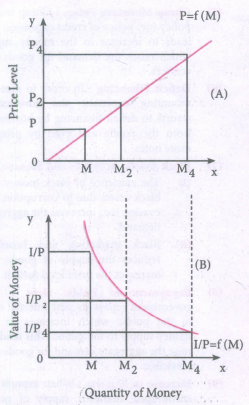
(i) It show's the effect of changes in the quantity of money on the price level.
(ii) When quantity of money is OM1, the price level is OP1.
(iii) When the quantity of money is doubled to OM2, the price level is also doubled to OP2.
(iv) When quantity of money is increased four-fold to OM4, the price level also increases by 4 times to OP4 his relationship is shown by the curve OP = f(M) from the origin at 45o.
Quantity of money
(i) Fig B shows the inverse relation between the quantity of money and the value of money.
(ii) Value of money is taken on the vertical axis.
(iii) When the quantity of money is OM1, the value of money is OI / P1.
(iv) When quantity of money is doubled to OM2, the value of money becomes one half of what it was before (OI / P2)
(v) When quantity of money increases by the four fold to OM4, the value of among is reduced by OI / P4
(vi) This inverse relationship between the quantity of money and the value of money is shown by downward sloping curve 1 / OP= f(M).

12th Standard Syllabus & Materials
12th Standard
TN 12th Computer Applications களப்பெயர் முறைமை (DNS) Sample Question Papers Study Material - QB365 Set A
NEW12th Standard
TN 12th Computer Applications வலையமைப்பு எடுத்துக்காட்டுகள் மற்றும் நெறிமுறைகள் Sample Question Papers Study Material - QB365 Set A
NEW12th Standard
TN 12th Computer Applications கணினி வலையமைப்பு ஓர் அறிமுகம் Sample Question Papers Study Material - QB365 Set A
NEW12th Standard
TN 12th Computer Applications PHP-உடன் MySQL-ஐ இணைத்தல் Sample Question Papers Study Material - QB365 Set A



Tamilnadu Stateboard 12th Standard Subjects

Maths

Chemistry

Physics

Biology

Computer Science

Business Maths and Statistics
Economics

Commerce

Accountancy

History

Computer Applications
Biology
Computer Technology
Computer Applications
Computer Science
Business Maths and Statistics
Commerce
Economics
Maths
Chemistry
Physics
Computer Technology
History
Accountancy

Tamil

English

French
Tamilnadu Stateboard Standards
