
 100% FREE ACCESS
12th Standard Syllabus & Materials
12th Standard
TN 12th Computer Applications மின்னணு தரவு பரிமாற்றம் Sample Question Papers Study Material - QB365 Set A
NEW12th Standard
TN 12th Computer Applications மின் - வணிக பாதுகாப்பு அமைப்புகள் Sample Question Papers Study Material - QB365 Set A
NEW12th Standard
TN 12th Computer Applications மின்னணு செலுத்தல் முறைகள் Sample Question Papers Study Material - QB365 Set A
NEW12th Standard
TN 12th Computer Applications மின் - வணிகம் Sample Question Papers Study Material - QB365 Set A
NEW12th Standard
TN 12th Computer Applications திறந்த மூல கருத்துருக்கள் Sample Question Papers Study Material - QB365 Set A
NEW12th Standard
TN 12th Computer Applications வலையமைப்பு வடமிடல் Sample Question Papers Study Material - QB365 Set A

Published on: 13/02/2020
12th Standard Economics public model Questions Paper -VI - 2019-2020
Download Tamil Nadu 12th Standard Economics question papers, model tests, one-mark questions, important questions, and public exam papers in PDF format. Free study materials and answer keys for TN State Board students.
Questions + Answers key
Take MCQ Economics Test
1.
During the past 67 years of planning, the population of India has increased from 36.1 crore in…………, to 121 crore in………..?
1951 and 2011
1981 and 2011
1991 and 2018
1971 and 2001
2.
Which of the following is not an assumption of classical theory?
Price flexibility
Unemployment
Say’s law
Neutrality of money
3.
Expand the term MOSPI.
The Ministry of Statistics and Programme Implementation
The Ministry of Statistics and Probability Implementation
The Ministry of Statistical and Programme Improvements
None of the above
4.
According to the Heckscher-Ohlin model, the source of comparative advantage is a country’s:
technology
advertising
factor endowments
both (a) and (c)
5.
A noisy party that keeps neighbors awake is an example of a
negative production externality
positive production externality
negative consumption externality
positive consumption externality
6.
Assertion: The progressive tax system increases the propensity to consume of the people by altering the income distribution in favour of poor.
Reason: When government reduces the tax the disposable income rises and the propensity to consume of community increases.
Both A and R are true and R is the correct explanation of A
Both A and R are true but R is not the correct explanation of A
A is true but R is false
A is false but R is true
7.
Identify which is not a subject matters covered in Macro Economics
employment
national income
inflation
Profit maximization
8.
Jakarta is the head quarters of _________.
BRICS
WTO
SAARC
ASEAN
9.
________ is the period of sixth five year plan during Janata party in centre.
1975-80
1980-85
1985-90
1978-83
10.
Great care is required to calculate ____________.
Capital Gains
Social Accounting
Double Counting
Statistical Problems
11.
If both variables X and Y increase or decrease simultaneously, then the coefficient of correlation will be:
Positive
Negative
Zero
One
12.
Which of the following country adopts indicative planning?
France
Germany
Italy
Russia
13.
Global warming also refers to as
Ecological change
Climate Change
Atmosphere change
None of the above
14.
15.
16.
Lender of the last resort is one of the functions of.
Central Bank
Commercial banks
Land Development Banks
Co-operative banks
17.
Inflation means
Prices are rising
Prices are falling
Value of money is increasing
Prices are remaining the same
18.
Say’s law stressed the operation of________ in the economy
Induced price mechanism
Automatic price mechanism
Induced demand
Induced investment
19.
Which is the largest figure?
Disposable income
Personal Income
NNP
GNP
20.
21.
Write a short note on former Indian Planning Commission.
22.
Explain the primary function of money.
23.
State Duesenberry hypothesis.
24.
Draw the diagram for World Bank group.
25.
What is Per capita income?
26.
Specify the objectives of econometrics.
27.
What are the causes of water pollution?
28.
Distinguish between Balance of Trade and Balance of Payments.
29.
What do you mean by aggregate demand ? Mention its components.
30.
Describe the different types of economic systems.
31.
What are the taxes levied and collected by the union but assigned to the states?
32.
Compare and contrast primary and secondary data.
33.
Draw the flow chart for correction of Balance Payment Disequilibrium
34.
Draw the 7 pillars of NITI Aayog.
35.
Explain other types of inflation (on the basis of inducement).
36.
Explain the importance of sustainable development and its goals.
37.
Explain the methods of debt redemption.
38.
Discuss the role of WTO in India’s socio-economic development.
39.
Explain the relationship between Foreign Direct Investment and Economic development.
40.
Explain the role of Commercial Banks in economic development.
41.
Explain Keynes psychological law of consumption function with diagram.
42.
Critically explain Say’s law of market.
43.
Explain the importance of national income
44.
Compare the features among Capitalism, Secularism and Mixedism
45.
Define a financial intermediary.
46.
Write a note on the supply side vicious circle of poverty.
47.
What is Aggregate supply?
48.
Mention any two uses of multiplier concept.
49.
Why Keynes is considered as the father of modern macro economics?
50.
What are the remedial measures to control noise pollution?
51.
What is Free trade area?
52.
What is Stagflation?
53.
54.
What is the difference between NNP and NDP?
1.
(a)
1951 and 2011
2.
(b)
Unemployment
3.
(a)
The Ministry of Statistics and Programme Implementation
4.
(c)
factor endowments
5.
(c)
negative consumption externality
6.
(a)
Both A and R are true and R is the correct explanation of A
7.
(d)
Profit maximization
8.
(d)
ASEAN
9.
(d)
1978-83
10.
(c)
Double Counting
11.
(a)
Positive
12.
(b)
Germany
13.
(d)
None of the above
14.
(b)
15.
(d)
16.
(a)
Central Bank
17.
(a)
Prices are rising
18.
(b)
Automatic price mechanism
19.
(d)
GNP
20.
(b)
21.
(i) On January 26, 1950, the Constitution came into force.
(ii) In logical order, the Planning Commission was created on March 15, 1950.
(iii) The plan era began on April 1, 1951, with the launch of the first five-year plan (1951-56).
(iv) Planning Commission was set up to formulate Five Year Plan in India by Jawaharlal Nehru.
(v) He was the first Chairman of Planning Commission, Government of India.
22.
(i) Money as a medium of exchange: This is considered as the basic function of money. Money has the quality of general acceptability, and all exchanges take place in terms of money.
(ii) Money as a measure of value: The second important function of money is that it measures the value of goods and services.
23.
Duesenberry has made two observations regarding the factors affecting consumption.
a) The consumption expenditure depends not only on his current income but also past income and standard of living. As the individuals are accustomed to a particular standard of living, they continue to spend the same amount on consumption even though the current income is reduced.
b) Consumption is influenced by demonstration effect. The consumption standards of low income groups are influenced by the consumption standards of high income groups. In other words, the poor people want to imitate the consumption pattern of rich. This results in spending beyond their income level.
24.
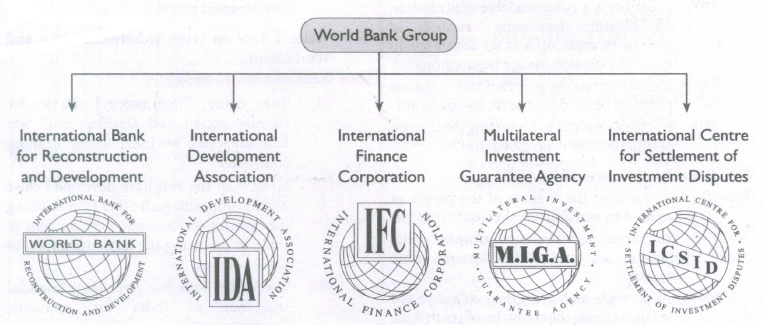
25.
(i) Per Capita income (or) output per person is an indicator to show the living standards of people in a country.
(ii) If real PCI increases.
(iii) It is considered to be an improvement in the overall living standard of people.
(iv) PCI is arrived at by dividing the GDP by the size of population.
(v) It is also arrived by making some adjustment with GDP
(vi) \(PCI=\frac { GDP }{ Total\ number\ of\ people\ in\ a\ country } \) (or)\(PCI=\frac { National\ Income }{ Total\ Population } \)
26.
(i) The general objective of Econometrics is to give empirical content to economic theory
(ii) The specific objectives are :
(i) It helps to explain the behaviour of a forthcoming period that is forecasting economic phenomena.
(ii) It helps to prove the old and established relationships among the variables or between the variables.
(iii) It helps to establish new theories and new relationships.
(iv) It helps to test the hypotheses and estimation of the parameter.
27.
Discharge of sewage and waste water:
(i) Sewage, garbage and liquid waste of households, agricultural runoff and effluents from factories are discharged into lakes and rivers.
(ii) These wastes contain harmful chemicals and toxins which make the water poisonous for aquatic animals and plants.
Dumping of solid wastes:
(i) The dumping of solid wastes and litters in water bodies cause huge problems.
Discharge of industrial wastes:
(i) Industrial waste contains asbestos, lead, mercury, grease oil and petrochemicals.
Oil Spill:
(i) Sea water gets polluted due to oil spilled from ships and tankers.
Acid Rain:
(i) When the acidic particles caused by air pollution mix with water vapour, it results in acid rain.
Global warming:
(i) The increase in water temperature affects aquatic plants and animals.
Eutrophication:
(i) The increased level of nutrients in water depletes oxygen in water and this negatively affects fish and other aquatic animal population.
28.
| S.No |
Balance of Trade |
Balance of Payments |
|---|---|---|
| 1 | Only export and import of commodities are included in BoT |
Export and import of commodities and services are included in BoP |
| 2 | i.e. Movement of goods or visible trade | Trade in both visible and non visible items. |
29.
(i) In the Keynesian model, output is determined mainly by aggregate demand.
(ii) The aggregate demand is the amount of money which entrepreneurs expect to get by selling the output produced by the labourers employed.
(iii) Aggregate demand (spending) is the amount that households, firms, the governments and the foreign purchasers would like to spend on domestic output
Aggregate demand has four components:
1. Consumption demand (C)
2. Investment demand (I)
3. Government expenditure (G)
Net Export ( export - import) (X - M)
AD = C + I + G + (X - M)
30.
Capitalism:
(i) The means of production are privately owned.
(ii) Manufacturers produce goods and services with profit motive.
(iii) Individual can take up any occupation and develop any skill. E.g. USA.
Socialism:
(i) All resources are owned and operated by the government.
(ii) Public welfare is the main motive.
(iii) There is equality in the distribution of income and wealth. E.g. China
Mixedism:
(i) Both private and public sectors co-exist and work together.
(ii) Resources are owned by individuals and the government. E.g. India
31.
1. Duties in respect of succession to property other than agricultural land.
2. Estate duty in respect of property other than agricultural land.
3. Taxes on railway fares and freights.
4. Taxes other than stamp duties on transactions in stock exchanges and future markets.
5. Taxes on the sale or purchase of newspapers and on advertisements published therein
6. Terminal taxes on goods or passengers carried by railways, sea or air.
7. Taxes on the sale or purchase of goods other than newspapers where such sale or purchase taxes place in the course of inter-State trade or commerce.
32.
| BASIS FOR COMPARISON |
PRIMARY DATA | SECONDARY DATA |
| Meaning | Those data which do not ready exist in any form, and thus have to be collected for the first time from the primary source(s). | They already exist in zome form: published or npublished in an identifiable secondary source. |
| Nature | Real time data - first-time collected | Past data - available from published source(s) |
| Process | Very involved | Quick and easy |
| Source | Surveys, observations, experiments, questionnaire, personal interview, etc. |
Government publications, websites, books, journal articles, internal records etc. Eg. Data from CSO, NSSO, RBI |
| Cost-effectiveness | Expensive | Economical |
| Collection time | Long | Short |
| Form | Crude form | Refined form |
| Accuracy and Reliability | More | Relatively less |
33.
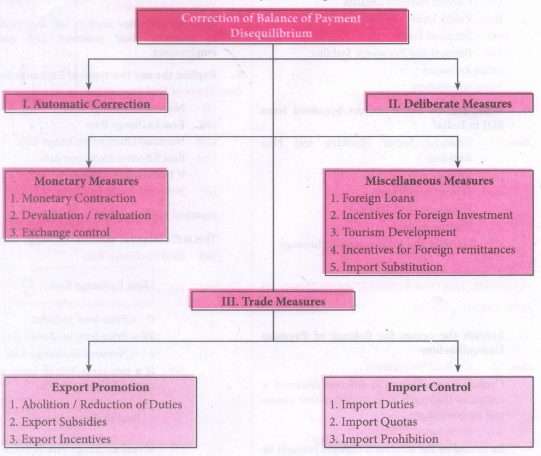
34.
7 pillars of effective governance:
NITI AAYOG
| Pro-People | Fulfills aspirations of society as well as individuals |
| Pro-Activity | in anticipation response to citizen needs |
| Participation | involvement of citizenry |
| Empowering | Women in all aspects |
| Inclusion of all | SC, ST, OBC, minorities, gareeb, gaon, kisaan |
| Equality | of opportunity for the youth |
| Transparency | making government visible and responsive. |
35.
(i) Currency Inflation:
The excess supply of money in circulation causes rise in price level.
(ii) Credit Inflation
When banks are liberal in lending credit, the money supply increases and thereby rising prices.
(iii) Deficit Induced Inflation:
The deficit budget is generally financed through printing of currency by the Central Bank. As a result, prices rise.
(iv) Profit Induced Inflation:
When the firms aim at higher profit, they fix the price with higher margin. So, prices go up.
(v) Scarcity Induced Inflation:
Scarcity of goods happens either due to fall in production (e.g. farm goods) or due to hoarding and black marketing.
(vi) TaxInducedInflation:
(1) Increase in indirect taxes like excise duty, custom duty and sales tax may lead to rise in price.
(2) This is also called taxflation.
36.
Introduction:
(i) Sustainable development is concerned with the welfare of the present and future generation.
(ii) It aims at satisfying the luxury wants of the rich and the basic necessities of the poor.
Definition:
(i) Sustainable development is development that meets the needs of the present without compromising the ability of future generations to meet their own needs.
Goals:
(i) It is crucial to harmonize three core elements such as economic growth, social inclusion and environmental protection.
(ii) A set of 17 goals for the world's future can be achieved before 2030 with three unanimous principles fixed by United Nations such as Universality, Integration and Transformation.
1) End poverty in all its forms everywhere.
2) End hunger, achieve food security and improved nutrition and promote sustainable agriculture.
3) Ensure healthy lives and promote wellbeing for all at all ages.
4) Ensure inclusive and quality education for all and promote lifelong learning.
5) Achieve gender equality and empower women and girls.
6) Ensure access to water and sanitation for all.
7) Ensure access to affordable, reliable, sustainable and modern energy for all.
8) Promote inclusive and sustainable economic growth, employment and decent work for all.
9) Build resilient infrastructure, promote, sustainable industrialization and foster innovation.
10) Reduce inequality within and among countries.
11) Make cities inclusive, safe, resilient and sustainable.
12) Ensure sustainable consumption and production pattern.
13) Take urgent action to combat climate change and its impacts
14) Conserve and sustainably use the oceans, seas and marine resources.
15) Sustainably manage forests, combat desertification, stop and reverse land degradation, stop biodiversity loss.
16) Promote just, peaceful and inclusive societies.
17) Revitalize the global partnership for sustainable development.
37.
Introduction:
(i) The process of repaying a public debt is called redemption.
Sinking Fund
(i) The Government establishes a separate fund into which every year a fixed amount of money is credited.
(ii) By the time the debt matures, the fund accumulates enough amount to pay off the principal along with interest.
Conversion
(i) An old loan is converted into a new loan.
(ii) A high interest public debt is converted into a low interest public debt.
Budgetary Surplus
(i) When the Government has a surplus budget, it can be used for repaying the debt.
Terminal Annuity
(i) Government pays off debt on the basis of terminal annuity in equal annual instalments.
Repudiation
(i) Government does not recognise its obligation to repay the loan.
(ii) But in normal case the Government does not do so; if done it will lose its credibility.
Reduction in Rate of Interest
(i) During financial crisis there is compulsory reduction in the rate of interest.
Capital Levy
(i) When Government imposes levy on the capital assets owned by an individual or any institution, it is called capital levy.
(ii) This levy is imposed on capital assets above a minimum limit on a progressive scale.
(iii) The fund so collected can be used by the Government for paying off war time debt.
38.
Introduction:
1. India is the founding member of the WTO.
2. India favours multilateral trade approach and enjoys MFN status.
3. India benefited from WTO on following grounds:
4. By reducing tariff rates on raw materials, components and capital goods, it was able to import more for meeting her developmental needs.
5. India's imports go on increasing.
6. India gets market access in several countries without any bilateral trade agreements.
7. Advanced technology has been obtained at cheaper cost.
8. India is in a better position to get quick redressal from the trade disputes.
9. Indian exporters benefited from wider market information.
39.
1. FDI is an important factor in global
2. Foreign trade and FDI are closely related.
3. In developing countries like India FDI in tie natural resource sector like plantations, increases rade.
4. Foreign production by FDI is useful to substitute foreign trade.
5. FDI is also influenced by the income generated from the trade and regional integration schemes.
6. FDI accelerates the economic growth by facilitating essential imports needed for development programs like capital goods, technical know-how, raw materials, other inputs and even scarce consumer goods.
7. When the export earnings of a country are not sufficient to finance for imports, FDI may be required to fill the trade gap.
8. FDI is encouraged by foreign exchange shortage, desire to create employment and acceleration of the pace of economic development.
9. Many developing countries strongly prefer foreign investment to imports.
40.
Introduction
(i) Commercial banks are institutions that conduct business with profit motive by accepting public deposits and lending loans.
Capital Formation
(i) Bank mobilize the small savings of the people scattered over a wide area through their network of branches and make it available for productive purposes.
(ii) Attractive schemes of the banks induce the people to save their money
Creation of Credit
(i) Credit creation leads to increased production, employment, sales and prices and thereby there is faster economic development.
Channelizing Funds towards Productive Investment
(i) Pooled savings is allocated to various sectors and productivity increases.
Encouraging Right Industries
(i) Banks give loan to right type of persons.
(ii) Banks grant loans and advances to manufacturers whose products are in great demand.
(iii) Manufacturers introduce new methods of production and assist in raising the national income of the country.
Banks Monetize Debt
(i) Banks transform the loan to be repaid after a certain period into cash, which can be immediately used for business activity.
(ii) Manufacturers and wholesale traders cannot increase their sales without selling goods on credit basis.
(iii) But credit sales may lead to locking up of capital.
(iv) So production is reduced.
(v) As banks are lending money by discounting bills of exchange, business concerns are able to carry out economic activities without gap.
Finance to Government
(i) Government needs finance for promoting industries.
(ii) Banks provide long-term credit to Government by investing their funds in Government securities and short-term finance by purchasing Treasury Bills.
(iii) RBI has given Rs.68,000 crores to the government of India in the year 2018-19.
Employment Generation
(i) Bank's branches are opened frequently and so new employment opportunities are created.
Banks Promote Entrepreneurship
(i) Banks induce new entrepreneurs to take up the well-formulated projects and provision of counseling services like technical and managerial guidance.
(ii) Conclusions Banks provide 100 % credit for worthwhile projects, which is also technically feasible and economically viable.
(iii) Thus commercial banks help for the development of entrepreneurship in the country.
41.
Law
According to Keynes, "men are disposed as a rule and on the average to increase their consumption as their income increases but not by as much as the increáse in their income".
Propositions
1. When income increases, consumption expenditure also increases, but by a smaller amount
(a) When income increases from 120 to 180; consumption also increases from 120 to 170 but the increase in consumption is less than the increase in income, 10 is saved.
2. The increased income will be divided in some proportion between consumption expenditure and saving
(a) When income increases to 180 and 240, it is divided between consumption (170 and 220) and saving (10 and 20)
3. Incrcascs in income always lead to in incrcase in both consumption and saving
(a) Increases in income to 180) and 240; lead to increased consumption 170 and 220; increased saving 10 and 20.
(b) It is clear from the widening area below the C curve and the saving gap between 45o line and C curve.
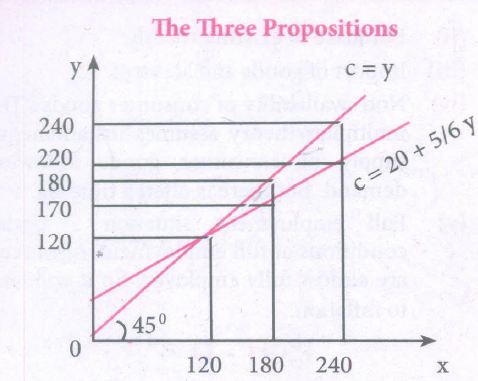
| Y | C | S |
|---|---|---|
| 120 | 120 | 0 |
| 180 | 170 | 10 |
| 240 | 220 | 20 |
42.
Introduction
According to J. B. Say "Supply creates its own demand"
Explanation
A person receives his income from production which is spent on the purchase of goods and services produced by others. For the economy as a whole, therefore, total production equals total income.
Criticisms
(i) According to Keynes, supply does not. create its demand. It is not applicable where demand does not increase as much as production increases.
(ii) Automatic adjustment process will not remove unemployment. Unemployment can be removed by increase in the rate of investment.
(iii) Money is not neutral. Individuals hold money for unforeseen contingencies, businessmen keep cash reserve for future activities.
(iv) Say's law is supply creates its own demand and there is no over production. Keynes said that over production is possible
(v) Keynes regards full employment as a special case because there is underemployment in capitalist economies.
(vi) State intervention is needed when there is over production and mass unemployment.
43.
(i) National income is of great importance for the economy of a country.
(ii) National income helps us to know the relative importance and contribution of each sector. We could find how income is produced, how it is distributed, how much is spent, saved or taxed.
(iii) National income data is used to formulate monetary policy, fiscal policy and other policies.
(iv) Data regarding gross income, output, saving and consumption is uscd in economic planning.
(v) National income data is used to build economic models in short run and long run.
(vi) It is used to make international comparison, inter regional comparison and inter temporal comparison of growth of the economy during different periods.
(vii) If income is equally distributed, the per capita income will reflect the economic welfare of the country.
44.
| S.No | Features | Capitalism | Socialism | Mixedism |
|---|---|---|---|---|
| 1. | Ownership of Means of Production | Private Ownership | Public Ownership | Private Ownership and Public Ownership |
| 2. | Economic Motive | Profit | Social Welfare | Social Welfare and Profit Motive |
| 3. | Solution of Central Problems | Free Market System | Central Planning System | Central Planning System and Free Market System |
| 4. | Government Role | Internal Regulation only | Complete Involvement | Limited Role |
| 5. | Income Distribution | Unequal | Equal | Less unequal |
| 6. | Nature of Enterprise | Private Enterprise | Government Enterprise | Both Private and State Enterprises |
| 7. | Economic Freedom | Complete Freedom | Lack of Freedom | Limited Freedom |
| 8 | Major Problem | Inequally | Inefficiency | Inequality and Inefficiency |
45.
(i) A financial intermediary is a bank or other institution that serves as a link between lenders and borrowers.
(ii) They typically accept savings deposits from consumers and then lend money to consumers and businesses to finance purchases of goods and services or for investment purposes.
46.
(i) On the supply side, the low level of real income means low savings.
(ii) The low level of saving leads to low investment and to deficiency of capital.
(iii) The deficiency of capital, in turn, leads to low levels of productivity and back to low income.
(iv) Low Income ⟶ Low Saving ⟶ Low Investment ⟶ Low Production ⟶ Low Income
47.
The value of total output of goods and services produced in an economy in a year
48.
1. Multiplier highlights the importance of investment in income and employment theory.
2. The process throws light on the different stages of trade cycle.
3. It also helps in bringing the equality between S and I.
4. It helps in formulating Government policies.
5. It helps to reduce unemployment and achieve full employment.
49.
1. Macroeconomics in its modern form, began with John Maynard Keynes and his book “The General Theory of Employment, Interest and Money” published in 1936.
2. Keynes offered an explanation for fallout from the Great Depression, when goods remained unsold and workers unemployed.
3. Hence, Keynes is regarded as the ‘Father of Modern Macro Economics’.
50.
1. Use of noise barriers
2. Newer roadway for surface transport
3. Traffic control
4. Regulating times for heavy vehicles
5. Installations of noise barriers in the work place
6. Regulation of Loudspeakers
51.
(i) Free trade area is the region around a trade bloc whose member countries have signed a free-trade agreement.
(ii) Such agreements involve cooperation between at least two countries to reduce trade barriers. e.g. SAFTA, EFTA.
52.
Stagflation is a combination of stagnant economic growth, high unemployment and high inflation.
53.
54.
(i) NDP = GDP - Depreciation.
(ii) NNP = GNP - Depreciation.
(iii) The difference between NDP and NNP is the net factor income from abroad.
(iv) In NDP it is excluded but in NNP it is included.

12th Standard Syllabus & Materials
12th Standard
TN 12th Computer Applications களப்பெயர் முறைமை (DNS) Sample Question Papers Study Material - QB365 Set A
NEW12th Standard
TN 12th Computer Applications வலையமைப்பு எடுத்துக்காட்டுகள் மற்றும் நெறிமுறைகள் Sample Question Papers Study Material - QB365 Set A
NEW12th Standard
TN 12th Computer Applications கணினி வலையமைப்பு ஓர் அறிமுகம் Sample Question Papers Study Material - QB365 Set A
NEW12th Standard
TN 12th Computer Applications PHP-உடன் MySQL-ஐ இணைத்தல் Sample Question Papers Study Material - QB365 Set A



Tamilnadu Stateboard 12th Standard Subjects

Maths

Chemistry

Physics

Biology

Computer Science

Business Maths and Statistics
Economics

Commerce

Accountancy

History

Computer Applications
Biology
Computer Technology
Computer Applications
Computer Science
Business Maths and Statistics
Commerce
Economics
Maths
Chemistry
Physics
Computer Technology
History
Accountancy

Tamil

English

French
Tamilnadu Stateboard Standards
