
 100% FREE ACCESS
12th Standard Syllabus & Materials
12th Standard
TN 12th Computer Applications மின்னணு தரவு பரிமாற்றம் Sample Question Papers Study Material - QB365 Set A
NEW12th Standard
TN 12th Computer Applications மின் - வணிக பாதுகாப்பு அமைப்புகள் Sample Question Papers Study Material - QB365 Set A
NEW12th Standard
TN 12th Computer Applications மின்னணு செலுத்தல் முறைகள் Sample Question Papers Study Material - QB365 Set A
NEW12th Standard
TN 12th Computer Applications மின் - வணிகம் Sample Question Papers Study Material - QB365 Set A
NEW12th Standard
TN 12th Computer Applications திறந்த மூல கருத்துருக்கள் Sample Question Papers Study Material - QB365 Set A
NEW12th Standard
TN 12th Computer Applications வலையமைப்பு வடமிடல் Sample Question Papers Study Material - QB365 Set A

Published on: 12/02/2020
12th Standard Economics public model Questions Paper - VII - 2019-2020
Download Tamil Nadu 12th Standard Economics question papers, model tests, one-mark questions, important questions, and public exam papers in PDF format. Free study materials and answer keys for TN State Board students.
Questions + Answers key
Take MCQ Economics Test
1.
Which of the following is the most comprehensive measure of budgetary imbalances?
Fiscal Deficit
Revenue Deficit
Primary Deficit
All of the above
2.
Suppose that tomatoes from India face a 20 percent tariff in the China and a 25 percenttariff in Pakistan. If the China and Pakistan maintain free trade between each other, the these two countries belong to a
free-trade area
customs union
common market
monetary union
3.
The correlation would be __________ if the amount of change in one variable does not bear a constant ratio to the amount of change in the other variables.
linear
scatter
non-linear
downward always
4.
Match the correct codes
| 1 | GNP | i | FC + Indirect Taxes - Subsidies |
| 2 | X-M | ii | MP - Indirect Taxes + Subsidies |
| 3 | MP | iii | C + I + G + (X - M) |
| 4 | FC | iv | Net exports |
(1) – (i) (2) – (ii) (3) – (iv) (4) – (iii)
(1) – (ii) (2) – (iii) (3) – (iv) (4) – (i)
(1) – (iv) (2) – (iii) (3) – (i) (4) – (ii)
(1) – (i) (2) – (ii) (3) – (iii) (4) – (iv)
5.
The Heckscher-Ohlin theory explains comparative advantage as the result of differences incountries:
Economies of large-scale production
Relative abundance of various resources
Relative costs of labor
Research and development expenditures
6.
Find the odd one in the context Solid waste
plastic containers
emission
bottles
used cars
7.
When MPC = 0.5, the value of multiplier is
5
0.5
2
4
8.
Assertion: Each individual and organization produce only those goods which ensure high profit.
Reason: Profit is the driving force behind all economic activities in a capitalistic economy
Both A and R are true and R is the correct explanation of A.
Both A and R are true but R is not the correct explanation of A
A is true but R is false
A is false but R is true
9.
Which is not the characteristics of UDCs?
Low per capita
Wide in equality
High rate of unemployment
Price mechanism
10.
The entrepreneur would be encouraged to employ ________________
more labour
more income
more product
more capital
11.
If both variables X and Y increase or decrease simultaneously, then the coefficient of correlation will be:
Positive
Negative
Zero
One
12.
Sarvodaya Plan was advocated by__________
Mahatma Gandhi
J.P.Narayan
S.N Agarwal
M.N. Roy
13.
Which of the following is main cause for deforestation?
Timber harvesting industry
Natural afforestation
Soil stabilization
Climate stabilization
14.
Finance Commission determines
The finances of Government of India
The resources transfer to the states
The resources transfer to the various departments
None of the above
15.
Cyclical disequilibrium in BOP occurs because of
Different paths of business cycle.
The income elasticity of demand or price elasticity of demand is different.
long-run changes in an economy
Both (a) and (b)
16.
EXIM bank was established in.
June 1982
April 1982
May 1982
March 1982
17.
Stagflation combines the rate of inflation with
Stagnation
employment
output
price
18.
_________ Flexibility brings equality between saving and investment
Demand
Supply
Capital
Rate of Interest
19.
Which is the largest figure?
Disposable income
Personal Income
NNP
GNP
20.
Identify The Father of Socialism
J M Keynes
Karl Marx
Adam Smith
Samuelson
21.
Explain the primary function of money.
22.
Draw the diagram of consumption function.
23.
Write a functions of WTO.
24.
What are the National Income identities?
25.
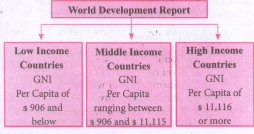
Classify the various countries on the basis of gross national income (GNI) per capita?
26.
What are the functions of Statistics?
27.
Brief the linkage between economy and environment.
28.
Distinguish between Balance of Trade and Balance of Payments.
29.
According to classical theory of employment, how wage reduction solve the problem of unemployment diagramatically explain.
30.
Outline the major merits of capitalism.
31.
Distinguish between Balanced and Unbalanced Budget.
32.
Find out graphically, if there is any correlation between price yield per plot (qtls); denoted by Y and quantity of fertilizer used (kg); denote by X.
| Plot No: | 1 | 2 | 3 | 4 | 5 | 6 | 7 | 8 | 9 | 10 |
| Y: | 3.5 | 4.3 | 5.3 | 5.8 | 6.4 | 7.3 | 7.2 | 7.5 | 7.8 | 8.3 |
| X: | 6 | 8 | 9 | 12 | 10 | 15 | 17 | 20 | 18 | 24 |
33.
Discuss the Non- Economic Factors economic development.
34.
Distinguish between Fisher’s and Cambridge Equation.
35.
Elaborate various Gains from International Trade?
36.
Explain the importance of sustainable development and its goals.
37.
Explain the scope of public finance.
38.
Explain the objectives of IMF.
39.
Discuss the differences between Internal Trade and International Trade.
40.
Elucidate the functions of Commercial Banks
41.
What are the differences between MEC and MEI.
42.
43.
Discuss the importance of social accounting in economic analysis.
44.
Compare the features among Capitalism, Secularism and Mixedism
45.
What are Time Deposits?
46.
Write a brief note on “Traditional Approach” about economic development
47.
What is Definition of “The accelerator coefficient”?
48.
What are the major types of economic systems.
49.
What are the two factors depend on MEC?
50.
Mention the countries where per capita carbondioxide emission is the highest in the world.
51.
Mention any two objectives of ASEAN.
52.
Define Money.
53.
List out the assumptions of Say’s law.
54.
What do you mean by the term ‘Personal Income’?
1.
(d)
All of the above
2.
(a)
free-trade area
3.
(c)
non-linear
4.
(b)
(1) – (ii) (2) – (iii) (3) – (iv) (4) – (i)
5.
(b)
Relative abundance of various resources
6.
(b)
emission
7.
(c)
2
8.
(a)
Both A and R are true and R is the correct explanation of A.
9.
(d)
Price mechanism
10.
(a)
more labour
11.
(a)
Positive
12.
(b)
J.P.Narayan
13.
(a)
Timber harvesting industry
14.
(b)
The resources transfer to the states
15.
(d)
Both (a) and (b)
16.
(d)
March 1982
17.
(a)
Stagnation
18.
(d)
Rate of Interest
19.
(d)
GNP
20.
(b)
Karl Marx
21.
(i) Money as a medium of exchange: This is considered as the basic function of money. Money has the quality of general acceptability, and all exchanges take place in terms of money.
(ii) Money as a measure of value: The second important function of money is that it measures the value of goods and services.
22.
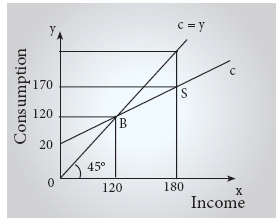
23.
(i) It facilitates the implementation and administration and operation of the objectives of the Agreement and the Multilateral Trade Agreements.
(ii) It provides a forum for negotiations among its members, concerning their multilateral trade relations in matters relating to the agreements.
(iii) It administers the understanding the rules and procedures governing the settlement of disputes.
(iv) It co-operates with the IMF and the World Bank and its affiliated agencies with a view to achieving greater coherence in global economic policy making.
24.
The followings are some of the National Income Identities:
NNP = GNP - Depreciation
NNI = NNP - Indirect taxes
PI = NNI - Retained earnings, corporate taxes and interest on public debt
PDI = PI - Personal taxes
Where,
GNP = Gross National Product
NNP = Net National Product
NNI = Net National Income
PI = Personal Income
PDI = Personal Disposable Income
25.
(i) The WorlthBank in its World Development Report classified various countries on the basis of Gross National Income (GNI) per capita.
(ii) Various countries on the basis of Gross National Income (GNI) per capita.
26.
(I) Statistics presents facts in a definite form.
(ii) It simplifies mass of figures.
(iii) It facilitates comparison.
(iv) It helps in formulating and testing.
(v) It helps in prediction.
(vi) It helps in the formulation of suitable policies.
27.
1. Man's life is interconnected with various other living and non-living things.
2. Life also depends on social, political, ethical, philosophical and other aspects of economic system.
3. The life of human beings is shaped by his living environment.
4. The relationship between the economy and the economy is explained in the "Material Balance Model" developed by Alen Kneese and R.V. Ayres.
5. Households and firms are connected to environment, and they are interconnected too.
6. Households and firms depend on nature for resources.
7. They send out residuals of consumption and production to nature.
8. Nature assimilates all forms of waste.
9. Thus the economy and environment are interconnected.
28.
| S.No |
Balance of Trade |
Balance of Payments |
|---|---|---|
| 1 | Only export and import of commodities are included in BoT |
Export and import of commodities and services are included in BoP |
| 2 | i.e. Movement of goods or visible trade | Trade in both visible and non visible items. |
29.
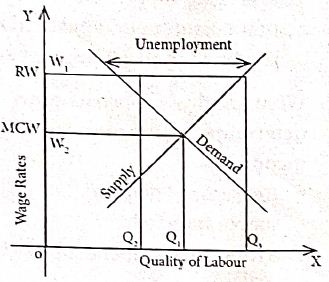
(i) Classical unemployment occurs when real wages are kept above the market clearing wage rate, leading to a surplus of labour supplied.
(ii) Classical unemployment is also called real wage unemployment.
(iii) Unemployment occurs when the worker is willing to accept (Real Wages)(RW) is in excess of those an employer is willing to pay (Market Clearing Wage)(MCW).
(iv) Real wage may be above the equilibrium level because of minimum wage policies or union bargaining.
(v) classical unemployment of Q1-Q2 can be solved by a wage cut.
(vi) If wages are allowed to fall to the market clearing level, unemployment is solved
30.
(i) Automatic working without any government intervention.
(ii) Efficient use of resources.
(iii) Incentives for hard work.
(iv) Production and productivity are high, so there is economic progress.
(v) Consumers sovereignty exist.
(vi) Increased saving and investment leads to higher capital formation.
(vii) Development of new technology.
31.
1. Income and Expenditure adjustment
The government adjusts the income to the expenditure while individuals adjust their expenditure to the income. Private finance involves stitching coat according to cloth available whereas public finance decides the cloth according to the need for the coat.
2. Borrowing
The government can borrow from internal and external sources; it can borrow from the people by issuing bonds. However, an individual cannot borrow from himself
3. Right to print currency
The government can print currency. This involves the creation, distribution and monitoring of currency. The private sector cannot create currency.
4. Present vs. future decisions
The public finance is more involved with future planning and making long-term decisions. These investments could include building of schools, hospitals and infrastructure. The private finance makes financial decisions on projects with a short term vision
5. Objective
The public sector’s main objective is to provide social benefit in the economy. The private sector aims to maximize personal benefit i.e. Profit.
6. Coercion to get revenue
The sources of income of a private individual is relatively limited while those of the Government is wide. The Government can use its power and authority
7. Ability to make huge and deliberate changes
The public finance has the ability to make big decisions on income. For example, it can effectively and deliberately adjust the revenue. But individuals cannot make such massive decisions.
32.
The correlogram of the given data is show in Figure 4-3
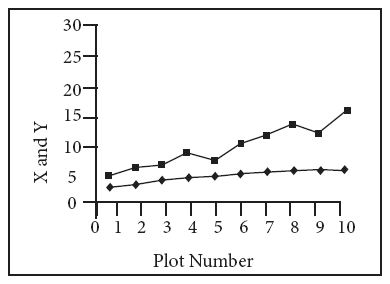
The figure shows that the two curves move in the same direction and, moreover, they are very close to each other, suggesting a close relationship between price yield per plot (qtls) and quantity of fertilizer used (kg).
33.
1. Human Resources:
Human resource is named as human capital because of its power to increase productivity and thereby national income. There is a circular relationship between human development and economic growth.
2. Technical Know-how:
As the scientific and technological knowledge advances, more and more sophisticated techniques steadily raise the productivity levels in all sectors. Schumpeter attributed the cause for economic development to innovation.
3. Political Freedom:
The process of development is linked to political freedom. DadabhaiNaoroji explained in his classic work ‘Poverty and Un- British Rule in India’ that the drain of wealth from India under the British rule was the major cause of the increase in poverty in India.
4. Social Organization:
People show interest in the development activity only when they feel that the fruits of development will be fairly distributed.
5. Corruption free administration:
Corruption is a negative factor in the growth process. Unless the countries root-out corruption in their administrative system, the crony capitalists and traders will continue to exploit national resources.
6. A desire for development:
The pace of economic growth in any country depends to a great extent on people’s desire for development
7. Moral, ethical and social values:
These determine the efficiency of the market, according to Douglas C. North. If people are not honest, the market cannot function.
8. Casino Capitalism:
If People spend a larger proportion of their income and time on entertainment liquor and other illegal activities, productive activities may suffer, according to Thomas Piketty.
9. Patrimonial Capitalism:
If the assets are simply passed on to children from their parents, the children would not work hard, because the children do not know the value of the assets.
34.
| Base of difference | Fisher's Equation | Cambridge's Equation |
| 1. Flow and stock of Money | Fishers's equation gives importance to flow of money | Cambridge's equation stress on stock of money. |
| 2. Natural of Price Level | P represents the average price level of all goods and services. | P represents the price of consumer goods. |
| 3. Stress on Demand Supply | Fisher's viewpoint stress on supply of money | Cambridge's viewpoint stresses on demand of money |
| 4. Time | It is associated with a period of time | It is associated with the point of time |
| 5. Demand of Money |
According to Fisher, the Demand of money is for actual transactions | According to Cambridge ideology, the demand of money is for the storage of money. |
35.
Introduction
(i) International trade helps a country to export its surplus goods to other countries and secure a better market for it.
(ii) Similarly, international trade helps a country to import the goods which cannot be produced at all or can be produced at a higher cost.
(iii) The gains from international trade may be categorized under four heads.
I. Efficient Production
International trade enables each participatory country to specialize in the production of goods in which it has absolute or comparative advantages. International specialization offers the following gains.
1. Better utilization of resources.
2. Concentration in the production of goods in which it has a comparative advantage.
3. Saving in time.
4. Perfection of skills in production.
5. Improvement in the techniques of production.
6. Increased production.
7. Higher standard of living in the trading countries
II. Equalization of Prices between Countries
International trade may help to equalize prices in all the trading countries
1. Prices of goods are equalized between the countries (However, in reality it has not happened).
2. The difference is only with regard to the cost of transportation.
3. Prices of factors of production are also equalized (However, in reality it has not happened).
III. Equitable Distribution of Scarce Materials
International trade may help the trading countries to have equitable distribution of scarce resources.
IV. General Advantages of International Trade
1. Availability of variety of goods for consumption.
2. Generation of more employment opportunities.
3. Industrialization of backward nations.
4. Improvement in relationship among countries (However, in reality it has not happened).
5. Division of labour and specialisation.
6. Expansion in transport facilities
36.
Introduction:
(i) Sustainable development is concerned with the welfare of the present and future generation.
(ii) It aims at satisfying the luxury wants of the rich and the basic necessities of the poor.
Definition:
(i) Sustainable development is development that meets the needs of the present without compromising the ability of future generations to meet their own needs.
Goals:
(i) It is crucial to harmonize three core elements such as economic growth, social inclusion and environmental protection.
(ii) A set of 17 goals for the world's future can be achieved before 2030 with three unanimous principles fixed by United Nations such as Universality, Integration and Transformation.
1) End poverty in all its forms everywhere.
2) End hunger, achieve food security and improved nutrition and promote sustainable agriculture.
3) Ensure healthy lives and promote wellbeing for all at all ages.
4) Ensure inclusive and quality education for all and promote lifelong learning.
5) Achieve gender equality and empower women and girls.
6) Ensure access to water and sanitation for all.
7) Ensure access to affordable, reliable, sustainable and modern energy for all.
8) Promote inclusive and sustainable economic growth, employment and decent work for all.
9) Build resilient infrastructure, promote, sustainable industrialization and foster innovation.
10) Reduce inequality within and among countries.
11) Make cities inclusive, safe, resilient and sustainable.
12) Ensure sustainable consumption and production pattern.
13) Take urgent action to combat climate change and its impacts
14) Conserve and sustainably use the oceans, seas and marine resources.
15) Sustainably manage forests, combat desertification, stop and reverse land degradation, stop biodiversity loss.
16) Promote just, peaceful and inclusive societies.
17) Revitalize the global partnership for sustainable development.
37.
Public Finance
(i) Public finance is a study of the financial aspects of Government.
Public Revenue:
(i) Public revenue deals with the methods of raising revenue such as tax and non-tax, the principles of taxation, rates of taxation, impact, incidence and shifting of taxes and their effects.
Public Expenditure
(i) It studies the fundamental principles that govern the Government expenditure, effects of public expenditure and control of public expenditure.
Public Debt
(i) Public debt deals with the methods of raising loans from internal and external sources.
(ii) The burden, effects and redemption of public debt fall under this head.
Financial Administration
(i) This part deals with the Annual master financial plan of the Government, the budget, the various objectives, steps in preparing a public budget passing or sanctioning, allocation, evaluation and auditing.
Fiscal Policy
(i) Taxes, subsidies, public debt and public expenditure are the instruments of fiscal policy.
38.
(i) To promote international monetary cooperation among the member nations.
(ii) To facilitate faster and balanced growth of international trade.
(iii) To ensure exchange rate stability by curbing competitive exchange depreciations.
(iv) To reduce exchange controls imposed by member nations.
(v) To establish multilateral trade and payment system in respect of current transactions.
(vi) To promote the flow of capital from developed to developing nations.
(vii) To solve the problem of international liquidity.
39.
| S.No |
Internal Trade |
International Trade |
|---|---|---|
| 1 | Trade takes place between different individual and firms within the same nation. | Trade takes place between different individual and firms in different countries. |
| 2 | Labour and capital move freely from one region to another. | Labour and capital do not move easily from one nation to another. |
| 3 | Free flow of goods and services since there are no restrictions. | Goods and services do not easily move from one country to another because of tariff and quota. |
| 4 | There is only one common currency. | There are different currencies. |
| 5 | Physical and geographical conditions of a country are similar. | There are differences in physical and geographical conditions of the two countries. |
| 6 | Trade and financial regulations are same. | Trade and financial regulations, interest rate, trade laws differ between countries. |
| 7 | No difference in political affiliations, customs and habits of the people and government policies. | There are lot of differences in political affiliation, habits, customs of the people and government policies. |
40.
Introduction
The functions of commercial banks are broadly classified into primary, and secondary functions
1) Primary Functions:
Accepting Deposits
Demand Deposits
1. It refers to deposits that can be withdrawn by individuals without any prior notice to the bank.
2. Depositors can withdraw money at any time by writing a withdrawal slip or a cheque or from ATM centres
Time Deposits
1. It refers to deposits that are made for certain committed period of time.
2. It has higher interest.
3. Deposits can be withdrawn only after a specific time period
Advancing Loans
1. Banks grant loans to individuals and businesses in the form of overdraft, cash credit and discounting bills of exchange.
2) Secondary Functions
Agency Functions
1. Commercial banks act as agents of customers by performing various functións.
Collecting Cheques
1. Banks collect cheques and bills of exchange on behalf of their customers through clearing house facilities provided by the central bank.
Collecting Income
1. Banks collect dividends, pension, salaries, rents and interests on investment on behalf of their customers.
2. A credit voucher is sent to customers for information when any income is collected by the bank.
Paying Expenses
1. Telephone bills, insurance premium, school fees and rents can be paid through banks.
2. A debit voucher is sent to customers for information when expenses are paid by the bank.
3) General Utility Functions
Providing Locker Facilities
1. Locker is provided for safe custody of jewellery, shares, debentures and other valuable items.
2. This minimizes the risk of loss due to theft at home.
Issuing Traveller's Cheques
1. Banks issue traveller's cheques to individuals for travelling outside the country.
2. These cheques are safe and easy way to protect money.
Dealing in Foreign Exchange
1. Banks provide foreign exchange to businessmen dealing in exports and imports.
2. But they need to take the permission of the Central Bank for dealing in foreign exchange.
4) Transferring Funds
1. Funds are transferred by means of draft, telephonic transfer and electronic transfer.
5) Letter of Credit
1. Commercial banks issue letters of credit to their customers to certify their credit worthiness.
Underwriting Securities
1. As public have full faith in the credit worthiness of banks, public do not hesitate in buying the securities underwritten by banks.
Electronic Banking
1. It includes services, such as debit cards, credit cards and Internet banking.
6) Other Functions
Money Supply
E.g: A bank lends Rs.5 lakh to an individual and opens a demand deposit in the name of that individual.
1. Bank makes a credit entry of 25 lakh in that account.
2. This leads to creation of demand deposits in that account.
3. Thus, without printing additional money, the supply of money is increased.
Credit Creation
1. It means the multiplication of loans and advances
2. Banks receive deposits from the public and use these deposits to give loans.
3. However, loans offered are many times more than the deposits received by banks.
Collection of Statistics
1. Banks collect and publish statistics relating to trade, commerce and industry and advice customers and public authorities on financial matters.
41.
| S. No | Marginal Efficiency of Captial (MEC) | Marginal Efficiency of Investment (MEI) |
|---|---|---|
| 1. | It is based on given supply price for capital. | It is based on the induced change in the price due to change in the demand for capital. |
| 2. | It represents the rate of return on all successive unit of capital without regard to existing capital. | It shows the rate of return on just those units of capital over and above the existing capital stock |
| 3. | The capital stock is taken on the X axis of diagram. | The amount of investment is taken on the X axis of diagram. |
| 4. | It is a 'Stock' concept. | It is a 'Flow' concept. |
| 5. | It determines the optimum capital stock in an economy at each level of interest rate. | It determines the net investment of the economy at each interest rate given the capital stock. |
42.
43.
Introduction:
National income can be measured by the social accounting method. Under this method, the transactions among various sectors such as firms, households, government are recorded and their interrelationships traced.
Firms:
undertake productive activities. They employ factors of production to produce goods and services.
Households:
Households are consuming entities. They represent the factors of production, who receive payment for services rendered by them to firms. (i) Households consume the goods produced by the firms. There is a circular flow of money between these two groups.
Government:
The Government sector refers to the economic transactions of public bodies at all levels-centre, state and local. Their purchases may be financed through taxation, public borrowings. The government provides public health, education. They satisfy the collective wants of society. But Post Offices and railways are separated from the Government sector and included as "Firms".
Rest of the world:
It relates to international economic transactions - income, export, import external loan transaction, and allied overseas investment income and payments.
Capital sector:
(i) Capital sector refers to saving and investment activities. It includes the transactions of banks, insurance corporations, financial houses. These are not included under "Firms".
(ii) The economy is also divided into primary, secondary tertiary and quaternary sectors.
Conclusion:
The social accounting framework is useful for economists as well as policy makers, because it represents the major economic flows and statistical relationships among various sectors of the economic system. It is possible to forecast the trends of economy more accurately.
44.
| S.No | Features | Capitalism | Socialism | Mixedism |
|---|---|---|---|---|
| 1. | Ownership of Means of Production | Private Ownership | Public Ownership | Private Ownership and Public Ownership |
| 2. | Economic Motive | Profit | Social Welfare | Social Welfare and Profit Motive |
| 3. | Solution of Central Problems | Free Market System | Central Planning System | Central Planning System and Free Market System |
| 4. | Government Role | Internal Regulation only | Complete Involvement | Limited Role |
| 5. | Income Distribution | Unequal | Equal | Less unequal |
| 6. | Nature of Enterprise | Private Enterprise | Government Enterprise | Both Private and State Enterprises |
| 7. | Economic Freedom | Complete Freedom | Lack of Freedom | Limited Freedom |
| 8 | Major Problem | Inequally | Inefficiency | Inequality and Inefficiency |
45.
(i) It refers to deposits that are made for certain committed period of time.
(ii) Banks pay higher interest on time deposits.
(iii) These deposits can be withdrawn only after a specific time period by providing a written notice to the bank.
46.
(i) The traditional approach defines development strictly in economic terms.
(ii) The increase in GNP is accompanied by decline in share of agriculture in output and employment while those of manufacturing and service sectors increase.
(iii) It emphasizes the importance of industrialization.
47.
“The accelerator coefficient is the ratio between induced investment and an initial change in consumption."
48.
There are three major types of economic systems.
1. Capitalistic Economy (Capitalism),
2. Socialistic Economy (Socialism) and
3. Mixed Economy (Mixedism)
49.
MEC depends on two factors namely
(i) Prospective yield of capital asset
(ii) Supply price of capital
50.
China, USA, India, Russia, Japan.
51.
(i) To accelerate the economic growth, social progress and cultural development in the region.
(ii) To promote regional peace and stability and adherence to the principles of the UN Charter.
52.
(i) Money is, what money does - Walker:
(ii) Money can be anything that is generally acceptable as a means of exchange and at the same time acts as a measure and a store of value. - Crowther.
53.
1. No single buyer or seller can affect the price.
2. Full employment
3. People are motivated by self interest Market forces determine everything right.
4. Perfect competition exists in labour and product market.
5. There is wage price flexibility.
6. Money acts as medium of exchange.
7. Long run analysis.
8. No overproduction or unemployment.
54.
It is the total income received by the individuals of a country before payment of direct tax.
Personal Income = National Income
- (Social Security Contribution and undistributed corporate profits)
+ Transfer payments

12th Standard Syllabus & Materials
12th Standard
TN 12th Computer Applications களப்பெயர் முறைமை (DNS) Sample Question Papers Study Material - QB365 Set A
NEW12th Standard
TN 12th Computer Applications வலையமைப்பு எடுத்துக்காட்டுகள் மற்றும் நெறிமுறைகள் Sample Question Papers Study Material - QB365 Set A
NEW12th Standard
TN 12th Computer Applications கணினி வலையமைப்பு ஓர் அறிமுகம் Sample Question Papers Study Material - QB365 Set A
NEW12th Standard
TN 12th Computer Applications PHP-உடன் MySQL-ஐ இணைத்தல் Sample Question Papers Study Material - QB365 Set A



Tamilnadu Stateboard 12th Standard Subjects

Maths

Chemistry

Physics

Biology

Computer Science

Business Maths and Statistics
Economics

Commerce

Accountancy

History

Computer Applications
Biology
Computer Technology
Computer Applications
Computer Science
Business Maths and Statistics
Commerce
Economics
Maths
Chemistry
Physics
Computer Technology
History
Accountancy

Tamil

English

French
Tamilnadu Stateboard Standards
