
 100% FREE ACCESS
12th Standard Syllabus & Materials
12th Standard
TN 12th Computer Applications மின்னணு தரவு பரிமாற்றம் Sample Question Papers Study Material - QB365 Set A
NEW12th Standard
TN 12th Computer Applications மின் - வணிக பாதுகாப்பு அமைப்புகள் Sample Question Papers Study Material - QB365 Set A
NEW12th Standard
TN 12th Computer Applications மின்னணு செலுத்தல் முறைகள் Sample Question Papers Study Material - QB365 Set A
NEW12th Standard
TN 12th Computer Applications மின் - வணிகம் Sample Question Papers Study Material - QB365 Set A
NEW12th Standard
TN 12th Computer Applications திறந்த மூல கருத்துருக்கள் Sample Question Papers Study Material - QB365 Set A
NEW12th Standard
TN 12th Computer Applications வலையமைப்பு வடமிடல் Sample Question Papers Study Material - QB365 Set A

Published on: 12/02/2020
12th Standard Economics public model Questions Paper - IX - 2019-2020
Download Tamil Nadu 12th Standard Economics question papers, model tests, one-mark questions, important questions, and public exam papers in PDF format. Free study materials and answer keys for TN State Board students.
Questions + Answers key
Take MCQ Economics Test
1.
_________ refers to the system of assigning the source of revenue to the Central as well as State Governments for the efficient discharge of their respective functions.
Public Economics
Federal Economics
Federal finance
Fiscal Economics
2.
The Keynesian remedy for unemployment is to
decrease aggregate demand
reduce tax rates or lower interest rates
decrease government spending
decrease private consumption and investment
3.
What is the count of classification of countries as per World Development Report?
Three
One
Four
Nine
4.
The correlation would be __________ if the amount of change in one variable does not bear a constant ratio to the amount of change in the other variables.
linear
scatter
non-linear
downward always
5.
Environmental Economics is an area of economics that studies the financial impact of ______________ issues and policies.
environmental
ecosystem
economy
egonomics
6.
With what kinds of topics does macroeconomics concern itself?
Economic activities of individual firms, households, and other organizations
Forces of supply and demand in a particular market
Consumer behavior and firms output decisions
Aggregate economic phenomena like the rate of unemployment and inflation
7.
SDR stands for __________.
Special Drawing Resource
Special Drawing Rights
Special Daily Rights
Special Detail Rights
8.
Trade is of _____ types
One
Two
Three
Four
9.
Higher Interest rates likely to
Reduce investment
Decrease the cost of borrowing
Discourage saving
Increase borrowing and spending
10.
Output = Income = _________
Price
Expenditure
Income
None of these
11.
Who stated that statistics as a science of estimates and probabilities.
Horace Secrist
R.A Fisher
Ya-Lun-Chou
Boddington
12.
Sarvodaya Plan was advocated by__________
Mahatma Gandhi
J.P.Narayan
S.N Agarwal
M.N. Roy
13.
Ecosystem is smallest unit of
Ionosphere
Lithosphere
Biosphere
Mesosphere
14.
The tax possesses the following characteristics
Compulsory
No quid pro quo
Failure to pay is offence
All the above
15.
Exchange rate for currencies is determined by supply a!ld demand under the-system of
Fixed exchange rate
Flexible exchange rate
Constant
Government regulated
16.
The Functions of commercial banks are broadly classified into
Primary Functions
Secondary functions
Other functions
a, b, and c
17.
During inflation, who are the gainers?
Debtors
Creditors
Wage and salary earners
Government
18.
In Keynes theory of employment and income, ___________ is the basic cause of economic depression
Less production
More demand
Inelastic supply
Less aggregate demand in relation to productive capacity
19.
Expenditure method is used to estimate national income in_______
Construction sector
Agricultural Sector
Service sector
Banking sector
20.
Quantity of a commodity accumulated at a point of time is termed as ____________..
production
stock
variable
flow
21.
Write a short note on TRIMs
22.
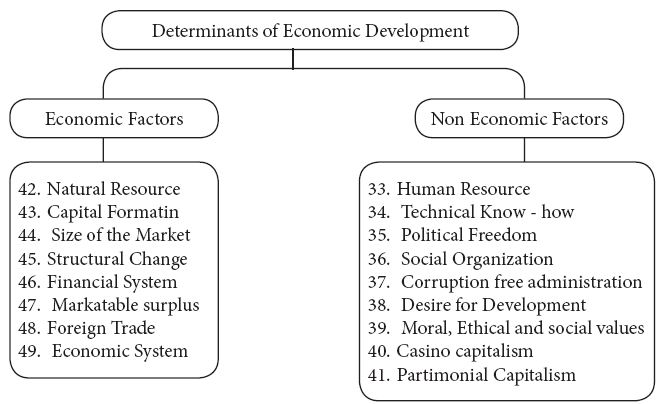
List the economic and non-economic determinants of economic development.
23.
Explain Effects on Production of Inflation.
24.
Write a note on social account method of national income.
25.
Assume the level of saving that would take place in an economy is - Rs.200 even when aggregate output is zero. Also assume that the marginal propensity to save is 0.1. Derive the algebraic expression for the saving function and the consumption function.
26.
Discuss the important statistical organizations (offices) in India.
27.
State the meaning of e-waste.
28.
Write a brief note on flexible exchange rate.
29.
According to classical theory of employment, how wage reduction solve the problem of unemployment diagramatically explain.
30.
Distinguish between Capitalism and Globalism.
31.
List the Revenue of Union Sources.
32.
Estimate the coefficient of correlation with actualmean method for the following data.
| Age of cars in years | 3 | 6 | 8 | 9 | 10 | 6 |
| Cost of Annual Maintains | 1 | 7 | 4 | 6 | 8 | 4 |
33.
Compare and contrast the “Planning Commission” and NITI Aayog”.
34.
Distinguish between Fisher’s and Cambridge Equation.
35.
Explain the any two types of Exchange Rates.
36.
Briefly explain the relationship between GDP growth and the quality of environment.
37.
Explain the methods of debt redemption.
38.
Bring out the functions of World Bank.
39.
Explain the types of Terms of Trade given by Viner.
40.
Elucidate the functions of Commercial Banks
41.
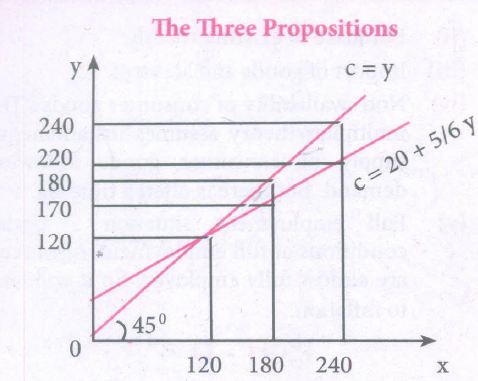
Explain Keynes psychological law of consumption function with diagram.
42.
Describe the types of unemployment.
43.
Discuss the importance of social accounting in economic analysis.
44.
Compare the features among Capitalism, Secularism and Mixedism
45.
Write few examples of NBFI.
46.
What are the two main approaches to the concept of development?
47.
Write a note on “wage-price flexibility” of classicals
48.
What are Ceteris paribus constant extraneous variables?
49.
What is Mixed Economy?
50.
State the meaning of environment.
51.
Point out any two ways in which IBRD lends to member countries.
52.
Define Money.
53.
List out the assumptions of Say’s law.
54.
Write the formula for calculating GNP.
1.
(c)
Federal finance
2.
(b)
reduce tax rates or lower interest rates
3.
(a)
Three
4.
(c)
non-linear
5.
(a)
environmental
6.
(d)
Aggregate economic phenomena like the rate of unemployment and inflation
7.
(b)
Special Drawing Rights
8.
(b)
Two
9.
(a)
Reduce investment
10.
(b)
Expenditure
11.
(d)
Boddington
12.
(b)
J.P.Narayan
13.
(c)
Biosphere
14.
(d)
All the above
15.
(b)
Flexible exchange rate
16.
(d)
a, b, and c
17.
(a)
Debtors
18.
(d)
Less aggregate demand in relation to productive capacity
19.
(a)
Construction sector
20.
(b)
stock
21.
Agreement on Trade Related Investment Measures (TRIMs)
(i) TRIMs are related to conditions or restrictions in respect of foreign investment in the country.
(ii) It calls for introducing equal treatment for foreign companies on par with national companies. TRIMs were widely employed by developing countries.
22.
23.
When the inflation is very moderate, it acts as an incentive to traders and producers. The profit due to rising prices encourages and induces business class to increase their investments in production, leading to generation of employment and income.
(i) However, hyper-inflation results in a serious depreciation of the value of money and it discourages savings.
(ii) When the value of money undergoes considerable depreciation, this may even drain out the foreign capital.
(iii) With reduced capital accumulation, the investment will suffer a serious set-back which may have an adverse effect on the volume of production.
24.
i. National income is also being measured by the social accounting method.
ii. Under this method, the transactions among various sectors such as firms, households, government, etc., are recorded and their interrelationships traced.
iii. The social accounting framework is useful for economists as well as policy makers,
iv. Because it represents the major economic flows and statistical relationships among various sectors of the economic system.
v. It becomes possible to forecast the trends of economy more accurately.
vi. Social Accounting and Sector Under this method, the economy is divided into several sectors. A sector is a group of individuals or institutions having common interrelated economic
vii. The economy is divided into the following sectors (i) Firms, (ii) Households, (iii) Government, (iv) Rest of the world and (v) Capital sector.
25.
(i) The saving function is S = -200 + 0.1Y.
(ii) Since Y = C + S then C = Y - (-200 + 0.1Y).
(iii) This reduces to C = 200 + 9Y.
26.
Central Statistical Office (CSO)
(i) It is responsible for co-ordination of statistical activities in the country and for evolving and maintaining statistical standards.
(ii) It compiles National Accounts, conducts Annual Survey of Industries and Economic Census, compiles Index of Industrial Production and Consumer Price Indices.
(iii) It deals with social statistics, training, international co-operation, Industrial Classification, etc.
National Sample Survey
Organisation
NSSO has four divisions:
(i) Survey Design and Research Division
(ii) Field Operations. Division
(iii) Data Processing Division
(iv) Co-ordination and Publication Division
The Programme Implementation Wing has 3 Divisions:
(i) Twenty Point Programme
(ii) Infrastructure Monitoring and Project Monitoring
(iii) Member of Parliament Local Area Development Scheme.
1. There is National Statistical Commission and one autonomous Institute, i.e., Indian Statistical Institute.
27.
(i) Electronic waste is the new by product of the Info Tech society.
(ii) It includes a growing range of electronic devices from household appliances, such as refrigerators, air conditioners, cell phones, computers.
(iii) e-waste can be defined as the result when consumer, business and household devices are sent for re-cycling (e.g., television, computers, audio-equipments, VCR, DVD, telephone, Fax, Xerox machines, wireless devices, video games).
28.
Also known as floating exchange rate, the exchange rates are freely determined in an open market by market forces of demand and supply.
29.
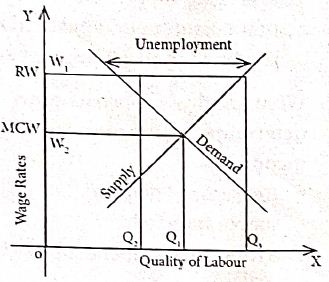
(i) Classical unemployment occurs when real wages are kept above the market clearing wage rate, leading to a surplus of labour supplied.
(ii) Classical unemployment is also called real wage unemployment.
(iii) Unemployment occurs when the worker is willing to accept (Real Wages)(RW) is in excess of those an employer is willing to pay (Market Clearing Wage)(MCW).
(iv) Real wage may be above the equilibrium level because of minimum wage policies or union bargaining.
(v) classical unemployment of Q1-Q2 can be solved by a wage cut.
(vi) If wages are allowed to fall to the market clearing level, unemployment is solved
30.
| S.No. | Capitalism | Globalism |
| 1 | Also called free economy or laissez faire or market economy where the role of the government is minimum | Also called extended capitalism. It connects nations together through international trade |
| 2 | Market determines economic activities within a nation | It aims at global development Manfred |
| 3 | Adam Smith is the father of the capitalism | D. Steger (2002) coined the term |
31.
1. Corporation tax.
2. Currency, coinage and legal tender, foreign exchange.
3. Duties of customs including export duties.
4. Duties of excise on tobacco and certain goods manufactured or produced in India.
5. Estate duty in respect of property other than agricultural land.
6. Fees in respect of any of the matters in the Union List, but not including any fees taken in any Court.
7. Foreign Loans.
8. Lotteries organized by the Government of India or the Government of a State.
9. Post Office Savings Bank.
10. Posts and Telegraphs, telephones, wireless, Broadcasting and other forms of communication.
11. Property of the Union.
12. Public Debt of the Union.
13. Railways.
14. Rates of stamp duty in respect of Bills of Exchange, Cheques, Promissory Notes, etc.
15. Reserve Bank of India.
16. Taxes on income other than agricultural income.
17. Taxes on the capital value of the assets, exclusive of agricultural land of individuals and companies.
18. Taxes other than stamp duties on transactions in stock exchanges and future markets.
19. Taxes on the sale or purchase of newspapers and on advertisements published therein.
20. Terminal taxes on goods or passengers, carried by railways, sea or air.
32.
\(r=\frac { \sum { xy } }{ \sqrt { { \sum { x } }^{ 2 }-\sum { { y }^{ 2 } } } } Where\quad X=(X-\bar { X } ),y=\sum { (y-\bar { y } ) } \)
| S.No | X | X-\(\bar { X } \) X - 7 = X |
(X-X\(\bar { X } \))2= X2 | Y | Y-\(\bar { Y} \) Y - 5 = Y |
(y-\(\bar { Y} \))2 = y2 | XY | |||
| 1 | 3 | -4 | 16 | 1 | -4 | 1 | 16 | |||
| 2 | 6 | -1 | 1 | 7 | 2 | 49 | -2 | |||
| 3 | 8 | +1 | 1 | 4 | -1 | 16 | -1 | |||
| 4 | 9 | 2 | 4 | 6 | 1 | 36 | 2 | |||
| 5 | 10 | 3 | 9 | 8 | 3 | 64 | 9 | |||
| 6 | 6 | -1 | 1 | 4 | -1 | 16 | +1 | |||
| \(\bar { X } \) | 42 6 |
= 7 | 0 | 32 | \(\bar { Y} \) | 42 6 |
= 7 | 0 | 182 | 25 |
| Σx2 = 32 Σy2 = 182 Σxy = 25 | ||||||||||
Applying formula
\(r=\frac { \sum { xy } }{ \sqrt { { \sum { x } }^{ 2 } } \sqrt { \sum { { y }^{ 2 } } } } =\frac { 25 }{ \sqrt { 32 } \sqrt { 182 } } =\frac { 25 }{ 5.66x13.49 } =\frac { 25 }{ 76.35 } \)
r = 0.327, The car is getting old in years the cost of maintenane is also increasing. The age of Car and its maintenance are postively correlated.
33.
I. Classification on the Basis of Benefit:
| BASIS FOR COMPARISON | PLANNING COMMISSION | NITI AAYOG |
|---|---|---|
| POWERS | Enjoyed the powers to allocate funds to ministries and state governments. | To be an advisory body or a think-tank. The powers to allocate funds might be vested in the finance ministry. |
| STATE’S ROLE | States' role was limited to the National Development Council and annual interaction during Plan meetings. | State governments are expected to play a more significant role than they did in the Planning Commission. |
| MEMBERS | The commission reported to National Development Council that had state chief ministers and lieutenant governors | Governing Council has state chief ministers and lieutenant governors |
| CHAIR-PERSON | Had deputy chairperson, a member secretary, and full-time members | New posts of CEO, of secretary rank, and Vice-Chairperson. Will also have five full-time members and two part-time members. Four cabinet ministers will serve as ex-o official members. |
| POLICY FORMULATION | Policy was formed by the commission and states were then consulted about allocation of funds | Consulting states while making policy and deciding on funds allocation. Final policy would be a result of that. |
| FUNDS ALLOCATION | Had power to decide allocation of government funds for various programs at national and state levels | No power to allocate funds |
| APPROVAL OF PROJECTS |
Imposed policies on states and tied allocation of funds with projects it approved. | NITI is a think-tank and does not have the power to impose policies. |
34.
| Base of difference | Fisher's Equation | Cambridge's Equation |
| 1. Flow and stock of Money | Fishers's equation gives importance to flow of money | Cambridge's equation stress on stock of money. |
| 2. Natural of Price Level | P represents the average price level of all goods and services. | P represents the price of consumer goods. |
| 3. Stress on Demand Supply | Fisher's viewpoint stress on supply of money | Cambridge's viewpoint stresses on demand of money |
| 4. Time | It is associated with a period of time | It is associated with the point of time |
| 5. Demand of Money |
According to Fisher, the Demand of money is for actual transactions | According to Cambridge ideology, the demand of money is for the storage of money. |
35.
Types of Exchange Rate:
(i) Nominal Exchange Rate
(ii) Real Exchange Rate
(iii) Nominal Effective Exchange Rate
(iv) Real Effective Exchange Rate If 1US Dollar = Rs.75
(i) Nominal Exchange Rate:
Nominal Exchange Rate =\(\cfrac { 75 }{ 1 } \)
This is the bilateral nominal exchange rate.
(ii) Real Exchange Rate:
(1) Real Exchange Rate = \(\cfrac { { eP }_{ r } }{ P } \)
P = Price level in India
PF = Price level in abroad (say US)
e = Nominal Exchange Rate
(2) If a pen costs Rs.50 in India and it costs 5 USD in the US.
\(\therefore \text {Real Exchange Rate}=\cfrac { 75\times 5 }{ 50 } =7.5\)
(3) If real exchange rate is equal to 1, the currencies are at purchasing power parity.
(4) If the price of the pen in US is 0:66 USD, then the real exchange rate
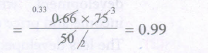
Then it could be said that the USD and Indian rupee are at purchasing power parity.
36.
(i) Strong economic growth or high GDP growth leads to excessive use of resources.
(ii) Natural resources are essential inputs for production in many sectors;
(iii) Production and consumption lead to pollution and other pressures on the environments.
(iv) Poor environmental quality affects economic growth and well being by lowering the quantity and quality of resources or due to health impact.
(v) There is the need to balance growth and the sustainability of eco system.
(vi) So we have to ensure our sustainable existence, consume less and curb economic growth.
37.
Introduction:
(i) The process of repaying a public debt is called redemption.
Sinking Fund
(i) The Government establishes a separate fund into which every year a fixed amount of money is credited.
(ii) By the time the debt matures, the fund accumulates enough amount to pay off the principal along with interest.
Conversion
(i) An old loan is converted into a new loan.
(ii) A high interest public debt is converted into a low interest public debt.
Budgetary Surplus
(i) When the Government has a surplus budget, it can be used for repaying the debt.
Terminal Annuity
(i) Government pays off debt on the basis of terminal annuity in equal annual instalments.
Repudiation
(i) Government does not recognise its obligation to repay the loan.
(ii) But in normal case the Government does not do so; if done it will lose its credibility.
Reduction in Rate of Interest
(i) During financial crisis there is compulsory reduction in the rate of interest.
Capital Levy
(i) When Government imposes levy on the capital assets owned by an individual or any institution, it is called capital levy.
(ii) This levy is imposed on capital assets above a minimum limit on a progressive scale.
(iii) The fund so collected can be used by the Government for paying off war time debt.
38.
Investment for productive purposes
(i) World Bank helps in reconstruction and development of territories of member nations through investment for productive purposes.
(ii) It encourages the development of productive facilities and resources in less developed countries.
Balanced growth of international trade
(i) Promoting the long range balanced growth of trade at international level and the maintaining equilibrium in BoPs of member nations by encouraging international investment.
Provision of loans and guarantees
(i) Arranging the loans or providing guarantee on loans by various other channels and execute important projects.
Promotion of foreign private investment
(i) This is done by means of guarantees on loans and other investment made by private investors.
(ii) The Bank supplements private investment by providing finance for productive purpose out of its own resources or from borrowed funds.
Technical services
(i) The World Bank facilitates different kinds of technical services to the member countries through Staff College and experts.
39.
Single Factoral Terms of Trade
(i) According to Viner, the single factoral terms of trade is an improvement over the commodity terms of trade.
(ii) It represents the ratio of export. price index to the import price index adjusted for changes in the productivity of factors in the production of exports.
\(\mathrm{T}_{\mathrm{f}}=\left(\mathrm{P}_{\mathrm{x}} / \mathrm{P}_{\mathrm{m}}\right) \mathrm{F}_{\mathrm{x}}\)
(iii) Tf is single factoral terms of trade index.
(iv) Fx is productivity in exports.
Double Factoral Terms of Trade
\(\mathrm{T}_{\mathrm{ff}}=\left(\mathrm{P}_{\mathrm{x}} / \mathrm{P}_{\mathrm{m}}\right)\left(\mathrm{F}_{\mathrm{x}} / \mathrm{F}_{\mathrm{m}}\right)\)
(i) It takes into account the productivity in country's exports and productivity of foreign factors.
(ii) Fm is import index (which is measured as index cost in terms of quantity of factors of production employed per unit) of imports.
40.
Introduction
The functions of commercial banks are broadly classified into primary, and secondary functions
1) Primary Functions:
Accepting Deposits
Demand Deposits
1. It refers to deposits that can be withdrawn by individuals without any prior notice to the bank.
2. Depositors can withdraw money at any time by writing a withdrawal slip or a cheque or from ATM centres
Time Deposits
1. It refers to deposits that are made for certain committed period of time.
2. It has higher interest.
3. Deposits can be withdrawn only after a specific time period
Advancing Loans
1. Banks grant loans to individuals and businesses in the form of overdraft, cash credit and discounting bills of exchange.
2) Secondary Functions
Agency Functions
1. Commercial banks act as agents of customers by performing various functións.
Collecting Cheques
1. Banks collect cheques and bills of exchange on behalf of their customers through clearing house facilities provided by the central bank.
Collecting Income
1. Banks collect dividends, pension, salaries, rents and interests on investment on behalf of their customers.
2. A credit voucher is sent to customers for information when any income is collected by the bank.
Paying Expenses
1. Telephone bills, insurance premium, school fees and rents can be paid through banks.
2. A debit voucher is sent to customers for information when expenses are paid by the bank.
3) General Utility Functions
Providing Locker Facilities
1. Locker is provided for safe custody of jewellery, shares, debentures and other valuable items.
2. This minimizes the risk of loss due to theft at home.
Issuing Traveller's Cheques
1. Banks issue traveller's cheques to individuals for travelling outside the country.
2. These cheques are safe and easy way to protect money.
Dealing in Foreign Exchange
1. Banks provide foreign exchange to businessmen dealing in exports and imports.
2. But they need to take the permission of the Central Bank for dealing in foreign exchange.
4) Transferring Funds
1. Funds are transferred by means of draft, telephonic transfer and electronic transfer.
5) Letter of Credit
1. Commercial banks issue letters of credit to their customers to certify their credit worthiness.
Underwriting Securities
1. As public have full faith in the credit worthiness of banks, public do not hesitate in buying the securities underwritten by banks.
Electronic Banking
1. It includes services, such as debit cards, credit cards and Internet banking.
6) Other Functions
Money Supply
E.g: A bank lends Rs.5 lakh to an individual and opens a demand deposit in the name of that individual.
1. Bank makes a credit entry of 25 lakh in that account.
2. This leads to creation of demand deposits in that account.
3. Thus, without printing additional money, the supply of money is increased.
Credit Creation
1. It means the multiplication of loans and advances
2. Banks receive deposits from the public and use these deposits to give loans.
3. However, loans offered are many times more than the deposits received by banks.
Collection of Statistics
1. Banks collect and publish statistics relating to trade, commerce and industry and advice customers and public authorities on financial matters.
41.
Law
According to Keynes, "men are disposed as a rule and on the average to increase their consumption as their income increases but not by as much as the increáse in their income".
Propositions
1. When income increases, consumption expenditure also increases, but by a smaller amount
(a) When income increases from 120 to 180; consumption also increases from 120 to 170 but the increase in consumption is less than the increase in income, 10 is saved.
2. The increased income will be divided in some proportion between consumption expenditure and saving
(a) When income increases to 180 and 240, it is divided between consumption (170 and 220) and saving (10 and 20)
3. Incrcascs in income always lead to in incrcase in both consumption and saving
(a) Increases in income to 180) and 240; lead to increased consumption 170 and 220; increased saving 10 and 20.
(b) It is clear from the widening area below the C curve and the saving gap between 45o line and C curve.
| Y | C | S |
|---|---|---|
| 120 | 120 | 0 |
| 180 | 170 | 10 |
| 240 | 220 | 20 |
42.
Cyclical unemployment:
(i) During the downturn phase (recession and depression) of trade cycle, income and output fall leading to cyclical unemployment.
(ii) It is caused by deficiency of effective demand
Structural unemployment:
(i) Unemployment due to massive and deep rooted changes in economic structure leads to structural unemployment.
(ii) Lack of demand for the product or shift in demand to other products cause this type of unemployment.
(iii) (e.g.) rise in demand for mobile phones has adversely affected the demand for cameras, tape recorders
Disguised unemployment:
(i) It occurs in agriculture when more people are there than required. Even if some workers are withdrawn, production does not suffer.
Actual marginal productivity is zero, less or negative.
(i) Seasonal unemployment
1. In agriculture and agro based industries like sugar, production activities are carried out only in some seasons.
2. These industries offer employment only during that season in a year.
3. People remain unemployed during the off season.
4. Seasonal unemployment takes place from demand side also (eg) ice cream industry, holiday resorts
(ii) Frictional unemployment (Temporary unemployment)
1. It arises due to imbalance between supply of labour and demand for labour.
2. It is because of immobility of labour, lack of necessary skills, break down of machinery, shortage of raw materials.
3. The persons who lose jobs and in search of jobs also come under frictional unemployment
(iii) Educated unemployment
1. Educated people are underemployed or unemployed when qualification does not match the job.
2. Faulty education system, lack of employable skills, mass student turnout and preference for white collar jobs are highly responsible for educated unemployment.
43.
Introduction:
National income can be measured by the social accounting method. Under this method, the transactions among various sectors such as firms, households, government are recorded and their interrelationships traced.
Firms:
undertake productive activities. They employ factors of production to produce goods and services.
Households:
Households are consuming entities. They represent the factors of production, who receive payment for services rendered by them to firms. (i) Households consume the goods produced by the firms. There is a circular flow of money between these two groups.
Government:
The Government sector refers to the economic transactions of public bodies at all levels-centre, state and local. Their purchases may be financed through taxation, public borrowings. The government provides public health, education. They satisfy the collective wants of society. But Post Offices and railways are separated from the Government sector and included as "Firms".
Rest of the world:
It relates to international economic transactions - income, export, import external loan transaction, and allied overseas investment income and payments.
Capital sector:
(i) Capital sector refers to saving and investment activities. It includes the transactions of banks, insurance corporations, financial houses. These are not included under "Firms".
(ii) The economy is also divided into primary, secondary tertiary and quaternary sectors.
Conclusion:
The social accounting framework is useful for economists as well as policy makers, because it represents the major economic flows and statistical relationships among various sectors of the economic system. It is possible to forecast the trends of economy more accurately.
44.
| S.No | Features | Capitalism | Socialism | Mixedism |
|---|---|---|---|---|
| 1. | Ownership of Means of Production | Private Ownership | Public Ownership | Private Ownership and Public Ownership |
| 2. | Economic Motive | Profit | Social Welfare | Social Welfare and Profit Motive |
| 3. | Solution of Central Problems | Free Market System | Central Planning System | Central Planning System and Free Market System |
| 4. | Government Role | Internal Regulation only | Complete Involvement | Limited Role |
| 5. | Income Distribution | Unequal | Equal | Less unequal |
| 6. | Nature of Enterprise | Private Enterprise | Government Enterprise | Both Private and State Enterprises |
| 7. | Economic Freedom | Complete Freedom | Lack of Freedom | Limited Freedom |
| 8 | Major Problem | Inequally | Inefficiency | Inequality and Inefficiency |
45.
a. insurance firms
b. pawn shops
c. currency exchanges
46.
There are two main approaches to the concept of development viz
i) the traditional approach and
ii) the new welfare-oriented approach.
47.
i. According to the classicals, the wages and prices are flexible.
ii. This flexibility ensures equilibrium in market. In other words, demand will be equal to supply in all markets.
iii. All disequilibrium conditions in the market will be corrected with the wageprice flexibility
48.
The constant extraneous variables such as income distribution, tastes, habits, social customs, price movements, population growth, etc. do not change and consumption depends on income alone.
49.
(i) In economic system both private and public sectors co-exist.
(ii) It work together towards economic development.
50.
(i) Environment means "all the conditions, circumstances, and influences surrounding and affecting the development of an organism or group of organisms".
(ii) It also means that the complex of physical, chemical and biotic factors that act upon an organism or an ecological community ultimately determine its form and survival.
51.
1. Loans out of its own fund.
2. Loans out of borrowed capital and
3. Loans through Bank's guarantee.
52.
(i) Money is, what money does - Walker:
(ii) Money can be anything that is generally acceptable as a means of exchange and at the same time acts as a measure and a store of value. - Crowther.
53.
1. No single buyer or seller can affect the price.
2. Full employment
3. People are motivated by self interest Market forces determine everything right.
4. Perfect competition exists in labour and product market.
5. There is wage price flexibility.
6. Money acts as medium of exchange.
7. Long run analysis.
8. No overproduction or unemployment.
54.
\(\mathrm{GNP}=\mathrm{C}+\mathrm{I}+\mathrm{G}+(\mathrm{X}-\mathrm{M})+(\mathrm{R}-\mathrm{P})\) or \(\mathrm{GNP}_{\mathrm{MP}}=\mathrm{GDP}_{\mathrm{MP}}\) + Net Factor income from Abroad.

12th Standard Syllabus & Materials
12th Standard
TN 12th Computer Applications களப்பெயர் முறைமை (DNS) Sample Question Papers Study Material - QB365 Set A
NEW12th Standard
TN 12th Computer Applications வலையமைப்பு எடுத்துக்காட்டுகள் மற்றும் நெறிமுறைகள் Sample Question Papers Study Material - QB365 Set A
NEW12th Standard
TN 12th Computer Applications கணினி வலையமைப்பு ஓர் அறிமுகம் Sample Question Papers Study Material - QB365 Set A
NEW12th Standard
TN 12th Computer Applications PHP-உடன் MySQL-ஐ இணைத்தல் Sample Question Papers Study Material - QB365 Set A



Tamilnadu Stateboard 12th Standard Subjects

Maths

Chemistry

Physics

Biology

Computer Science

Business Maths and Statistics
Economics

Commerce

Accountancy

History

Computer Applications
Biology
Computer Technology
Computer Applications
Computer Science
Business Maths and Statistics
Commerce
Economics
Maths
Chemistry
Physics
Computer Technology
History
Accountancy

Tamil

English

French
Tamilnadu Stateboard Standards
