
 100% FREE ACCESS
12th Standard Syllabus & Materials
12th Standard
TN 12th Computer Applications மின்னணு தரவு பரிமாற்றம் Sample Question Papers Study Material - QB365 Set A
NEW12th Standard
TN 12th Computer Applications மின் - வணிக பாதுகாப்பு அமைப்புகள் Sample Question Papers Study Material - QB365 Set A
NEW12th Standard
TN 12th Computer Applications மின்னணு செலுத்தல் முறைகள் Sample Question Papers Study Material - QB365 Set A
NEW12th Standard
TN 12th Computer Applications மின் - வணிகம் Sample Question Papers Study Material - QB365 Set A
NEW12th Standard
TN 12th Computer Applications திறந்த மூல கருத்துருக்கள் Sample Question Papers Study Material - QB365 Set A
NEW12th Standard
TN 12th Computer Applications வலையமைப்பு வடமிடல் Sample Question Papers Study Material - QB365 Set A

Published on: 12/02/2020
12th Standard Economics public model Questions Paper - VIII - 2019-2020
Download Tamil Nadu 12th Standard Economics question papers, model tests, one-mark questions, important questions, and public exam papers in PDF format. Free study materials and answer keys for TN State Board students.
Questions + Answers key
Take MCQ Economics Test
1.
Pick out the item which is not a part of non-tax revenue,
Interest Receipts
Dividends
Customs
Profits
2.
Match list-I with List-II correctly and select your answer from the codes given below:
|
List I |
List II |
||
|---|---|---|---|
| a) | Gandhian Plan | 1) | ArdesirDalal |
| b) | People’s plan | 2) | Mannarayana |
| c) | Bombay Plan | 3) | M. N. Roy |
| d) | Sarvodaya Plan | 4) | Jay Prakash Narayan |
1 2 3 4
2 3 1 4
2 3 4 1
1 2 4 3
3.
Find the equation of multiple correlation.
Qd= f (P, Pc, Ps, t, y)
X= a – bx
Y= a + bx
Y= a – bx
4.
Assertion: Double counting is to be avoided under value added method.
Reason: Any commodity which is either raw material or intermediate good for the final production should not be included.
Both A and R are true and R is the correct explanation of A.
Both A and R are true but R is not the correct explanation of A
A is true but R is false
A is false but R is true
5.
Match the correct codes
| 1 | The motive of precaution | i | The desire to enjoy interest and appreciation |
| 2 | The motive of foresight | ii | The desire to enjoy for improving standard of living. |
| 3 | The motive of calculation | iii | The desire to provide for anticipated future needs. Eg. Old age |
| 4 | The motive of improvement | iv | To build up a reserve against unforeseen contingencies. Eg. Accidents, sickness |
(1) – (i) (2) – (ii) (3) – (iv) (4) – (iii)
(1) – (ii) (2) – (iii) (3) – (iv) (4) – (i)
(1) – (iv) (2) – (iii) (3) – (i) (4) – (ii)
(1) – (i) (2) – (ii) (3) – (iii) (4) – (iv)
6.
Find the incorrect one with respect to Indian rupee devaluation
On 29th September, 1949
On 6th June, 1966
On 1st July, 1991
On 9st August, 1990
7.
Pick basic composition of three sector of model of economy.
Y = C + I + G + (X – M)
Y = C + I + G
Y = C + S
Y = C + I
8.
_______________ is the example of positive production externality.
Bee-hive pollination
Beetle pollination
Birds
All the above
9.
The Bretton Woods conference proposal IMF, World Bank and International Trade Organisation (ITO) in ________.
1944
1934
1964
1974
10.
Effective demand equals to ____________
National income
Gross income
Total income
Net income
11.
The term regression was used by:
Newton
Pearson
Spearman
Galton
12.
13.
Sustainable Development Goals and targets are to be achieved by ____________
2020
2025
2030
2050
14.
The difference between revenue expenditure and revenue receipts is
Revenue deficit
Fiscal deficit
Budget deficit
Primary deficit
15.
Benefits of FDI include, theoretically
Boost in Economic Growth
Increase in the import and export of goods and services
Increased employment and skill levels
All of these
16.
ARDC started functioning from
June 3, 1963
July 3, 1963
June 1, 1963
July 1, 1963
17.
__________inflation results in a serious depreciation of the value of money.
Creeping
Walking
running
Hyper
18.
In Keynes theory of employment and income, ___________ is the basic cause of economic depression
Less production
More demand
Inelastic supply
Less aggregate demand in relation to productive capacity
19.
Net National product at factor cost is also known as
National Income
Domestic Income
Per capita Income
Salary
20.
The branches of the subject Economics are
Wealth and Welfare
Production and Consumption
Demand and Supply
Micro and Macro
21.
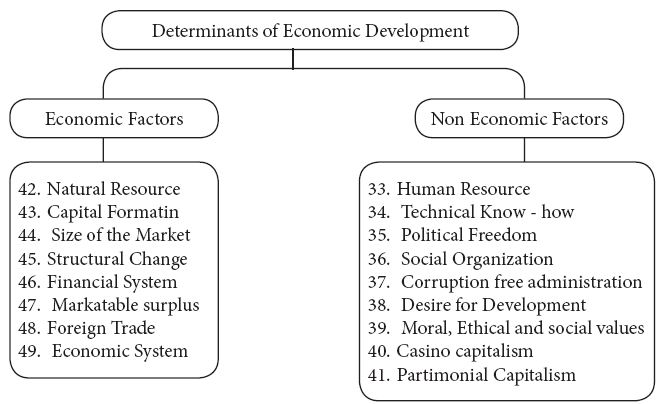
List the economic and non-economic determinants of economic development.
22.
What are the Contingent Functions?
23.
Explain any three leakages of multiplier.
24.
Explain the achievements of WTO.
25.
What are the difficulties in measuring National Income?
26.
Specify the objectives of econometrics.
27.
Write a note on
a) Climate change and
b) Acid rain
28.
Compare the Classical Theory of international trade with Modern Theory of International trade.
29.
Write short note on the implications of Say’s law
30.
Distinguish between Capitalism and Globalism.
31.
List the degrees of correlation corresponding to various values of r.
32.
Solve and discuss the following using Marshall “Cash Balance Approach”.
(i) Suppose money supply in cash and bank deposits (M) = Rs. 1,000.
(ii) The total annual national income (R) = 10,000 units.
(iii) The goods (income) which the community wants to hold in money (K), say one-fifth of Y = 2,000 units.
33.
Explain the determinants of Equilibrium Exchange Rate.
34.
What are the advantages of GST?
35.
Explain non-economic factors determining development?
36.
Briefly explain the relationship between GDP growth and the quality of environment.
37.
38.
Explain the objectives of IMF.
39.
Explain the types of Terms of Trade given by Viner.
40.
What are the objectives of Monetary Policy? Explain.
41.
What are the differences between MEC and MEI.
42.
Critically explain Say’s law of market.
43.
Discuss the various methods of estimating the national income of a country.
44.
45.
Write a note on “Providing Locker Facilities” of banks.
46.
How does World Development Report classifies countries?
47.
Comment : “Self-Adjustment not Possible”
48.
When income increases, consumption expenditure also increases but by a smaller amount. Justify.
49.
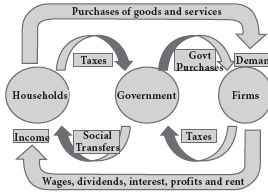
Draw the circular flow of a three sector economy.
50.
What are environmental goods? Give examples
51.
What is Free trade area?
52.
Define Money.
53.
What is effective demand?
54.
Write the formula for calculating GNP.
1.
(b)
Dividends
2.
(b)
2 3 1 4
3.
(a)
Qd= f (P, Pc, Ps, t, y)
4.
(a)
Both A and R are true and R is the correct explanation of A.
5.
(c)
(1) – (iv) (2) – (iii) (3) – (i) (4) – (ii)
6.
(d)
On 9st August, 1990
7.
(b)
Y = C + I + G
8.
(a)
Bee-hive pollination
9.
(a)
1944
10.
(a)
National income
11.
(d)
Galton
12.
(c)
13.
(c)
2030
14.
(a)
Revenue deficit
15.
(d)
All of these
16.
(d)
July 1, 1963
17.
(d)
Hyper
18.
(d)
Less aggregate demand in relation to productive capacity
19.
(a)
National Income
20.
(d)
Micro and Macro
21.
22.
(i) Basis of the Credit System: Money is the basis of the Credit System. Business transactions are either in cash or on credit.
(ii) Money facilitates distribution of National Income: The task of distribution of national income was exceedingly complex under the barter system.
(iii) Money helps to Equalize Marginal Utilities and Marginal Productivities: Consumer can obtain maximum utility only if he incurs expenditure on various commodities in such a manner as to equalize marginal utilities accruing from them.
(iv) Money Increases Productivity of Capital: Money is the most liquid form of capital. In other words, capital in the form of money can be put to any use.
23.
1. Payment towards past debts.
If a portion of the additional income is used for repayment of old loan, the MPC is reduced and as a result the value of multiplier is cut.
2. Purchase of existing wealth
If income is used in purchase of existing wealth such as land, building and shares money is circulated among people and never enters into the consumption stream. As a result the value of multiplier is affected.
24.
(i) Use of restrictive measures for BoP problems has declined markedly.
(ii) Services trade has been brought into the multilateral system and many countries.
(iii) The trade policy review mechanism has created as process of continuous monitoring of trade policy developments.
25.
(i) Transfer payments
(ii) Difficulties in assessing depreciation allowance.
(iii) Unpaid Services
(iv) Income from illegal activities.
(v) Production for self consumption and changing price.
(vi) Capital Gains
(vii) Statistical problems
26.
(i) The general objective of Econometrics is to give empirical content to economic theory
(ii) The specific objectives are :
(i) It helps to explain the behaviour of a forthcoming period that is forecasting economic phenomena.
(ii) It helps to prove the old and established relationships among the variables or between the variables.
(iii) It helps to establish new theories and new relationships.
(iv) It helps to test the hypotheses and estimation of the parameter.
27.
a) Climate change
(i) Climate change refers to seasonal changes over a long period with respect to the growing accumulation of greenhouse gases in the atmosphere.
(ii) Industrial revolution has increased the concentration of carbon dioxide in the atmosphere by 40 %.
(iii) Several parts of the world have experienced warming of coastal waters, high temperatures, a marked change in rainfall patterns and an increased intensity and frequency of storms.
(iv) Sea levels and temperatures are expected to be rising.
b) Acid rain
(i) Acid rain is one of the results of air pollution.
28.
| S.No | Classical Theory of International Trade |
Modern Theory of International Trade |
|---|---|---|
| 1 |
International trade is on the basis of labour theory of value.
|
International trade is on the basis of general theory of value. |
| 2 | It presents a one factor (labour) model. | It presents a multi factor (labour and capital) model. |
| 3 | It attributes the differences in the comparative costs to differences in the productive efficiency of workers in the two countries. |
It attributes the differences in comparative costs to the differences in factor endowments in the two countries. |
29.
(i) There is no possibility for over production or unemployment.
(ii) If there exist unutilized resources, it is profitable to employ them up to full employment.
(iii) There is automatic price mechanism, so no need for government intervention
(iv) Interest flexibility brings about equality between saving and investment.
(v) Money acts as the medium of exchange.
30.
| S.No. | Capitalism | Globalism |
| 1 | Also called free economy or laissez faire or market economy where the role of the government is minimum | Also called extended capitalism. It connects nations together through international trade |
| 2 | Market determines economic activities within a nation | It aims at global development Manfred |
| 3 | Adam Smith is the father of the capitalism | D. Steger (2002) coined the term |
31.
| Value of r | Degree of correlation |
| ±1 | Perfect correlation |
| ±0.90 or more | very high degree of correlation |
| ±0.75 to ± 0.90 | sufficiently high degree of correlation |
| ±0.60 to0.90 | moderate degree of correlation |
| ±0.30 to ± 0.60 | only the possibility of a correlation |
| less than ±0.30 | possibly no correlation |
| 0 | absence of correlation |
32.
Marshall’s Equation
1. The Marshall equation is expressed as:
2. M = KPY the price level P = M/KY or the value of money = The reciprocal of price level is 1/P = KY/M the value of money (one rupee) = 2,000 units = (KY/M) = two units of goods, or Prices level P = (M/KY) = 1/2 = 0.50 paise per unit.
3. It is, therefore, clear that the value of money (its purchasing power) is found by dividing the total amount of goods, which the community wants to hold out of the total income (KY), by the amount of the supply of the money held by the public (M), and the price level (P) is found out by dividing the money supply (M) by the amount of goods which the community wants to hold (KY), as the price level is the opposite of the value of money.
33.
Determinants of Exchange Rates
Exchange rates are determined by numerous factors and they are related to the trading relationship between two countries
1. Differentials in Inflation
Inflation and exchange rates are inversely related. A country with a consistently lower inflation rate exhibits a rising currency value, as its purchasing power increases relative to other currencies.
2. Differentials in Interest Rates
There is a high degree of correlation between interest rates, inflation and exchange rates. Central banks can influence over both inflation and exchange rates by manipulating interest rates. Higher interest rates attract foreign capital and cause the exchange rate to rise and vice versa.
3. Current Account Deficits
A deficit in the current account implies excess of payments over receipts. The country resorts to borrowing capital from foreign sources to make up the deficit. Excess demand for foreign currency lowers a country’s exchange rate.
4. Public Debt
Large public debts are driving out foreign investors, because it leads to inflation. As a result, exchange rate will be lower
5. Terms of Trade
A country’s terms of trade also determines the exchange rate. If the price of a country’s exports rises by a greater rate than that of its imports, its terms of trade will improve. Favorable terms of trade imply greater demand for the country’s exports and thus BoP becomes favorable.
6. Political and Economic Stability
If a nation’s political climate is stable and economic performance is good, its currency value will be appreciated by attracting more foreign capital
7. Recession
Interest rates are low during the recession phase. This will decrease inflow of foreign capital. As a result, a currency will be depreciated against other currencies, thereby lowering the exchange rate.
8. Speculation
If a country’s currency value is expected to rise, investors will demand more of that currency in order to make a profit in the near future. This results in appreciation of the exchange rate. Beside the above determinants, relative dominance in the global politics and the power to announce economic sanctions over other countries also determine exchange rates
34.
(i) GST will mainly remove the cascading effect on the sale of goods and services.
(ii) Removal of cascading effect will directly impact of the cost of goods.
(iii) Tax is eliminated in this regime, the cost of goods decreases.
(iv) GST is also mainly technologically driven.
(v) All activities like registration, return filing, application for refund and response to notice need to be done online on the GST portal. This will speed up the processes.
35.
1. Human Resources
(i) Human resource is named as human capital because of its power to increase productivity and thereby national income. There is a circular relationship between human development and economic growth.
(ii) If labour is efficient and skilled, its capacity to contribute to growth will be high. For example Japan and China.
2. Technical Know-how: As the scientific and technological knowledge advances, more and more sophisticated techniques steadily raise the productivity levels in all sectors.
3. Political freedom: The process of development is linked with the political freedom.
4. Social organization: People show interest in the development activity only when they feel that the fruits of development will be fairly distributed. Mass participation in development programs is a pre-condition for accelerating the development process.
5. Corruption free administration:
Corruption is a negative factor in the growth process. Unless the countries rootout corruption in their administrative system, the crony capitalists and traders will continue to exploit national resources. The tax evasion tends to breed corruption and hamper economic progress.
6. Desire for development:
The pace of economic growth in any country depends to a great extent on people's desire for development.
7. Moral, ethics and social values:
(i) These determine the efficiency of the market.
(ii) If people are not honest, market cannot function.
8. Casino Capitalism:
If People spend larger proportion of their income and time on entertainment liquor and other illegal activities, productive activities may suffer.
9. Patrimonial Capitalism:
If the assets are simply passed on to children from their parents, the children would not work hard, because the children do not know the value of the assets. Hence productivity will be low.
36.
(i) Strong economic growth or high GDP growth leads to excessive use of resources.
(ii) Natural resources are essential inputs for production in many sectors;
(iii) Production and consumption lead to pollution and other pressures on the environments.
(iv) Poor environmental quality affects economic growth and well being by lowering the quantity and quality of resources or due to health impact.
(v) There is the need to balance growth and the sustainability of eco system.
(vi) So we have to ensure our sustainable existence, consume less and curb economic growth.
37.
38.
(i) To promote international monetary cooperation among the member nations.
(ii) To facilitate faster and balanced growth of international trade.
(iii) To ensure exchange rate stability by curbing competitive exchange depreciations.
(iv) To reduce exchange controls imposed by member nations.
(v) To establish multilateral trade and payment system in respect of current transactions.
(vi) To promote the flow of capital from developed to developing nations.
(vii) To solve the problem of international liquidity.
39.
Single Factoral Terms of Trade
(i) According to Viner, the single factoral terms of trade is an improvement over the commodity terms of trade.
(ii) It represents the ratio of export. price index to the import price index adjusted for changes in the productivity of factors in the production of exports.
\(\mathrm{T}_{\mathrm{f}}=\left(\mathrm{P}_{\mathrm{x}} / \mathrm{P}_{\mathrm{m}}\right) \mathrm{F}_{\mathrm{x}}\)
(iii) Tf is single factoral terms of trade index.
(iv) Fx is productivity in exports.
Double Factoral Terms of Trade
\(\mathrm{T}_{\mathrm{ff}}=\left(\mathrm{P}_{\mathrm{x}} / \mathrm{P}_{\mathrm{m}}\right)\left(\mathrm{F}_{\mathrm{x}} / \mathrm{F}_{\mathrm{m}}\right)\)
(i) It takes into account the productivity in country's exports and productivity of foreign factors.
(ii) Fm is import index (which is measured as index cost in terms of quantity of factors of production employed per unit) of imports.
40.
Introduction
(i) Monetary Policy is the macroeconomic policy laid down by the Central Bank towards the management of money, supply and interest rate. It is associated with Milton Friedman
1) Neutrality of Money
(i) Wicksteed, Hayek and Robertson are the chief exponents of neutral money.
(ii) They say that the monetary authority should aim at neutrality of money in the economy.
(iii) Monetary changes cause distortion and disturbances in the proper functioning of the economic system of the leading to all economic fluctuations.
2) Exchange Rate Stability
(i) It is a traditional objective from the Gold Standard period
(ii) When there was disequilibrium in the balance of payment, it was automatically corrected by movements.
(iii) It was popularly known as "Expand Currency and Credit when gold is coming in; Contract currency and credit when gold is going out."
(iv) If there is instability in the exchange rates, it would result in outflow or inflow of gold resulting in unfavorable balance of payments.
3) Price Stability
(i) Crustave Cassel and Keynes suggested price stabilization as a main objective of monetary policy.
(ii) Stable Price creates public confidence, promotes business activity and ensures equitable distribution of income and wealth leading to prosperity and welfare
(iii) Price stability does not mean price rigidity or price stagnation.
(iv) A mild increase in the price level provides a tonic for economic growth.
4) Full Employment
(i) Unemployment was socially dangerous, economically wasteful and morally deplorable.
(ii) Both Keynes' General Theory of Employment, Interest and Money in 1936, the objective of full employment became very important
5) Economic Growth
(i) Economic growth is the process whereby the real per capita income of a country increases
(ii) There is increase in the total physical or real output
(iii) Monetary policy should promote sustained and continuous economic growth by maintaining equilibrium between the total demand for money and total production capacity for creating increase in saving and investment.
(iv) Flexible monetary policy is the best solution.
6) Equilibrium in the Balance of Payments (BoP)
(i) World trade was faster than world liquidity.
(ii) Increasing deficit in BoP reduces the ability of an economy to achieve other objectives.
(iii) Many less developed countries reduce their imports which adversely affects development activities, so monetary authority should make efforts to bring equilibrium in the BoP.
41.
| S. No | Marginal Efficiency of Captial (MEC) | Marginal Efficiency of Investment (MEI) |
|---|---|---|
| 1. | It is based on given supply price for capital. | It is based on the induced change in the price due to change in the demand for capital. |
| 2. | It represents the rate of return on all successive unit of capital without regard to existing capital. | It shows the rate of return on just those units of capital over and above the existing capital stock |
| 3. | The capital stock is taken on the X axis of diagram. | The amount of investment is taken on the X axis of diagram. |
| 4. | It is a 'Stock' concept. | It is a 'Flow' concept. |
| 5. | It determines the optimum capital stock in an economy at each level of interest rate. | It determines the net investment of the economy at each interest rate given the capital stock. |
42.
Introduction
According to J. B. Say "Supply creates its own demand"
Explanation
A person receives his income from production which is spent on the purchase of goods and services produced by others. For the economy as a whole, therefore, total production equals total income.
Criticisms
(i) According to Keynes, supply does not. create its demand. It is not applicable where demand does not increase as much as production increases.
(ii) Automatic adjustment process will not remove unemployment. Unemployment can be removed by increase in the rate of investment.
(iii) Money is not neutral. Individuals hold money for unforeseen contingencies, businessmen keep cash reserve for future activities.
(iv) Say's law is supply creates its own demand and there is no over production. Keynes said that over production is possible
(v) Keynes regards full employment as a special case because there is underemployment in capitalist economies.
(vi) State intervention is needed when there is over production and mass unemployment.
43.
Introduction:
(i) Whatever is produced is either used for consumption or for saving. So, national output can be computed at any of three levels, ie., production, income and expenditure.
(ii) Therefore there are three methods to measure national income.
Product Method (inventory method):
(i) This method measures the output of the country. Gross value of output from different sectors like agriculture, industry, trade, commerce is obtained by the summation of all the values added in the productive process.
(ii) In India, the gross value of the farm output is obtained as follows:
(iii) Total production of 64 agriculture commodities is estimated. The output of each crop is measured by multiplying the area sown by the average yield per hectare.
(iv) Total output of each commodity is valued at market prices.
(v) The aggregate value of total output of these 64 commodities is taken to measure the gross value of agricultural output.
(vi) The net value of the agricultural output is measured by making deductions for the cost of seed, manures and fertilizers, market charges.
(vii) Net value of each sector is measured in this way.
(viii) Double counting should be avoided.
(ix) Value of output used for self consumption should be counted but sale and purchase of second hand durable goods should be excluded.
Income Method (Factor Earning Method):
(i) National income is calculated by adding up all the incomes generated while producing national product.
(ii) Enterprises are classified into industrial groups.
(iii) Factor incomes are grouped under labour income (wages, salaries, fringe benefits), capital income (profit, interest, dividend) and mixed income (farming, sole proprietorship).
\(\mathrm{Y}=\mathrm{w}+\mathrm{r}+\mathrm{i}+\pi+(\mathrm{R}-\mathrm{P})\)
(iv) Transfer payment, receipt from sale of second hand goods, windfall gains and corporate profit tax must not be included.
(v) Imputed value of rent for self occupied houses or offices and Imputed value of services provided by owners of production units are to be included.
Expenditure method (outlay method):
(i) The total expenditure incurred by the society in a particular year is added together.
(ii) It includes personal consumption expenditure (C), net domestic investment (I), Government expenditure on consumption (G) and net exports (X-M).
\(\mathrm{GNP}=\mathrm{C}+\mathrm{I}+\mathrm{G}+(\mathrm{X}-\mathrm{M})\)
(iii) Expenditure on second hand goods, purchase of shares and bonds, transfer payments and expenditure on intermediate goods should not be included.
Conclusion:
Output = Income = Expenditure
(i) This is because the three methods are circular in nature. So, if the 3 methods are done correctly this equation must hold.
44.
45.
(i) Commercial banks provide locker facilities to its customers for safe custody of jewellery, shares, debentures, and other valuable items.
(ii) This minimizes the risk of loss due to theft at homes. Banks are not responsible for the items in the lockers.
46.
(i) Low Income Countries
(ii) Middle Income Countries
(iii) High Income Countries
47.
i. According to Say‘s Law, full employment is maintained by an automatic and self adjustment mechanism in the long run.
ii. But Keynes had no patience to wait for the long period for he believed that – In the long run we are all dead.
iii. It is not the automatic adjustment process which removes unemployment.
iv. But unemployment can be removed by increase in the rate of investment.
48.
(i) The reason is that as income increases, our wants are satisfied side by side, so that the need to spend more on consumer goods diminishes.
(ii) So, the consumption expenditure increases with increase in income but less than proportionately.
49.
50.
Environmental goods are typically non-market goods, including clear air, clean water, landscape, green transport infrastructure, public parks, rivers, mountains, forest and beaches.
51.
(i) Free trade area is the region around a trade bloc whose member countries have signed a free-trade agreement.
(ii) Such agreements involve cooperation between at least two countries to reduce trade barriers. e.g. SAFTA, EFTA.
52.
(i) Money is, what money does - Walker:
(ii) Money can be anything that is generally acceptable as a means of exchange and at the same time acts as a measure and a store of value. - Crowther.
53.
(i) Effective demand is the money spent on consumption of goods and services and on investment.
(ii) Employment and output depends on the level of effective demand
(iii) When effective demand increases, employment will increase.
(iv) Effective demand is determined by aggregate supply and aggregate demand.
54.
\(\mathrm{GNP}=\mathrm{C}+\mathrm{I}+\mathrm{G}+(\mathrm{X}-\mathrm{M})+(\mathrm{R}-\mathrm{P})\) or \(\mathrm{GNP}_{\mathrm{MP}}=\mathrm{GDP}_{\mathrm{MP}}\) + Net Factor income from Abroad.

12th Standard Syllabus & Materials
12th Standard
TN 12th Computer Applications களப்பெயர் முறைமை (DNS) Sample Question Papers Study Material - QB365 Set A
NEW12th Standard
TN 12th Computer Applications வலையமைப்பு எடுத்துக்காட்டுகள் மற்றும் நெறிமுறைகள் Sample Question Papers Study Material - QB365 Set A
NEW12th Standard
TN 12th Computer Applications கணினி வலையமைப்பு ஓர் அறிமுகம் Sample Question Papers Study Material - QB365 Set A
NEW12th Standard
TN 12th Computer Applications PHP-உடன் MySQL-ஐ இணைத்தல் Sample Question Papers Study Material - QB365 Set A



Tamilnadu Stateboard 12th Standard Subjects

Maths

Chemistry

Physics

Biology

Computer Science

Business Maths and Statistics
Economics

Commerce

Accountancy

History

Computer Applications
Biology
Computer Technology
Computer Applications
Computer Science
Business Maths and Statistics
Commerce
Economics
Maths
Chemistry
Physics
Computer Technology
History
Accountancy

Tamil

English

French
Tamilnadu Stateboard Standards
