
 100% FREE ACCESS
12th Standard Syllabus & Materials
12th Standard
TN 12th Computer Applications மின்னணு தரவு பரிமாற்றம் Sample Question Papers Study Material - QB365 Set A
NEW12th Standard
TN 12th Computer Applications மின் - வணிக பாதுகாப்பு அமைப்புகள் Sample Question Papers Study Material - QB365 Set A
NEW12th Standard
TN 12th Computer Applications மின்னணு செலுத்தல் முறைகள் Sample Question Papers Study Material - QB365 Set A
NEW12th Standard
TN 12th Computer Applications மின் - வணிகம் Sample Question Papers Study Material - QB365 Set A
NEW12th Standard
TN 12th Computer Applications திறந்த மூல கருத்துருக்கள் Sample Question Papers Study Material - QB365 Set A
NEW12th Standard
TN 12th Computer Applications வலையமைப்பு வடமிடல் Sample Question Papers Study Material - QB365 Set A

Published on: 13/02/2020
12th Standard Economics public model Question paper I - 2019-2020
Download Tamil Nadu 12th Standard Economics question papers, model tests, one-mark questions, important questions, and public exam papers in PDF format. Free study materials and answer keys for TN State Board students.
Questions + Answers key
Take MCQ Economics Test
1.
Finance commission is a __________ set up under Article 280 of the Indian Constitution.
statutory body
quasi-judicial body
permanent body
international body
2.
What are the BENELUX countries?
Brazil, Nigeria and Luxumburag
Belgium, Netherland and Luxumbuarg
Bay of Jamaica, Norway and Luxumbuarg
None of the above
3.
Find the meaning of the following statement “If People spend larger propotion of their income and time on entertainment liquor and other illegal activities, productive activities may suffer”
Hayek
Joseph Waker
Lipsey
Thomas Piketty
4.
Say’s law of market says:
Supply creates its own demand
Demand creates supply
Income generates demand
Savings create demand
5.
If all values of a sample are same, then its variance is
1
0
2
Cannot be determined
6.
In economic activities of Goods and Service, what the RrP + RrC mean?
Recycles from Production and Consumption
Residual Discharges from Consumption and Production
Consumption and Production
Final Residual Discharge from Production and Consumption
7.
Find the missing flow of concept of H-O Theorem. Abundance of skilled labour → specialisation → ………?……..→ exchange for goods are services produced by countries with abundance of unskilled labour
import
export
devaluation
factor endowment
8.
Which of the following is not a macroeconomic goal?
Full Employment
Price Stability
Economic Security
All of the above are macro economic goals
9.
K=1/MPS= ____________
\(\frac{ΔP}{ΔQ}\)
\(\frac{C}{4}\times\frac{ΔP}{ΔQ}\)
Value of multiplier
Value of accelerator
10.
Secondary sector is __________
Industry
Trade
Agriculture
Manufacture
11.
In the regression equation \(Y={ \beta }_{ 0 }+{ \beta }_{ 1 }{ X }_{ , }\) the X is called:
Independent variable
Dependent variable
Continuous variable
None of the above
12.
The Chair Person of NITI Aayog is
Prime Minister
President
Vice - President
Finance Ministed
13.
Which one of the following causes of global warming?
Earth gravftation force
Oxygen
Centripetal force
Increasing temperature
14.
Conversion of public debt means exchange of
New bonds for the old ones
Low interest bonds for higher interest bonds
Long term bonds for short term bonds
All the above
15.
Cyclical disequilibrium in BOP occurs because of
Different paths of business cycle.
The income elasticity of demand or price elasticity of demand is different.
long-run changes in an economy
Both (a) and (b)
16.
NBFI does not have.
Banking license
government approval
Money market approval
Finance ministry approval
17.
_____inflation is in no way dangerous to the economy.
walking
running
creeping
galloping
18.
Aggregate supply is equal to ___________.
C + I + G
C + S + G + (x - m)
C + S + T + (x - m)
C + S + T + Rf
19.
Tertiary sector is also called as __________sector
Service
Income
Industrial
Consumption
20.
Identify the flow variable
money supply
assests
income
foreign exchange reserves
21.
What are the Contingent Functions?
22.
How India benefited with WTO?
23.
Explain any three limltations of leakages of multiplier.
24.
What is Output method? What is its major challenge?
25.
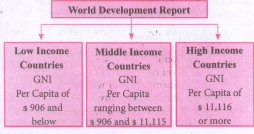
Classify the various countries on the basis of gross national income (GNI) per capita?
26.
Specify the objectives of econometrics.
27.
What are the causes of water pollution?
28.
Compare the Classical Theory of international trade with Modern Theory of International trade.
29.
30.
Describe the different types of economic systems.
31.
Explain the Non-Tax Revenue of a state.
32.
Compare and contrast economic growth and economic development.
33.
Consider M = Rs. 1000. M’ = Rs. 500, V = 3, V’ = 2, T = 4000 goods and Find the value of money using Fisher’s quantity theory of
34.
Compare and contrast fixed and flexible exchange rates.
35.
Explain the importance of sustainable development and its goals.
36.
37.
Discuss the role of WTO in India’s socio-economic development.
38.
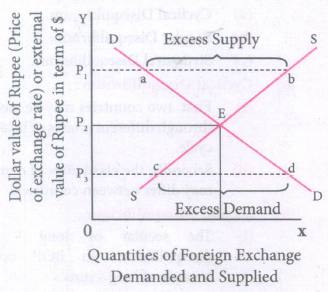
How the Rate of Exchange is determined? Illustrate.
39.
Elucidate the functions of Commercial Banks
40.
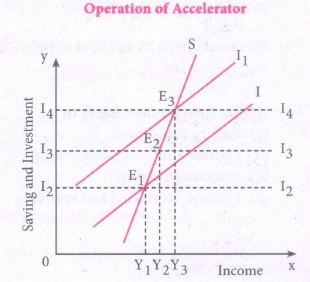
Explain the operation of the Accelerator.
41.
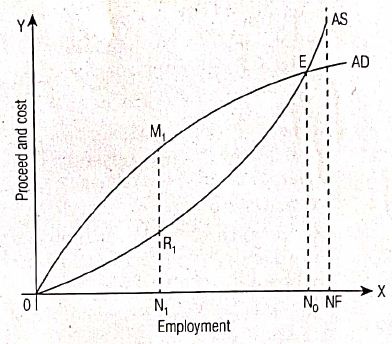
Narrate the equilibrium between ADF and ASF with diagram
42.
Discuss the importance of social accounting in economic analysis.
43.
44.
Write the equation of effective demand
45.
Define Investment Function.
46.
What are the major types of economic systems.
47.
Write any two characteristics of UDCs
48.
In which year the state financial corporation was started?
49.
State the meaning of environment.
50.
51.
What is plastic money? Give example.
52.
List out the assumptions of Say’s law.
53.
What is the difference between NNP and NDP?
1.
(b)
quasi-judicial body
2.
(b)
Belgium, Netherland and Luxumbuarg
3.
(d)
Thomas Piketty
4.
(a)
Supply creates its own demand
5.
(b)
0
6.
(a)
Recycles from Production and Consumption
7.
(b)
export
8.
(d)
All of the above are macro economic goals
9.
(c)
Value of multiplier
10.
(a)
Industry
11.
(a)
Independent variable
12.
(a)
Prime Minister
13.
(d)
Increasing temperature
14.
(b)
Low interest bonds for higher interest bonds
15.
(d)
Both (a) and (b)
16.
(a)
Banking license
17.
(c)
creeping
18.
(d)
C + S + T + Rf
19.
(a)
Service
20.
(c)
income
21.
(i) Basis of the Credit System: Money is the basis of the Credit System. Business transactions are either in cash or on credit.
(ii) Money facilitates distribution of National Income: The task of distribution of national income was exceedingly complex under the barter system.
(iii) Money helps to Equalize Marginal Utilities and Marginal Productivities: Consumer can obtain maximum utility only if he incurs expenditure on various commodities in such a manner as to equalize marginal utilities accruing from them.
(iv) Money Increases Productivity of Capital: Money is the most liquid form of capital. In other words, capital in the form of money can be put to any use.
22.
i) By reducing tariff rates on raw materials components and capital goods it was able to import more for meeting her developmental requirements.
ii) India gets market access in several countries without any bilateral agreement.
23.
(i) Payfent towards past debts:
If a portion of the additional income is used for repayment of old loan, the MPC is reduced.
(ii) Non availability of consumer goods:
The multiplier theory assumes instantaneous supply of consumer goods following demand. But there is often a time lag.
(iii) Full employment situation:
Under conditions of full employment, resources are almost fully employed.
(iv) So additional investment will lead to inflation only rather than generation of additional real income.
24.
(i) In the output or product method, the measures of GDP are calculated by adding the total value of the output (of goods and services) produced by all activities during any time period, such as a year.
(ii) The major challenge of this method is the problem of double counting.
25.
(i) The WorlthBank in its World Development Report classified various countries on the basis of Gross National Income (GNI) per capita.
(ii) Various countries on the basis of Gross National Income (GNI) per capita.
26.
(i) The general objective of Econometrics is to give empirical content to economic theory
(ii) The specific objectives are :
(i) It helps to explain the behaviour of a forthcoming period that is forecasting economic phenomena.
(ii) It helps to prove the old and established relationships among the variables or between the variables.
(iii) It helps to establish new theories and new relationships.
(iv) It helps to test the hypotheses and estimation of the parameter.
27.
Discharge of sewage and waste water:
(i) Sewage, garbage and liquid waste of households, agricultural runoff and effluents from factories are discharged into lakes and rivers.
(ii) These wastes contain harmful chemicals and toxins which make the water poisonous for aquatic animals and plants.
Dumping of solid wastes:
(i) The dumping of solid wastes and litters in water bodies cause huge problems.
Discharge of industrial wastes:
(i) Industrial waste contains asbestos, lead, mercury, grease oil and petrochemicals.
Oil Spill:
(i) Sea water gets polluted due to oil spilled from ships and tankers.
Acid Rain:
(i) When the acidic particles caused by air pollution mix with water vapour, it results in acid rain.
Global warming:
(i) The increase in water temperature affects aquatic plants and animals.
Eutrophication:
(i) The increased level of nutrients in water depletes oxygen in water and this negatively affects fish and other aquatic animal population.
28.
| S.No | Classical Theory of International Trade |
Modern Theory of International Trade |
|---|---|---|
| 1 |
International trade is on the basis of labour theory of value.
|
International trade is on the basis of general theory of value. |
| 2 | It presents a one factor (labour) model. | It presents a multi factor (labour and capital) model. |
| 3 | It attributes the differences in the comparative costs to differences in the productive efficiency of workers in the two countries. |
It attributes the differences in comparative costs to the differences in factor endowments in the two countries. |
29.
30.
Capitalism:
(i) The means of production are privately owned.
(ii) Manufacturers produce goods and services with profit motive.
(iii) Individual can take up any occupation and develop any skill. E.g. USA.
Socialism:
(i) All resources are owned and operated by the government.
(ii) Public welfare is the main motive.
(iii) There is equality in the distribution of income and wealth. E.g. China
Mixedism:
(i) Both private and public sectors co-exist and work together.
(ii) Resources are owned by individuals and the government. E.g. India
31.
The revenue obtained by the government from sources other than tax is called Non-Tax Revenue. The sources of non-tax revenue are
1. Fees
Fees are another important source of revenue for the government. A fee is charged by public authorities for rendering a service to the citizens. Unlike tax, there is no compulsion involved in case of fees.
2. Fine
A fine is a penalty imposed on an individual for violation of law. For example, violation of traffic rules, payment of income tax after the stipulated time etc.
3. Earnings from Public Enterprises
The Government also gets revenue by way of surplus from public enterprises. Some of the public sector enterprises do make a good amount of profits. The profits or dividends which the government gets can be utilized for public expenditure.
4. Special assessment of betterment levy
It is a kind of special charge levied on certain members of the community who are beneficiaries of certain government activities or public projects. For example, due to a public park or due to the construction of a road, people in that locality may experience an appreciation in the value of their property or land.
5. Gifts, Grants and Aids
A grant from one government to another is an important source of revenue in the modern days. The government at the Centre provides grants to State governments and the State governments provide grants to the local government to carry out their functions.
6. Escheats
It refers to the claim of the state to the property of persons who die without legal heirs or documented will.
32.
| BASIS FOR COMPARISON | ECONOMIC GROWTH | ECONOMIC DEVELOPMENT |
|---|---|---|
| MEANING | Economic Growth is the positive change in the real output of the country in a particular span of time. | Economic Development involves a rise in the level of production in an economy along with the advancement of technology, improvement in living standards and so on. |
| CONCEPT | Narrow | Broad |
| SCOPE | Increase in the indicators like GDP, per capita income, etc. | Improvement in life expectancy rate, infant mortality rate, literacy rate, and poverty rates |
| TERM | Short term process | Long term process |
| APPLICABLE TO | Developed Economies | Developing Economies |
| HOW IT CAN BE MEASURED? | Upward movement in national income. | An upward movement in real national income. |
| WHICH KIND OF CHANGES ARE EXPECTED? | Quantitative changes | Qualitative and quantitative change |
| TYPE OF PROCESS | Automatic | Manual |
| WHEN IT ARISES? | In a certain period of time | Continuous process. |
33.
P = \(\frac { MV+{ M }^{ 1 }{ V }^{ 1 } }{ T } \)
P = \(\frac { (1000\times 3)+(500\times 2) }{ 4000 } \)
= Rs. 1 Per good
Value of money (1/p) = 1
If the supply of money is double
P = \(\frac { (2000\times 3)+(1000\times 2) }{ 4000 } \)
= Rs. 2 Per good
Value of money (1/p) = 1/2
Thus, when money supply in doubled, i.e., increases from Rs. 4000 to 8000, the price level is doubled. i.e., from Re. 1 per good to Rs. 2 per good and the value of money is halved, i.e., from 1 to 1/2.
P = \(\frac { (500\times 3)+(250\times 2) }{ 4000 } \)
= Rs. 1 Per good
Value of money (1/p) = 1/2
Thus, when money supply is halved, i.e., decreases from Rs. 4000 to 2000, the price level is halved, i.e., from 1 to 1/2, and the value of money is doubled, i.e., from 1 to
34.
| BASIS FOR COMPARISON | FIXED EXCHANGE RATE | FLEXIBLE EXCHANGE RATE |
| Meaning | Fixed exchange rate refers to a rate which the government sets and maintains at the same level. | Flexible exchange rate is a rate that varies according to the market forces. |
| Determined by | Government or central bank | Demand and Supply forces |
| Changes in currency price | Devaluation and Revaluation | Depreciation and Appreciation |
| Speculation | Takes place when there is rumor about change in government policy. | Operates to remove external instability by change in Forex rate. |
| Self adjusting mechanism | Operates through variation in supply of money, domestic interest rate and price. | No |
35.
Introduction:
(i) Sustainable development is concerned with the welfare of the present and future generation.
(ii) It aims at satisfying the luxury wants of the rich and the basic necessities of the poor.
Definition:
(i) Sustainable development is development that meets the needs of the present without compromising the ability of future generations to meet their own needs.
Goals:
(i) It is crucial to harmonize three core elements such as economic growth, social inclusion and environmental protection.
(ii) A set of 17 goals for the world's future can be achieved before 2030 with three unanimous principles fixed by United Nations such as Universality, Integration and Transformation.
1) End poverty in all its forms everywhere.
2) End hunger, achieve food security and improved nutrition and promote sustainable agriculture.
3) Ensure healthy lives and promote wellbeing for all at all ages.
4) Ensure inclusive and quality education for all and promote lifelong learning.
5) Achieve gender equality and empower women and girls.
6) Ensure access to water and sanitation for all.
7) Ensure access to affordable, reliable, sustainable and modern energy for all.
8) Promote inclusive and sustainable economic growth, employment and decent work for all.
9) Build resilient infrastructure, promote, sustainable industrialization and foster innovation.
10) Reduce inequality within and among countries.
11) Make cities inclusive, safe, resilient and sustainable.
12) Ensure sustainable consumption and production pattern.
13) Take urgent action to combat climate change and its impacts
14) Conserve and sustainably use the oceans, seas and marine resources.
15) Sustainably manage forests, combat desertification, stop and reverse land degradation, stop biodiversity loss.
16) Promote just, peaceful and inclusive societies.
17) Revitalize the global partnership for sustainable development.
36.
37.
Introduction:
1. India is the founding member of the WTO.
2. India favours multilateral trade approach and enjoys MFN status.
3. India benefited from WTO on following grounds:
4. By reducing tariff rates on raw materials, components and capital goods, it was able to import more for meeting her developmental needs.
5. India's imports go on increasing.
6. India gets market access in several countries without any bilateral trade agreements.
7. Advanced technology has been obtained at cheaper cost.
8. India is in a better position to get quick redressal from the trade disputes.
9. Indian exporters benefited from wider market information.
38.
(i) The equilibrium rate of exchange is determined in the foreign exchange market according to the general theory of value, by the interaction of demand and supply,
(ii) Y axis represents exchange rate, be cos value of rupee in terms of dollars
(iii) X axis represents demand and supply of forex.
(iv) E is the equilibrium point where DD intersects SS. The exchange rate is P2.
39.
Introduction
The functions of commercial banks are broadly classified into primary, and secondary functions
1) Primary Functions:
Accepting Deposits
Demand Deposits
1. It refers to deposits that can be withdrawn by individuals without any prior notice to the bank.
2. Depositors can withdraw money at any time by writing a withdrawal slip or a cheque or from ATM centres
Time Deposits
1. It refers to deposits that are made for certain committed period of time.
2. It has higher interest.
3. Deposits can be withdrawn only after a specific time period
Advancing Loans
1. Banks grant loans to individuals and businesses in the form of overdraft, cash credit and discounting bills of exchange.
2) Secondary Functions
Agency Functions
1. Commercial banks act as agents of customers by performing various functións.
Collecting Cheques
1. Banks collect cheques and bills of exchange on behalf of their customers through clearing house facilities provided by the central bank.
Collecting Income
1. Banks collect dividends, pension, salaries, rents and interests on investment on behalf of their customers.
2. A credit voucher is sent to customers for information when any income is collected by the bank.
Paying Expenses
1. Telephone bills, insurance premium, school fees and rents can be paid through banks.
2. A debit voucher is sent to customers for information when expenses are paid by the bank.
3) General Utility Functions
Providing Locker Facilities
1. Locker is provided for safe custody of jewellery, shares, debentures and other valuable items.
2. This minimizes the risk of loss due to theft at home.
Issuing Traveller's Cheques
1. Banks issue traveller's cheques to individuals for travelling outside the country.
2. These cheques are safe and easy way to protect money.
Dealing in Foreign Exchange
1. Banks provide foreign exchange to businessmen dealing in exports and imports.
2. But they need to take the permission of the Central Bank for dealing in foreign exchange.
4) Transferring Funds
1. Funds are transferred by means of draft, telephonic transfer and electronic transfer.
5) Letter of Credit
1. Commercial banks issue letters of credit to their customers to certify their credit worthiness.
Underwriting Securities
1. As public have full faith in the credit worthiness of banks, public do not hesitate in buying the securities underwritten by banks.
Electronic Banking
1. It includes services, such as debit cards, credit cards and Internet banking.
6) Other Functions
Money Supply
E.g: A bank lends Rs.5 lakh to an individual and opens a demand deposit in the name of that individual.
1. Bank makes a credit entry of 25 lakh in that account.
2. This leads to creation of demand deposits in that account.
3. Thus, without printing additional money, the supply of money is increased.
Credit Creation
1. It means the multiplication of loans and advances
2. Banks receive deposits from the public and use these deposits to give loans.
3. However, loans offered are many times more than the deposits received by banks.
Collection of Statistics
1. Banks collect and publish statistics relating to trade, commerce and industry and advice customers and public authorities on financial matters.
40.
Introduction
A systematic development of the simple accelerator model was made by J.M.Clark, It was further developed by Hicks, Samuelson and Harrod.
Definition
Accelerator coefficient is the ratio between induced investment and an initial change in consumption \(\beta=\frac{\Delta \mathrm{I}}{\Delta \mathrm{C}}\)
Operation
Suppose that in order to produce 1000 consumer goods, 100 machines are needed. Working life of a machine is 10 yrs i.e, every year 10 machines have to be replaced. This is called replacement demand
(i) Suppose that demand for consumer goods rises by 10 % (i.e, from 1000 to 1100)
(ii) This results in increase in demand for 10 more machines
(iii) The total demand for machines is 20 i.e, 10 % increase in demand for consumer goods causes 100 % increase in demand for machine (from 10 to 20 )
Explanation
(i) SS is the saving curve.
(ii) II is the investment curve.
(iii) At point E1 the economy is in equilibrium with OY1 income.
(iv) S and I are equal at O2.
(v) Now I increased from OI2 to OI4.
(vi) This increases income from OY1 to OY3 at E2 equilibrium.
(vii) If the increase in investment by I2I4 is purely exogenous, then the increase in income by Y1Y3 would be due to multiplier.
(viii) But in this diagram it is assumed that exogenous investment is only by I2I3 and induced investment is by I3I4.
(ix) Therefore, the increase in income by Y1Y2 is due to the multiplier effect and the increase in income by Y2Y3 is due to the accelerator effect.
41.
Introduction
Under the Keynes theory of employment, a simple two sector economy consisting of the household sector and the business sector is taken to understand the equilibrium between ADF and ASF.
Explanation
1. AD and AS reach equilibrium at E. The employment level is No
2. At ON1employment, the aggregate supply is N1R1. But the aggregate demand is M1N1.
3. The expected level of profit is M1R1.
4. To attain this level of profit, entrepreneurs will employ more labourers, till they reach point E i.e. ONo.
5. Beyond ONo, the aggregate demand curve is below the aggregate supply curve showing loss.
6. So they will never employ more than ONo labour.
7. The equilibrium level of employment need not be the full employment level (No).
8. The difference between No - N1 is the level of unemployment.
Conclusion
Thus the concept of effective demand becomes significant in explaining the under employment equilibrium.
42.
Introduction:
National income can be measured by the social accounting method. Under this method, the transactions among various sectors such as firms, households, government are recorded and their interrelationships traced.
Firms:
undertake productive activities. They employ factors of production to produce goods and services.
Households:
Households are consuming entities. They represent the factors of production, who receive payment for services rendered by them to firms. (i) Households consume the goods produced by the firms. There is a circular flow of money between these two groups.
Government:
The Government sector refers to the economic transactions of public bodies at all levels-centre, state and local. Their purchases may be financed through taxation, public borrowings. The government provides public health, education. They satisfy the collective wants of society. But Post Offices and railways are separated from the Government sector and included as "Firms".
Rest of the world:
It relates to international economic transactions - income, export, import external loan transaction, and allied overseas investment income and payments.
Capital sector:
(i) Capital sector refers to saving and investment activities. It includes the transactions of banks, insurance corporations, financial houses. These are not included under "Firms".
(ii) The economy is also divided into primary, secondary tertiary and quaternary sectors.
Conclusion:
The social accounting framework is useful for economists as well as policy makers, because it represents the major economic flows and statistical relationships among various sectors of the economic system. It is possible to forecast the trends of economy more accurately.
43.
44.
ED = Y = C + I = Output = Employment
45.
The investment function refers to investment - interest rate relationship. There is a functional and inverse relationship between rate of interest and investment.
I = f (r)
I = Investment (Dependent variable)
r = Rate of interest (Independent variable)
46.
There are three major types of economic systems.
1. Capitalistic Economy (Capitalism),
2. Socialistic Economy (Socialism) and
3. Mixed Economy (Mixedism)
47.
(i) Predominance of primary sector.
(ii) Low per capita income
48.
The Government of India passed in 1951 the State Financial Corporation Act and SFCs were setup in many states.
49.
(i) Environment means "all the conditions, circumstances, and influences surrounding and affecting the development of an organism or group of organisms".
(ii) It also means that the complex of physical, chemical and biotic factors that act upon an organism or an ecological community ultimately determine its form and survival.
50.
51.
(i) Plastic money refers to the hard plastic cards used everyday in place of actual bank notes.
(ii) They aim at removing the need for carrying cash to make transactions.
(iii) (E.g.) Cash cards, Credit cards, Debit cards, Pre-paid Cash cards, Store cards, Forex cards and Smart cards.
52.
1. No single buyer or seller can affect the price.
2. Full employment
3. People are motivated by self interest Market forces determine everything right.
4. Perfect competition exists in labour and product market.
5. There is wage price flexibility.
6. Money acts as medium of exchange.
7. Long run analysis.
8. No overproduction or unemployment.
53.
(i) NDP = GDP - Depreciation.
(ii) NNP = GNP - Depreciation.
(iii) The difference between NDP and NNP is the net factor income from abroad.
(iv) In NDP it is excluded but in NNP it is included.

12th Standard Syllabus & Materials
12th Standard
TN 12th Computer Applications களப்பெயர் முறைமை (DNS) Sample Question Papers Study Material - QB365 Set A
NEW12th Standard
TN 12th Computer Applications வலையமைப்பு எடுத்துக்காட்டுகள் மற்றும் நெறிமுறைகள் Sample Question Papers Study Material - QB365 Set A
NEW12th Standard
TN 12th Computer Applications கணினி வலையமைப்பு ஓர் அறிமுகம் Sample Question Papers Study Material - QB365 Set A
NEW12th Standard
TN 12th Computer Applications PHP-உடன் MySQL-ஐ இணைத்தல் Sample Question Papers Study Material - QB365 Set A



Tamilnadu Stateboard 12th Standard Subjects

Maths

Chemistry

Physics

Biology

Computer Science

Business Maths and Statistics
Economics

Commerce

Accountancy

History

Computer Applications
Biology
Computer Technology
Computer Applications
Computer Science
Business Maths and Statistics
Commerce
Economics
Maths
Chemistry
Physics
Computer Technology
History
Accountancy

Tamil

English

French
Tamilnadu Stateboard Standards
