
 100% FREE ACCESS
12th Standard Syllabus & Materials
12th Standard
TN 12th Computer Applications மின்னணு தரவு பரிமாற்றம் Sample Question Papers Study Material - QB365 Set A
NEW12th Standard
TN 12th Computer Applications மின் - வணிக பாதுகாப்பு அமைப்புகள் Sample Question Papers Study Material - QB365 Set A
NEW12th Standard
TN 12th Computer Applications மின்னணு செலுத்தல் முறைகள் Sample Question Papers Study Material - QB365 Set A
NEW12th Standard
TN 12th Computer Applications மின் - வணிகம் Sample Question Papers Study Material - QB365 Set A
NEW12th Standard
TN 12th Computer Applications திறந்த மூல கருத்துருக்கள் Sample Question Papers Study Material - QB365 Set A
NEW12th Standard
TN 12th Computer Applications வலையமைப்பு வடமிடல் Sample Question Papers Study Material - QB365 Set A

Published on: 13/02/2020
12th Standard Economics public model Question paper- II - 2019-2020
Download Tamil Nadu 12th Standard Economics question papers, model tests, one-mark questions, important questions, and public exam papers in PDF format. Free study materials and answer keys for TN State Board students.
Questions + Answers key
Take MCQ Economics Test
1.
The interest payment of the central government has increased from Rs. 21,500 crores in ________ to Rs. 5, 75,794 crores in _________?
1950-51 and 2018-19
2000-01 and 2018-19
1990-91 and 2018-19
1960-61 and 2018-19
2.
The name “International Bank for Reconstruction and Development” was first suggested by ___________ to the drafting committee.
China
USA
Japan
India
3.
________________ are/is the Chairperson of NITI Aayog and ___________ will be Ex-officio members.
The Prime Minister and The Finance Commission
The Prime Minister and Union Ministers
The Finance and Union Ministers
Union Ministers and The Prime Minister
4.
Which of the following economies have the unemployment is purely temporary or cyclical or frictional?
Developed Economies
Underdeveloped economies
Developing economics
None of the above
5.
In regression, the equation that describes how the response variable (y) is related to the explanatory variable (x) is:
the correlation model
the regression model
used to compute the correlation coefficient
None of these alternatives is correct.
6.
| 1 | EcoSystem | i. | The presence of harmful or objectionable material to damage water quality. |
| 2 | Pollution | ii. | The increase in temperature of the Earth’s surface, due to greenhouse gases. |
| 3 | Water Pollution | iii. | Residual discharges of contaminants into the natural environment to the air or water |
| 4 | Global warming | iv. | The interacting system of a biological community and its nonliving environmental surroundings. |
(1) – (i) (2) – (ii) (3) – (iv) (4) – (iii)
(1) – (ii) (2) – (iii) (3) – (iv) (4) – (i)
(1) – (iv) (2) – (iii) (3) – (i) (4) – (ii)
(1) – (i) (2) – (ii) (3) – (iii) (4) – (iv)
7.
Assertion: The multiplier refers to the change in national income resulting from change in investment.
Reason: The value of multiplier itself depends on consumption function or marginal propensity to consume.
Both A and R are true and R is the correct explanation of A
Both A and R are true but R is not the correct explanation of A
A is true but R is false
A is false but R is true
8.
Match the correct codes
| 1 | Govt. Internal Regulation only | i | Capitalism |
| 2. | Complete Involvement of Gov.t | ii | Socialism |
| 3. | Limited Role of Government | iii | Mixed Economy |
| 4 | Government Enterprise Naure | iv | Capitalist Economy |
(1) – (i) (2) – (ii) (3) – (iv) (4) – (iii)
(1) – (ii) (2) – (iii) (3) – (iv) (4) – (i)
(1) – (iv) (2) – (iii) (3) – (i) (4) – (ii)
(1) – (i) (2) – (ii) (3) – (iii) (4) – (iv)
9.
The official reserve assets of a country include its_______.
Gold stock
Shares
Debenture
General reserve
10.
_________ Income is the buying power of nominal income.
Gross Income
Real Income
Percapita Income
National Income
11.
The term Uiis introduced for the representation of
Omitted Variable
Standard error
Bias
Discrete Variable
12.
The Chair Person of NITI Aayog is
Prime Minister
President
Vice - President
Finance Ministed
13.
The process of nutrient enrichment is termed as
Eutrophication
Limiting nutrients
Enrichment
Schistosomiasis
14.
"Revenue Receipts" of the Government do not include
Interest
Profits and dividents
Recoveries and loans
Rent from property
15.
If there is an imbalance in the trade balance (more imports than exports), it can be reduced by
decreasing customs duties
increasing export duties
stimulating exports
stimulating imports
16.
Lender of the last resort is one of the functions of.
Central Bank
Commercial banks
Land Development Banks
Co-operative banks
17.
When prices rise slowly, we call it
galloping inflation
mild inflation
hyper inflation
deflation
18.
19.
GNP = _________ + Net factor income from abroad
NNP
NDP
GDP
Personal income
20.
The Circular Flow Model that represents an open Economy
Two Sector Model
Three Sector Model
Four Sector Model
All the above
21.
What is money? Explain the three functions that money performs. Which one is the primary function of money?
22.
What are the five types of final goods and services that GNP includes?
23.
How India benefited with WTO?
24.
Explain the uses of multiplier
25.
Explain the concept "economic development".
26.
What are the functions of Statistics?
27.
Write a note on
a) Climate change and
b) Acid rain
28.
Compare the Classical Theory of international trade with Modern Theory of International trade.
29.
Write any five differences between classicism and Keynesianism.
30.
State the importance of Macro Economics.
31.
What are the taxes levied and collected by the union but assigned to the states?
32.
Fit two regression equation
X on Y and Y on X for the following data.
x̅ =12, y =10, σy = 0.2, σx = 0.1 and r = 0.85
33.
Compare and contrast the “Planning Commission” and NITI Aayog”.
34.
Consider M = Rs. 1000. M’ = Rs. 500, V = 3, V’ = 2, T = 4000 goods and Find the value of money using Fisher’s quantity theory of
35.
Discuss the state of FDI in India.
36.
37.
State and explain instruments of fiscal policy.
38.
Explain the objectives of IMF.
39.
Explain the types of Terms of Trade given by Viner.
40.
Describe the functions of Reserve Bank of India.
41.
Briefly explain the subjective and objective factors of consumption function?
42.
43.
Discuss the various methods of estimating the national income of a country.
44.
Discuss the scope of Macro Economics.
45.
What are the State Level Institutions for industrial finance?
46.
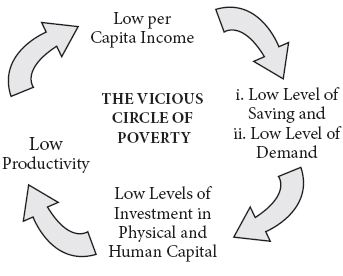
Draw the The Vicious Circle of Poverty
47.
What is Aggregate supply?
48.
Mention any two uses of multiplier concept.
49.
Which are the four components of the macroeconomy?
50.
Mention the countries where per capita carbondioxide emission is the highest in the world.
51.
Point out any two ways in which IBRD lends to member countries.
52.
What is commodity money?
53.
54.
Why is self consumption difficult in measuring national income?
1.
(c)
1990-91 and 2018-19
2.
(b)
USA
3.
(b)
The Prime Minister and Union Ministers
4.
(a)
Developed Economies
5.
(b)
the regression model
6.
(c)
(1) – (iv) (2) – (iii) (3) – (i) (4) – (ii)
7.
(b)
Both A and R are true but R is not the correct explanation of A
8.
(a)
(1) – (i) (2) – (ii) (3) – (iv) (4) – (iii)
9.
(a)
Gold stock
10.
(b)
Real Income
11.
(a)
Omitted Variable
12.
(a)
Prime Minister
13.
(a)
Eutrophication
14.
(d)
Rent from property
15.
(c)
stimulating exports
16.
(a)
Central Bank
17.
(b)
mild inflation
18.
(c)
19.
(c)
GDP
20.
(c)
Four Sector Model
21.
(i) Money is anything that is generally accepted as a medium of exchange.
(ii) Money must be able to act as a medium of exchange, a store of value, and a unit of account. For money to act as a medium of exchange, sellers must generally accept and buyers must generally use it to pay for goods and services.
(iii) For money to serve as a store of value, it can be used to transport purchasing power from one period of time to another.
(iv) For money to serve as a unit of account, it must function as a consistent way of quoting prices.
(v) The primary function of money is to serve as a medium of exchange.
22.
(1) Value of final consumer goods and services produced in a year to satisfy the immediate wants of the people which is referred to as consumption (C);
(2) Gross private domestic investment in capital goods consisting of fixed capital formation, residential construction and inventories of finished and unfinished goods which is called as gross investment (I);
(3) Goods and services produced or purchased by the government which is denoted by (G) ; and
(4) Net exports of goods and services, i.e., the difference between value of exports and imports of goods and services, known as (X - M)
(5) GNP at market prices means the gross value of final goods and services produced annually in a country plus net factor income from abroad (C + I + G + (X - M) + (R - P)).
23.
i) By reducing tariff rates on raw materials components and capital goods it was able to import more for meeting her developmental requirements.
ii) India gets market access in several countries without any bilateral agreement.
24.
(i) Multiplier highlights the importance of investment in income and employment theory.
(ii) The process throws light on the different stages of trade cycle.
(iii) It also helps in bringing the equality between S and I.
(iv) It helps to reduce unemployment and achieve full employment.
25.
(i) Development means, people must have higher incomes, better education, better health care and nutrition, less poverty and more equality of opportunity.
(ii) According to Michael P. Todaro and Stephen C. Smith, "development must beconceived of as multidimensional process involving major changes in social structure, popular attitudes and national institutions, as well as the acceleration of economic growth, the reductions of inequality and the eradications of poverty".
26.
(I) Statistics presents facts in a definite form.
(ii) It simplifies mass of figures.
(iii) It facilitates comparison.
(iv) It helps in formulating and testing.
(v) It helps in prediction.
(vi) It helps in the formulation of suitable policies.
27.
a) Climate change
(i) Climate change refers to seasonal changes over a long period with respect to the growing accumulation of greenhouse gases in the atmosphere.
(ii) Industrial revolution has increased the concentration of carbon dioxide in the atmosphere by 40 %.
(iii) Several parts of the world have experienced warming of coastal waters, high temperatures, a marked change in rainfall patterns and an increased intensity and frequency of storms.
(iv) Sea levels and temperatures are expected to be rising.
b) Acid rain
(i) Acid rain is one of the results of air pollution.
28.
| S.No | Classical Theory of International Trade |
Modern Theory of International Trade |
|---|---|---|
| 1 |
International trade is on the basis of labour theory of value.
|
International trade is on the basis of general theory of value. |
| 2 | It presents a one factor (labour) model. | It presents a multi factor (labour and capital) model. |
| 3 | It attributes the differences in the comparative costs to differences in the productive efficiency of workers in the two countries. |
It attributes the differences in comparative costs to the differences in factor endowments in the two countries. |
29.
| S. No: | Keynesianism | Classicism |
| 1. | Short-run equilibrium | Long-run equilibrium |
| 2. | Saving is a vice | Saving is a social virtue. |
| 3. | Money functions as medium of exchange and store of value | Money acts as a medium of exchange |
| 4. | Macro approach to national problems | Micro approach to macro problems |
| 5. | State intervention is advocated | Favoured laissez-faire policy |
30.
(i) Macro economics helps to understand the functioning of the economy at the aggregate level, to evolve strategies to solve the basic problems.
(ii) To understand the future problems, needs and challenges.
(iii) To provide opportunities to use scientific investigation to understand reality.
(iv) To make meaningful comparison and analysis of economic indicators. To predict the future and formulate suitable policies to avoid economic crises.
31.
1. Duties in respect of succession to property other than agricultural land.
2. Estate duty in respect of property other than agricultural land.
3. Taxes on railway fares and freights.
4. Taxes other than stamp duties on transactions in stock exchanges and future markets.
5. Taxes on the sale or purchase of newspapers and on advertisements published therein
6. Terminal taxes on goods or passengers carried by railways, sea or air.
7. Taxes on the sale or purchase of goods other than newspapers where such sale or purchase taxes place in the course of inter-State trade or commerce.
32.
he regression X on y is
\((X-\bar { X } )=r\times \frac { \sigma x }{ \sigma y } \times (Y-\bar { Y } )\)
Given x̅̅ = 12, \(\bar { Y } \) = 10
r = 0.85, σx = 0.1 and σy = 0.2
Then substituting the values in formula
(X-12) = 0.85 × (0.1/0.2) σy = 0.2
(X-12) = 0.85 × (0.5) × (Y-10)
X = 0.425 × (Y-10) + 12
X = 0.425y – 4.25 + 12
x = 0.425Y + 7.75
X on Y
Answer
X= 0.425Y + 7.75
The regression Y on X is
\((Y-\bar { Y } )=r\times \frac { \sigma x }{ \sigma y } \times (X-\bar { X } )\)
Given x̅ = 12, \(\bar { Y } \) = 10
r = 0.85, σx = 0.1 and σy =0.2
Then substituting the values in formula
(Y-10) = 0.85 × (0.2/0.1) × ( X–12)
(Y-10) = 0.85 × (2) × ( X–12)
Y = 1.7 × (X-12) + 10
Y = 1.7 X – 20.4 + 10
Y = 1.7 X + 10.4
Y on X
Y = 1.7 X – 10.4
33.
I. Classification on the Basis of Benefit:
| BASIS FOR COMPARISON | PLANNING COMMISSION | NITI AAYOG |
|---|---|---|
| POWERS | Enjoyed the powers to allocate funds to ministries and state governments. | To be an advisory body or a think-tank. The powers to allocate funds might be vested in the finance ministry. |
| STATE’S ROLE | States' role was limited to the National Development Council and annual interaction during Plan meetings. | State governments are expected to play a more significant role than they did in the Planning Commission. |
| MEMBERS | The commission reported to National Development Council that had state chief ministers and lieutenant governors | Governing Council has state chief ministers and lieutenant governors |
| CHAIR-PERSON | Had deputy chairperson, a member secretary, and full-time members | New posts of CEO, of secretary rank, and Vice-Chairperson. Will also have five full-time members and two part-time members. Four cabinet ministers will serve as ex-o official members. |
| POLICY FORMULATION | Policy was formed by the commission and states were then consulted about allocation of funds | Consulting states while making policy and deciding on funds allocation. Final policy would be a result of that. |
| FUNDS ALLOCATION | Had power to decide allocation of government funds for various programs at national and state levels | No power to allocate funds |
| APPROVAL OF PROJECTS |
Imposed policies on states and tied allocation of funds with projects it approved. | NITI is a think-tank and does not have the power to impose policies. |
34.
P = \(\frac { MV+{ M }^{ 1 }{ V }^{ 1 } }{ T } \)
P = \(\frac { (1000\times 3)+(500\times 2) }{ 4000 } \)
= Rs. 1 Per good
Value of money (1/p) = 1
If the supply of money is double
P = \(\frac { (2000\times 3)+(1000\times 2) }{ 4000 } \)
= Rs. 2 Per good
Value of money (1/p) = 1/2
Thus, when money supply in doubled, i.e., increases from Rs. 4000 to 8000, the price level is doubled. i.e., from Re. 1 per good to Rs. 2 per good and the value of money is halved, i.e., from 1 to 1/2.
P = \(\frac { (500\times 3)+(250\times 2) }{ 4000 } \)
= Rs. 1 Per good
Value of money (1/p) = 1/2
Thus, when money supply is halved, i.e., decreases from Rs. 4000 to 2000, the price level is halved, i.e., from 1 to 1/2, and the value of money is doubled, i.e., from 1 to
35.
Introduction
(i) The early 1990s witnessed reforms in the economic policy. This helped to open up Indian markets to FDI
(ii) FDI in India has increased over the years
(iii) In India, FDI has been advantageous in terms of free flow of capital, improved technology, management expertise and access to international markets
The major sectors benefited from FDI in India are:
(i) financial sector (banking and nonbanking)
(ii) insurance
(iii) telecommunication
(iv) hospitality and tourism
(v) pharmaceuticals and
(vi) software and information technology
FDI is not permitted in the industrial sectors like
(i) Arms and ammunition
(ii) atomic energy,
(iii) railways,
(iv) coal and lignite and
(v) mining of iron, manganese, chrome, gypsum, sulphur, gold, diamonds, copper etc.,
Latest trend of FDI in India
i. FDI inflow in India has increased from $97 million in 1990-91 to $5,535 million in 2004-2005.
ii. It amounted to $32,955 million in 2011-2012.
iii. UNCTAD’s World Investment Report 2018 reveals that FDI to India declined to $40 billion in 2017 from $44 billion in 2016
36.
37.
(i) Fiscal Policy is implemented through fiscal instruments also called 'fiscal tools' or fiscal levers - Government expenditure, taxation and borrowing are the instruments of fiscal policy.
Taxation:
(i) Taxes transfer income from the people to the Government.
(ii) Taxes are direct or indirect.
(iii) An increase in tax reduces disposable income.
(iv) So tax should be raised to control inflation.
(v) During depression, taxes are to be reduced.
Public Expenditure:
(i) Public expenditure raises wages and salaries of the employees and so aggregate demand for goods rises.
(ii) So, public expenditure is raised during recession and reduced during inflation.
Public debt:
(i) When Government borrows by floating a loan, there is transfer of funds from the public to the Government.
(ii) At the time of interest payment and repayment of public debt, funds are transferred from Government to public.
38.
(i) To promote international monetary cooperation among the member nations.
(ii) To facilitate faster and balanced growth of international trade.
(iii) To ensure exchange rate stability by curbing competitive exchange depreciations.
(iv) To reduce exchange controls imposed by member nations.
(v) To establish multilateral trade and payment system in respect of current transactions.
(vi) To promote the flow of capital from developed to developing nations.
(vii) To solve the problem of international liquidity.
39.
Single Factoral Terms of Trade
(i) According to Viner, the single factoral terms of trade is an improvement over the commodity terms of trade.
(ii) It represents the ratio of export. price index to the import price index adjusted for changes in the productivity of factors in the production of exports.
\(\mathrm{T}_{\mathrm{f}}=\left(\mathrm{P}_{\mathrm{x}} / \mathrm{P}_{\mathrm{m}}\right) \mathrm{F}_{\mathrm{x}}\)
(iii) Tf is single factoral terms of trade index.
(iv) Fx is productivity in exports.
Double Factoral Terms of Trade
\(\mathrm{T}_{\mathrm{ff}}=\left(\mathrm{P}_{\mathrm{x}} / \mathrm{P}_{\mathrm{m}}\right)\left(\mathrm{F}_{\mathrm{x}} / \mathrm{F}_{\mathrm{m}}\right)\)
(i) It takes into account the productivity in country's exports and productivity of foreign factors.
(ii) Fm is import index (which is measured as index cost in terms of quantity of factors of production employed per unit) of imports.
40.
Introduction
(i) The Reserve Bank of India is India's central banking institution
(ii) It commenced its operations on 1 April 1935 and it was nationalised on 1 Jan, $1949 .$
1) Monetary Authority
(i) It controls the supply of money in the economy to stabilize exchange rate, maintain healthy balance of payment, attain financial stability, control inflation, strengthen banking system.
2) Issuer of currency
(i) It is the sole authority to issue currency
(ii) It also takes action to control the circulation of fake currency.
3) Issuer of Banking License
(i) Every bank has to obtain a banking license from RBI to conduct banking business in India.
4) Banker to the Government
(i) It is the banker to the central and the state governments.
(ii) It provides short term credit, manages all need issues of government loans, services the government debt outstanding
(iii) It advises the government on banking and financial matters.
5) Banker's Bank
(i) It is the bank of all banks in India as it provides loan to banks, accepts the deposit of banks and rediscounts the bills of banks.
6) Lender of last resort
(i) The banks can borrow from RBI by keeping eligible securities as collateral at the time of need when there is no other source.
7) Act as clearing house
(i) For settlement of banking transactions, RBI manages 14 clearing houses.
(ii) It facilitates the exchange of instruments and processing of payment instructions.
8) Custodian of foreign exchange reserves
(i) It administers and enforces the provision of Foreign Exchange Management Acr, 1999.
(ii) RBI buys and sells foreign currency to maintain the exchange rate of Indian rupee vs foreign currencies.
9) Regulator of Economy
(i) It controls the money supply in the system, monitors GDP, Inflation
10) Managing Government securities
(i) RBI administers investments in institutions when they invest specified minimum proportions of their total assets/liabilities in government securities.
11) Regulator and Supervisor of Payment and Settlement Systems
(i) RBI oversees the payment and settlement systems in the country.
(ii) It focuses on the development and functioning of safe, secure and efficient payment and settlement mechanisms.
12) Developmental Role
(i) It develops the quality of banking system in India and ensures that credit is available to the productive sectors of the economy.
(ii) It provides a wide range of promotional functions to support national objectives.
(iii) It establishes institutions which build the financial infrastructure.
(iv) It also helps in expanding access to affordable financial services and promotes financial education and literacy.
13) Publisher of monetary data
(i) It maintains and provides all essential bánking and other economic "data, formulating and critically evaluating the economic policies in India.
(ii) RBI collects, collates and publishes data regularly.
14) Exchange manager and controller
(i) RBI represents India as a member of the International Monetary Fund.
(ii) Most of thé commercial banks are authorized dealers of RBI.
15) Banking Ombudsman Scheme
(i) RBI introduced this Scheme in 1995
(ii) Those who have complaints including online, can appeal to the Ombudsman against the awards and the other decisions of the Banks.
16) Banking Codes and Standards Board of India
(i) To measure the performance of banks against Codes and Standards based on established global practices, the RBI has set up the Banking Codes and Standards Board of India.
41.
Introduction
J.M Keynes has divided factors influencing the consumption function into two namely Subjective factors and Objective factors
Subjective Factors
These factors are internal and related to psychological feelings. Keynes lists 8 motives which lead individuals to refrain from spending
Motive of precaution
To build a reserve against unforeseen contingencies. (eg.) Accidents
Motive of foresight
The desire to provide for anticipated future needs. (eg.) Old age
Motive of calculation
The desire to enjoy interest and appreciation.
Motive of improvernent
(i) The desire to enjoy for improving standard of living.
(ii) Motive of financial independence
(iii) Motive of enterprise - desire to do forward trading
(iv) Motive of pride - desire to leave a fortune
(v) Motive of avarice - miserly instinct
(vi) The government institutions, business corporations and firms may also consume mainly because of:
Motive of enterprise
The desire to get resources to carry out further capital investment without debt.
Motive of liquidity
The desire to secure liquid resources to meet emergency
Motive of improvement
The desire to secure a rising income and to demonstrate successful management
Motive of financial prudence
The desire to ensure adequate financial provision against depreciation, obsolescence and to discharge debt.
Objective Factors
They are the external factors which are real and measurable. They can be easily changed in the long run;
Income Distribution
According to VKRV Rao if incone is equally distributed propensity to consume increases
Price level
When price falls, real income rises; people consume more and save more.
Wage level
Consumption expenditure increases with a rise in wages.
Interest rate
Higher interest rate will encourage people to save more money and reduces consumption.
Fiscal Policy
When government reduces tax, disposable income rises and propensity to consume increases.
Consumer credit
The availability of consumer credit at easy installments will encourage people to buy consumer durables like car, fridge, computer
Demographic factors
(i) Size of family, stage in family life cycle, place of residence and occupation affect the consumption pattern
Duesenberry hypothesis
(i) Consumption expenditure depends on current income, past income and standard of living
(ii) As individuals are accustomed to a particular standard of living, they continue to spend the same amount on consumption
(iii) Consumption of the poor people is influenced by the rich. This is called Demonstration effect.
Windfall gain and loss
Unexpected changes in the stock market leads to gain or loss, so consumption function shifts upward or downward.
Conclusion
According to Keynes only the subjective factors do not change in the short-run, so consumption function remains stable in the short period.
42.
43.
Introduction:
(i) Whatever is produced is either used for consumption or for saving. So, national output can be computed at any of three levels, ie., production, income and expenditure.
(ii) Therefore there are three methods to measure national income.
Product Method (inventory method):
(i) This method measures the output of the country. Gross value of output from different sectors like agriculture, industry, trade, commerce is obtained by the summation of all the values added in the productive process.
(ii) In India, the gross value of the farm output is obtained as follows:
(iii) Total production of 64 agriculture commodities is estimated. The output of each crop is measured by multiplying the area sown by the average yield per hectare.
(iv) Total output of each commodity is valued at market prices.
(v) The aggregate value of total output of these 64 commodities is taken to measure the gross value of agricultural output.
(vi) The net value of the agricultural output is measured by making deductions for the cost of seed, manures and fertilizers, market charges.
(vii) Net value of each sector is measured in this way.
(viii) Double counting should be avoided.
(ix) Value of output used for self consumption should be counted but sale and purchase of second hand durable goods should be excluded.
Income Method (Factor Earning Method):
(i) National income is calculated by adding up all the incomes generated while producing national product.
(ii) Enterprises are classified into industrial groups.
(iii) Factor incomes are grouped under labour income (wages, salaries, fringe benefits), capital income (profit, interest, dividend) and mixed income (farming, sole proprietorship).
\(\mathrm{Y}=\mathrm{w}+\mathrm{r}+\mathrm{i}+\pi+(\mathrm{R}-\mathrm{P})\)
(iv) Transfer payment, receipt from sale of second hand goods, windfall gains and corporate profit tax must not be included.
(v) Imputed value of rent for self occupied houses or offices and Imputed value of services provided by owners of production units are to be included.
Expenditure method (outlay method):
(i) The total expenditure incurred by the society in a particular year is added together.
(ii) It includes personal consumption expenditure (C), net domestic investment (I), Government expenditure on consumption (G) and net exports (X-M).
\(\mathrm{GNP}=\mathrm{C}+\mathrm{I}+\mathrm{G}+(\mathrm{X}-\mathrm{M})\)
(iii) Expenditure on second hand goods, purchase of shares and bonds, transfer payments and expenditure on intermediate goods should not be included.
Conclusion:
Output = Income = Expenditure
(i) This is because the three methods are circular in nature. So, if the 3 methods are done correctly this equation must hold.
44.
National Income:
(i) Measurement of national income and its composition by sectors are the basic aspects of macro economic analysis.
(ii) It gives a long term understanding of the growth process of an economy.
Inflation:
(i) Estimating the general price level based on wholesale price, index, consumer price.
Business Cycle:
(i) Cyclical movements can be studied based on aggregate economic variables.
Poverty and Unemployment:
(i) Clear understanding about the magnitude of poverty and unemployment helps allocation of resources and adapting corrective measures.
Economic Growth:
(i) The growth and development of an economy and the factors determining them could be understood only through macro analysis.
Economic Policies:
(i) Macro Economics is used to frame economic policies.
(ii) Economic policies are used to solve the basic problems, to overcome the obstacles and to achieve growth.
45.
(i) State Financial Corporations (SFCs)
(ii) State Industrial Development Corporation (SIDCs)
46.
47.
The value of total output of goods and services produced in an economy in a year
48.
1. Multiplier highlights the importance of investment in income and employment theory.
2. The process throws light on the different stages of trade cycle.
3. It also helps in bringing the equality between S and I.
4. It helps in formulating Government policies.
5. It helps to reduce unemployment and achieve full employment.
49.
groups: households and firms (the private sector), the government (the public sector), and the rest of the world (the external sector.
50.
China, USA, India, Russia, Japan.
51.
1. Loans out of its own fund.
2. Loans out of borrowed capital and
3. Loans through Bank's guarantee.
52.
(i) Surplus goods were exchanged for money which in turn was exchanged for other needed goods.
(ii) Goods like furs, skins, salt, rice, wheat, utensils, weapons were used as money
53.
54.
(i) Farmers keep a large portion of food and other goods produced on the farm for self consumption.
(ii) This amount varies from person to person.
(iii) The problem is whether this unsold portion should be included in NI or not.

12th Standard Syllabus & Materials
12th Standard
TN 12th Computer Applications களப்பெயர் முறைமை (DNS) Sample Question Papers Study Material - QB365 Set A
NEW12th Standard
TN 12th Computer Applications வலையமைப்பு எடுத்துக்காட்டுகள் மற்றும் நெறிமுறைகள் Sample Question Papers Study Material - QB365 Set A
NEW12th Standard
TN 12th Computer Applications கணினி வலையமைப்பு ஓர் அறிமுகம் Sample Question Papers Study Material - QB365 Set A
NEW12th Standard
TN 12th Computer Applications PHP-உடன் MySQL-ஐ இணைத்தல் Sample Question Papers Study Material - QB365 Set A



Tamilnadu Stateboard 12th Standard Subjects

Maths

Chemistry

Physics

Biology

Computer Science

Business Maths and Statistics
Economics

Commerce

Accountancy

History

Computer Applications
Biology
Computer Technology
Computer Applications
Computer Science
Business Maths and Statistics
Commerce
Economics
Maths
Chemistry
Physics
Computer Technology
History
Accountancy

Tamil

English

French
Tamilnadu Stateboard Standards
