
 100% FREE ACCESS
12th Standard Syllabus & Materials
12th Standard
TN 12th Computer Applications மின்னணு தரவு பரிமாற்றம் Sample Question Papers Study Material - QB365 Set A
NEW12th Standard
TN 12th Computer Applications மின் - வணிக பாதுகாப்பு அமைப்புகள் Sample Question Papers Study Material - QB365 Set A
NEW12th Standard
TN 12th Computer Applications மின்னணு செலுத்தல் முறைகள் Sample Question Papers Study Material - QB365 Set A
NEW12th Standard
TN 12th Computer Applications மின் - வணிகம் Sample Question Papers Study Material - QB365 Set A
NEW12th Standard
TN 12th Computer Applications திறந்த மூல கருத்துருக்கள் Sample Question Papers Study Material - QB365 Set A
NEW12th Standard
TN 12th Computer Applications வலையமைப்பு வடமிடல் Sample Question Papers Study Material - QB365 Set A

Published on: 13/02/2020
12th Standard Economics public model Question paper III - 2019-2020
Download Tamil Nadu 12th Standard Economics question papers, model tests, one-mark questions, important questions, and public exam papers in PDF format. Free study materials and answer keys for TN State Board students.
Questions + Answers key
Take MCQ Economics Test
1.
Which of the following institutions is not part of the World Bank community?
IBRD
WTO
IDA
IFC
2.
Who said, “Planning is more necessary in backward countries to devise ways and means and to make concerted efforts to raise national income”
1 and 2
2 and 3
3 and 4
1 and 4
3.
If the correlation coefficient is a positive value, then the slope of the regression line
must also be positive
can be either negative or positive
can be zero
can not be zero
4.
The modern theory of international trade explains the causes for …………….?
comparative cost difference
absolute cost difference
comparative cost similarities
absolute cost similarities
5.
The value of multiplier itself depends on ______ or marginal propensity to consume.
savings function
investment function
consumption function
interest function
6.
Inflation refers to steady ________ in general price level.
decrease
increase
constant
flat
7.
The natural pollution causes both aquatic and
Cancer
Human illness
Children
Asthm(a)
8.
A ________ is a penalty imposed on an individual for violation of law.
Grants
Aids
Fine
fees
9.
GDP= _________.
GNP + Depreciation
GNP - Net income earned from abroad
GNP - Depreciation
NNP - Depreciation
10.
'Full employments the absence of involuntary unemployment' was said by __________.
J.B. Say
Ricardo
J.M. Keynes
Adam smith
11.
If Y = 2 - O.2X, then the value of Y intercept is equal to
-0.2
2
0.2X
All of the above
12.
Which of the following country adopts indicative planning?
France
Germany
Italy
Russia
13.
Environmental goods are ____________
Market goods
Non-market goods
Both
None ofthe above
14.
The difference between total expenditure and total receipts including loans and other liabilities is called
Fiscal deficit
Budget deficit
Primary deficit
Revenue deficit
15.
In the case of BOT,
Transactions of goods are recorded.
Transactions of both goods and services are recorded.
Both capital and financial accounts are included.
All of these
16.
The Functions of commercial banks are broadly classified into
Primary Functions
Secondary functions
Other functions
a, b, and c
17.
“Money can be anything that is generally acceptable as a means of exchange and that thesame time acts as a measure and a store of value”, This definition was given by
Crowther
A.C.Pigou
F.A.Walker
Francis Bacon
18.
J.B. Say is a _______.
Neo Classical Economist
Classical Economist
Modern Economist
New Economist
19.
Per capita income is obtained by dividing the National income by__________
Production
Population of a country
Expenditure
GNP
20.
An economic system where the economic activities of a nation are done both by the private and public together is termed as__________
Capitalistic Economy
Socialistic Economy
Globalisic Economy
Mixed Economy
21.
Calculate the standard deviation from the following data by Actual Mean Method: 25, 15, 23, 42, 27, 25, 23, 25, and 20.
22.
What are essential features of an economic plan
23.
Explain the primary function of money.
24.
What are the five types of final goods and services that GNP includes?
25.
Explain any three short fun factors of MEC.
26.
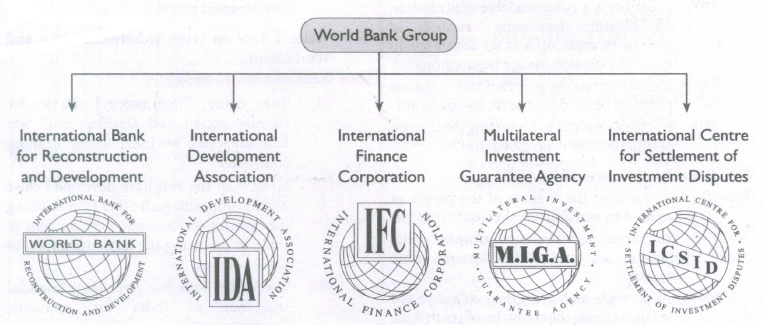
Draw the diagram for World Bank group.
27.
28.
What are the causes of water pollution?
29.
State the objectives of Foreign Direct Investment.
30.
Explain about aggregate supply with the help of diagram.
31.
Distinguish between Capitalism and Globalism.
32.
Compare and contrast economic growth and economic development.
33.
Explain the supply of Money and determinants of money supply in India.
34.
Explain the classification of public expenditure.
35.
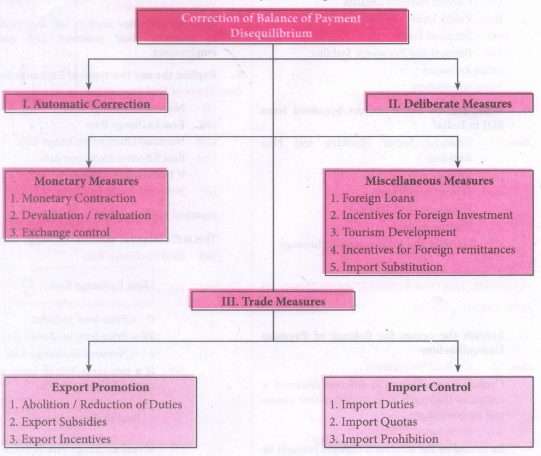
Draw the flow chart for correction of Balance Payment Disequilibrium
36.
37.
State and explain instruments of fiscal policy.
38.
Bring out the functions of World Bank.
39.
Discuss the various types of disequilibrium in the balance of payments.
40.
Elucidate the functions of Commercial Banks
41.
Briefly explain the subjective and objective factors of consumption function?
42.
Narrate the equilibrium between ADF and ASF with diagram
43.
Explain the importance of national income
44.
45.
Define a financial intermediary.
46.
List various types of unemployment.
47.
What do you mean by investment?
48.
What is financial planning?
49.
What is Economic Policies?
50.
Define Global warming.
51.
Mention any two objectives of ASEAN.
52.
What is Stagflation?
53.
Define full employment.
54.
Write the formula for calculating GNP.
1.
(b)
WTO
2.
(d)
1 and 4
3.
(a)
must also be positive
4.
(a)
comparative cost difference
5.
(c)
consumption function
6.
(b)
increase
7.
(b)
Human illness
8.
(c)
Fine
9.
(b)
GNP - Net income earned from abroad
10.
(c)
J.M. Keynes
11.
(b)
2
12.
(b)
Germany
13.
(b)
Non-market goods
14.
(a)
Fiscal deficit
15.
(a)
Transactions of goods are recorded.
16.
(d)
a, b, and c
17.
(a)
Crowther
18.
(b)
Classical Economist
19.
(b)
Population of a country
20.
(d)
Mixed Economy
21.
Deviations from actual mean.
| S.No | X | (x-x) | (x-\(\bar { x } \))2 |
| 1 | 25 | 25-25=0 | 0 |
| 2 | 15 | 15-25=10 | 100 |
| 3 | 23 | 23-25=-2 | 1 |
| 4 | 42 | 42-25=17 | 289 |
| 5 | 27 | 27-25=2 | 4 |
| 6 | 25 | 25-25=0 | 0 |
| 7 | 23 | 23-25=-2 | 4 |
| 8 | 25 | 25-25=0 | 0 |
| 9 | 20 | 20-25=-5 | 25 |
| N-9 | 225 | 0 | 126 |
\(\bar { X } =\frac { 225 }{ 9 } =25\)
\(\sigma =\sqrt { \frac { { \sum { (x-\bar { X } ) } }^{ 2 } }{ N } } \)
\(=\sqrt { \frac { 426 }{ 9 } } \)
\(=\sqrt { 47.33 } \)
\(\sigma =6.88\)
22.
1. Predetermined and well-defined objectives or goals.
2. For economic planning deliberate control and direction of the economy by a central authority, e.g., the state.
3. Optimum utilization of natural resources and capital which may be scarce and labor that may be abundant.
4. The objectives are to be achieved within a given interval of time – 5 years, 7 years, etc.
5. The performance of the economic functions of increasing production, maximizing employment and controlling population growth so that production outstrips population growth.
23.
(i) Money as a medium of exchange: This is considered as the basic function of money. Money has the quality of general acceptability, and all exchanges take place in terms of money.
(ii) Money as a measure of value: The second important function of money is that it measures the value of goods and services.
24.
(1) Value of final consumer goods and services produced in a year to satisfy the immediate wants of the people which is referred to as consumption (C);
(2) Gross private domestic investment in capital goods consisting of fixed capital formation, residential construction and inventories of finished and unfinished goods which is called as gross investment (I);
(3) Goods and services produced or purchased by the government which is denoted by (G) ; and
(4) Net exports of goods and services, i.e., the difference between value of exports and imports of goods and services, known as (X - M)
(5) GNP at market prices means the gross value of final goods and services produced annually in a country plus net factor income from abroad (C + I + G + (X - M) + (R - P)).
25.
Short - Run Factors
(i) Demand for the product: If the market for a particular good is expected to grow and its costs are likely to fall, the rate of return from investment will be high. If entrepreneurs expect a fall in demand for goods and a rise in cost, the investment will decline.
(ii) Liquid assets:
If the entrepreneurs are holding large volume of working capital, they can take advantage of the investment opportunities that come in their way. The MEC will be high.
(iii) Sudden changes in income:
The MEC is also influenced by sudden changes in income of the entrepreneurs. If the business community gets windfall profits, or tax concession the MEC will be high and hence investment in the country will go up. On the other hand, MEC falls with the decrease in income.
26.
27.
28.
Discharge of sewage and waste water:
(i) Sewage, garbage and liquid waste of households, agricultural runoff and effluents from factories are discharged into lakes and rivers.
(ii) These wastes contain harmful chemicals and toxins which make the water poisonous for aquatic animals and plants.
Dumping of solid wastes:
(i) The dumping of solid wastes and litters in water bodies cause huge problems.
Discharge of industrial wastes:
(i) Industrial waste contains asbestos, lead, mercury, grease oil and petrochemicals.
Oil Spill:
(i) Sea water gets polluted due to oil spilled from ships and tankers.
Acid Rain:
(i) When the acidic particles caused by air pollution mix with water vapour, it results in acid rain.
Global warming:
(i) The increase in water temperature affects aquatic plants and animals.
Eutrophication:
(i) The increased level of nutrients in water depletes oxygen in water and this negatively affects fish and other aquatic animal population.
29.
FDI has the following objectives.
(i) Sales Expansion
(ii) Acquisition of resources
(iii) Diversification
(iv) Minimization of competitive risk
30.
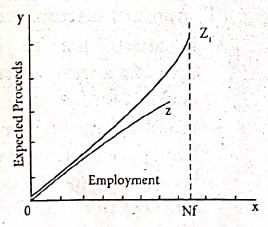
(i) Aggregate supply refers to the value of total output of goods and services produced in an economy in a year ie national product or income.
(ii) The components of aggregate supply are:
(iii) Aggregate (desired) consumption expenditure (C)
(iv) Aggregate (desired) private savings (S)
(v) Net tax payments (T)
(vi) Personal (desired) transfer payments to the foreigners (Rf)
AS = C + S + T + Rf
In this figure 2 aggregate supply curves are drawn for the assumption of fixed money wages and variable wages.
Explanation
(i) Z Curve is linear (fixed money wages)
(ii) Z1 curve is non-linear (wage rate increases with employment)
(iii) When full employment level of Nf is reached output cannot be increased by employing more men.
(iv) So aggregate supply curve becomes inelastic (Vertical straight line).
(v) In reality aggregate supply curve will be like Z1 .
(vi) If prices are high and wages low, the producers will employ more labourers.
(vii) 4YAggregate supply is an important factor in determining the level of economic activity.
31.
| S.No. | Capitalism | Globalism |
| 1 | Also called free economy or laissez faire or market economy where the role of the government is minimum | Also called extended capitalism. It connects nations together through international trade |
| 2 | Market determines economic activities within a nation | It aims at global development Manfred |
| 3 | Adam Smith is the father of the capitalism | D. Steger (2002) coined the term |
32.
| BASIS FOR COMPARISON | ECONOMIC GROWTH | ECONOMIC DEVELOPMENT |
|---|---|---|
| MEANING | Economic Growth is the positive change in the real output of the country in a particular span of time. | Economic Development involves a rise in the level of production in an economy along with the advancement of technology, improvement in living standards and so on. |
| CONCEPT | Narrow | Broad |
| SCOPE | Increase in the indicators like GDP, per capita income, etc. | Improvement in life expectancy rate, infant mortality rate, literacy rate, and poverty rates |
| TERM | Short term process | Long term process |
| APPLICABLE TO | Developed Economies | Developing Economies |
| HOW IT CAN BE MEASURED? | Upward movement in national income. | An upward movement in real national income. |
| WHICH KIND OF CHANGES ARE EXPECTED? | Quantitative changes | Qualitative and quantitative change |
| TYPE OF PROCESS | Automatic | Manual |
| WHEN IT ARISES? | In a certain period of time | Continuous process. |
33.
Money Supply in India
Money supply is a stock variable. RBI publishes information for four alternative
measures of Money supply, namely M1, M2, M3 and M4.
M1 = Currency, coins and demand deposits
M2 = M1 + Savings deposits with post office savings banks
M3 = M2 + Time deposits of all commercial and cooperative banks
M4 = M3 + Total deposits with Post offices.
M1 and M2 are known as narrow money
M3 and M4 are known as broad money
Determinants of Money Supply
1. Currency Deposit Ratio (CDR); It is the ratio of money held by the public in currency to that they hold in bank deposits.
2. Reserve deposit Ratio (RDR); Reserve Money consists of two things (a) vault cash in banks and (b) deposits of commercial banks with RBI.
3. Cash Reserve Ratio (CRR); It is the fraction of the deposits the banks must keep with RBI.
4. Statutory Liquidity Ratio (SLR); It is the fraction of the total demand and time deposits of the commercial banks is the form of specified liquid assets.
34.
Classification of public expenditure are as follows:
1. Classification on the Basis of Benefit:
(a) Public expenditure benefiting the entire society, e.g., the expenditure on general administration, defense, education, public health, transport.
(b) Public expenditure conferring a special benefit on certain people and at the same time common benefit on the entire community, e.g, administration of justice etc.
(c) Public expenditure directly benefiting particular group of persons and indirectly the entire society, e.g. social security, public welfare, pension, unemployment relief etc. (d) Public expenditure conferring a special benefit on some individuals, e.g., subsidy granted to a particular industry.
2. Classification on the Basis of Function:
(a) Protection Functions: This group includes public expenditure incurred on the security of the citizens, to protect from external invasion and internal disorder, e.g., defence, police, courts etc.
(b) Commercial Functions: This group includes public expenditure incurred on the development of trade and commerce, e.g., development of means of transport and communication etc.
35.
36.
37.
(i) Fiscal Policy is implemented through fiscal instruments also called 'fiscal tools' or fiscal levers - Government expenditure, taxation and borrowing are the instruments of fiscal policy.
Taxation:
(i) Taxes transfer income from the people to the Government.
(ii) Taxes are direct or indirect.
(iii) An increase in tax reduces disposable income.
(iv) So tax should be raised to control inflation.
(v) During depression, taxes are to be reduced.
Public Expenditure:
(i) Public expenditure raises wages and salaries of the employees and so aggregate demand for goods rises.
(ii) So, public expenditure is raised during recession and reduced during inflation.
Public debt:
(i) When Government borrows by floating a loan, there is transfer of funds from the public to the Government.
(ii) At the time of interest payment and repayment of public debt, funds are transferred from Government to public.
38.
Investment for productive purposes
(i) World Bank helps in reconstruction and development of territories of member nations through investment for productive purposes.
(ii) It encourages the development of productive facilities and resources in less developed countries.
Balanced growth of international trade
(i) Promoting the long range balanced growth of trade at international level and the maintaining equilibrium in BoPs of member nations by encouraging international investment.
Provision of loans and guarantees
(i) Arranging the loans or providing guarantee on loans by various other channels and execute important projects.
Promotion of foreign private investment
(i) This is done by means of guarantees on loans and other investment made by private investors.
(ii) The Bank supplements private investment by providing finance for productive purpose out of its own resources or from borrowed funds.
Technical services
(i) The World Bank facilitates different kinds of technical services to the member countries through Staff College and experts.
39.
Cyclical Disequilibrium
Cyclical Disequilibrium occurs because of:
(i) Two countries may be passing through different phases of business cycle.
(ii) The elasticities of demand may differ between countries.
Secular Disequilibrium
(i) It occurs because of long-run and deep rooted changes in an economy as it advances from one stage of growth to another.
(ii) In the initial stages of development, domestic investment exceeded domestic savings and imports exceeded exports, as it happened in India since $1951.
Structural disequilibrium
(i) Structural changes in line economy may also cause BoP disequibrium
(ii) Structural changes include development of alternative sources of supply, development of better substitutes, exhaustion of protective resources or changes in transport routes and costs.
40.
Introduction
The functions of commercial banks are broadly classified into primary, and secondary functions
1) Primary Functions:
Accepting Deposits
Demand Deposits
1. It refers to deposits that can be withdrawn by individuals without any prior notice to the bank.
2. Depositors can withdraw money at any time by writing a withdrawal slip or a cheque or from ATM centres
Time Deposits
1. It refers to deposits that are made for certain committed period of time.
2. It has higher interest.
3. Deposits can be withdrawn only after a specific time period
Advancing Loans
1. Banks grant loans to individuals and businesses in the form of overdraft, cash credit and discounting bills of exchange.
2) Secondary Functions
Agency Functions
1. Commercial banks act as agents of customers by performing various functións.
Collecting Cheques
1. Banks collect cheques and bills of exchange on behalf of their customers through clearing house facilities provided by the central bank.
Collecting Income
1. Banks collect dividends, pension, salaries, rents and interests on investment on behalf of their customers.
2. A credit voucher is sent to customers for information when any income is collected by the bank.
Paying Expenses
1. Telephone bills, insurance premium, school fees and rents can be paid through banks.
2. A debit voucher is sent to customers for information when expenses are paid by the bank.
3) General Utility Functions
Providing Locker Facilities
1. Locker is provided for safe custody of jewellery, shares, debentures and other valuable items.
2. This minimizes the risk of loss due to theft at home.
Issuing Traveller's Cheques
1. Banks issue traveller's cheques to individuals for travelling outside the country.
2. These cheques are safe and easy way to protect money.
Dealing in Foreign Exchange
1. Banks provide foreign exchange to businessmen dealing in exports and imports.
2. But they need to take the permission of the Central Bank for dealing in foreign exchange.
4) Transferring Funds
1. Funds are transferred by means of draft, telephonic transfer and electronic transfer.
5) Letter of Credit
1. Commercial banks issue letters of credit to their customers to certify their credit worthiness.
Underwriting Securities
1. As public have full faith in the credit worthiness of banks, public do not hesitate in buying the securities underwritten by banks.
Electronic Banking
1. It includes services, such as debit cards, credit cards and Internet banking.
6) Other Functions
Money Supply
E.g: A bank lends Rs.5 lakh to an individual and opens a demand deposit in the name of that individual.
1. Bank makes a credit entry of 25 lakh in that account.
2. This leads to creation of demand deposits in that account.
3. Thus, without printing additional money, the supply of money is increased.
Credit Creation
1. It means the multiplication of loans and advances
2. Banks receive deposits from the public and use these deposits to give loans.
3. However, loans offered are many times more than the deposits received by banks.
Collection of Statistics
1. Banks collect and publish statistics relating to trade, commerce and industry and advice customers and public authorities on financial matters.
41.
Introduction
J.M Keynes has divided factors influencing the consumption function into two namely Subjective factors and Objective factors
Subjective Factors
These factors are internal and related to psychological feelings. Keynes lists 8 motives which lead individuals to refrain from spending
Motive of precaution
To build a reserve against unforeseen contingencies. (eg.) Accidents
Motive of foresight
The desire to provide for anticipated future needs. (eg.) Old age
Motive of calculation
The desire to enjoy interest and appreciation.
Motive of improvernent
(i) The desire to enjoy for improving standard of living.
(ii) Motive of financial independence
(iii) Motive of enterprise - desire to do forward trading
(iv) Motive of pride - desire to leave a fortune
(v) Motive of avarice - miserly instinct
(vi) The government institutions, business corporations and firms may also consume mainly because of:
Motive of enterprise
The desire to get resources to carry out further capital investment without debt.
Motive of liquidity
The desire to secure liquid resources to meet emergency
Motive of improvement
The desire to secure a rising income and to demonstrate successful management
Motive of financial prudence
The desire to ensure adequate financial provision against depreciation, obsolescence and to discharge debt.
Objective Factors
They are the external factors which are real and measurable. They can be easily changed in the long run;
Income Distribution
According to VKRV Rao if incone is equally distributed propensity to consume increases
Price level
When price falls, real income rises; people consume more and save more.
Wage level
Consumption expenditure increases with a rise in wages.
Interest rate
Higher interest rate will encourage people to save more money and reduces consumption.
Fiscal Policy
When government reduces tax, disposable income rises and propensity to consume increases.
Consumer credit
The availability of consumer credit at easy installments will encourage people to buy consumer durables like car, fridge, computer
Demographic factors
(i) Size of family, stage in family life cycle, place of residence and occupation affect the consumption pattern
Duesenberry hypothesis
(i) Consumption expenditure depends on current income, past income and standard of living
(ii) As individuals are accustomed to a particular standard of living, they continue to spend the same amount on consumption
(iii) Consumption of the poor people is influenced by the rich. This is called Demonstration effect.
Windfall gain and loss
Unexpected changes in the stock market leads to gain or loss, so consumption function shifts upward or downward.
Conclusion
According to Keynes only the subjective factors do not change in the short-run, so consumption function remains stable in the short period.
42.
Introduction
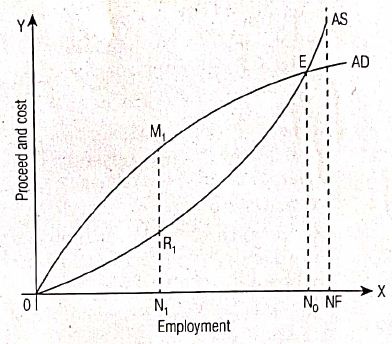
Under the Keynes theory of employment, a simple two sector economy consisting of the household sector and the business sector is taken to understand the equilibrium between ADF and ASF.
Explanation
1. AD and AS reach equilibrium at E. The employment level is No
2. At ON1employment, the aggregate supply is N1R1. But the aggregate demand is M1N1.
3. The expected level of profit is M1R1.
4. To attain this level of profit, entrepreneurs will employ more labourers, till they reach point E i.e. ONo.
5. Beyond ONo, the aggregate demand curve is below the aggregate supply curve showing loss.
6. So they will never employ more than ONo labour.
7. The equilibrium level of employment need not be the full employment level (No).
8. The difference between No - N1 is the level of unemployment.
Conclusion
Thus the concept of effective demand becomes significant in explaining the under employment equilibrium.
43.
(i) National income is of great importance for the economy of a country.
(ii) National income helps us to know the relative importance and contribution of each sector. We could find how income is produced, how it is distributed, how much is spent, saved or taxed.
(iii) National income data is used to formulate monetary policy, fiscal policy and other policies.
(iv) Data regarding gross income, output, saving and consumption is uscd in economic planning.
(v) National income data is used to build economic models in short run and long run.
(vi) It is used to make international comparison, inter regional comparison and inter temporal comparison of growth of the economy during different periods.
(vii) If income is equally distributed, the per capita income will reflect the economic welfare of the country.
44.
45.
(i) A financial intermediary is a bank or other institution that serves as a link between lenders and borrowers.
(ii) They typically accept savings deposits from consumers and then lend money to consumers and businesses to finance purchases of goods and services or for investment purposes.
46.
i. Cyclical Unemployment
ii. Seasonal Unemployment
iii. Frictional Unemployment
iv. Educated Unemployment
v. Technical Unemployment
vi. Structural Unemployment
vii. Disguised Unemployment
47.
The term investment means purchase of stocks and shares, debentures, government bonds and equities.
48.
Financial planning is nothing but techniques of planning in which resources are allocated in terms of money
49.
Economic policies are necessary to solve the basic problems to overcome the obstacles and to achieve growth.
50.
Global warming is the current increase in temperature of the earth's surface (both land and water) and its atmosphere.
51.
(i) To accelerate the economic growth, social progress and cultural development in the region.
(ii) To promote regional peace and stability and adherence to the principles of the UN Charter.
52.
Stagflation is a combination of stagnant economic growth, high unemployment and high inflation.
53.
(i) "Full employment is the absence of involuntary unemployment." - Keynes
(ii) "Full employment is that level of employment at which any further increase in spending would result in an inflationary spiral of wages and prices" - Lerner
54.
\(\mathrm{GNP}=\mathrm{C}+\mathrm{I}+\mathrm{G}+(\mathrm{X}-\mathrm{M})+(\mathrm{R}-\mathrm{P})\) or \(\mathrm{GNP}_{\mathrm{MP}}=\mathrm{GDP}_{\mathrm{MP}}\) + Net Factor income from Abroad.

12th Standard Syllabus & Materials
12th Standard
TN 12th Computer Applications களப்பெயர் முறைமை (DNS) Sample Question Papers Study Material - QB365 Set A
NEW12th Standard
TN 12th Computer Applications வலையமைப்பு எடுத்துக்காட்டுகள் மற்றும் நெறிமுறைகள் Sample Question Papers Study Material - QB365 Set A
NEW12th Standard
TN 12th Computer Applications கணினி வலையமைப்பு ஓர் அறிமுகம் Sample Question Papers Study Material - QB365 Set A
NEW12th Standard
TN 12th Computer Applications PHP-உடன் MySQL-ஐ இணைத்தல் Sample Question Papers Study Material - QB365 Set A



Tamilnadu Stateboard 12th Standard Subjects

Maths

Chemistry

Physics

Biology

Computer Science

Business Maths and Statistics
Economics

Commerce

Accountancy

History

Computer Applications
Biology
Computer Technology
Computer Applications
Computer Science
Business Maths and Statistics
Commerce
Economics
Maths
Chemistry
Physics
Computer Technology
History
Accountancy

Tamil

English

French
Tamilnadu Stateboard Standards
